
Reviewed · JAPAN
Discover The Hidden Pottery Town of Tokoname
Tokoname turns pottery into a walking adventure. This two-hour tour follows the town’s famous Pottery Footpath with a local ceramic artist, giving you far more context than a self-guided stroll. I especially like the chance to meet artists in their own workshop and the small group size, capped at eight people. The main consideration is the pace: five stops in two hours leaves little time for lingering or shopping.
The local guide’s perspective is the real reason to book. Guides such as Issei and Mr. Yagi bring personal experience as working ceramic artists, and Mr. Yagi has been praised for fluent English, patience, and flexibility. You also get Tokoname’s cultural background in English, Spanish, and other languages, though availability should be confirmed before booking.
In This Review
- Key points to know before you book
- Why Tokoname is worth a morning
- Starting at Tokoname Ceramic Hall
- Meeting Tokonyan, Tokoname’s giant lucky cat
- Walking up Dokanzaka’s pipe-lined slope
- Stepping inside a kiln at Togama Square Museum
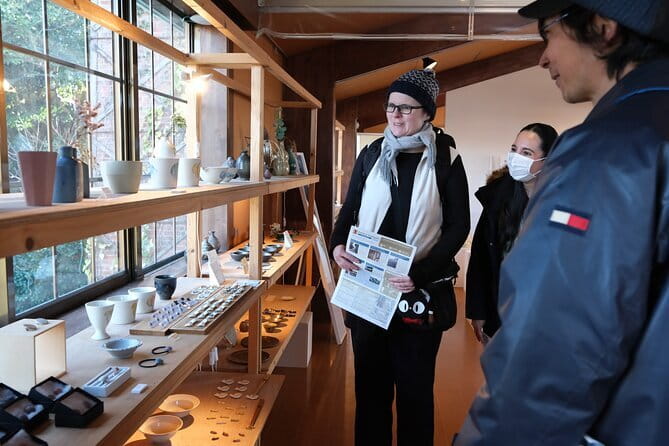
- Visiting Issei-Touen’s working pottery space
- What the $65.32 price really covers
- Language, group size, and walking pace
- Who will enjoy this Tokoname tour
- Should you book the Tokoname Pottery Footpath tour?
- FAQ
- Where does the Tokoname pottery tour start?
- Where does the tour finish?
- How long does the experience last?
- What is included in the tour price?
- How many people can join the tour?
- Can I cancel for a full refund?
Key points to know before you book
- Tokoname Ceramic Hall begins the story, with an introduction to one of Japan’s oldest pottery traditions.
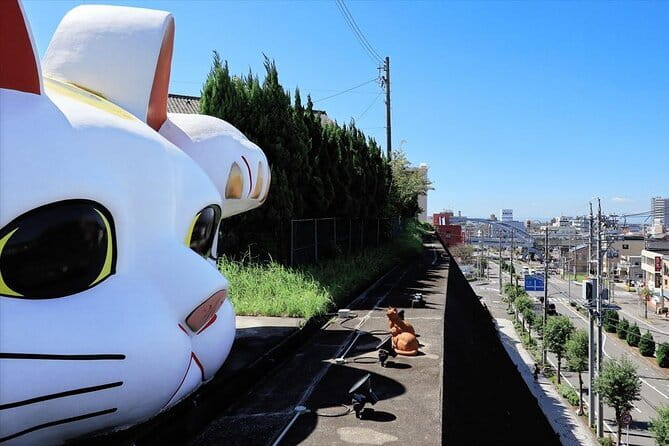
- Tokonyan is a quick but memorable photo stop, featuring a giant 3.8-meter-tall Maneki Neko.
- Dokanzaka provides the most atmospheric walk, with earthenware pipes and shochu jars built into the slope.
- Togama Square lets you step inside a real kiln and try painting Tokoname pottery.
- Issei-Touen adds a personal artist connection, with handmade ceramics and a working workshop.
- The $65.32 price buys guidance and access, not meals, souvenirs, or other personal purchases.
Why Tokoname is worth a morning
Tokoname sits in Aichi Prefecture, on the Chita Peninsula, and pottery is part of the town’s identity rather than a display arranged only for visitors. The Pottery Footpath winds through streets shaped by kilns, jars, pipes, workshops, and old ceramic production.
That matters because the appeal here is not limited to looking at finished bowls in a shop. You see how pottery affected the town itself. Walls, slopes, buildings, and public spaces carry traces of the craft. A local ceramic artist can explain why Tokoname developed its own character and how traditional work connects with modern design.
I like that this tour gives you a reason to look closely. On your own, a row of large jars might seem decorative. With the right explanation, you begin to see the practical side of Tokoname’s ceramic industry and the skill involved in making durable objects for everyday use.
The two-hour length also makes sense for a short visit. You can fit the experience into a morning or afternoon without giving up an entire day. At the same time, the schedule is fairly full, so you should expect a guided introduction rather than a slow, unplanned wandering tour.
Other trips worth a look in Japan:
- Tokyo Disney Resort – Tokyo Disneyland & Tokyo DisneySea Park Tickets
★ 4.8 · 99,488 reviews - Universal Studios Japan Studio Pass
★ 4.8 · 89,883 reviews - Universal Studios Japan Express Pass
★ 4.7 · 53,138 reviews
Starting at Tokoname Ceramic Hall
The meeting point is Tokoname Ceramic Hall at 3-chōme-8 Sakaemachi, Tokoname, Aichi 479-0836. This is a useful starting place because the tour begins with context before taking you into the pottery streets.
You spend about 20 minutes learning about Tokoname City and its ceramics. The hall introduces the town’s long pottery tradition and the craftsmanship that made Tokoname important. This opening gives you a framework for everything that follows.
I appreciate this order. Without an introduction, the Pottery Footpath can look like a pleasant collection of old lanes and ceramic decorations. After the hall, you can connect the objects along the route with the town’s working past.
Do not expect a long museum visit here. Twenty minutes is enough for orientation, not for a detailed examination of every display. If you already know a great deal about Japanese ceramics, this part may feel brief. For most people, though, it is a useful first chapter.
The admission ticket is included at no extra cost. The tour fee covers the guide, while personal expenses such as purchases are separate.
Meeting Tokonyan, Tokoname’s giant lucky cat
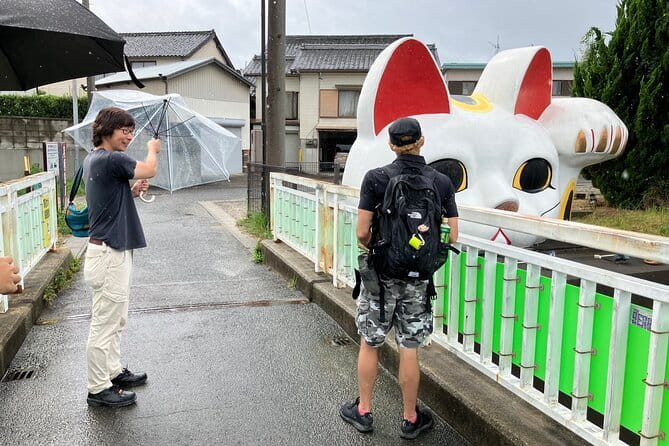
The next stop is Tokonyan, Tokoname’s enormous Maneki Neko. The cat measures about 3.8 meters tall and 6.3 meters wide, and it appears to peek over the town from above.
This is a ten-minute stop, so think of it as a quick visual punctuation mark rather than a major museum visit. Tokonyan gives you a playful break from the more serious pottery background and makes an easy photo opportunity.
The connection to Tokoname also makes the statue more than a random oversized mascot. Maneki Neko figures are familiar across Japan, and Tokoname is closely associated with ceramic production. The giant cat fits the town’s pottery identity while adding a little fun to the route.
The short time here is probably enough. You will not need half an hour to appreciate a giant cat, unless you are determined to perfect the photo. The guide can also help place the statue within Tokoname’s local identity instead of treating it as a quick photo and nothing more.
Walking up Dokanzaka’s pipe-lined slope
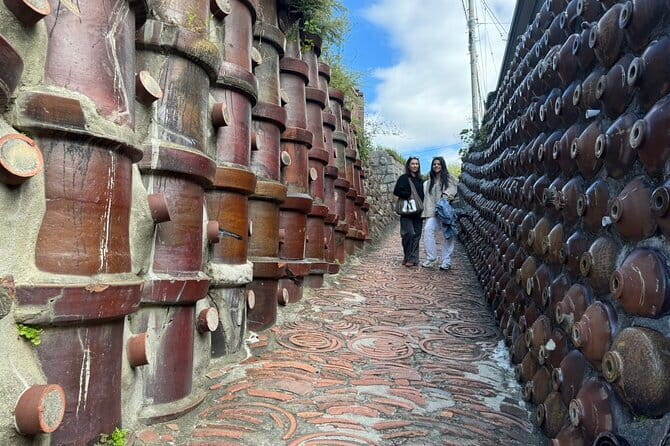
Dokanzaka is likely to be the most distinctive part of the walking route. This slope sits near the center of the Pottery Footpath and is lined on both sides with large earthenware pipes and shochu jars.
You spend about 30 minutes here, which allows time to walk uphill, look at the ceramic details, and hear how these objects fit into Tokoname’s pottery world. The slope is not a conventional polished attraction. Its appeal comes from the way working materials and old ceramic forms shape an ordinary street.
I like this stop because it shows pottery on a large scale. You are not simply looking at a teacup behind glass. Pipes and jars become part of the street itself, creating a route that feels tied to production and daily use.
The climb is worth keeping in mind. The tour includes walking on a slope, and the route may feel less comfortable if you have difficulty with inclines. Most people can participate, but practical footwear is sensible. Since the whole tour lasts only two hours, the guide will keep things moving rather than turning the slope into a long rest stop.
A completely different kind of day out:
- SHIBUYA SKY Ticket
★ 4.7 · 46,509 reviews - Mt. Fuji Instagram-Worthy Spots Day Tour: Ladder Town, Oshino Hakkai, Lake Kawaguchi, Lawson Convenience Store (Departing from Tokyo Station or Shinjuku Station)
★ 4.8 · 35,467 reviews - JR Whole Japan Rail Pass
★ 4.8 · 29,150 reviews - Mt Fuji and Hakone 1-Day Bus Tour Return by Bullet Train
★ 5.0 · 26,383 reviews
Stepping inside a kiln at Togama Square Museum
At Togama Square Museum, you get one of the tour’s most hands-on moments. You can step into an actual kiln, see the interior up close, and take part in a painting activity using Tokoname pottery.
That kiln access gives the museum real character. Instead of viewing a kiln only as a large object in a display, you can enter it and better understand its size and function. For anyone interested in how ceramics are fired, this is more useful than simply browsing finished pieces.
The painting activity adds another layer. You are not required to be an experienced potter to appreciate ceramics, and a simple hands-on task can help you notice shape, surface, and decoration in a more direct way.
The museum stop lasts about 30 minutes. That is enough for an introduction and a short activity, but not an extended workshop. If you want to make a complex piece from start to finish, this tour is not designed for that. Its goal is to let you handle the material and gain a better sense of the craft.
There is also a shop with souvenirs and handmade works. This is where personal spending can enter the picture. The tour price does not cover purchases, so leave room in your budget if a cup, plate, or small ceramic object catches your eye.
Visiting Issei-Touen’s working pottery space
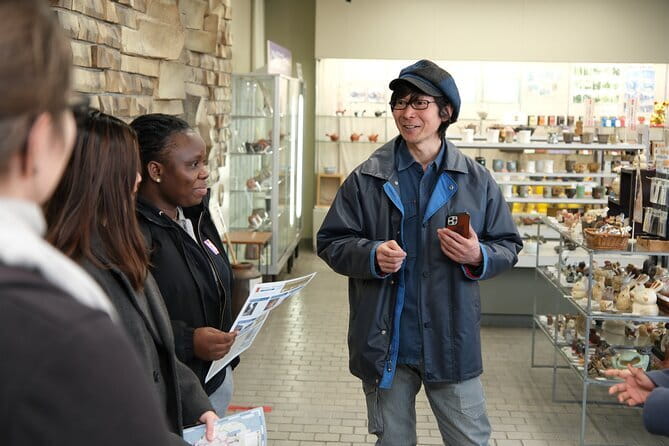
The final listed stop is 一菁陶園 Issei-Touen Tokoname, the pottery space connected with the tour provider. You spend about 30 minutes here looking at handmade ceramics, seeing the workshop, and learning how traditional methods meet contemporary design.
This is the part that gives the tour its personal edge. A ceramic artist is not explaining Tokoname only from a textbook. The guide can connect the town’s past with the choices involved in making and selling pottery today.
The workshop setting also changes the mood. Museums explain. A working pottery space shows you where the craft continues. You might see pieces that feel more personal and less standardized than the souvenirs found in a general shop.
Several strong comments about the experience point to Issei’s role as both guide and potter. He has been praised for his broad understanding of Tokoname and ceramics, and for showing guests his own work. Mr. Yagi has also been singled out for his English, patience, and willingness to adjust the experience when needed.
That personal connection is the tour’s best feature. If you only want a list of sights, you can walk the Pottery Footpath independently. If you want to ask why a form is made a certain way, how a workshop functions, or how Tokoname fits into Japanese ceramics, an artist guide offers something a map cannot.
What the $65.32 price really covers
At $65.32 per person, this is not a bargain walking tour in the strictest sense. The public sights are free, and you could visit Tokonyan and parts of the Pottery Footpath without paying for admission.
The value comes from the guide fee. You are paying for a small group, interpretation in multiple languages, access to a local ceramic artist’s perspective, and a planned route that links the museum, streets, kiln, and workshop.
The maximum group size is eight. That is important. A small group makes it easier to hear the guide, ask questions, and spend a little time examining pottery without being lost in a crowd. It also suits a workshop visit better than a large bus group would.
I would consider the price fair if you care about craft, local history, or meeting an artist. It is less appealing if you only want a quick photo at Tokonyan or a casual walk through town. In that case, the free public locations may be enough.
Remember that the fee includes the guide only. Food, drinks, souvenirs, and other personal expenses are not included. Since the route includes pottery shops and a workshop, you may want to set a separate amount for purchases.
Language, group size, and walking pace

The tour is offered in English, Spanish, and other languages. The information provided does not guarantee every language on every departure, so you should confirm the language you need before booking.
The small maximum of eight people is a major practical advantage. It should give you a more direct exchange with the guide and a better chance to ask about the objects you see. It also means the experience may feel more like a guided visit with an artist than a standard sightseeing group.
The tour lasts approximately two hours and returns to the starting point at Tokoname Ceramic Hall. That makes planning simpler, especially if you are using public transportation or have another activity afterward.
The route includes an uphill slope at Dokanzaka. Most people can participate, and service animals are allowed. Still, you should be comfortable walking through the pottery area and managing an incline. The schedule is compact, so anyone needing frequent breaks may find the pace demanding.
Confirmation is sent within 48 hours of booking, subject to availability. Free cancellation is available until 24 hours before the start time. Changes or cancellations inside that 24-hour window are not accepted, and the amount paid is not refunded.
Who will enjoy this Tokoname tour
I would recommend this experience to anyone with a real interest in Japanese pottery, design, or small-town cultural history. It is also a good choice if you prefer meeting a local specialist instead of simply reading signs at a museum.
Families may enjoy Tokonyan and the painting activity, while art students and pottery fans will get more from the kiln and workshop visits. The multilingual format makes it useful for international visitors who want more explanation than a self-guided walk provides.
This tour may not suit you if you want a long pottery class, a relaxed shopping afternoon, or a route with no uphill walking. The five-stop schedule is efficient but not leisurely. You get a taste of several parts of Tokoname rather than hours at one workshop.
It also works well for a first visit. The Ceramic Hall provides the background, Dokanzaka gives you the visual character of the pottery district, and Issei-Touen shows you the craft in a living setting. Afterward, you will have a clearer idea of which shops, streets, or ceramic styles deserve more of your own time.
Should you book the Tokoname Pottery Footpath tour?
Book it if you want Tokoname explained by someone who actually works with clay. The guide’s personal connection, the maximum group size of eight, and the visit to Issei-Touen make this more than a basic walking route.
I would be especially inclined to book if you have only a short time in Tokoname and want a focused introduction. The $65.32 cost is reasonable for the guidance and artist access, though less so if you plan to skip the museum and workshop details.
Choose a self-guided visit if your priority is saving money, taking photographs at your own pace, or shopping without a schedule. Choose this tour if you want the town’s pottery streets to make sense. Its 4.7 rating from 12 reviews and 100 percent recommendation provide encouraging evidence, while the tight two-hour schedule remains the main limitation.
FAQ
Where does the Tokoname pottery tour start?
The tour starts at Tokoname Ceramic Hall, 3-chōme-8 Sakaemachi, Tokoname, Aichi 479-0836, Japan.
Where does the tour finish?
The activity ends back at the meeting point at Tokoname Ceramic Hall.
How long does the experience last?
The tour lasts approximately two hours.
What is included in the tour price?
The price includes the guide fee. Other personal expenses, including purchases, are not included.
How many people can join the tour?
The tour has a maximum of eight participants.
Can I cancel for a full refund?
Yes. You can cancel at least 24 hours before the local start time for a full refund. Cancellations or changes made less than 24 hours before the start time are not accepted and are not refunded.
Just added in Japan
- A One-of-a-Kind Sushi Experience in a Special Place of Japan★ 5.0 · 15 reviews
- Tokyo Cute Bento Cooking Class – Make a Kawaii Character Lunchbox★ 5.0 · 126 reviews
- Japanese Home Cooking Class & Walk in Todoroki Temple Tokyo★ 5.0 · 88 reviews
- Japan Tokyo Tower Observatory Deck E-Ticket★ 4.0 · 34 reviews
- Catch a Baseball Game in Tokyo with a Local – Tickets Included★ 5.0 · 24 reviews
- JDM Experience with Fast&Furious RX-7 (English speaking Driver)★ 5.0 · 57 reviews
- Tokyo Private Day Tour by Car with English speaking Driver Guide★ 4.0 · 29 reviews
- Japan Classic 10 Day – One Life Adventures★ 5.0 · 129 reviews