
Reviewed · DAY TRIPS
Kyoto and Nara UNESCO Highlights Full-day Tour From Osaka
Japan packs a lot into one day. This Kyoto and Nara day tour links Kiyomizu-dera, Fushimi Inari Shrine, and Nara Park without making you work out several train connections. I like the efficient route and the generous time at Kiyomizu-dera, where you can explore old lanes as well as the temple itself. I also like the easy bus transport from Osaka, especially for a first visit.
The tradeoff is a tight schedule. Fushimi Inari gets about 70 minutes, and Nara about 90 minutes, so you will see major sights rather than study each one at length. The bus is air-conditioned in principle, but hot-weather conditions have caused comfort problems when it could not remain running at a parking area.
In This Review
- Key points at a glance
- What the $62.75 price really gets you
- Meeting the bus in Osaka or Kyoto
- Kiyomizu-dera and Kyoto’s old lanes
- Fushimi Inari’s orange torii gates
- Nara Park, friendly deer, and Todaiji Temple
- A guide-led bus ride, followed by free time
- Walking, weather, and the pace of the day
- Who should book this Kyoto and Nara day trip?
- Practical verdict: good coverage for a modest price
- FAQ
- How long does the Kyoto and Nara tour last?
- Where does the tour begin in Osaka?
- Can I join the tour in Kyoto?
- Does the Kyoto pickup include a Kyoto return?
- Is transportation included?
- Are temple admission fees included?
- Is lunch included?
- What languages does the guide support?
- How many people can join the tour?
- What happens if I arrive late?
- Can the itinerary change?
- What is the cancellation policy?
Key points at a glance
- Three major Kansai sights in one day: Visit Kiyomizu-dera, Fushimi Inari Shrine, and Nara Park on a single organized route.
- Kiyomizu-dera gets 2.5 hours: You have time for the temple, hillside views, Ninenzaka, Sannenzaka, Ishibe Alley, Gion, and Hanamikoji Street.
- Fushimi Inari is free to enter: The 70-minute stop lets you walk beneath the famous orange torii gates without paying an admission fee.
- Nara combines deer and temple grandeur: You have about 90 minutes for Nara Park and the Todaiji Temple area.
- Multilingual help is available: Guides may provide explanations in English, Mandarin, and Japanese.
- The price is modest for the route: At $62.75 per person, the bus service and packed sightseeing plan offer good value, though entrance fees and lunch cost extra.
What the $62.75 price really gets you
At $62.75 per person, this tour is priced as a practical sightseeing shuttle with a guide, not as a private cultural lesson. Your fee covers pickup and drop-off at designated areas, an air-conditioned bus, and a multilingual guide. That matters because Kyoto and Nara are close enough to visit together, but moving between all three stops by public transport takes planning and time.
You should budget extra for lunch and two temple admissions. Kiyomizu-dera costs $5 per person, and Todaiji Temple costs $7 per person. Fushimi Inari Shrine is free. With those admissions, you are looking at $74 per person before food, which is still a reasonable price for a full day of transport between Osaka, Kyoto, and Nara.
The value is strongest if you want coverage. You can see three of the region’s best-known sights in about nine hours and 20 minutes, while avoiding the stress of figuring out each train, bus, and walking connection. The value is weaker if you prefer slow temple visits, long meals, or quiet photography time.
This is a shared group tour with a maximum of 40 people. That is a fairly large group, so expect a set departure time and firm return instructions. The guide may help through a group message or WhatsApp, as some guides have done, which can make it easier to reconnect after free time.
More Day Trips in Osaka
- From Osaka: Himeji Castle, Arima Onsen & Mt. Rokko Day Tour
★ 4.6 · 339 reviews - Osaka Day Tour: Amanohashidate & Ine Bay
★ 5.0 · 280 reviews - Kyoto and Nara Day Trip from Osaka
★ 4.0 · 175 reviews
Meeting the bus in Osaka or Kyoto
The main Osaka meeting point is at 1-chōme-3-6 Nipponbashi, Chuo Ward. The listed pickup time is 8:40 a.m. at Nipponbashi Exit 2. You should arrive at least 15 minutes early and look for a guide holding a yellow flag with the Gogoday logo.
There is also a Kyoto pickup at the Kyoto-Hachijoguchi Bus Loading Area at 9:50 a.m. The important catch is that the drop-off for this trip is only in Osaka. If you join in Kyoto, you still need to plan for your return from Osaka at the end of the day.
The meeting point details deserve care. The operator notes that the last two product photos show the actual meeting area, so check those images before leaving your hotel. No refund is given for a late arrival or no-show. Have your booking name ready for the guide.
The bus parking area may be some distance from the main sights. You will walk from the bus to the attractions, and the day already includes plenty of walking on slopes, stone lanes, and temple grounds. Wear shoes that can handle uneven surfaces and uphill sections.
Kiyomizu-dera and Kyoto’s old lanes
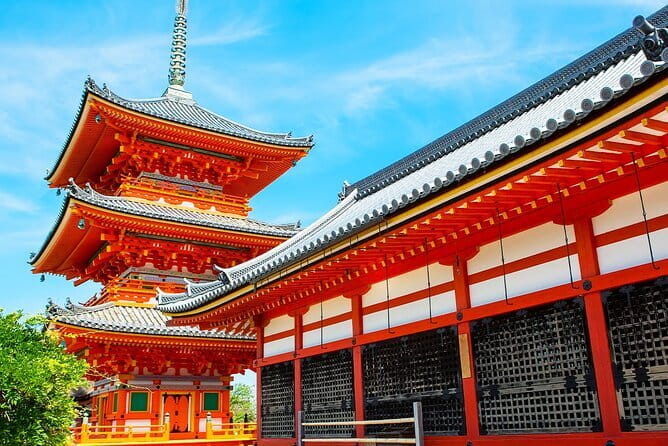
The first Kyoto stop begins at about 10 a.m. and lasts roughly two and a half hours. That is the most generous sightseeing block of the day, and it gives you time to do more than enter the temple, take one photo, and hurry back to the bus.
Kiyomizu-dera sits on a hillside above Kyoto. Its raised wooden stage is famous for views across the city and, in autumn, for the colorful trees below. The setting is one reason this stop works so well early in the day. You can take in the temple, then walk downhill through the surrounding lanes at your own pace.
Admission is not included, so bring cash for the $5 fee. The tour information also advises carrying cash because some places may not accept cards. That is useful advice for small purchases and temple-related expenses.
From Kiyomizu-dera, the route includes Ninenzaka and Sannenzaka, two historic streets lined with traditional wooden buildings, shops, and food stops. These lanes are attractive but can be crowded, and the stone paving plus uphill walking can tire you quickly. The best approach is to avoid spending all your time at the first viewpoint. Keep an eye on the clock and leave room for the streets.
Ishibe Alley offers a quieter change of pace. Its narrow path and wooden houses give you a more intimate sense of old Kyoto than the larger temple approach. Gion and Hanamikoji Street add another classic Kyoto setting, with preserved architecture and a strong connection to the city’s traditional entertainment districts.
The itinerary gives you freedom to explore rather than a long, fixed walking lecture. That suits people who want to choose their own photos, snacks, and stops. Guides may explain the background on the bus or before setting you loose, but the sightseeing itself is largely independent.
The main limitation is that two and a half hours can pass fast. Kiyomizu-dera, the old streets, Ishibe Alley, Gion, and Hanamikoji could each fill a morning. You will need to choose between lingering at the temple, browsing shops, stopping for food, and walking every lane.
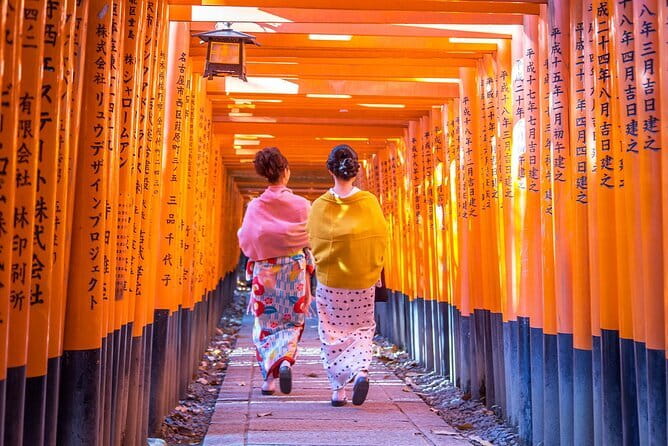
Fushimi Inari’s orange torii gates
The bus leaves Kyoto’s old streets for Fushimi Inari Taisha Shrine, scheduled for about 1:30 p.m. You get approximately 70 minutes here, and entrance is free.
Fushimi Inari is famous for its Senbon Torii, the long rows of orange gates climbing into the wooded hills. The first section is the most accessible and photogenic, but the full shrine route extends much farther uphill. With only 70 minutes, you should not expect to complete the entire mountain walk.
Use this stop for a focused visit. Walk through the first gates, look back toward the shrine buildings, and continue as far as your energy and schedule allow. If you want a quieter stretch, moving beyond the first dense crowd may help, but you must return to the meeting point on time.
This is also a good place to remember that the tour is not a private escort. The guide will tell you when and where to meet the bus, while you explore independently. Some guides provide detailed introductions and practical suggestions before free time, which can help you make quick decisions.
The free admission keeps the overall cost down. It also makes Fushimi Inari an efficient stop because you do not lose time buying a ticket. Still, the short visit means the shrine is a highlight sampler, not a full pilgrimage.
A completely different kind of day out:
- Osaka Go Karting Tour with Funny Costume
★ 5.0 · 2,658 reviews - Osaka Castle: Museum and Tower Entry Ticket
★ 4.5 · 2,380 reviews - Osaka: Shinsekai Food Tour with 13-15 Dishes at 5 Eateries
★ 4.8 · 2,204 reviews - Osaka Food Tour: 13 Dishes at 5 Local Eateries
★ 5.0 · 2,149 reviews
Nara Park, friendly deer, and Todaiji Temple
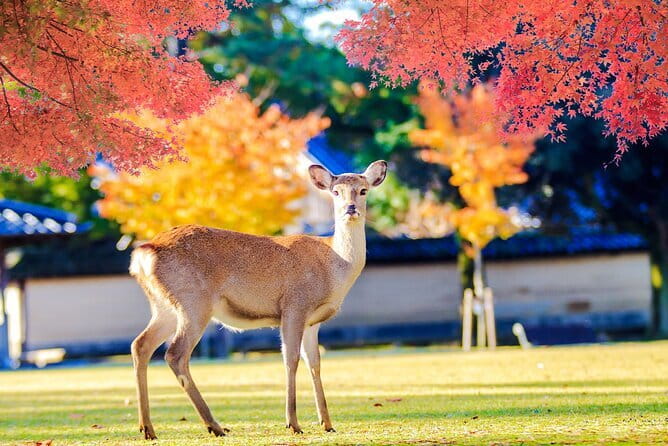
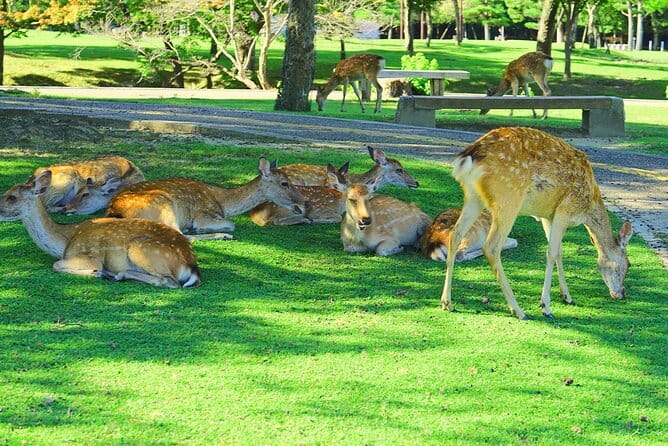
The final major stop is Nara Park at about 4 p.m., with around 90 minutes of free time. Nara Park spreads around the foot of Mount Wakakusa and includes several famous attractions, including Todaiji Temple and Kasuga Taisha Shrine.
The deer are the immediate draw. You can see them moving through the park and interact with them, creating one of the day’s most memorable moments. Feeding the deer is a favorite part of the visit, but keep your attention on the animals and your surroundings. The tour description specifically highlights friendly deer, not a guided animal activity, so your time here is self-directed.
Todaiji Temple brings a very different scale. It is home to the world’s largest bronze Buddha, and the enormous temple structure gives the final stop real weight. Admission costs $7 per person and is not included.
Ninety minutes is enough to combine the park and Todaiji if you move with purpose. It is not enough for a slow visit to every nearby sight. One useful choice is to decide before leaving the bus whether Todaiji or the deer are your priority. If you spend too long taking photos at the park entrance, you may have little time inside the temple.
Timing can also affect the feel of this stop. One visitor found that the late visit allowed only about an hour at Todaiji before closing, with darkness arriving quickly. Your exact conditions will depend on the date, weather, traffic, and daylight, but the point is practical: treat Nara as a timed visit, not an open-ended afternoon.
A guide-led bus ride, followed by free time
The guide’s role varies by the flow of the day, but the strongest part of the service is often the explanation between stops. Guides including Leo, Ako, Lu, Jason, Yujun, and Ms. Zhao have been praised for clear instructions, humor, historical context, and personal help. Lu, for example, has provided explanations in both English and Chinese, while Jason has helped guests understand where to go and what to do in English and Japanese.
The tour offers English, Mandarin, and Japanese support. You should confirm the language arrangement for your departure, since a multilingual guide may need to repeat information for several parts of the group.
Do not book this expecting a guide to walk beside you for every minute. The structure is closer to guided transportation plus independent sightseeing. You receive introductions, meeting instructions, and suggestions, then explore each site on your own before returning to the bus.
That arrangement has advantages. You can spend more time taking photos at a favorite spot, choose your own food, and avoid being pulled through every shop or side street. The downside is that anyone wanting constant historical commentary will need to listen carefully during the bus ride and perhaps do some reading before departure.
The bus makes the long route easier, but conditions matter. It is advertised as air-conditioned, and the vehicle may be comfortable in normal weather. On very hot days, the bus cannot always keep its engine running while parked in a residential area, so the interior can become uncomfortably warm. In one case, a heat index near 97 degrees made the bus feel like a hot box.
Walking, weather, and the pace of the day
This is a walking-filled day. Kiyomizu-dera includes uphill sections, and the approach through Ninenzaka and Sannenzaka uses stone paving. Fushimi Inari can tempt you into a longer uphill walk beneath the torii gates. Nara Park involves open walking between the deer area and Todaiji.
You should bring water, cash, sun protection, and shoes with firm soles. Lunch is not included, and the schedule does not promise a dedicated sit-down meal. You will need to manage food during the free-time portions without losing track of the bus departure.
Weather can change the experience. Autumn brings the foliage views that make Kiyomizu-dera and Nara especially attractive, but the tour runs in other seasons too. In heat, the walking and bus waits are harder. In rain, stone lanes and temple approaches require extra care.
Traffic, weather, or other unexpected problems can shorten sightseeing time or cancel a stop. You should not schedule another important activity immediately after the tour. The operator specifically advises leaving your evening open because the return time can change.
Who should book this Kyoto and Nara day trip?
I would choose this tour if you are staying in Osaka and want a broad first look at Kyoto and Nara without handling the transport yourself. It fits first-time visitors, families who prefer a fixed route, and anyone with only one free day for the Kansai highlights.
It also suits you if you like a mix of guided context and personal freedom. The guide can provide useful background, while you decide how to spend your limited time at each site.
I would hesitate if your main goal is a slow Kyoto experience. You cannot properly linger at every temple, lane, shrine, and park in one day. You should also think twice if you dislike group departures, fixed meeting times, or walking in hot weather.
A group of up to 40 people can feel impersonal, but it keeps the price down. The tour works best when you accept its purpose: efficient sightseeing, not a quiet private tour.
Practical verdict: good coverage for a modest price
This is a strong value choice for a packed Kansai day. For $62.75, you get bus transport, designated pickup and drop-off, a multilingual guide, and access to three major cultural sights. The extra $12 for Kiyomizu-dera and Todaiji is easy to factor into your budget, while Fushimi Inari costs nothing to enter.
The best parts are the 2.5-hour Kyoto block, the simple bus connections, and the chance to feed deer in Nara Park before seeing the enormous bronze Buddha at Todaiji. The weak points are the short Fushimi Inari and Nara visits, the amount of walking, and possible bus discomfort in extreme heat.
Book it if you want to cover Kyoto and Nara from Osaka in one efficient day and are comfortable exploring mostly on your own. Skip it if you want long temple visits, a relaxed meal, or a schedule with plenty of breathing room. Free cancellation is available until 24 hours before the start time, which gives you some flexibility when making the decision.
FAQ
How long does the Kyoto and Nara tour last?
The tour lasts approximately 9 hours and 20 minutes.
Where does the tour begin in Osaka?
The Osaka meeting point is 1-chōme-3-6 Nipponbashi, Chuo Ward, with pickup at Nipponbashi Exit 2 at 8:40 a.m.
Can I join the tour in Kyoto?
Yes. A second pickup is available at the Kyoto-Hachijoguchi Bus Loading Area at 9:50 a.m.
Does the Kyoto pickup include a Kyoto return?
No. The only drop-off location for this trip is in Osaka.
Is transportation included?
Yes. Pickup and drop-off from designated areas and air-conditioned bus transportation are included.
Are temple admission fees included?
No. Kiyomizu-dera costs $5 per person, and Todaiji Temple costs $7 per person. Fushimi Inari Shrine is free to enter.
Is lunch included?
No. Lunch is not included in the tour price.
What languages does the guide support?
The tour provides multilingual guiding in English, Mandarin, and Japanese.
How many people can join the tour?
The shared group tour has a maximum of 40 participants.
What happens if I arrive late?
You should arrive 15 minutes early and look for the guide holding a yellow Gogoday flag. There is no refund for late arrivals or no-shows.
Can the itinerary change?
Yes. Traffic, weather, and other unforeseen circumstances may lead to shorter sightseeing times or canceled attractions.
What is the cancellation policy?
You can cancel at least 24 hours before the start time for a full refund. Cancellations or changes made less than 24 hours before the start time are not accepted.
Just added in Osaka
- Osaka: 2-Hour Nightlife District Walking & Local Food Culture★ 5.0 · 199 reviews
- Osaka Japanese Cooking And Matcha Class near Osaka Castle★ 5.0 · 22 reviews
- Osaka Dotonbori Daytime Food Tour★ 5.0 · 24 reviews
- Osaka Dotonbori Wonder Cruise★ 4.0 · 28 reviews
- Osaka Food Walking Tour with Market Visit★ 4.5 · 14 reviews
- Cooking Ramen&Gyoza/KatsuCurry/Bento/Okonomiyaki+Store Tour@Osaka★ 5.0 · 138 reviews
- Osaka Private Pop Culture Tour: Historic Tenma to Dotonbori★ 4.5 · 13 reviews
- Osaka Cooking Class and Sake Tasting with Local Supermarket Visit★ 5.0 · 79 reviews
Day Trips, compared.
Hiroshima and Miyajima UNESCO Sites 1-Day Tour
Read our review →
Mt Fuji Top 5 Spots Day Tour: Arakurayama Park,Oshino Hakkai
Read our review →
Kamakura & Enoshima Day Trip including Temple Tickets
Read our review →
One-Day Tour of Kyoto’s Highlights from Osaka/Kyoto
Read our review →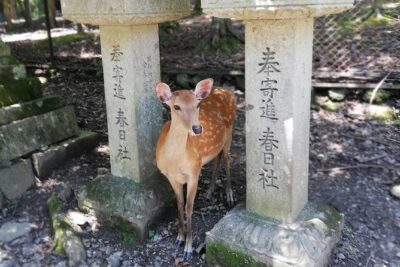
Nara Half Day Trip Walking Tour (Private Option Available)
Read our review →
Mt. Fuji, Kamakura, Big Buddha, & Lake Ashi Day Trip
Read our review →
Nagano: Snow Monkeys, Zenkoji Temple & Sake Day Trip
Read our review →
Mt. Fuji & Hakone Private Day Tour with English-Speaking Driver
Read our review →Browse the lists this tour appears in