Reviewed · FULL-DAY
Full-Day Accessible Tour of Tokyo for Wheelchair Users
Tokyo rewards a little help. This private, full-day tour makes the city far easier to approach by wheelchair, pairing a professional guide with train tickets, hotel pickup within Tokyo’s 23 wards, and a route that links old temples with modern districts. I like the one-to-one attention and the way the guide can adjust the pace. I also like that you use Tokyo’s trains instead of watching the city pass from a private vehicle. The main caution is that this is still a long day, with considerable walking and station movement.
The route covers Asakusa, Sumida Park, Shibuya, Harajuku, Meiji Shrine, Omotesando, and Tokyo Tower according to the tour description, though the detailed stop list does not show Tokyo Tower. That makes the exact order and final stops worth confirming before you go. The tour costs $191.08 per person, and the price is easiest to justify for visitors who want help with Tokyo’s huge rail system and need a guide who understands mobility needs.
In This Review
- Key points to know before booking
- Why this private Tokyo tour is useful
- Starting at Asakusa’s modern gateway
- Senso-ji and the Sumida River
- Crossing Shibuya without the stress
- Meiji Jingu, Tokyo’s calm center
- Omotesando and Tokyo’s polished side
- Using Tokyo’s trains with a guide
- What the $191.08 price buys
- Who will get the most from this day
- Guides who make the route work
- Booking details worth checking
- Should you book this accessible Tokyo tour?
- FAQ
- How long is the accessible Tokyo tour?
- Is hotel pickup included?
- Are train tickets included in the price?
- Is this a private tour?
- Is Tokyo Tower definitely included?
- Can I cancel for a full refund?
Key points to know before booking
- Hotel pickup within Tokyo’s 23 wards: You can begin with a transfer from your hotel rather than finding your way to an unfamiliar station.
- Train tickets are included: The guide handles the basic rail logistics and helps with the station routes used during the day.
- Private and adjustable: Only your group participates, so the guide can respond to fatigue, requests, and access needs.
- Classic Tokyo in seven hours: The day connects Asakusa’s temples, the Sumida River, Shibuya Crossing, Harajuku, Meiji Shrine, and Omotesando.
- Strong guide support: Guides including Michiko, Machiko, Kaori, Fumiko, Yumi, Emiko, and Keita Mizuri are praised for patience, route planning, cultural explanations, and care with wheelchair access.
- A full physical day: One account describes 15,000 steps, so you should plan for a busy outing even though the route is designed with wheelchair users in mind.
Why this private Tokyo tour is useful
Tokyo is a city of short distances that can feel long. A map may show two nearby districts, yet the route can involve a crowded sidewalk, a large station, an elevator search, or a crossing with several lanes of traffic. A guide who already thinks about ramps, slopes, station assistance, and fewer steps can save you both time and energy.
That practical help is the heart of this tour. You are not simply being shown famous sights. You are being helped through the parts of Tokyo that can be tiring or confusing when you use a wheelchair, rollator, or need a slower walking pace.
The tour is private, and that matters. If you need a pause, want to spend longer at Senso-ji, or would rather cut a shopping stop short, you can ask. Kaori is specifically praised for adapting the plan quickly, while Yumi found routes with fewer steps when legs were tired. Those details give you a good sense of the service: the schedule is a framework, not a rigid march.
The tour lasts about seven hours and begins at 9:30 a.m. The meeting information lists the Asakusa Culture Tourist Information Center as the start point, while hotel pickup and drop-off within the 23 wards are included. Since the end information also says the activity finishes back at the meeting point, confirm the exact pickup and return arrangement when booking.
A few more options to weigh up in Tokyo
- Tokyo Disney Resort – Tokyo Disneyland & Tokyo DisneySea Park Tickets
★ 4.8 · 99,488 reviews - SHIBUYA SKY Ticket
★ 4.7 · 46,509 reviews - JR Whole Japan Rail Pass
★ 4.8 · 29,150 reviews
Starting at Asakusa’s modern gateway
The first stop is the Asakusa Culture Tourist Information Center, a striking eight-story building designed by Kengo Kuma. It is more than a place to collect maps. Its design gives you an early look at how Tokyo mixes traditional forms with clean, modern architecture.
You have about 15 minutes here. That is enough to get oriented and begin the day without rushing into the packed temple area. It is also a sensible place for the guide to explain the route and help you prepare for the crowds ahead.
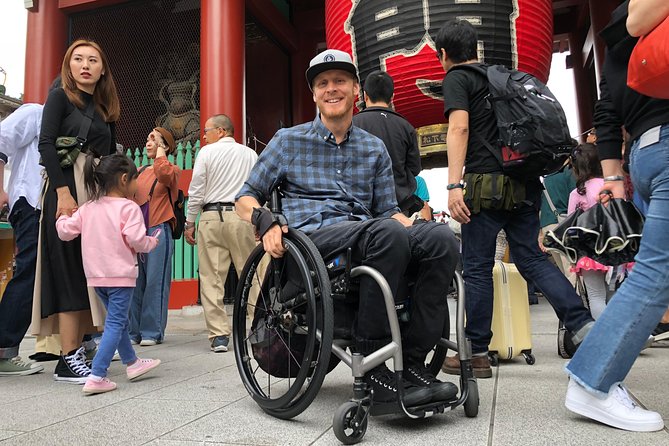
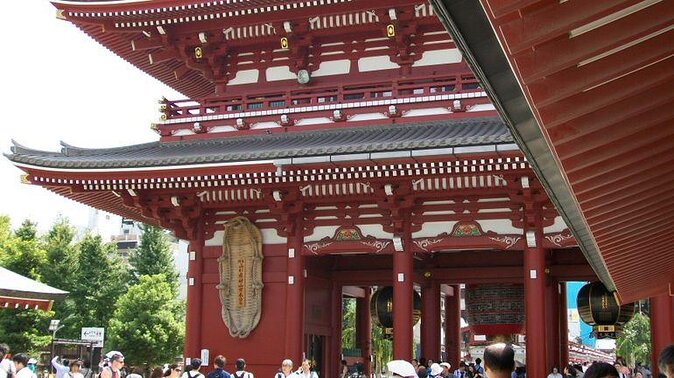
From here, you move toward Kaminarimon, the Thunder Gate. This is the famous entrance to Senso-ji and one of the most recognizable scenes in Asakusa. The large lantern and gate create a clear visual entrance to the temple district, but the approach can be crowded.
You have about 20 minutes on Nakamise Shopping Street. The street runs toward Senso-ji and is lined with small shops selling snacks, souvenirs, and traditional goods. For wheelchair users, the value of having a guide here is not only historical explanation. It is also help with keeping a comfortable line through a busy pedestrian area.
Senso-ji and the Sumida River
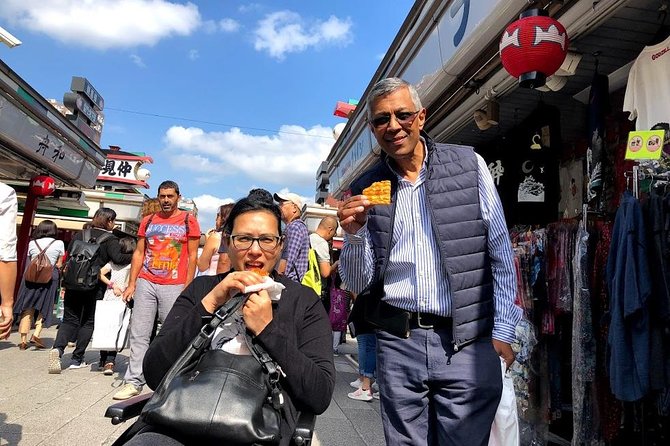
Senso-ji is Tokyo’s best-known Buddhist temple and one of the city’s most colorful historic sights. The temple is dedicated to Kannon, and its origin story reaches back to the seventh century, when two fishermen reportedly found a statue in the Sumida River.
The planned visit lasts around 20 minutes. That is enough for a first look, some photos, and a clear explanation of the temple’s role in Asakusa. It is not a long temple study, so if religious art or architecture is your main interest, tell your guide early that you would like more time here.
Next comes Sumida Park, with about 15 minutes beside the river. The park offers views toward Tokyo Skytree and is especially attractive during cherry blossom season. It gives you a change of pace after the temple streets, with more open space and a chance to look across the water.
The short timing is both a benefit and a limit. You get a pleasant river view without spending too much of the day in one area, but you will not have time for a long riverside stroll. If the weather is good and Sumida Park appeals to you, ask if the schedule can be adjusted.
Crossing Shibuya without the stress
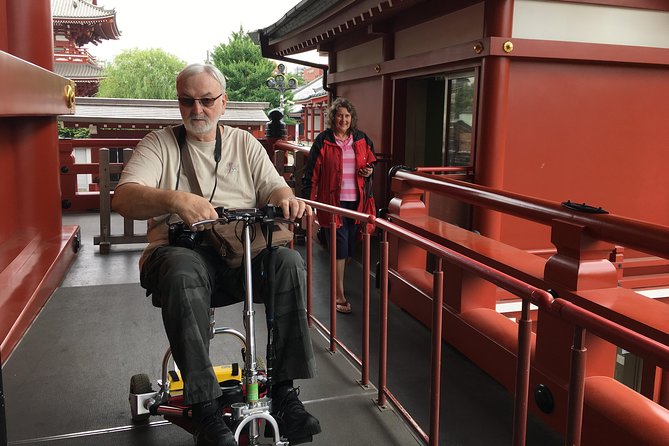
Shibuya Crossing is Tokyo theater in its simplest form. When the signals change, streams of people cross from several directions at once, with the surrounding buildings forming a giant wall of signs and screens.
The scheduled stop is about 20 minutes. That gives you time to take in the crossing and see the scale of Shibuya Station. The crossing itself is flat at street level, but the crowds can make movement slow. Your guide’s job here is especially valuable because staying together in a dense crowd is not always easy.
One account specifically praises Fumiko for keeping track of the group in crowded Tokyo. That is the sort of small service you may appreciate more here than at a quiet shrine. You will need to stay alert, listen to the guide, and allow extra space around your chair.
After the crossing, the tour visits Cat Street for about 25 minutes. This half-mile route between Harajuku and Shibuya is known for fashion shops and a younger street style. It offers a different side of Tokyo from the old temple district.
Do not expect a formal attraction with a single grand viewpoint. Cat Street is about the feel of the neighborhood, window-shopping, and the contrast between the major commercial centers nearby. The stop is most useful if you enjoy fashion, design, and watching everyday city life.
A completely different kind of day out:
- Mt Fuji and Hakone 1-Day Bus Tour Return by Bullet Train
★ 5.0 · 26,383 reviews - TOKYO SKYTREE® Ticket
★ 4.7 · 25,136 reviews - teamLab Borderless Tickets: MORI Building DIGITAL ART MUSEUM
★ 4.7 · 24,126 reviews - teamLab Planets TOKYO Ticket
★ 4.7 · 21,663 reviews
Meiji Jingu, Tokyo’s calm center
Meiji Jingu is dedicated to Emperor Meiji and Empress Shoken. The shrine sits beside Harajuku Station, yet its grounds feel removed from the station crowds and nearby shops.
The planned visit is 50 minutes, making it one of the longest stops. That is appropriate. Meiji Jingu needs time for the approach, the wooded setting, and the shrine buildings themselves.
Access conditions can vary by route and by the mobility equipment you use. The tour is designed around wheelchair users, but you should still describe your chair or rollator needs clearly when booking. The guide may choose a route with fewer steps or make an adjustment based on fatigue.
The shrine also gives you a chance to ask questions about the difference between a Shinto shrine and a Buddhist temple. Yumi is praised for explaining those architectural and cultural differences, which can make the day more meaningful than a quick sequence of photo stops.
For many people, Meiji Jingu is the emotional pause in the day. After Asakusa’s crowded temple approach and Shibuya’s moving tide of people, the shrine offers a quieter setting. The scheduled 50 minutes will pass quickly, especially if you want time for photographs or a careful look at the architecture.
Omotesando and Tokyo’s polished side
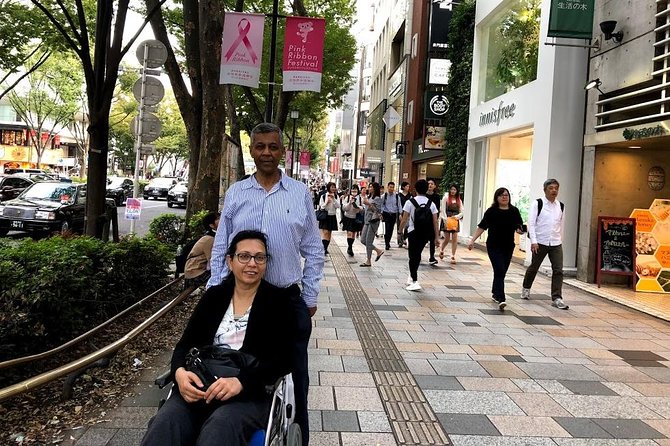
Omotesando is a broad, tree-lined boulevard in the Aoyama area, often linked with Harajuku. It is known for fashion, design, and modern buildings, and it gives you a final look at Tokyo’s stylish commercial side.
The stop lasts around 20 minutes. This is enough for a short walk or a look at the street, but not a full shopping session. If you want to enter stores, ask about access and available time. The route is designed to cover a lot of Tokyo in one day, so shopping is not its main purpose.
The contrast between Omotesando and Senso-ji is one of the tour’s strengths. In a single day, you move from Buddhist tradition to shrine customs, from riverside views to youth fashion, and from a famous crossing to polished architecture. You get a useful first picture of Tokyo rather than spending the entire day in one district.
The overview also lists Tokyo Tower among the accessible sights, but the detailed timetable names Omotesando as the final stop and does not assign Tokyo Tower a separate time slot. Confirm if Tokyo Tower is included on your date, or ask if it can replace another stop.
Using Tokyo’s trains with a guide
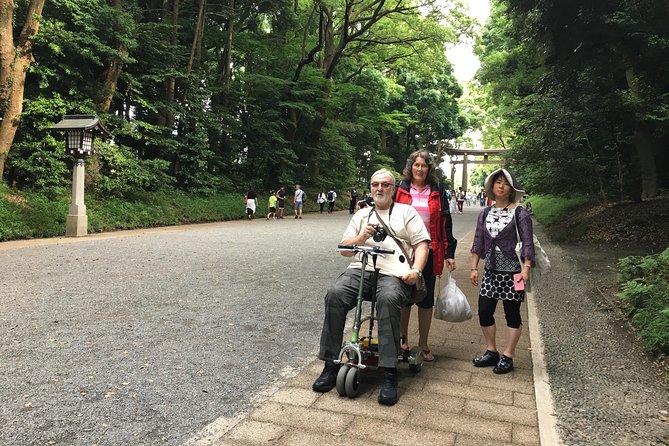
Train tickets are included, and the tour is designed to use public transportation. That is a major part of its value. Tokyo’s rail network is efficient, but large stations can be tiring even when you know where you are going.
The guide helps with tickets, navigation, and the station process. A particularly useful detail from the experience is the assistance provided by station attendants, who supplied slope ramps at each station used by the group. You should not assume every station experience will feel identical, but this shows why local support can matter.
The train portion also helps you learn how Tokyo works. Instead of being sealed inside a private car, you see how residents move between neighborhoods. At the same time, rail travel requires transfers, waiting, and movement through stations, so it can add to the physical demands of the day.
Private transportation by taxi, private car, or bus is available for an extra fee. That option may suit you if train transfers are too tiring or if your chair requires more vehicle space. It will raise the total cost, so ask for the price before deciding.
What the $191.08 price buys
At $191.08 per person, this is not a budget sightseeing walk. You are paying for a private guide, included train tickets, hotel pickup and drop-off within the 23 wards, local taxes, and help with a difficult citywide route.
The value is strongest for a couple, family, or small group that needs mobility-aware planning. A shared tour might cost less, but it would not offer the same control over pace or route changes. Here, the guide can respond to your needs instead of following a large group’s schedule.
The price is less compelling if you already know Tokyo’s rail system, have no trouble planning step-free routes, and mainly want a quick transfer between famous sights. You may save money by visiting fewer districts on your own.
The tour requires at least two people per booking, including caregivers, and the minimum age is six. Since it is private, only your group participates. Group discounts are available, so larger families should check how the total price changes.
Who will get the most from this day
I would choose this tour if you are visiting Tokyo for the first time and want to see several major districts without solving every transport problem yourself. It is also a good fit for families traveling with an older relative or someone who uses a wheelchair only part of the time.
The guidance appears especially useful for:
- A wheelchair user who wants to use Tokyo’s trains with support
- A family that needs the day adjusted around fatigue
- A visitor who wants both historic and modern Tokyo
- Anyone nervous about crowded places such as Asakusa and Shibuya
- A group that values a private guide over a low-cost shared excursion
You should think carefully if you dislike long days, crowded stations, or frequent changes of scene. The route is ambitious. One family covered 15,000 steps during the day, although your distance will depend on your equipment, pace, and adjustments.
The tour requires a moderate level of physical fitness. That does not mean you must walk independently, but you should be ready for a full day of movement, station access, and sightseeing. Tell the operator about your needs in advance so the guide can plan sensibly.
Guides who make the route work
The guide is the most important part of this experience. Names praised for the job include Michiko, Machiko, Kaori, Fumiko, Yumi, Emiko, and Keita Mizuri.
Their strengths are consistent: patient explanations, careful attention to pace, help with the rail system, and willingness to change the plan. Machiko is praised for explaining Tokyo’s history while responding to wheelchair access needs. Kaori is praised for organization and a useful lunch recommendation. Emiko helped a 96-year-old visitor using a combination rollator and wheelchair.
That does not mean every guide will have the same personality or the exact same route. It does mean the service is built around personal assistance rather than a rehearsed speech. I would write down your priorities before the day begins: temples, shopping, photography, Tokyo Tower, food, or fewer steps.
The tour receives a 4.9 rating from 32 ratings, with 100 percent recommending it. Those numbers suggest a strong record, but your experience will still depend on weather, crowds, your mobility needs, and how well the plan is adjusted.
Booking details worth checking
Confirmation is provided at booking. Service animals are allowed, and the experience is near public transportation.
Free cancellation is available up to 24 hours before the start time for a full refund. Changes made less than 24 hours before the start time are not accepted, and the cut-off uses Tokyo local time.
Before booking, confirm four points directly:
- Your exact hotel pickup time
- The return point at the end of the day
- Whether Tokyo Tower is included in your version of the route
- The type and size of wheelchair or rollator you will use
The listed start point is the Asakusa Culture Tourist Information Center at 2 Chome 18-9 Kaminarimon, Taito City, Tokyo. The scheduled start time is 9:30 a.m.
Should you book this accessible Tokyo tour?
Book it if you want a broad first look at Tokyo and need a guide to handle rail travel, crowded areas, ramps, and route choices. The private format, included train tickets, hotel pickup within the 23 wards, and flexible pace give it real value for visitors with mobility concerns.
I would not book it simply because it visits famous places. The day is long, and some stops are brief. If you want a slow temple visit, a long meal, or serious shopping, you will need to ask for a shorter route.
For most wheelchair users visiting Tokyo for the first time, this is a practical way to see a lot without facing the city’s logistics alone. Confirm the Tokyo Tower detail and your return arrangements, then book it for the guidance, not just the checklist of sights.
FAQ
How long is the accessible Tokyo tour?
The tour lasts approximately seven hours and begins at 9:30 a.m.
Is hotel pickup included?
Yes. Hotel pickup and drop-off are included for locations within Tokyo’s 23 wards.
Are train tickets included in the price?
Yes. Train tickets are included, and the tour uses Tokyo’s public transportation as part of the experience.
Is this a private tour?
Yes. Only your group participates, and the tour requires a minimum of two people, including caregivers.
Is Tokyo Tower definitely included?
Tokyo Tower appears in the tour overview, but it is not assigned a separate stop in the detailed timetable provided. Confirm its inclusion and timing before booking.
Can I cancel for a full refund?
Yes. You can cancel at least 24 hours before the start time for a full refund. Cancellations or changes made less than 24 hours before the start time are not accepted for a refund.
Just added in Tokyo
- A One-of-a-Kind Sushi Experience in a Special Place of Japan★ 5.0 · 15 reviews
- Tokyo Cute Bento Cooking Class – Make a Kawaii Character Lunchbox★ 5.0 · 126 reviews
- Japanese Home Cooking Class & Walk in Todoroki Temple Tokyo★ 5.0 · 88 reviews
- Japan Tokyo Tower Observatory Deck E-Ticket★ 4.0 · 34 reviews
- Catch a Baseball Game in Tokyo with a Local – Tickets Included★ 5.0 · 24 reviews
- Tokyo Private Day Tour by Car with English speaking Driver Guide★ 4.0 · 29 reviews
- Japan Classic 10 Day – One Life Adventures★ 5.0 · 129 reviews
- JDM Experience with Fast&Furious RX-7 (English speaking Driver)★ 5.0 · 57 reviews
Full-Day, compared.

Mount Fuji Full-Day Private Tour from Tokyo (Customizable)
Read our review →
Hiroshima / Miyajima Full-day Private Tour with Government Licensed Guide
Read our review →
Mount Fuji Full-Day Small Group driver-guide tour (with Pick-up option)
Read our review →

5 Top Highlights of Kyoto Full Day Bike Tour (E-bike option)
Read our review →