
Reviewed · BOAT TRIPS AND CRUISES
Hiroshima: City and Miyajima Bike and Boat Tour
Hiroshima comes alive on two wheels. I like the way this small-group tour links the Peace Park and A-bomb Dome with Hiroshima Castle, then carries you by train and ferry to Miyajima. I also like the easy, flat cycling route, which lets you cover a lot without turning the day into a fitness test.
The main consideration is time. At 450 minutes, this is a full-day outing, and the combination of cycling, public transport, ferry travel, and walking leaves little room for a slow, unplanned afternoon. Still, the mix of sobering history, feudal Japan, island scenery, and Itsukushima Shrine gives you a remarkably broad view of Hiroshima in one day.
In This Review
- Key points at a glance
- Why this tour works so well in Hiroshima
- Cycling through the Peace Park and past the A-bomb Dome
- Hiroshima Castle and the city’s feudal past
- Taking the train and ferry to Miyajima
- Walking Miyajima as a former religious center
- Guides are a major part of the experience
- Bikes, weather, food, and practical comfort
- Is $138 a fair price?
- Who should book this Hiroshima day tour?
- Should you book it?
- FAQ
- How long does the Hiroshima and Miyajima bike and boat tour last?
- What language is the tour offered in?
- How large is the tour group?
- Is the cycling route difficult?
- Are bikes and helmets included?
- Does the tour include the ferry to Miyajima?
- Is lunch included?
- What happens if it rains?
- Is hotel pickup included?
- Who should not take this tour?
Key points at a glance
- A flat cycling route: The Peace Park section suits anyone who can ride a bike, including slower riders.
- A small group of eight or fewer: You get more opportunity to ask questions and stay connected with the guide.
- Three very different settings: The route moves from the Peace Park to Hiroshima Castle, then to Miyajima’s forested island setting.
- Guides who add real value: Ishan, Aimee-Linh, Melissa, Sage, and Aimée have all been praised for clear explanations, humor, and thoughtful answers.
- Transport is part of the experience: Your train and ferry connections to Miyajima are included, so you can focus on the day rather than arranging each leg yourself.
- Lunch and water are included: That matters on a long tour with both a bike ride and a walking portion.
Why this tour works so well in Hiroshima
Hiroshima is not a one-sight city. The Peace Park explains the destruction of 1945 and the city’s message of remembrance. Hiroshima Castle points you toward the city’s earlier feudal era. Miyajima then shifts the mood again, with wooded hills, Shinto architecture, and lanes shaped by centuries of religious activity.
I like that this tour does not treat those places as separate day trips. You see how Hiroshima changed over time, from feudal stronghold to modern city, from wartime tragedy to a place built around memory and peace. The contrast is the point.
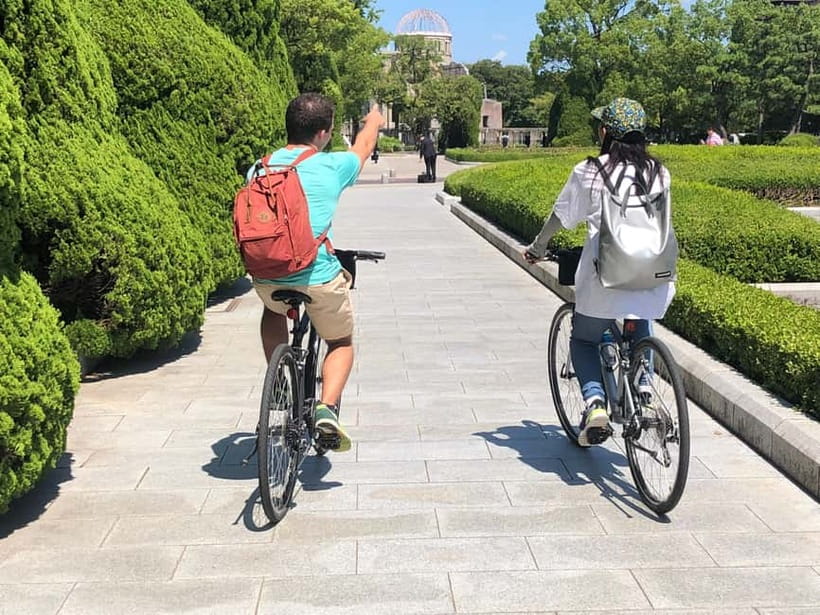
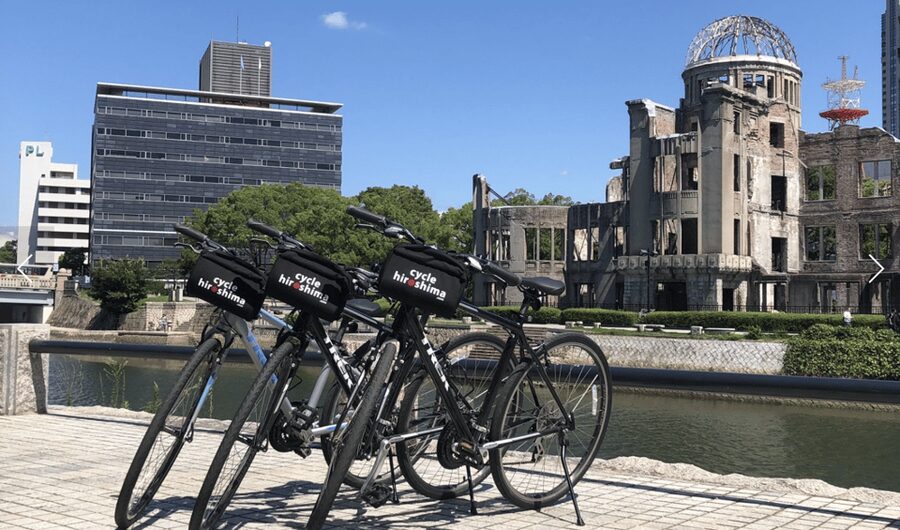
The bike makes the first part efficient without making it feel rushed. The route around Peace Park and the A-bomb Dome is completely flat, and the pace is described as suitable for all riding abilities. Trek bikes are available in several sizes, along with step-through bikes and child-sized bikes. You need to be able to ride, but you do not need advanced cycling skills.
With no more than eight people, the guide can keep the group together and respond to questions. That personal contact matters most at the Peace Park, where a guide’s tone and judgment can shape how you understand the memorials.
More Boat Trips in Hiroshima:
- Hiroshima and Miyajima Day Trip with Itsukushima Shrine & Ferry
★ 5.0 · 378 reviews - Hiroshima to Miyajima: Private Custom Tour with Ferry Ride
★ 4.9 · 77 reviews - Hiroshima and Miyajima 1 Day Cruise Tour
★ 5.0 · 24 reviews
Cycling through the Peace Park and past the A-bomb Dome
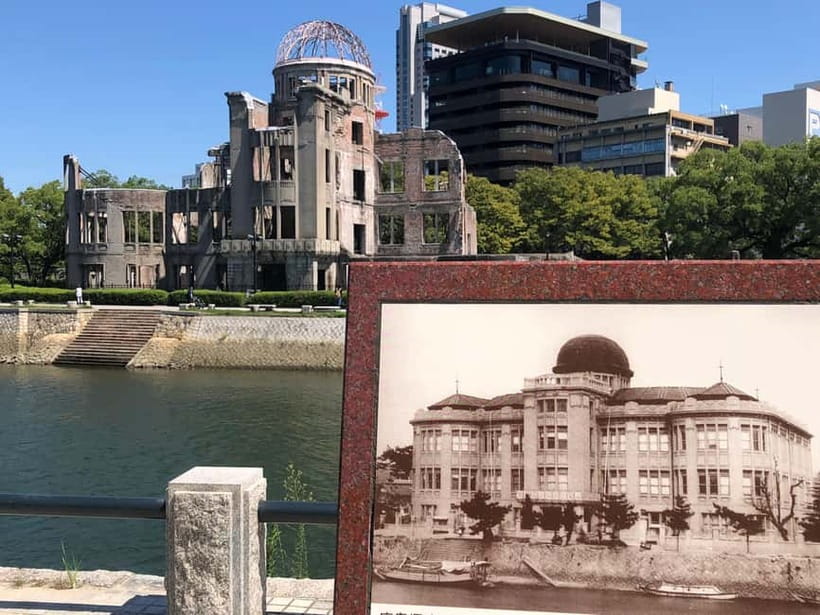
The tour begins with a guided ride around Hiroshima’s most important modern landmarks. The A-bomb Dome is the visual anchor. Its damaged structure remains one of the clearest reminders of the atomic bombing, and seeing it from a bicycle gives you a sense of how the memorial area fits into the wider city.
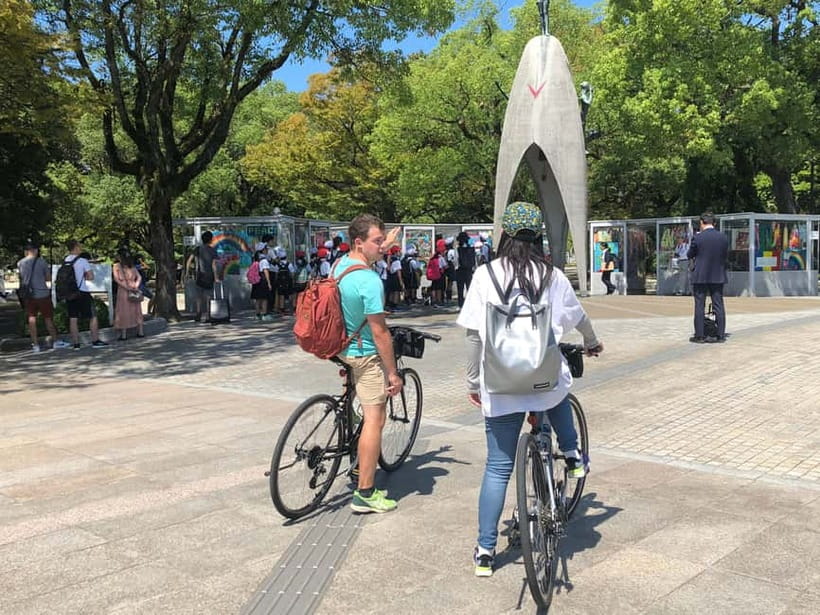
The Peace Park is not simply a photo stop. It is a place of remembrance, reflection, and difficult questions. You can expect commentary about Hiroshima’s history, the bombing, and the meaning of the memorial site. The experience is serious, but the guide’s role is to explain rather than overwhelm you.
This is one area where a small group helps. You can stop, listen, and ask a question without trying to make yourself heard over a large crowd. Guides such as Sage and Melissa have been praised for explaining both the painful side of the bombing and the city’s later work of remembrance in a clear, thoughtful way.
The flat route is a practical advantage. You are not spending your energy climbing hills before the more demanding part of the day. Slow riders are supported, and the cycling is intended to be easy and steady.
You should still wear comfortable clothes and shoes. A helmet and bike are provided, but you will be riding outdoors and then walking around Miyajima, so footwear matters more than dressing for a formal sightseeing day. Bring a camera, but give the Peace Park the attention it deserves before reaching for it.
Hiroshima Castle and the city’s feudal past
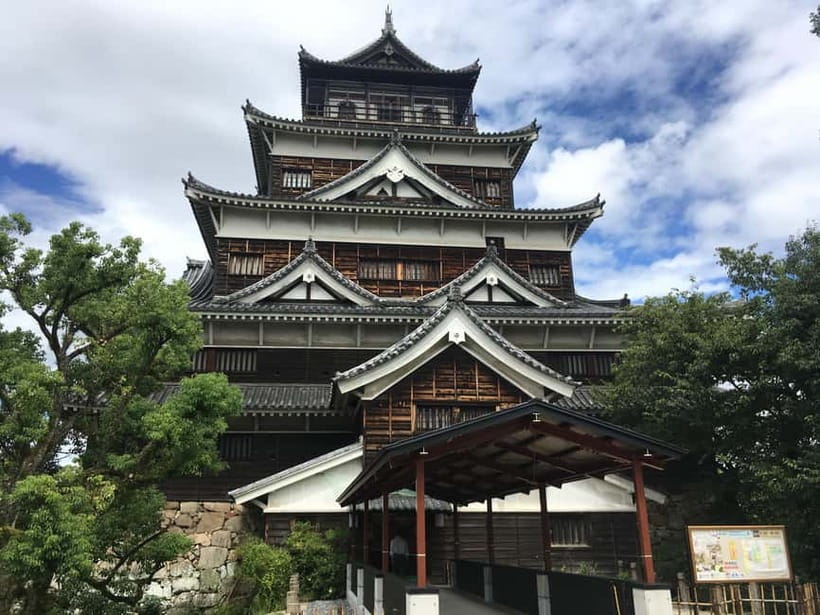
After the Peace Park, the tour turns to Hiroshima Castle. This changes the story from modern war and peace to the city’s feudal past.
The castle helps place Hiroshima in its earlier political and military setting. It gives you a chance to see that the city’s story did not begin in the twentieth century. The guide’s commentary connects the castle with pre-Meiji history, a point that Sage explained especially well according to the tour feedback.
I appreciate this stop because it keeps the day from becoming narrowly focused on the atomic bombing. Hiroshima is not defined by one event, even though that event changed the world. The castle gives the city more depth and helps you understand the older foundations beneath today’s streets.
The provided information does not specify how long you spend inside or around the castle, so you should think of it as one part of a wider route rather than a long museum visit. If you want a full castle interior experience, check the day’s exact schedule before booking. The value here is the historical contrast and the guide’s explanation.
Taking the train and ferry to Miyajima
From Hiroshima, you continue by train before boarding a ferry to Miyajima. Both transfers are included, which simplifies the day and removes the need to work out the connection yourself.
The change in transport also creates a clean break in the itinerary. The city’s roads and memorial spaces give way to water, island views, and a slower walking section. After the intensity of the Peace Park, that shift can feel welcome.
The ferry ride is not just a practical transfer. It is part of the pleasure of reaching Miyajima. The island offers a clear contrast to the city, with lush greenery and orange Shinto buildings creating a different visual setting. The change is especially useful for first-time visitors trying to understand how varied the Hiroshima area can be.
The day is long, so keep an eye on your energy. You will cycle, ride public transport, take a ferry, and walk. Lunch and water are included, which helps, but this is not a short city orientation tour. It is better suited to someone who wants a full day of sightseeing than to someone who prefers a loose schedule with long café breaks.
A few more options to weigh up in Hiroshima
- Peaceful Hiroshima & Miyajima UNESCO 1 Day Bus Tour
★ 5.0 · 5,309 reviews - Hiroshima Peace Memorial Museum Ticket
★ 4.8 · 2,727 reviews - Hiroshima: Hiroshima and Miyajima UNESCO Sites 1-Day Tour
★ 4.9 · 2,330 reviews - Hiroshima Peace Memorial Museum Admission
★ 4.6 · 1,308 reviews
Walking Miyajima as a former religious center
Once you reach Miyajima, the pace changes from cycling to walking. The guide explains how the island developed as a religious center, then leads you through its lanes and key sights.
This part of the tour is where the city and island contrast becomes most complete. Hiroshima’s Peace Park is carefully arranged around public memory. Miyajima feels more connected to religious tradition, wooded surroundings, and old routes through the island settlement.
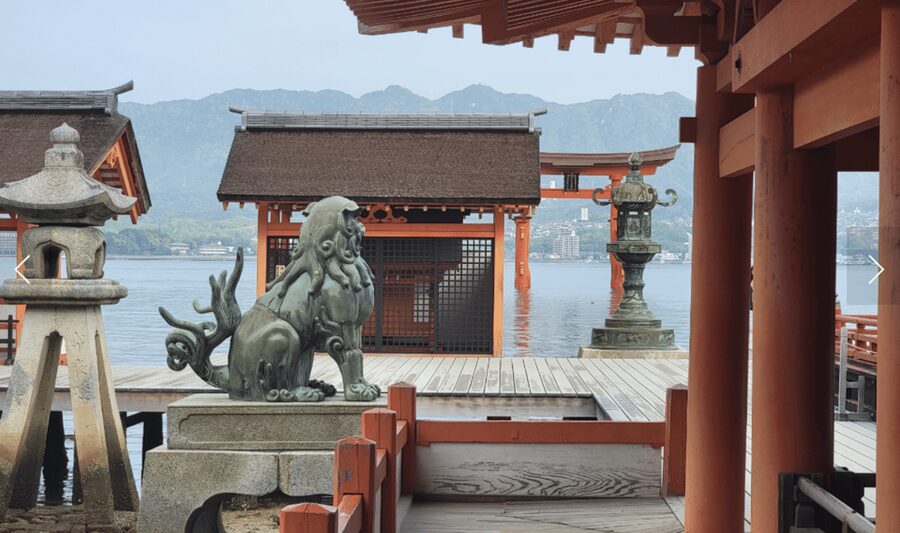
You can expect plenty of photo opportunities, especially around the orange Shinto buildings and the approach to Itsukushima Shrine. The tour includes a visit to the shrine, one of the island’s defining sights. The provided details do not promise a specific tide condition or a particular view of the famous gate, so do not book based on one exact photograph. The broader experience is the shrine, the island setting, and the explanation of Miyajima’s religious role.
The walking tour also gives you a better chance to notice small details than a quick independent visit might. Your guide can explain why the island mattered as a place of worship and how its lanes fit into that history. Aimée-Linh was praised for combining historical detail with humor, while Melissa was noted for answering questions and giving the island visit special attention.
Miyajima is the likely highlight for many people, but it should not be treated as a completely separate attraction. It works because the tour places it after Hiroshima’s memorial and feudal sites. You finish the day with a setting that is visually lighter, but still historically important.
Guides are a major part of the experience
The guide can make or break a tour that covers such serious and varied material. Here, the strongest feedback focuses on enthusiasm, answers to questions, and the ability to keep the day moving.
Ishan was praised for his knowledge of the subject, enthusiasm, and willingness to answer many questions. Aimee was called a fabulous guide, while Aimee-Linh was praised for historical detail and humor. Melissa received especially strong approval for explaining the bombing, Hiroshima’s remembrance, and the city’s earlier history. Sage was noted for helping a group stay comfortable on a rainy day while providing detailed commentary.
Those comments point to an important benefit of the small group. You are not simply following a flag through a series of stops. You can ask about the bombing, pre-Meiji Hiroshima, the castle, or Miyajima’s religious role and receive a direct response.
Guide quality can vary from one departure to another, of course. The information identifies English as the tour language, but it does not guarantee a particular guide. Still, the repeated praise for different guides suggests that interpretation is a central strength of the experience.
Bikes, weather, food, and practical comfort
The bikes are Trek brand models in different sizes. Step-through options and child-sized bikes are also available, which makes the setup more flexible than a one-size-fits-all rental. You need to provide the height of everyone in your group, so do that carefully when booking.
The route is flat and suitable for all skill levels, but the tour is not suitable for people who cannot ride a bike. It is also not suitable for pregnant women or wheelchair users. Those limits are important because the first section is a real cycling tour, not a sightseeing ride where you can simply sit back.
Rain requires a little flexibility. If the weather is poor, the operator will contact you and offer either a walking tour around the Peace Park or a full refund. Make sure you can be reached before the tour, especially if the forecast looks uncertain.
Lunch and water are included, and you should provide information about dietary restrictions ahead of time. Hotel pickup and drop-off are not included, so you need to reach the starting point yourself and make your own way back after the tour.
Smoking is not allowed. Comfortable shoes, comfortable clothing, and a camera are the stated items to bring. I would also plan for a full day outdoors, with enough room in your schedule that you do not have to hurry away from the final island visit.
Is $138 a fair price?
At $138 per person, this is not the cheapest way to see Hiroshima. The value depends on how much structure and explanation you want.
You are paying for a guided cycling route, bike, helmet, English commentary, Hiroshima Castle, train and ferry transfers, a Miyajima walking tour, Itsukushima Shrine, lunch, and water. You are also paying for a small group capped at eight people. Arranging all of that independently could cost less, especially if you already know Hiroshima well and are comfortable handling public transport.
The tour becomes better value if you are visiting Hiroshima for only a day or two. You can cover the Peace Park, A-bomb Dome, castle, and Miyajima without spending time planning each connection. The guide also supplies historical context that is easy to miss when moving between sights on your own.
I would not choose it if you want to spend hours at one museum, shop at your own pace on Miyajima, or build in lots of free time. The price is easier to justify for an active first visit, particularly if you value a small group and clear English explanations.
Free cancellation up to 24 hours before the start and a reserve-now, pay-later option also reduce the risk of committing too early. Those policies are useful when your Japan itinerary is still changing.
Who should book this Hiroshima day tour?
I would recommend it to a first-time Hiroshima visitor who wants both the city and Miyajima in one organized day. It is also a good fit if you like learning through conversation, prefer a small group, and can ride a bicycle comfortably.
Families may appreciate the step-through and child-sized bike options, though the long duration means you should consider each child’s stamina. The flat route helps, but the full day still includes several kinds of travel and a walking tour.
History-focused visitors will get the most from the guide commentary. The day gives you modern Hiroshima, pre-Meiji history, the castle, and Miyajima’s religious past instead of reducing the city to one memorial.
I would skip it if you cannot ride, use a wheelchair, are pregnant, or want a quiet, self-directed day. I would also think twice if a rainy forecast would make cycling unpleasant, even though a walking alternative may be offered.
Should you book it?
Book this tour if you want an efficient, thoughtful introduction to Hiroshima and Miyajima, with a guide to connect the pieces. The flat ride, small group, included transport, and strong guide feedback make it a practical choice for active visitors.
The best reason to book is the range. You move from the A-bomb Dome to Hiroshima Castle, then across the water to Itsukushima Shrine and Miyajima’s wooded lanes. It is a long day, but it gives you a fuller understanding of the place than a single-sight visit.
Skip it only if you need lots of free time or cannot manage a full day of cycling and walking. For everyone else, $138 is a reasonable price for the amount of ground, transport, equipment, food, and interpretation included.
FAQ
How long does the Hiroshima and Miyajima bike and boat tour last?
The tour lasts 450 minutes, or 7.5 hours. It includes cycling, sightseeing, train and ferry transfers, and walking on Miyajima.
What language is the tour offered in?
The live tour guide speaks English.
How large is the tour group?
The tour is limited to eight participants, making it a small-group experience.
Is the cycling route difficult?
The cycling route is completely flat and is suitable for anyone who can ride a bike. Slow riders are supported.
Are bikes and helmets included?
Yes. A bike and helmet are included. Trek bikes come in several sizes, and step-through and child-sized bikes are available.
Does the tour include the ferry to Miyajima?
Yes. Train and ferry transfers to Miyajima Island are included, including the boat ticket.
Is lunch included?
Yes. Lunch and water are included. You should provide information about dietary restrictions in advance.
What happens if it rains?
If rain affects the tour, you may be offered a walking tour around the Peace Park or a full refund. Make sure you can be reached about the change.
Is hotel pickup included?
No. Hotel pickup and drop-off are not included.
Who should not take this tour?
The tour is not suitable for pregnant women, people who cannot ride a bike, or wheelchair users.
Just added in Hiroshima
- Hiroshima Peace Memorial Museum Ticket★ 4.8 · 2,727 reviews
- Hiroshima Peace Memorial Museum Admission★ 4.6 · 1,308 reviews
- Private Full Day Hiroshima Tour★ 4.5 · 29 reviews
- The Peace Memorial to Miyajima : Icons of Peace and Beauty★ 4.5 · 31 reviews
- Shore Excursion from Hiroshima Port : Private Tour in Hiroshima★ 5.0 · 17 reviews
- Hiroshima & Miyajima All-Inclusive Tour w/Licensed guide Pancho★ 5.0 · 54 reviews
- Hiroshima Country Cycling: Explore Rural Life 1 HR from City★ 5.0 · 22 reviews
- Hiroshima Saijo Sake Tasting Tour with visit to 7 Breweries★ 5.0 · 104 reviews
Boat Trips and Cruises, compared.
Mt Fuji & Hakone Cruise, Drum Show Bullet Train 1 Day from Tokyo
Read our review →
Tokyo Mt Fuji 5th St & Hakone Cruise Bus Tour w/Bullet Train
Read our review →
Kyushu: Mount Aso, Kusasenri & Takachiho Gorge Day Tour (Optional Takachiho Boat Ride Experience)
Read our review →
Japan’s Three Scenic Views & Kyoto by the Sea: Amanohashidate Cable Car + Ine Bay Boat Tour Day Trip (Departing from Osaka or Kyoto)
Read our review →
Mt. Fuji 5th Station & Hakone Cruise 1-Day Bus Tour
Read our review →
Meiji Shrine, Asakusa, Skytree Bus Tour and Cruise
Read our review →Browse the lists this tour appears in