
Reviewed · GO-KARTS
Tokyo: Asakusa, Skytree & Akhihabara Go-Kart City Experience
Tokyo looks different from a tiny open kart. You sit close to the pavement, feel the air, and pass through Asakusa, Tokyo Skytree, and Akihabara in one lively 70-minute ride. I like the included costume choice, which turns an ordinary sightseeing outing into something playful, and I like that the guide takes photos while you concentrate on driving. The main catch is important: you need the correct paper driving permit before you leave home.
This is a small-group outing, limited to eight people, with an English-speaking guide leading the way. I also like the choice of start times, since late afternoon can give you both daylight and Tokyo lights. Still, you are driving on public roads, not racing around a private course, so the experience suits people who want a guided city ride more than serious karting.
In This Review
- Key points to know before booking
- What this Tokyo go-kart tour is really like
- Asakusa gives the ride its old Tokyo flavor
- Tokyo Skytree is the route’s big visual marker
- Akihabara adds the color and pop-culture energy
- The driving feels exciting, but the guide matters most
- Photos are a real part of the value
- Is $96 a fair price?
- Who should book, and who should skip it?
- The license rules can make or break your booking
- Should you book this Tokyo go-kart experience?
- FAQ
- Where does the tour start?
- How long does the go-kart experience last?
- Which Tokyo areas does the route cover?
- Is Tokyo Skytree admission included?
- What language does the guide speak?
- How many people can join the tour?
- What driving document do I need?
- Are digital copies of permits accepted?
- Do drivers from France, Switzerland, Taiwan, Germany, Monaco, and Belgium need anything else?
- What happens if it rains?
- Are costumes and photos included?
Key points to know before booking
- You drive on Tokyo streets: This is a street-level city tour, not a closed go-kart track.
- The route links three famous areas: You pass through historic Asakusa, by Tokyo Skytree, and into Akihabara.
- Costumes and photos are included: You can dress up, and the guide shares photos by AirDrop or email.
- The group stays small: A maximum of eight participants makes it easier to follow the guide.
- The driving permit rules are strict: Japan requires a hard-copy 1949 Geneva Convention IDP for many drivers.
- Late afternoon can be a smart choice: You may catch the change from daylight to evening city lights.
What this Tokyo go-kart tour is really like
The experience begins at 4-chōme-9-9 Yokokawa, about a seven-minute walk from Oshiage Station. You are asked to arrive 20 minutes early, and you should take that seriously. There is paperwork and a safety briefing to handle before anyone rolls onto the road.
Staff welcome you, explain how the kart works, and cover the road rules. Several people who felt nervous at first said the briefing helped them settle down. That matters here. Driving through Tokyo traffic is very different from steering a kart around a fairground, and you need to watch the guide, obey signals, and keep your place in the group.
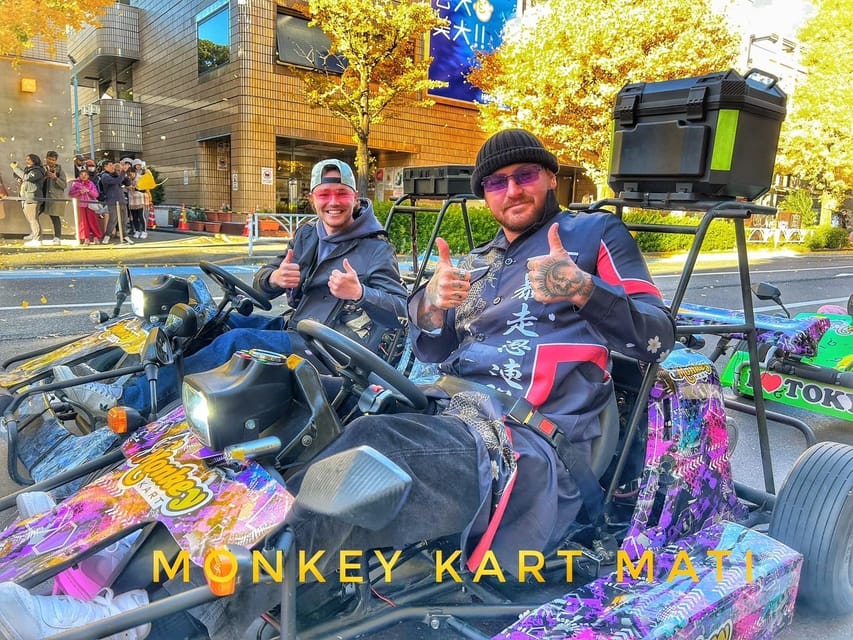
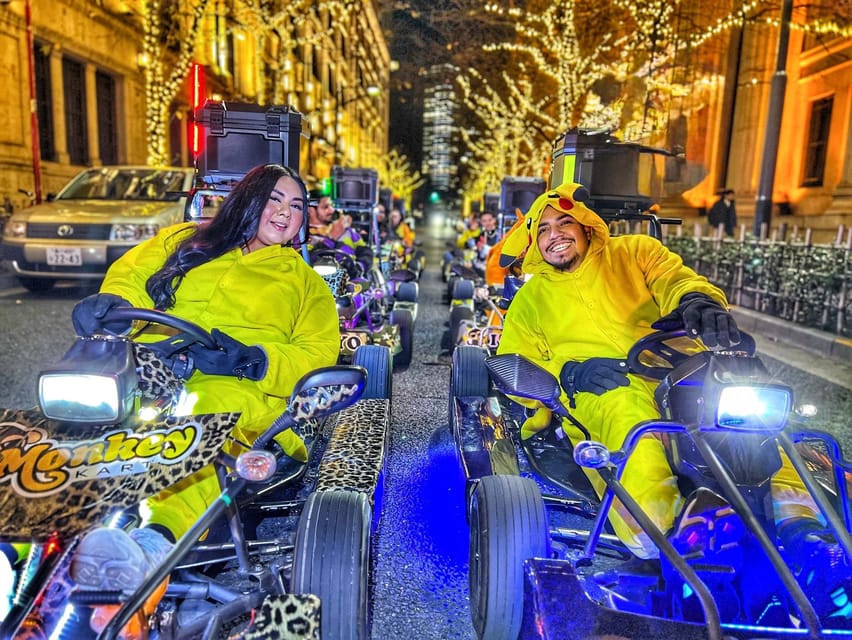
Before departure, you can select a costume. The exact selection may vary, but the dress-up option is one of the tour’s most popular touches. It adds color to the photos and makes the karts easy for pedestrians to notice. You might get waves and thumbs-up from people along the route, though you should still remember that this is a public road experience, not a performance arranged for spectators.
The guide leads from the front and sets the pace. English is the tour language, and guides such as Adam, Hannah, Shoma, Brandon, Louis, and Matias have been praised for clear instructions, good humor, and calm handling of nervous drivers. The guide also points out key sights and takes photos at suitable points.
A few more options to weigh up in Tokyo
- Tokyo Disney Resort – Tokyo Disneyland & Tokyo DisneySea Park Tickets
★ 4.8 · 99,488 reviews - SHIBUYA SKY Ticket
★ 4.7 · 46,509 reviews - JR Whole Japan Rail Pass
★ 4.8 · 29,150 reviews
Asakusa gives the ride its old Tokyo flavor
Asakusa is the most traditional part of this route. From the kart, you do not get the slow, quiet look you would have on foot, but you do get a quick sense of how old Tokyo and modern traffic share the same streets.
The area is known for its temples, traditional streets, and strong connection to Tokyo’s past. The kart route does not replace a walking visit to Asakusa, but it gives you a different angle. You see the district as part of a working city, with local roads, traffic signals, shopfronts, and pedestrians all moving around you.
That contrast is part of the fun. A person in a costume, seated in a small open kart, passing through one of Tokyo’s older districts is not an everyday sight. The experience can feel amusing without requiring you to spend the whole day at a formal attraction.
The trade-off is that sightseeing can be brief. You are following the group and concentrating on traffic, so you will not stop to study temple details or browse shops. I would plan a separate visit to Asakusa if you want proper time for the district’s major sights.
Tokyo Skytree is the route’s big visual marker
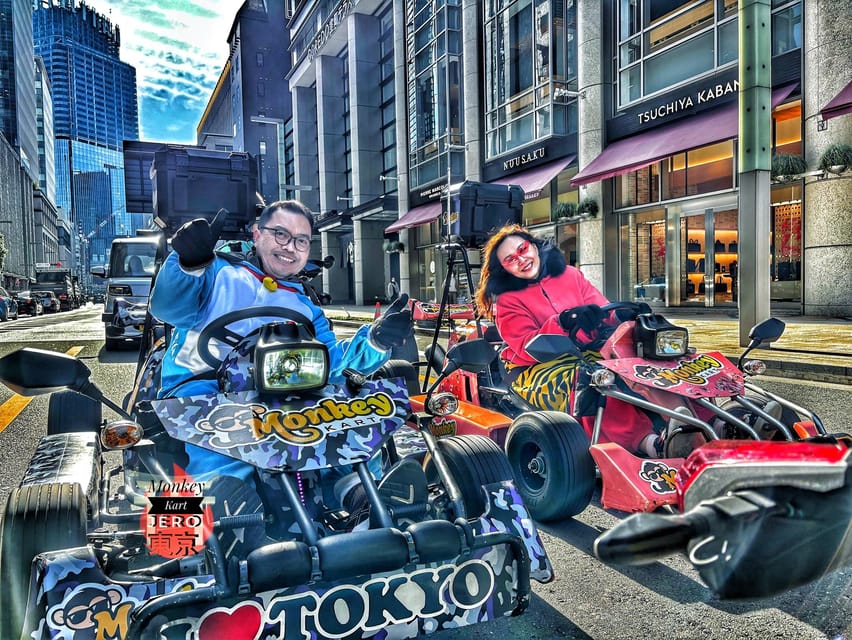
Tokyo Skytree Town is listed as the main photo stop and sightseeing point. The tower provides an unmistakable reference point as you ride through the area, and it gives the guide a strong backdrop for group photos.
From street level, Skytree feels different from a viewing deck visit. You are not looking out over Tokyo from above. Instead, you are passing beneath the huge structure and seeing how it rises over the surrounding streets. That scale is especially striking when the tower is visible beyond the smaller buildings.
The route may include a brief stop or a pass-by rather than a long visit inside Tokyo Skytree Town. Do not book this expecting admission to the tower, time on the observation decks, or a full shopping visit. The value here is the moving view and the chance to have the guide photograph you with the tower nearby.
Sunset can make this portion especially attractive. The provided schedule allows different starting times, and several participants preferred around 4 p.m. for the shift from daylight to evening lights. Exact sunset timing changes with the season, so check available departure times when you book.
Akihabara adds the color and pop-culture energy
Akihabara brings a sharp change in mood. The district is famous for electronics, anime, manga, games, and character culture. Even if you are not shopping, its signs and bright streets give the ride a lively finish.
The costume option fits naturally here. Dressing as a favorite character can make the Akihabara section feel like part of the setting rather than a separate activity. It also gives your photos a clear Tokyo pop-culture feel.
Again, the kart ride is a moving tour. You will see the district from the road, but you will not have time to stop at stores or explore arcades. I would schedule Akihabara shopping before or after the tour, leaving enough time to return to the meeting point without rushing.
The route is also a good choice if you have already visited Tokyo’s major sights from buses and trains. You are not simply ticking off another viewpoint. You are seeing the city at traffic level, with the sounds, air, and pace of the street around you.
A completely different kind of day out:
- Mt Fuji and Hakone 1-Day Bus Tour Return by Bullet Train
★ 5.0 · 26,383 reviews - TOKYO SKYTREE® Ticket
★ 4.7 · 25,136 reviews - teamLab Borderless Tickets: MORI Building DIGITAL ART MUSEUM
★ 4.7 · 24,126 reviews - teamLab Planets TOKYO Ticket
★ 4.7 · 21,663 reviews
The driving feels exciting, but the guide matters most
The karts are custom-built and street-legal. They are described as well maintained, large, and comfortable, and water is included. An action camera or Insta360 mount is also provided, so you can attach suitable equipment if available.
The strongest part of the setup is the guide system. You follow a lead driver through the route rather than trying to navigate Tokyo alone. Guides have been praised for helping first-time kart drivers, calming anxious participants, and keeping an eye on the whole group.
You still need to stay alert. One participant found the guide’s hand signals hard to see from three karts back. That is useful advice for you: keep a safe view of the lead guide, pay close attention during the briefing, and do not treat the ride like a free-for-all.
The group size is capped at eight. That is small enough to feel organized, though a full group may still stretch out in traffic. The tour is paced for sightseeing and safety, not speed. You get the thrill of driving through Tokyo, but the guide’s instructions come first.
Some participants chose to return for both morning and night rides. The morning gives you a clearer look at the districts, while evening offers illuminated streets and a stronger sense of Tokyo after dark. You do not need to book both, but timing will shape the mood of the experience.
Photos are a real part of the value
The guide takes photos at key points throughout the ride. After returning to the starting point, the images are shared by AirDrop or email, and one hard-copy photo is included.
This is more useful than it may sound. You cannot safely hold a phone and photograph yourself while driving, and stopping to manage a camera would break the flow of the group. Having the guide handle the pictures lets you focus on the road.
Several participants specifically praised the number and quality of the photos. Guides including Julian, Ken, Jerome, and Adam were singled out for choosing good photo moments. The costume makes the pictures more memorable, while Skytree and the city streets provide recognizable backgrounds.
The action-camera mount is a nice extra, but it is not the same as having a camera supplied with a full battery. One participant advised checking the charge before using a GoPro. If you bring your own camera, make sure it is secure and follow the staff’s directions.
Is $96 a fair price?
At $96 per person, this is not a cheap way to move around Tokyo. Local trains and walking will show you more of the city for far less money. A standard sightseeing bus may also provide more commentary and a longer view of the urban layout.
The price makes more sense if you value the activity itself. You are paying for the kart, guide, safety briefing, costume, water, photos, one printed image, and a small group capped at eight. You also get an unusual route through several well-known districts without arranging your own transport between them.
The photo service adds practical value, especially for couples and groups. You leave with images of the experience rather than relying only on quick phone snapshots. For a birthday, first visit, or special evening, the cost may feel reasonable.
I would not choose this as your main Tokyo sightseeing tour. It is better understood as a memorable activity that includes sightseeing. If you want detailed cultural explanation, long stops, or time inside attractions, spend your money elsewhere and visit these districts on foot.
Who should book, and who should skip it?
This tour suits adults over 18 who hold the required driving documents and want something lively. Couples, groups of friends, repeat visitors, and families with adult children can all find something to enjoy here.
It can also work well for nervous beginners. The guide’s instruction and the small group help, and several people who had never driven a go-kart felt comfortable after the briefing. You should still be honest with yourself about driving on public roads.
You should skip it if you are pregnant, weigh more than 331 pounds or 150 kilograms, or are taller than 5 feet 9 inches or 180 centimeters. The listed restrictions are unusually specific, so check them before paying.
Rain can cause the tour to be rescheduled. Tokyo weather can change quickly, and an open kart is not a pleasant place in wet conditions. Keep some flexibility in your schedule if the forecast looks poor.
The license rules can make or break your booking
This is the most important practical point. Many drivers need a hard-copy paper booklet of a 1949 Geneva Convention International Driving Permit issued by the official agency in their home country, such as AAA, AA, CAA, or another approved organization.
An online permit, digital image, or soft copy is not valid. A 1968 Vienna Convention permit is not recognized for this purpose, and permits issued by FIA, IDA, or IAA are also not recognized according to the supplied rules.
Drivers from France, Switzerland, Taiwan, Germany, Monaco, and Belgium need a Japanese translation of their local license. The physical translation can be obtained through the Japan Automobile Federation, known as JAF.
The information also specifically warns that permits from Indonesia, Pakistan, Saudi Arabia, Mexico, Brazil, Costa Rica, Colombia, Kuwait, Qatar, and some other countries may not be accepted. Check your country’s exact position before booking, and obtain the correct documents before leaving home.
Bring your international driving license and arrive 20 minutes early. Alcohol, drugs, and intoxication are not allowed. These are legal and safety requirements, not minor tour preferences.
Should you book this Tokyo go-kart experience?
Book it if you want a fun, photo-friendly way to see Tokyo from the road, and if you already have the correct driving permit. The combination of Asakusa, Skytree, Akihabara, costumes, and a small group gives the outing a clear personality.
I would choose a late-afternoon departure when possible, especially if you want daylight views followed by city lights. Expect a guided ride rather than a race, and plan separate walking time for Asakusa, Skytree Town, and Akihabara.
Skip it if you want quiet sightseeing, detailed historical commentary, or a low-cost way to get around. For everyone else who meets the license and physical requirements, $96 buys a distinctive Tokyo memory, with the photos to prove it.
FAQ
Where does the tour start?
The meeting point is at 4-chōme-9-9 Yokokawa, about a seven-minute walk from Oshiage Station.
How long does the go-kart experience last?
The tour lasts 70 minutes, including the guided city ride and sightseeing time.
Which Tokyo areas does the route cover?
The route includes Asakusa, the Tokyo Skytree area, and Akihabara.
Is Tokyo Skytree admission included?
No tower admission or observation-deck visit is listed. Tokyo Skytree Town is used for sightseeing and a photo stop.
What language does the guide speak?
The live tour guide speaks English.
How many people can join the tour?
The activity is limited to eight participants.
What driving document do I need?
Most drivers need a hard-copy paper booklet of a 1949 Geneva Convention International Driving Permit issued by the official agency in their country.
Are digital copies of permits accepted?
No. Online or soft copies of driving permits are not valid for this activity.
Do drivers from France, Switzerland, Taiwan, Germany, Monaco, and Belgium need anything else?
Yes. Drivers with licenses from those places need a Japanese translation of their local license, available as a physical copy through JAF.
What happens if it rains?
The tour may be rescheduled because of rain.
Are costumes and photos included?
Yes. A costume, a photoshoot, shared tour photos, and one hard-copy photo are included. Water and an action-camera or Insta360 mount are also included.
Just added in Tokyo
- Private Nippori Fabric Town Walking Tour★ 5.0 · 21 reviews
- Official Street Go Kart Tour Akihabara 2nd★ 5.0 · 19 reviews
- Nikko Private Day Tour – Temples, Nature & Hidden Gems★ 5.0 · 41 reviews
- Ninja Wire Action Experience★ 5.0 · 29 reviews
- Nikko one day trip GREEN NUMBER PLATES★ 4.5 · 47 reviews
- Nikko Private Tour from Tokyo with Licensed Guide and Vehicle★ 4.5 · 15 reviews
- Nikko Toshogu, Kegon waterfall, Lake Chuzenji One Day Pvt. Tour★ 5.0 · 22 reviews
- Nikko Private Day Tour with Guide by Car (from Tokyo)★ 4.0 · 16 reviews
Go-Karts, compared.
Flagship 2-Hours Official Street Go-Kart Tour – Tokyo Bay Shop
Read our review →
Shibuya Go Karting Experience by Akiba Kart Shibuya
Read our review →
Tokyo Go Kart: Asakusa, Skytree, and Akihabara **IDP MUST**
Read our review →
Shibuya Official Street Go-Kart in Shibuya Annex
Read our review →Browse the lists this tour appears in