Reviewed · TOKYO TOURS
Daikoku Car meet: Tokyo Drift Car Club membership
Tokyo’s car culture runs after dark. This four to five-hour outing links Akihabara, the Wangan Bayshore route, and Daikoku Parking Area in one memorable evening, with transport included and a chance to ride in a Japanese performance car. I like the convoy feel and the direct access to a car meet that is awkward to reach on your own.
I also like the stop at A-PIT Super Autobacs, where you can browse Japanese car parts, magazines, clothing, and small souvenirs. The main consideration is that your exact car is not guaranteed, and one poor booking experience involved a van instead of the promised sports car. I would confirm the vehicle and group arrangements before paying.
In This Review
- Key points to know before you book
- Why Daikoku Parking Area matters to car fans
- Starting in Akihabara with the right expectations
- Riding the Wangan Bayshore route
- Crossing Rainbow Bridge after dark
- A-PIT Super Autobacs: a useful 30-minute stop
- The two-hour visit at Daikoku
- Tokyo Tower for a final photo
- What the $171.93 price gets you
- Who will enjoy this most
- Should you book the Daikoku car meet?
- FAQ
- Where does the experience start and finish?
- How long does the experience last?
- What kind of car will I ride in?
- Is entry to Tokyo Tower included?
- Is transport included?
- What happens if the weather is poor?
Key points to know before you book
- Daikoku is the main event: You get about two hours at one of Japan’s best-known gathering spots for modified cars and sports cars.
- The ride is part of the attraction: Depending on the guide and availability, you might ride in a Silvia S15, Toyota Chaser, V8 Mustang, or another enthusiast car.
- The route has real car-culture meaning: The Wangan Bayshore route is tied to Japan’s famous Midnight Club street-racing story.
- Super Autobacs adds a useful shopping stop: You have about 30 minutes to browse parts, accessories, magazines, clothes, and gifts.
- Tokyo Tower is a photo stop only: You will not go inside or visit the observation decks.
- The group is limited to 12 people: That keeps the outing smaller, though the experience can still vary by vehicle and guide.
Why Daikoku Parking Area matters to car fans
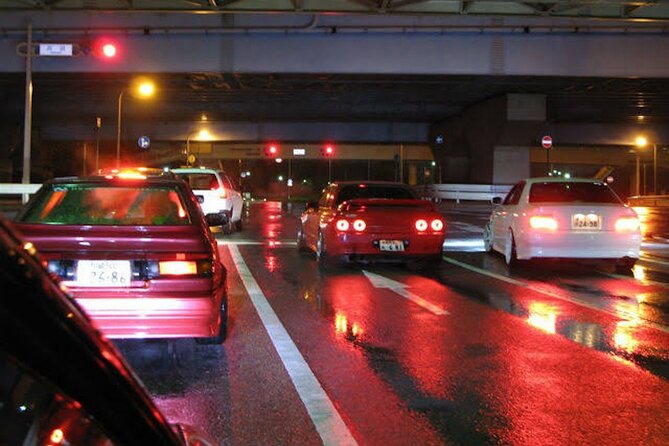
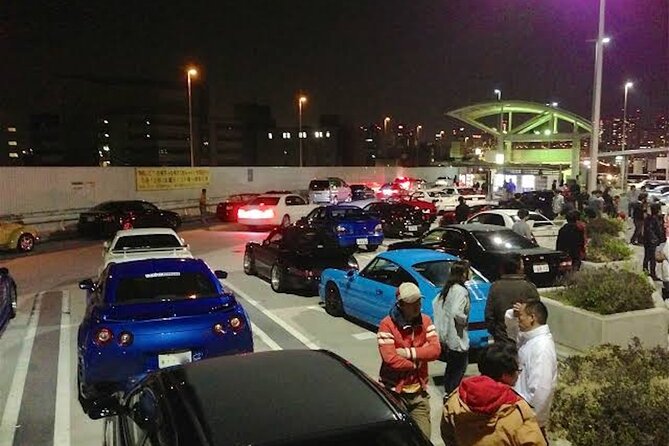
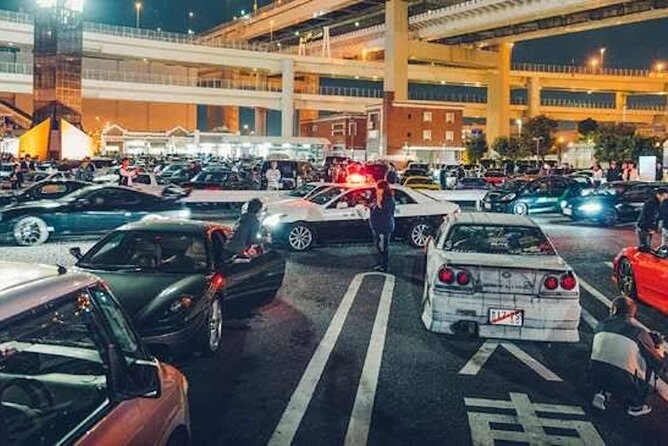
Daikoku Parking Area is not simply a highway rest stop with vending machines. For Japanese car enthusiasts, it is a meeting point where owners bring carefully maintained, modified, and often rare cars. The appeal comes from the steady change in what is parked there. You may find JDM sports cars, tuned sedans, American performance cars, and unusual builds sharing the same rows.
The experience gives you roughly two hours at Daikoku, which is the right amount of time for looking around, taking photographs, and watching cars arrive and leave. A shorter visit would feel rushed. A much longer visit could become repetitive unless you are deeply focused on specific models.
The setting also gives the evening a sense of occasion. You are not looking at cars in a museum or a staged display. The cars are part of an active meeting place, and the people bringing them are there for their own reasons. That makes the atmosphere more genuine, though it also means no one can promise a particular model or a packed parking area.
The strongest evenings seem to come on Saturdays and in good weather. One especially busy Saturday produced a full Daikoku lot and a steady stream of cars. That is useful guidance, but it is not a guarantee. Weather, timing, and the wider car scene will affect what you see.
A few more options to weigh up in Tokyo
- Tokyo Disney Resort – Tokyo Disneyland & Tokyo DisneySea Park Tickets
★ 4.8 · 99,488 reviews - SHIBUYA SKY Ticket
★ 4.7 · 46,509 reviews - JR Whole Japan Rail Pass
★ 4.8 · 29,150 reviews
Starting in Akihabara with the right expectations
The meeting point is Tully’s Coffee at Akihabara UDX, at 4-chōme 14-1 Sotokanda, Chiyoda City, Tokyo 101-0021. Akihabara is an easy place to reach by public transport and gives you plenty to do before the outing begins.
This part of Tokyo is famous for electronics, manga, anime, games, trading cards, and maid cafés. Yodobashi Multimedia Akiba covers many floors, while Radio Kaikan is known for toys, collectibles, and hobby goods. If you arrive early, you can make Akihabara a small pre-tour stop rather than waiting around the coffee shop.
The meeting point itself is practical, but you should pay attention to the exact location inside the Akihabara UDX complex. Tokyo stations and commercial buildings can be confusing, especially if you are carrying shopping bags or arriving during a busy evening period.
The activity ends back at the same meeting point. That is helpful if you have left luggage at your hotel or want to continue your night in central Tokyo. It also means you do not need to arrange a separate return from Daikoku, which is one of the main practical benefits of booking this experience.
Riding the Wangan Bayshore route
The Wangan, or Bayshore route, is more than a long stretch of highway. In Japanese car culture, it is connected with the old Midnight Club and the high-speed racing stories that helped make the road famous among enthusiasts.
You will pass along the Wangan during the drive to and from Daikoku. The road time matters because the outing is not just a transfer followed by a parking-lot visit. The drive gives you the chance to see Tokyo from a car enthusiast’s point of view, with the city lights, expressways, bridges, and waterfront areas forming the backdrop.
The exact driving style depends on the guide and the car. One booking described repeated hard driving in a comfortable V8 Mustang, with an English-speaking driver named Kaito, or possibly Keito. Another person described a private sports-car ride as the best part of the evening. These details show why the vehicle assignment matters so much to the experience.
At the same time, you should not assume every ride will feel like a high-performance demonstration. Cars vary, guides vary, and traffic affects the route. The activity is best understood as a car-culture outing with an exciting ride, not as a guaranteed racing session.
The operator should also follow Japanese road laws. You are there to enjoy the cars, the route, and the atmosphere, not to take part in illegal racing. That distinction matters, especially because the Wangan’s reputation comes partly from stories of past street racing.
Crossing Rainbow Bridge after dark
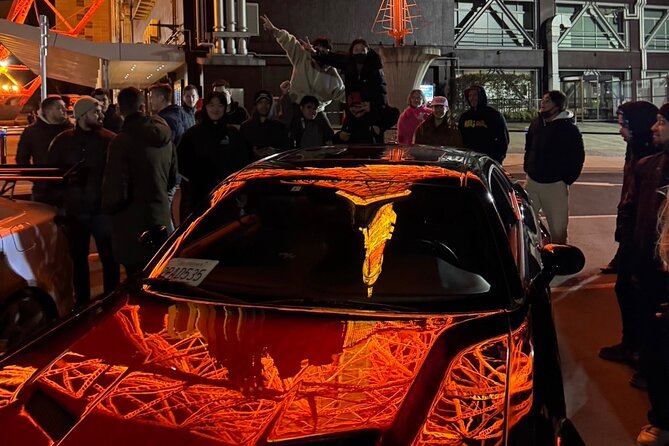
Rainbow Bridge is one of the visual highlights of the route. The suspension bridge links Odaiba with central Tokyo and has been part of the city’s evening skyline since opening in 1993.
You pass across the bridge, but this is not a dedicated photo stop. That detail is easy to miss, so keep your camera ready while the car is moving, and do not expect time to get out. The bridge is also featured often in Japanese films, television dramas, photos, and videos, which adds to its appeal for anyone interested in Tokyo’s modern image.
The bridge crossing works best as part of the drive rather than as a separate attraction. You get the view, the lights, and the sense of moving through Tokyo’s waterfront districts, but you do not get a long stop or a guided explanation at the bridge.
A completely different kind of day out:
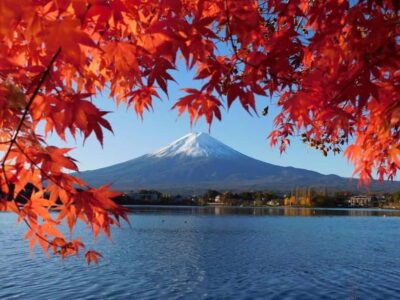
- Mt Fuji and Hakone 1-Day Bus Tour Return by Bullet Train
★ 5.0 · 26,383 reviews - TOKYO SKYTREE® Ticket
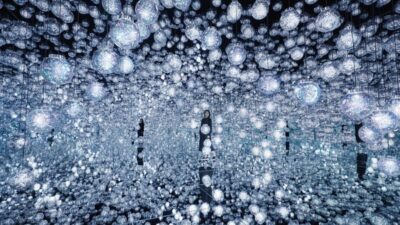
★ 4.7 · 25,136 reviews - teamLab Borderless Tickets: MORI Building DIGITAL ART MUSEUM
★ 4.7 · 24,126 reviews - teamLab Planets TOKYO Ticket
★ 4.7 · 21,663 reviews
A-PIT Super Autobacs: a useful 30-minute stop
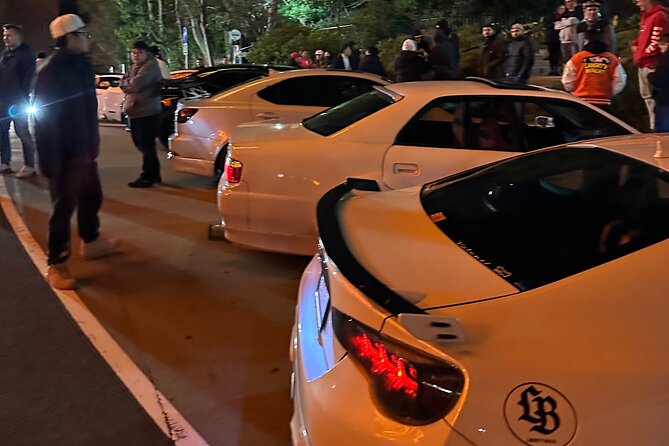
A-PIT Super Autobacs is Japan’s largest auto parts and accessories shop, and it gives the outing a welcome change of pace. You have about 30 minutes to look around, get coffee, and browse the kind of products that are difficult or expensive to find outside Japan.
The shop is a hangout for owners of Japanese domestic-market cars. People come here for maintenance parts, accessories, clothing, and car-care products. You might also find key chains, stickers, magnets, and other small gifts that pack easily into luggage.
Car magazines are especially worth a look. Japanese automotive magazines can be hard to find overseas and may cost much more when imported. If you collect them, this is one of the few stops where you can browse a broad selection in their original market. Check your baggage space before buying in bulk.
Thirty minutes is enough for a focused visit, but not enough for a relaxed inspection of a large shop. I would decide in advance what interests you most: magazines, model-specific parts, clothing, or souvenirs. If you do not care about automotive merchandise, the stop may feel less important than it does to a serious enthusiast.
Admission is free, but transport is included, so you are not trying to reach the shop independently. That saves time and keeps the evening moving.
The two-hour visit at Daikoku
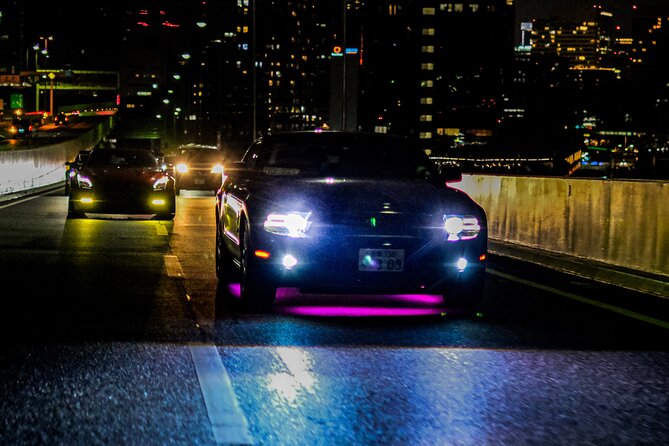
Daikoku is where the experience earns its price. You are taken directly to the parking area for about two hours, with admission included. The long stop lets you inspect cars at a natural pace instead of rushing through a quick photo opportunity.
The most enjoyable approach is to treat the parking area like a changing street exhibition. Look at the details owners have chosen, compare different generations of Japanese cars, and watch the flow of vehicles through the lot. The group setting also makes it easier to meet other car fans from different countries.
The outing is particularly well suited to people who know what they are seeing. If you can identify a Silvia, Chaser, Skyline, or other performance model, you will get more from the visit. You do not need to be an expert, though. The range of cars and the setting provide plenty to look at even if you simply appreciate design and engineering.
The main limitation is that Daikoku is an active public parking area, not a private car show. Cars may come and go during your visit. The selection can be excellent one night and more ordinary the next. A full Saturday evening in good weather offers the best chance of seeing the scene at its busiest, but the experience cannot control who shows up.
You should also keep your expectations realistic about guide commentary. One booking praised the ride but noted that the guide did not speak to the group continuously and that language differences were noticeable. This is more of a shared outing than a nonstop lecture. The real focus is the drive, the cars, and time at Daikoku.
Tokyo Tower for a final photo
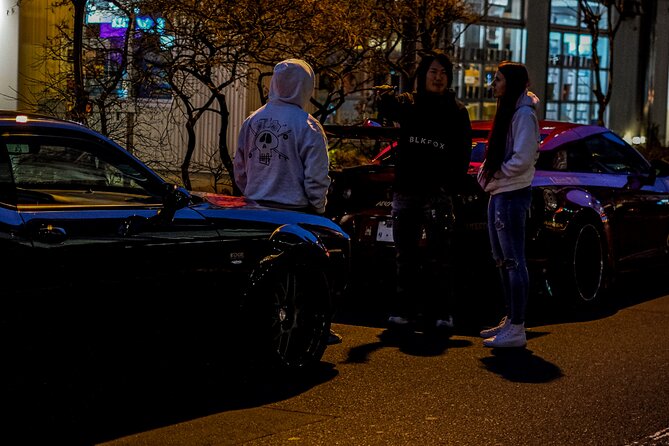
The last major stop is outside Tokyo Tower. You get around 20 minutes for photographs, but admission to the tower is not included and you will not go inside.
At 333 meters, Tokyo Tower is one of the city’s best-known symbols. It was completed in 1958 as a broadcasting tower and remained Japan’s tallest structure until Tokyo Skytree surpassed it in 2012. Its red and white frame is particularly effective in evening photographs.
Twenty minutes is enough for group photos and a few individual shots if the area is not crowded. It is not enough for a tower visit, museum time, or a leisurely look around the surrounding district. Think of this as a closing picture stop that adds a classic Tokyo image to an evening centered on cars.
This stop also helps balance the program. Daikoku serves the enthusiast, while Tokyo Tower gives companions who are less interested in modified cars a familiar city landmark. Still, anyone expecting tower tickets or an observation-deck visit should know that those are not part of the plan.
What the $171.93 price gets you
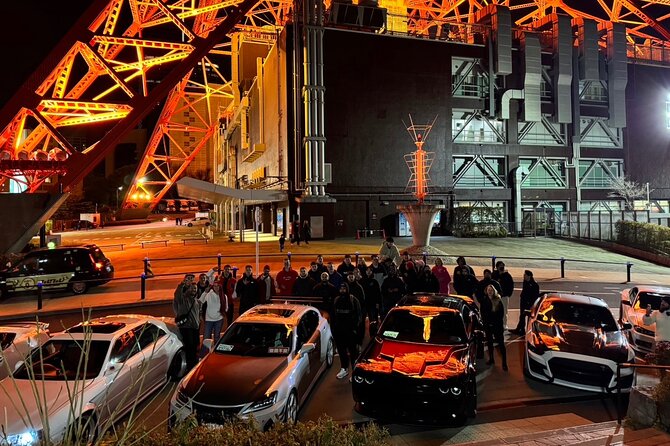
At $171.93 per person, this is not a cheap sightseeing ride. You are paying for a niche experience that combines transport, a car-focused route, access to Daikoku, a Super Autobacs stop, and a Tokyo Tower photo stop in about four to five hours.
The value is strongest if you would otherwise struggle to reach Daikoku. The parking area is not a simple central-Tokyo attraction, and arranging transport, finding the right route, and knowing when to go can take effort. The included ride also gives you a way to experience the Wangan without spending the evening on trains or taxis.
The price feels less attractive if you mainly want to shop at Autobacs or photograph Tokyo Tower. Both stops are short, and Tokyo Tower entry costs extra. The purchase makes sense because of the car ride and Daikoku, not because of the landmarks alone.
Vehicle assignment is the biggest value question. The experience may use a Silvia S15, Toyota Chaser, V8 Mustang, or another enthusiast car, depending on the guide. One serious complaint described a family of five being placed in a van despite expecting sports cars. That appears to be an exception, but it is an important warning. If the specific car is central to your decision, contact the operator before booking and ask what vehicle is planned for your date.
A maximum group size of 12 is another useful detail. It is small enough to feel more personal than a large bus tour, although the number of cars in the convoy and the seating arrangement can still vary.
Who will enjoy this most
I would recommend this to a car enthusiast who wants to see Tokyo through its expressways, parking areas, and owner community rather than only through major landmarks. It is especially appealing if you recognize JDM models, enjoy photography, or want to ride in a performance car while meeting like-minded people.
It can also work for a couple or small group with mixed interests. The Rainbow Bridge and Tokyo Tower provide familiar city sights, while the car culture supplies the main theme. The outing may be less satisfying for someone who wants detailed historical commentary, a fixed schedule of attractions, or a guaranteed particular vehicle.
You need a moderate level of physical fitness. The activity includes moving around at stops and spending a long evening away from the starting point. The total four to five hours includes driving time, so the pace is not four to five hours of sightseeing on foot.
The experience requires good weather. If poor weather causes cancellation, you are offered another date or a full refund. You can cancel for a full refund up to 24 hours before the start time, but changes or cancellations inside that window are not refunded.
Should you book the Daikoku car meet?
Book it if the ride and Daikoku are your priorities. The two-hour parking-area visit, Wangan route, convoy atmosphere, and included transport give you something difficult to arrange alone. The best version includes a car you are excited to ride in and a busy evening at Daikoku.
Before booking, ask about the expected vehicle, seating, and departure arrangements. Do not assume the Silvia S15 or Toyota Chaser will be available, and do not treat the Tokyo Tower stop as an entrance visit.
I would skip it if you want a standard sightseeing tour with constant guide narration or guaranteed access to a specific attraction. For the right enthusiast, though, this is a focused and memorable way to spend an evening in Tokyo, with the strongest value coming from the driving and the car meet rather than the short landmark stops.
FAQ
Where does the experience start and finish?
It starts and ends at Tully’s Coffee in Akihabara UDX, located at 4-chōme 14-1 Sotokanda, Chiyoda City, Tokyo 101-0021.
How long does the experience last?
The total duration is approximately four to five hours, including travel time.
What kind of car will I ride in?
The vehicle depends on the guide. Possible cars include a Silvia S15 or Toyota Chaser, while other bookings have included cars such as a V8 Mustang. A specific vehicle is not guaranteed in the provided details.
Is entry to Tokyo Tower included?
No. The Tokyo Tower stop is for photographs outside the tower only, and admission tickets are not included.
Is transport included?
Yes. Transport is included, including the drive to Daikoku Parking Area and the other stops.
What happens if the weather is poor?
The experience requires good weather. If it is canceled because of poor weather, you can choose another date or receive a full refund. You can also cancel at least 24 hours before the start time for a full refund.
Just added in Tokyo
- Mt. Fuji & Hakone: Fuji Sengen Shrine, Cruise, and Ramen-Making★ 5.0 · 124 reviews
- Daruma Workshop by Making your Own Japanese Souvenir in Shinjuku★ 5.0 · 25 reviews
- Day Trip to Kamakura & Enoshima: Shrines, Seaside, Temples & Tea★ 5.0 · 32 reviews
- DAIKOKU excursion by car DRIFT automobile encounter★ 4.5 · 19 reviews
- Real Tokyo Runner Club : Daikoku Car Meet Night Tour with JDM Car★ 5.0 · 25 reviews
- Tokyo Toilet Tour★ 5.0 · 18 reviews
- Tokyo Private Tour with Customized Itinerary★ 5.0 · 24 reviews
- Cosplay Experience with Professional Makeup and Photo Shoot!★ 5.0 · 19 reviews
Tokyo Tours, compared.
Tokyo Disney Resort – Tokyo Disneyland & Tokyo DisneySea Park Tickets
Read our review →
Mt Fuji and Hakone 1-Day Bus Tour Return by Bullet Train
Read our review →
teamLab Borderless Tickets: MORI Building DIGITAL ART MUSEUM
Read our review →