
Reviewed · GO-KARTS
GINZA: Go Kart Experience with NEO GINZA
Tokyo looks different from a go-kart. This one-hour NEO GINZA ride puts you on open-air streets around Tokyo Tower, Ginza, and the Imperial Palace, with two guides keeping the group together and stopping for photos. I like the small maximum of six people, and I like that the guides do more than point the way. Patrick, praised for his friendly storytelling and Tokyo tips, is one of the hosts you may meet. The main catch is simple: you must arrive with the correct Japanese driving documents, or you cannot take the wheel.
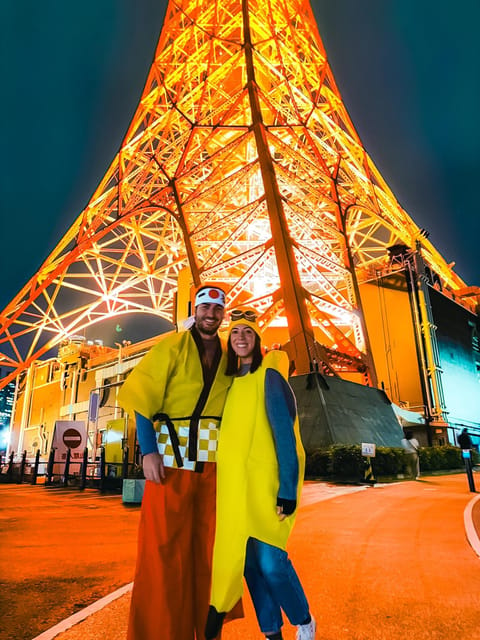
I also like the costume choice. You can turn a regular city drive into a playful photo session, and the guides send the pictures to you afterward. Night departures add glowing Tokyo Tower and a more theatrical city feel, but daytime may suit you better if clear views matter more than neon and evening atmosphere.
In This Review
- Key things to know before you book
- Why this Ginza go-kart ride is different
- Starting at Shintomicho 1-chome
- Zojo-ji Temple: a calm first landmark
- Tokyo Tower: the big photo moment
- The Imperial Palace Outer Gardens: open space in central Tokyo
- Tokyo Station: a grand urban backdrop
- Kabuki-za: finishing in Ginza
- Costumes, photos, and the playful side
- What the guides add
- Is $64 good value for one hour?
- Day or night: choosing the right departure
- Who should book this ride?
- Documents and rules you must handle first
- FAQ
- How long does the NEO GINZA go-kart experience last?
- What landmarks does the route pass?
- Is the tour available in English?
- How many people can join the group?
- What documents do I need to drive?
- Can people under 18 join?
- Are costumes and photos included?
- Should you book the NEO GINZA go-kart ride?
Key things to know before you book
- You drive past five major Tokyo sights: Zojo-ji Temple, Tokyo Tower, the Imperial Palace Outer Gardens, Tokyo Station, and Kabuki-za.
- The group is limited to six participants: Two staff members guide the ride, which helps keep the outing personal and controlled.
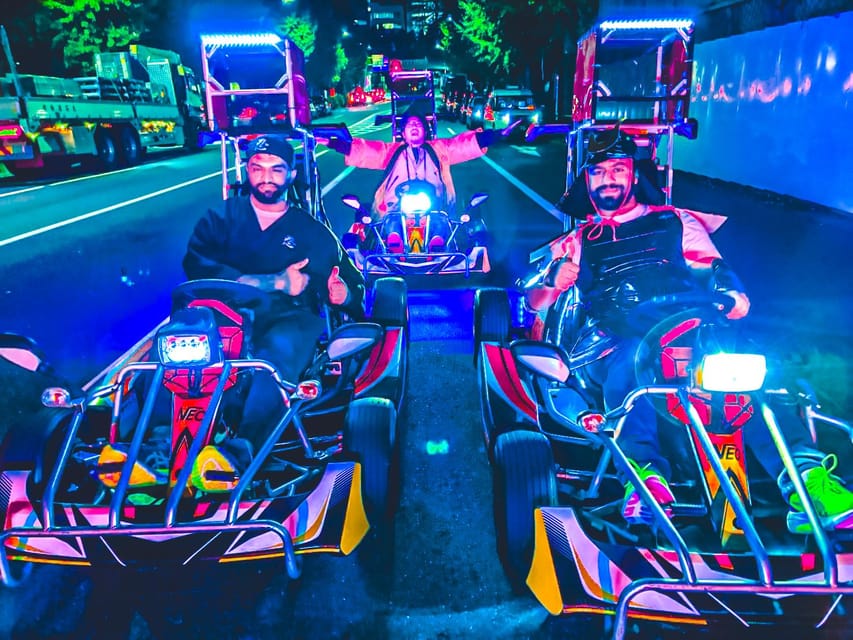
- Costumes are included: Choose a fun outfit before heading out for extra photos and plenty of attention from people along the route.
- The tour lasts exactly one hour: It is a compact sightseeing activity, not a full-day city tour.
- Your driving paperwork matters: Bring your physical passport and a valid International Driving Permit, or the required Japanese translation for certain licenses.
- The best value is the combination: You pay $64 per person for the kart, guides, insurance, costume, and photo service.
Why this Ginza go-kart ride is different
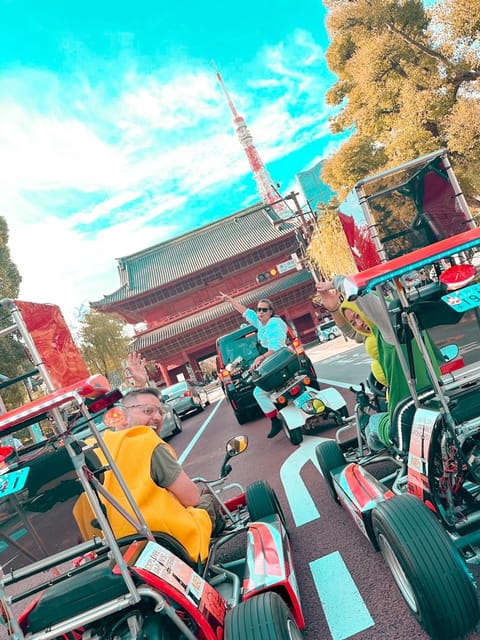
Most Tokyo sightseeing happens at walking speed, behind a train window, or from a bus seat. This ride gives you a low, open view of the city and lets you move through the streets as part of the scene. You are not simply looking at Tokyo from a distance. You are driving through it, with the city lights, buildings, traffic, and signs around you.
That makes the outing fun, but it also makes it less polished than a standard sightseeing tour. You will not spend ten minutes inside each landmark. Zojo-ji Temple, Tokyo Tower, the Imperial Palace area, Tokyo Station, and Kabuki-za are mainly seen while passing by, with photo stops along the way.
The route is designed for a quick taste of central Tokyo. You get several famous sights in one hour, but the pleasure comes from the movement between them. The two guides add structure, point out places, help the group stay together, and take pictures at suitable stops.
The small-group limit is important. With no more than six participants, you are less likely to feel lost in a long line of karts. Two staff members can focus on driving guidance, safety, and photos instead of trying to manage a large crowd.
A few more options to weigh up in Tokyo
- Tokyo Disney Resort – Tokyo Disneyland & Tokyo DisneySea Park Tickets
★ 4.8 · 99,488 reviews - SHIBUYA SKY Ticket
★ 4.7 · 46,509 reviews - JR Whole Japan Rail Pass
★ 4.8 · 29,150 reviews
Starting at Shintomicho 1-chome
The ride begins at the Shintomicho 1-chome Building, written in the provided meeting information as 新富町一丁目ビル. You return to the same place at the end, so this is a simple out-and-back outing rather than a one-way city transfer.
Plan to arrive ready to drive. You need your physical passport or ID card and the proper driving permit. Your domestic license alone is not enough for most participants.
The dress rules are practical. High heels and slippers are not allowed, and you should wear shoes that give you firm control of the pedals. Cellphones are also not allowed during the driving portion, so do not plan to navigate, film, or answer messages from the kart.
Alcohol and drugs are prohibited. That may sound obvious, but it matters here because you are driving on public roads. You need to be alert, properly documented, and ready to follow the guides’ instructions.
Zojo-ji Temple: a calm first landmark
Zojo-ji Temple gives the route a strong opening. The temple is one of the best-known religious sites in the Tokyo Tower area, and its traditional setting contrasts sharply with the modern streets and tall buildings around it.
You pass by with a guide and have a chance for a photo stop. Do not expect a long temple visit or time to explore the grounds. The value here is visual: old Tokyo meets new Tokyo in a single stop.
From the kart, you can take in the change of mood without leaving the route. One moment the ride feels like a playful city cruise, and the next you are looking toward a major temple complex. If you want to visit Zojo-ji properly, save a separate visit for another part of your day.
Tokyo Tower: the big photo moment
Tokyo Tower is likely the most memorable landmark on the route. The karts pass by and, according to the route details, may go under or near the tower area. The guides stop for sightseeing and photos, giving you a chance to pose with one of Tokyo’s most recognizable structures behind you.
Night rides have a clear advantage here. The tower is lit after dark, and the effect makes the costume photos more dramatic. Several riders chose evening departures specifically for Tokyo at night and felt the glowing tower added something special to the hour.
Daytime has its own benefit. You may get a clearer look at the tower and surrounding streets, especially if you care more about seeing details than creating a night-time city scene. The choice comes down to mood: day for clearer sightseeing, night for lights and atmosphere.
The guide’s photo service is especially useful at this stop. You cannot safely use your cellphone while driving, and there is no need to ask a stranger to frame a hurried picture. The staff takes photos along the way and shares them afterward.
A completely different kind of day out:
- Mt Fuji and Hakone 1-Day Bus Tour Return by Bullet Train
★ 5.0 · 26,383 reviews - TOKYO SKYTREE® Ticket
★ 4.7 · 25,136 reviews - teamLab Borderless Tickets: MORI Building DIGITAL ART MUSEUM
★ 4.7 · 24,126 reviews - teamLab Planets TOKYO Ticket
★ 4.7 · 21,663 reviews
The Imperial Palace Outer Gardens: open space in central Tokyo
The route continues toward the Imperial Palace Outer Gardens. This section gives you a break from the close streets of Ginza and a look at one of central Tokyo’s broad public areas.
The gardens are not a full palace tour. You pass through the outer area, take in the views, and continue by kart. That distinction matters if you are hoping to see palace interiors or spend time walking among the grounds. This activity offers a drive-by view, not a formal palace visit.
Still, the stop adds variety. The route is not only neon signs and commercial streets. You get temple architecture, a famous tower, government-area surroundings, and historic central-city spaces in a short loop.
Tokyo Station: a grand urban backdrop
Tokyo Station provides another strong photo setting. The station area is one of the city’s key transport and business centers, and the contrast between the station’s formal architecture and your costume-clad kart makes for a playful picture.
You pass by with a scenic view and a guided stop. The timing is brief, so you will not enter the station or explore its underground shopping and food areas. Think of this as a quick visual encounter that adds another side of central Tokyo to the route.
The open-air format helps here. From inside a bus, your view can be blocked by windows, seats, or other vehicles. In the kart, you have a wider view around you, though you should also expect ordinary road conditions and city traffic. This is an active drive, not a quiet sightseeing platform.
Kabuki-za: finishing in Ginza
Kabuki-za brings you back to Ginza and gives the ride a distinctly Japanese cultural marker. The theater’s traditional design and role in kabuki performance make it one of the most recognizable buildings in the district.
The route passes by the theater and includes a photo opportunity. Again, the theater is not an indoor performance visit. You will not watch kabuki during this one-hour activity, but you will see the building as part of a wider Ginza drive.
This final landmark works well because it returns you to the commercial heart of Tokyo. Ginza has polished department stores, major intersections, signs, and busy streets, so the karts become part of a lively city scene. The route ends back at the Shintomicho meeting point after this circuit.
Costumes, photos, and the playful side
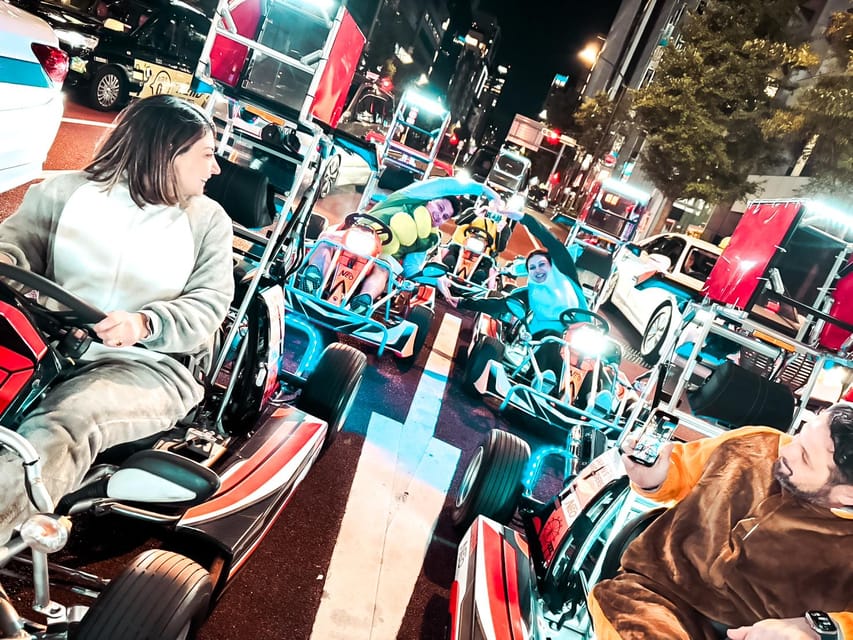
Costumes are included in the $64 price. The available choices are described as fun and varied, with enough range to let you pick a character or silly outfit that suits your mood.
A costume is not required to make the drive worthwhile, but it changes the tone. Without one, this is a city sightseeing ride in a small kart. With one, it becomes a moving photo session, and you are likely to attract smiles and curious looks from people along the streets.
The photo service adds real value. The staff takes pictures during the route and shares them at the end. You should smile for the camera when the guides signal a photo stop, since the best images come when you are facing the lens instead of concentrating on traffic.
A GoPro and SD card are not included. If you want action-camera footage, you need to arrange the GoPro rental separately. The included photo service may be enough for most people, especially if your main goal is to keep a few good images from the ride.
What the guides add
The tour includes English-speaking and Japanese-speaking staff. Two guides lead the group, which is one of the most useful features for a road-based activity.
A good guide does more than keep the route moving. The staff gives instructions, helps you feel comfortable with the kart, manages the stops, and takes photos. Patrick received especially warm praise for explaining monuments and buildings, discussing Tokyo culture and daily life, and suggesting other places to visit.
That kind of conversation can turn a short ride into a useful introduction to the city. You may get ideas for meals, neighborhoods, or later sightseeing, although the exact advice will depend on which guide leads your departure.
Safety is another reason the two-guide setup matters. Participants described the driving instructions as clear and said they felt safe with the guides. You still need to drive responsibly and pay attention, but a small group with support on the road is reassuring.
Is $64 good value for one hour?
At $64 per person, this is not the cheapest way to see Tokyo landmarks. You can walk around Ginza for free, and public transport costs far less. A standard bus tour may also cover more ground or provide a longer commentary program.
The value here comes from the combination of activities. You get 60 minutes of driving, two guides, insurance, a costume, and photo service. You also get a format that is very different from a normal city tour.
I would consider it good value if you want a memorable activity rather than the most efficient landmark tour. You are paying for the novelty, the open-air views, the small group, the costume, and the chance to drive through the city yourself.
I would be more cautious if your top priority is detailed history or time inside attractions. This ride gives you brief guided views and photo stops. It does not replace a temple visit, palace walk, theater performance, or proper Ginza shopping day.
Day or night: choosing the right departure
The activity runs for one hour, and starting times depend on availability. The supplied experiences strongly favor the night option for mood. Tokyo Tower is lit, Ginza has a different visual character, and the photos can feel more dramatic.
Night driving may suit you if you want bright signs, illuminated buildings, and a more unusual version of Tokyo. It also works well for couples and friends who see the ride as a fun evening activity.
Daytime may be better if you want clearer views of the architecture and surrounding streets. It can also be the better choice if you are less comfortable driving after dark.
The route is the same basic sightseeing loop, including Zojo-ji Temple, Tokyo Tower, the Imperial Palace Outer Gardens, Tokyo Station, and Kabuki-za. Pick the time based on the kind of pictures and city mood you want.
Who should book this ride?
This is a strong match for adults who already have the required driving documents and want something active and playful. It suits couples, friends, and solo participants who enjoy costumes, photos, and a bit of attention from the public.
It also works well for a first visit to Tokyo because you see several major central sights in one compact outing. The route gives you a useful sense of how the temple district, tower area, palace surroundings, station district, and Ginza connect.
You should skip it if you do not have a driver’s license, cannot obtain the required permit, or are under 18. High heels, slippers, alcohol, drugs, cellphones, and missing documents can prevent participation.
The activity is also not ideal for someone who dislikes driving on public streets or wants a slow, quiet tour. The karts are easy to drive according to the experience details, but you still need to concentrate and follow the staff.
Documents and rules you must handle first
For most countries, you need an International Driving Permit issued in the booklet format under the 1949 Geneva Convention. It must be issued by the same country that issued your domestic license, and you cannot obtain a valid one online while already traveling.
Licenses from Switzerland, Germany, France, Taiwan, Belgium, and Monaco require an official Japanese translation from the Japan Automobile Federation, known as JAF, rather than an International Driving Permit. In those cases, carry both your physical domestic license and the official translation.
Licenses from countries not covered by the 1949 Geneva Convention, including China, Indonesia, Mexico, Qatar, and Saudi Arabia, are not accepted for driving in Japan under the stated rules.
Bring the physical documents. Digital copies are not a safe substitute for the required physical International Driving Permit or translation and passport. Check this before booking, because paperwork is the biggest practical obstacle in the whole activity.
Cancellation is flexible enough for changing plans: you can cancel up to 24 hours before departure for a full refund. You can also reserve now and pay later, subject to the available booking terms.
FAQ
How long does the NEO GINZA go-kart experience last?
The driving experience lasts 60 minutes, or one hour. The route begins and ends at the Shintomicho 1-chome Building.
What landmarks does the route pass?
The route includes Zojo-ji Temple, Tokyo Tower, the Imperial Palace Outer Gardens, Tokyo Station, and Kabuki-za in Ginza.
Is the tour available in English?
Yes. English-speaking and Japanese-speaking staff are available, and the activity includes a live guide.
How many people can join the group?
The group is limited to six participants. Two guides support the group during the ride.
What documents do I need to drive?
Most participants need a physical passport and a physical International Driving Permit in the booklet format compliant with the 1949 Geneva Convention. Drivers from Switzerland, Germany, France, Taiwan, Belgium, and Monaco need their physical domestic license plus an official Japanese translation from JAF.
Can people under 18 join?
No. Drivers under 18 and people without a driver’s license are not suitable for this activity.
Are costumes and photos included?
Yes. A costume and photo shooting service are included. GoPro rental and an SD card are not included.
Should you book the NEO GINZA go-kart ride?
Book it if you want a short, unusual Tokyo activity with famous sights, friendly guides, costumes, and photos. The small group and two-guide setup make the ride feel well supported, while the night option gives you especially good city lights and Tokyo Tower pictures.
Do not book it as a replacement for sightseeing on foot. You will pass the landmarks rather than explore them in depth. But if you have your driving paperwork ready and want one hour of open-air fun through central Tokyo, $64 is a fair price for a memorable change of pace.
Just added in Tokyo
- A One-of-a-Kind Sushi Experience in a Special Place of Japan★ 5.0 · 15 reviews
- Tokyo Cute Bento Cooking Class – Make a Kawaii Character Lunchbox★ 5.0 · 126 reviews
- Japanese Home Cooking Class & Walk in Todoroki Temple Tokyo★ 5.0 · 88 reviews
- Japan Tokyo Tower Observatory Deck E-Ticket★ 4.0 · 34 reviews
- Catch a Baseball Game in Tokyo with a Local – Tickets Included★ 5.0 · 24 reviews
- Japan Classic 10 Day – One Life Adventures★ 5.0 · 129 reviews
- JDM Experience with Fast&Furious RX-7 (English speaking Driver)★ 5.0 · 57 reviews
- Tokyo Private Day Tour by Car with English speaking Driver Guide★ 4.0 · 29 reviews
Go-Karts, compared.
Flagship 2-Hours Official Street Go-Kart Tour – Tokyo Bay Shop
Read our review →
Shibuya Go Karting Experience by Akiba Kart Shibuya
Read our review →
Tokyo Go Kart: Asakusa, Skytree, and Akihabara **IDP MUST**
Read our review →
Shibuya Official Street Go-Kart in Shibuya Annex
Read our review →Browse the lists this tour appears in