Reviewed · TOKYO TOURS
Tokyo Toilet Tour
Toilets rarely make a Tokyo itinerary. This tour changes that, pairing striking public facilities by major architects with quiet streets, small parks, and a walk through Shibuya. I like the private format, which lets your guide adjust the pace and explain the design choices, and I like that the route shows ordinary neighborhoods rather than only famous sights. The main drawback is that transportation and lunch are not included, and much of the experience is on foot.
The tour costs $223.34 per group of up to four, not per person, which can be good value for a family or small group. It lasts about three and a half hours, begins near Yoyogi Fukamachi Mini Park, and ends at Ebisu Station. You should be comfortable walking between stops and using Tokyo’s public transport system if needed.
In This Review
- Key points to know before booking
- Why Tokyo’s public toilets make a worthwhile tour
- Starting at Yoyogi Hachimangu Shrine
- Miyashita Park and Tadao Ando’s design
- A five-minute crossing at Shibuya Crossing
- Nabeshima Shoto Park and Kengo Kuma
- Ebisu’s trio of designers
- What the private guide adds
- Price, walking, and what you need to plan
- Who will enjoy this tour most
- Cancellation and final practical advice
- Should you book the Tokyo Toilet Tour?
- FAQ
- How long does the Tokyo Toilet Tour last?
- How much does the tour cost?
- Is this a private tour?
- What does the tour price include?
- Are lunch and private transportation included?
- Where does the tour begin?
- Where does the tour end?
- What level of fitness do I need?
- Can I cancel for a full refund?
Key points to know before booking
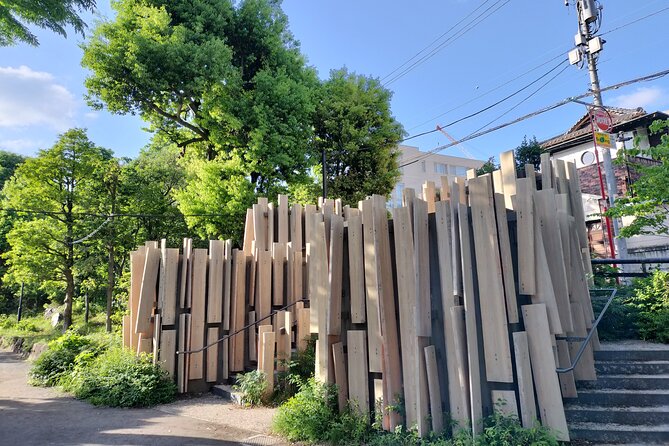
- Shigeru Ban and Toyo Ito toilets: Begin near Yoyogi Hachimangu Shrine, where design meets a small neighborhood Shinto setting.
- A walk through western Shibuya: The route connects Yoyogi, Harajuku, Shibuya, Shoto, and Ebisu rather than keeping you inside the busiest tourist lanes.
- Shibuya Crossing included: You cross Tokyo’s famous intersection for about five minutes on the way to the next stop.
- Private guide Ken: Ken is praised for his friendly manner and clear explanations of the architects and the city project.
- Architectural variety: Tadao Ando, Kengo Kuma, Fumihiko Maki, Kashiwa Sato, Nao Tamura, Shigeru Ban, and Toyo Ito are represented.
- Best value for one to four people: The fixed group price works especially well when shared by a couple, family, or small private party.
Why Tokyo’s public toilets make a worthwhile tour
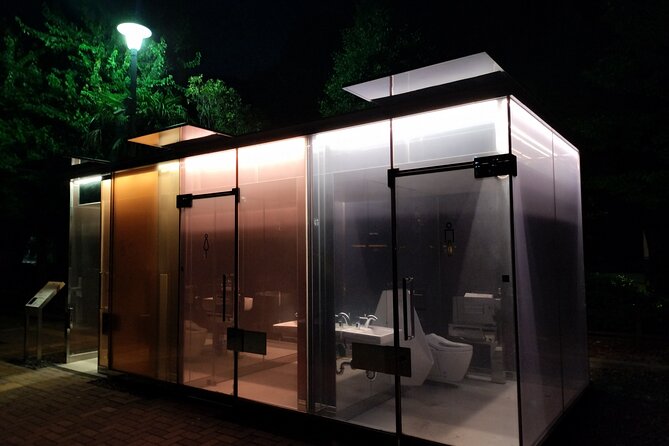
The Tokyo Toilet project gave leading architects a chance to rethink a very practical part of city life. Instead of treating public toilets as an afterthought, the project placed unusual designs in parks and neighborhoods across Shibuya.
That gives you a useful way to see Tokyo. You are not simply moving from one major sight to another. You are looking at how a city handles public space, daily routines, privacy, and design.
I find the idea appealing because the buildings are small enough to study closely. You can notice the shape, materials, entrances, and setting without needing a long museum visit. The toilets also sit beside shrines, parks, shopping areas, and residential streets, so the walk gives you a better feel for the parts of Tokyo between the headline attractions.
This is not a traditional sightseeing tour with a long list of monuments. It is a focused introduction to architecture and city life. If you enjoy design, photography, urban planning, or the film Perfect Days, the theme has more weight than its playful name suggests.
A few more options to weigh up in Tokyo
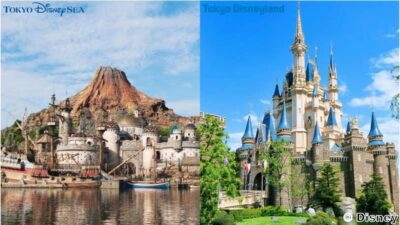
- Tokyo Disney Resort – Tokyo Disneyland & Tokyo DisneySea Park Tickets
★ 4.8 · 99,488 reviews - SHIBUYA SKY Ticket
★ 4.7 · 46,509 reviews - JR Whole Japan Rail Pass
★ 4.8 · 29,150 reviews
Starting at Yoyogi Hachimangu Shrine
The tour begins at Yoyogi Fukamachi Mini Park, at 1-chōme-54-1 Tomigaya in Shibuya. From there, you visit the Yoyogi Hachimangu Shrine area and see toilets designed by Shigeru Ban and Toyo Ito.
This is a strong opening because the setting is smaller and calmer than the main Shibuya streets. A Shinto shrine gives the stop a clear sense of place, while the nearby facilities show how contemporary design can sit beside an older religious environment.
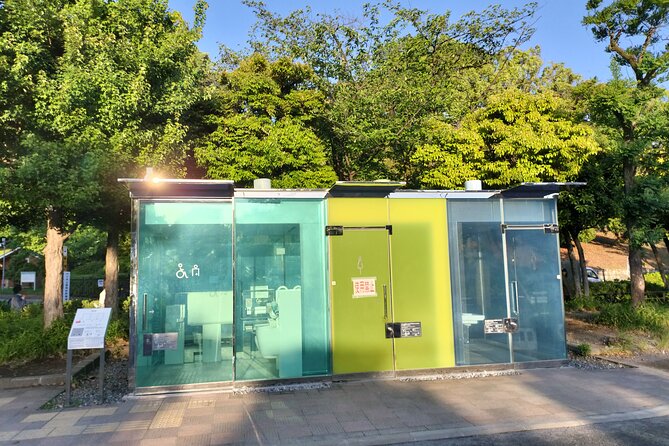
One of the designs is a transparent cubicle by Shigeru Ban. Its unusual appearance is likely to prompt questions about privacy and how the facility works. Your guide can give the stop meaning beyond a quick photograph, especially by explaining why the project used different approaches at different locations.
The connection to Perfect Days adds another layer. In the film, the main character takes a lunch break at this shrine. Fans of Wim Wenders’ movie will recognize the location and may enjoy seeing how a film setting fits into a real Tokyo neighborhood.
You have about 30 minutes here, with no separate admission fee. That time is enough for a look at the designs and the shrine surroundings without turning the first stop into a rushed photo call.
Miyashita Park and Tadao Ando’s design
The next stop is Miyashita Park, in the area between Shibuya and Harajuku. This part of Tokyo has seen major redevelopment in recent years, so the toilet by Tadao Ando offers an interesting contrast between a newly reshaped urban district and the project’s smaller, more human-scale facilities.
You have around 30 minutes here. The stop is not only about the toilet itself. It also places you in a part of the city where older streets and new commercial development meet.
Tadao Ando is known for a restrained approach to form and materials, and this stop gives your guide a chance to compare his work with the other architects on the route. You do not need a background in architecture to enjoy the contrast. A good guide can point out the broad ideas, then let you decide which designs you prefer.
Miyashita Park can feel more urban and active than the shrine area. That change helps keep the tour from becoming repetitive. Each facility is part of a different neighborhood, and the surroundings are as useful as the buildings for understanding Tokyo.
A five-minute crossing at Shibuya Crossing
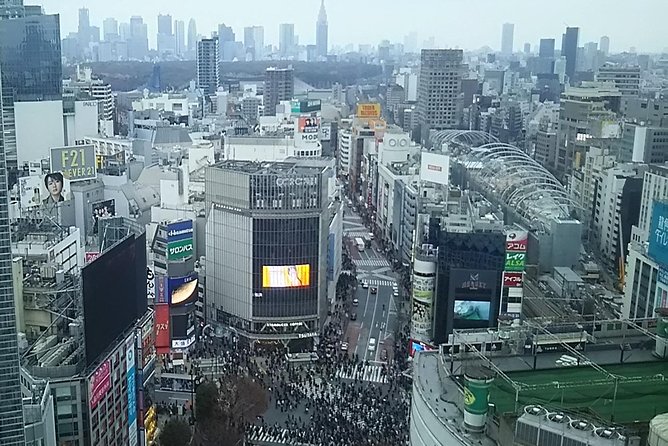
Shibuya Crossing is not one of the project’s toilet locations, but the route takes you across the famous intersection. The stop lasts about five minutes, so you should think of it as a brief passage rather than a full sightseeing visit.
That short crossing is still useful. It links the quieter architectural stops with the next part of the route and gives you a quick look at one of Tokyo’s most recognizable public spaces.
If you have already visited Shibuya Crossing, this will not add much time. If you are new to Tokyo, it helps connect the private neighborhood walk with the city image you probably expect to see.
The practical benefit is that the tour does not isolate you in a single theme. You get both the polished, high-energy side of Shibuya and the calmer streets nearby.
A completely different kind of day out:
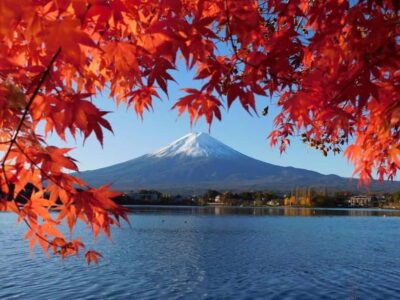
- Mt Fuji and Hakone 1-Day Bus Tour Return by Bullet Train
★ 5.0 · 26,383 reviews - TOKYO SKYTREE® Ticket
★ 4.7 · 25,136 reviews - teamLab Borderless Tickets: MORI Building DIGITAL ART MUSEUM
★ 4.7 · 24,126 reviews - teamLab Planets TOKYO Ticket
★ 4.7 · 21,663 reviews
Nabeshima Shoto Park and Kengo Kuma
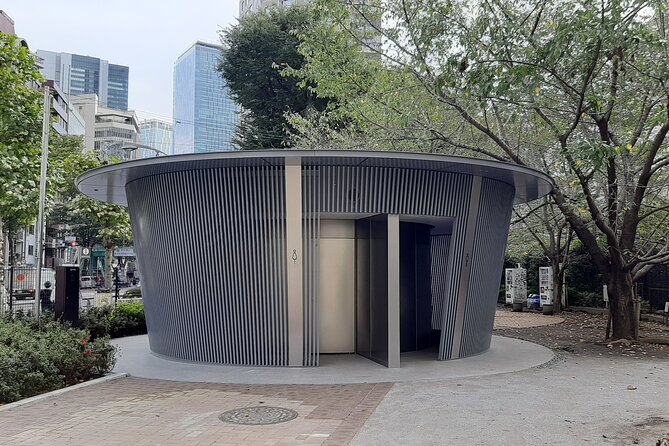
From Shibuya, the route continues to Nabeshima Shoto Park, about a kilometer from the main station area. Here you see a toilet designed by Kengo Kuma in a quiet residential setting.
This is one of the more useful parts of the tour for understanding how Tokyo changes within a short distance. The city can shift from packed streets to low-key residential lanes very quickly. Nabeshima Shoto Park provides that contrast without requiring a long journey.
You spend about 15 minutes here, making it the briefest listed stop. That should be enough for the facility and the park, but it is worth knowing that this is more of a compact viewing stop than a long neighborhood visit.
The walk to this location is part of the appeal, though it also explains why moderate physical fitness is recommended. You are covering several districts over three and a half hours, and the route includes regular walking between facilities.
Ebisu’s trio of designers
The final section takes you south to Ebisu, where the route ends at Ebisu Station. Here you see toilets by Fumihiko Maki, Kashiwa Sato, and Nao Tamura.
This stop allows for about 30 minutes and brings together three different design voices in one neighborhood. It is a fitting end because you can compare the final facilities with the designs seen earlier in Yoyogi, Harajuku, Shibuya, and Shoto.
Ebisu is also a convenient endpoint. The tour finishes at JR Ebisu Station on the Yamanote Line and the Tokyo Metro Hibiya Line, giving you an easy starting point for the rest of your day.
Because the tour ends at a transport hub rather than returning to the starting point, you should plan your next activity from Ebisu. That is helpful if you want to continue sightseeing in southern or central Tokyo, but less convenient if you have left luggage or plans back near Yoyogi.
What the private guide adds
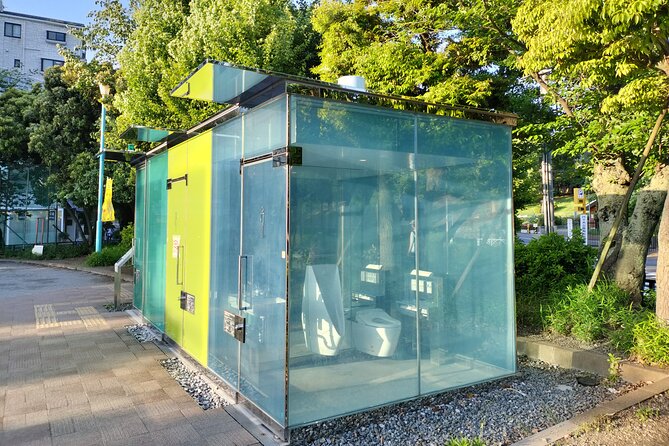
A private guide changes the experience more than the subject might suggest. Public toilets can be viewed in a few minutes, but the design choices, the architects, the film connection, and the neighborhood context give you reasons to linger.
Ken is specifically praised for being friendly and informative. He explains the history of the Shibuya City project and the architects involved, while also helping you notice small parks and less touristy parts of the city.
That personal attention matters for families and couples. You can ask questions as they come up, adjust the amount of time spent taking photos, and set a pace that suits your group. The private format also means you are not sharing the walk with a large crowd.
The tour is suitable for solo participants as well, though the fixed group price is harder to justify for one person. For two, three, or four people, the cost becomes easier to assess because the $223.34 fee covers the whole group.
The description also presents the experience as customizable. The specific route supplied here is the Tokyo Toilet route, so you should confirm the exact plan when booking if you have other priorities. The important point is that you are not signing up for an impersonal bus outing. You receive a private guide and a route built around your group’s interests and abilities.
Price, walking, and what you need to plan
At $223.34 per group of up to four, the tour costs about $55.84 per person for four people, before any additional transport or food costs. For a couple, the per-person figure is higher, but you are paying for a private guide rather than joining a shared group.
The price includes the guide only. Lunch is not included, and private transportation is not included. Since the route connects several parts of Shibuya on foot and uses public transport areas, you should budget separately for any train or other local transport you need.
The three-and-a-half-hour length makes this a manageable half-day activity. You can pair it with another plan before or after, but allow enough time to reach the Yoyogi starting point and continue from Ebisu at the end.
You should also wear comfortable shoes. The route includes several walks between stops, and the tour recommends a moderate level of physical fitness. No separate admission fees are listed for the stops, which keeps the cost easy to understand.
The experience is mobile-ticketed, and confirmation is sent within 48 hours of booking, subject to availability. It is commonly reserved well ahead, with bookings averaging 39 days in advance, so last-minute availability may not be dependable.
Who will enjoy this tour most
I would choose this for a first visit to Tokyo if I wanted a guided introduction that avoided the usual checklist. The route gives you Shibuya, Harajuku, Ebisu, a shrine, parks, and residential streets in one outing.
It is also a natural choice for Perfect Days fans. The Yoyogi Hachimangu Shrine stop connects directly with the film, while the overall subject reflects the movie’s attention to ordinary city spaces and daily work.
Architecture fans will get the most from the tour, but you do not need specialist knowledge. The appeal is visual and practical. You can compare several major architects while seeing how their designs fit real public settings.
Families may appreciate the private structure, especially if children need breaks or the pace needs adjusting. Couples can use it as an unusual way to explore Shibuya together, and solo participants get direct access to the guide without being placed in a large group.
I would hesitate if you want a broad Tokyo overview with the Imperial Palace, Tsukiji Market, or Meiji Jingu Shrine. Those attractions may be part of a customizable day with a guide, but the detailed route here focuses on the toilet project and nearby neighborhoods. Confirm your preferred itinerary before committing.
Cancellation and final practical advice
Free cancellation is available if you cancel at least 24 hours before the local start time. Changes or cancellations made less than 24 hours in advance are not accepted for a refund.
Before booking, make sure your group can reach Yoyogi Fukamachi Mini Park at the start and can finish at Ebisu Station. Keep the meeting and ending points in mind when planning hotel transfers, meals, or another timed attraction.
Bring a charged phone for the mobile ticket and maps. Since the tour does not include lunch, you can plan a meal around Ebisu after the walk, though the tour itself does not provide one.
Should you book the Tokyo Toilet Tour?
Book it if you want a private, offbeat walk through Tokyo that combines architecture with real neighborhoods. The strongest reasons are the small group size, the range of designers, the Perfect Days connection, and Ken’s friendly explanations.
The value is best for up to four people sharing the fixed price. You should be comfortable walking, paying separately for lunch and transport, and spending three and a half hours on a focused theme.
Skip it if you want Tokyo’s major historic sights in one compact tour or if public toilet design does not interest you. For everyone else, this is a smart way to see a more ordinary and thoughtful side of Shibuya, with a subject that turns out to be far more revealing than its name suggests.
FAQ
How long does the Tokyo Toilet Tour last?
The tour lasts approximately 3 hours and 30 minutes.
How much does the tour cost?
The price is $223.34 per group of up to four people.
Is this a private tour?
Yes. Only your group participates in the private tour or activity.
What does the tour price include?
The price includes a private tour guide.
Are lunch and private transportation included?
No. Lunch and private transportation are not included.
Where does the tour begin?
The meeting point is Yoyogi Fukamachi Mini Park, 1-chōme-54-1 Tomigaya, Shibuya, Tokyo 151-0063, Japan.
Where does the tour end?
The tour ends at Ebisu Station, 1 Chome-5 Ebisuminami, Shibuya, Tokyo 150-0022, Japan.
What level of fitness do I need?
A moderate level of physical fitness is recommended because the experience involves walking between several locations.
Can I cancel for a full refund?
Yes. You can cancel at least 24 hours before the experience start time for a full refund. Changes or cancellations made less than 24 hours before the start time are not accepted for a refund.
Just added in Tokyo
- Mt. Fuji & Hakone: Fuji Sengen Shrine, Cruise, and Ramen-Making★ 5.0 · 124 reviews
- Daruma Workshop by Making your Own Japanese Souvenir in Shinjuku★ 5.0 · 25 reviews
- Day Trip to Kamakura & Enoshima: Shrines, Seaside, Temples & Tea★ 5.0 · 32 reviews
- DAIKOKU excursion by car DRIFT automobile encounter★ 4.5 · 19 reviews
- Daikoku Car meet: Tokyo Drift Car Club membership★ 4.5 · 21 reviews
- Real Tokyo Runner Club : Daikoku Car Meet Night Tour with JDM Car★ 5.0 · 25 reviews
- Tokyo Private Tour with Customized Itinerary★ 5.0 · 24 reviews
- Cosplay Experience with Professional Makeup and Photo Shoot!★ 5.0 · 19 reviews
Tokyo Tours, compared.
Tokyo Disney Resort – Tokyo Disneyland & Tokyo DisneySea Park Tickets
Read our review →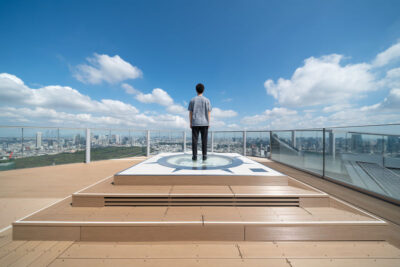
Mt Fuji and Hakone 1-Day Bus Tour Return by Bullet Train
Read our review →

teamLab Borderless Tickets: MORI Building DIGITAL ART MUSEUM
Read our review →