
Reviewed · CASTLES AND HISTORIC SITES
Full Day Tour Eiheiji Buddhist Temple and Fukui City Castle Town
Fukui rewards a slower day. This 9.5-hour trip from Kanazawa brings together castle ruins, hilltop shrines, and Zen temples in a part of Japan many visitors skip. I like the mix of city history and mountain calm, and I like that a guide handles the train-area meeting, local transport, and Eiheiji admission. The main drawback is the pace: you will spend most of the day walking, riding buses, and following a set schedule, with lunch left to you.
I also like the small maximum of 20 people. Guides such as Mike and Garrett have created the kind of friendly, personal day that makes a long excursion feel less formal. Just keep your expectations sensible: Fukui Castle is a ruin rather than a restored castle, and the private meeting with a senior monk that has been part of one tour may not be available every time.
In This Review
- Key points to know before you book
- Why this Fukui day trip is worth your time
- Starting at Kanazawa Station with a clear meeting point
- Zuigenji and the story of moved castle buildings
- Fukui Castle Ruins, where government works inside old walls
- Atagozaka, uphill views before lunch
- Lunch in Fukui, with the cost and choice left to you
- Eiheiji Temple, the calm center of the afternoon
- What the 9.5-hour schedule feels like in practice
- Who will enjoy this tour most
- Should you book the Fukui day trip from Kanazawa?
- FAQ
- Where does the tour begin?
- Where does the tour end?
- How long does the tour last?
- Is lunch included?
- Is admission to Eiheiji Temple included?
- How many people can join the tour?
Key points to know before you book
- Fukui beyond the usual route: See a prefectural capital and mountain temple often missed on a Kanazawa visit.
- A full 9.5-hour day: The schedule combines walking, local buses, sightseeing, and lunch time.
- Eiheiji is the major draw: Entry and a guided visit are included at one of Zen Buddhism’s head temples.
- A small-group feel: The maximum group size is 20, with English-speaking guidance throughout.
- Lunch is separate: Your guide can recommend Fukui specialties, but you pay for the meal yourself.
- Simple meeting point: Meet outside the Shinkansen ticket gate at Kanazawa Station, in front of the information center sign.
Why this Fukui day trip is worth your time
Kanazawa is an easy base for exploring the Hokuriku region, but many visitors stop at its famous gardens, old districts, and markets. This tour points you toward Fukui, a prefecture that has long connected roads, trade routes, and military powers along the Sea of Japan.
You are not just checking off a temple. The day gives you several ways to read the area. The castle ruins show how modern government occupies an older political center. Atagozaka offers a hilltop view and a very old religious site. Eiheiji then shifts the mood entirely, taking you into a wooded mountain setting shaped by Zen practice.
I find that contrast valuable. You get urban Fukui first, then a quieter temple visit later. The result feels more like a day spent understanding a place than a quick photo stop.
The price is $158.08 per person. That is not cheap for a day trip, but it includes transport to and from Fukui Station, the local bus to Eiheiji, an English-speaking guide, entry to Eiheiji, and guided visits at several locations. If you tried to arrange the same route yourself, you would still need to manage the connections, admission, timing, and walking route.
The value depends on how much help you want. Independent visitors who enjoy reading signs, checking bus schedules, and making their own route may prefer to go alone. I would consider the price reasonable if you want context at the historic sites and do not want to spend a day working out the transport.
More Castles and Historic Sites in Kanazawa
- Kanazawa: Samurai Residence Remains Nomura Family admission
★ 4.4 · 111 reviews - Kanazawa: Samurai, Matcha, Gardens and Geisha Full-Day Tour
★ 4.9 · 75 reviews - Full-Day Tour from Kanazawa: Samurai, Matcha, Gardens and Geisha
★ 5.0 · 68 reviews
Starting at Kanazawa Station with a clear meeting point
The day begins at Kanazawa Station. Meet outside the Shinkansen ticket gate, in front of the information center sign. That detail matters because large Japanese stations can feel confusing when you are trying to find a guide and manage a morning departure.
Your guide greets you there before the group sets off. Since the tour begins and ends at the same general meeting point, you do not need to arrange a separate return transfer or find your way back from Fukui.
The tour uses public transport as part of the experience. Transportation to and from Fukui Station, the local Fukui bus, and the ride to Eiheiji are included. This is practical, but it also means the day follows public transport timing rather than your own preferred pace.
The trip is listed as about nine hours and 30 minutes. I would treat that as a full day, not a casual outing. Wear comfortable shoes, keep your morning simple, and avoid planning a demanding evening activity after you return to Kanazawa.
The group can have up to 20 people. That is not a private tour, but it is small enough for questions and conversation to feel possible. The strongest personal feedback has centered on guides named Mike and Garrett, with Mike praised for his humor and warm group manner. Guide assignments can vary, but those comments suggest that the human side of the tour is a real part of its appeal.
Zuigenji and the story of moved castle buildings
The first listed stop is Zuigenji Cemetery, with about three hours devoted to this opening section of the day. The tour description also refers to guided access to Zuigenji’s castle rooms, including buildings connected with a former castle that were moved to the temple.
That is an unusual detail. Instead of seeing a castle only as walls, gates, or reconstructed rooms, you get a reminder that old buildings can survive by being reused elsewhere. A temple setting gives the castle material a different context and makes you think about how Japanese sites were altered over time.
The exact sequence of this section may involve walking and local transport before the group continues through Fukui. The description does not provide every street or building detail, so you should expect the guide to shape the visit around access and the day’s operating conditions.
Three hours is a substantial amount of time for the opening portion. That can be good if you enjoy explanation and historical context. It may feel long if you prefer fast sightseeing or want to spend most of the day at Eiheiji.
I would pay attention here to the connection between religious buildings and regional power. The tour is not presenting Fukui as a string of isolated attractions. It is showing how temples, castles, roads, and government have occupied the same area across different periods.
Admission is listed as free for this stop. Guided interpretation is included, which gives the visit more value than simply passing through a cemetery or looking at an old building without knowing its story.
Fukui Castle Ruins, where government works inside old walls
The next stop lasts about one hour and 30 minutes. Fukui Castle is no longer a complete castle complex, but its original walls and moat remain. The unusual modern detail is that the prefectural office and police headquarters sit inside the former castle grounds.
That mixture is exactly what makes the stop worthwhile. You see a historic defensive site that has not been sealed off from daily civic life. Instead, the old walls form part of the working city.
I like this kind of stop because it avoids the polished version of castle history. There is no promise of a grand reconstructed keep or a perfectly preserved feudal scene. You get stonework, water, modern offices, and a clear view of how a city grows around its past.
Your guide can explain the castle’s role in Fukui’s political story and point out the surviving features. The walls and moat are the main physical attractions, so set your expectations accordingly. If you want an intact castle interior, this will not be the strongest part of the day.
The one-hour-30-minute timing should give you room to walk and listen without turning the visit into a rushed photograph. Since admission is free, the cost here is covered mainly by the guide’s time and the route design.
More Day Trips in Kanazawa
- Kanazawa Half Day Tour (Private Guide)
★ 5.0 · 361 reviews - Kanazawa Full Day Tour (Private Guide)
★ 5.0 · 323 reviews - From Kanazawa/Toyama: Shirakawago and Takayama Day Tour
★ 4.7 · 82 reviews - [Day trip bus tour from Kanazawa Station] Weekend only! World Heritage Shirakawago Day Bus Tour
★ 5.0 · 46 reviews
Atagozaka, uphill views before lunch
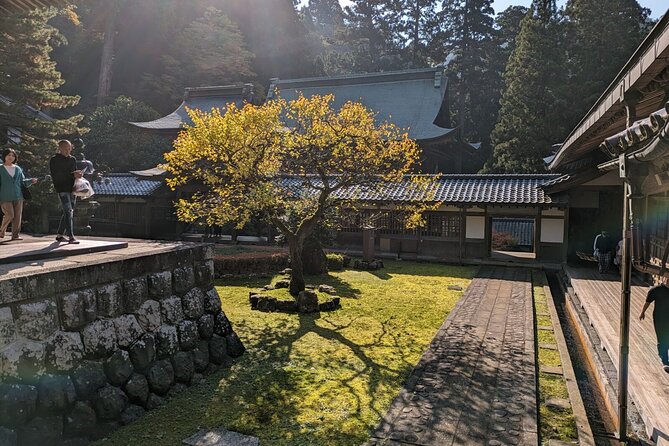
Before lunch, the route climbs Atagozaka, also called the Atago Slope. The stop lasts about one hour and uses a series of staircases leading toward the top of a broad group of hills.
This is the part of the morning where comfortable footwear becomes important. The tour description specifically calls out the stairs, so I would not treat this as a flat city walk. Anyone who finds repeated uphill steps difficult should consider that carefully before booking.
At the top is one of the oldest shrines in the prefecture. You also get views over the modern city skyline from a hill with more than a thousand years of history connected to it. That combination gives the stop a useful rhythm: climb through an older religious setting, then look back toward present-day Fukui.
The view is not just a reward for the steps. It helps you understand Fukui’s position as a city shaped by both old routes and modern development. From above, the contrast between the historic hill and the urban center becomes easy to see.
I would also use this stop as a natural pause in the historical story. The castle grounds show power at street level. Atagozaka gives you a higher view and a religious landmark. After that, lunch provides a needed break before the temple portion.
Lunch in Fukui, with the cost and choice left to you
Lunch is not included. You can ask the guide for recommendations for local Fukui specialties, then meet back at Fukui Station afterward for the direct bus to Eiheiji.
I see this as both a weakness and a small advantage. The weakness is obvious: the advertised price does not cover your midday meal, and you may have limited time to choose and eat. The advantage is flexibility. You are not locked into a fixed menu or a restaurant that does not suit your appetite.
Ask your guide early about the lunch plan. The day has several timed sections, and you do not want to spend too long deciding where to eat. Since the tour specifically offers local recommendations, this is a good moment to try something associated with Fukui rather than defaulting to familiar chain food.
The return to Fukui Station is important. This is where you regroup for the direct bus to Eiheiji. Keep your belongings organized and listen closely to the meeting time, since missing the group transport would disrupt the second half of the day.
Eiheiji Temple, the calm center of the afternoon
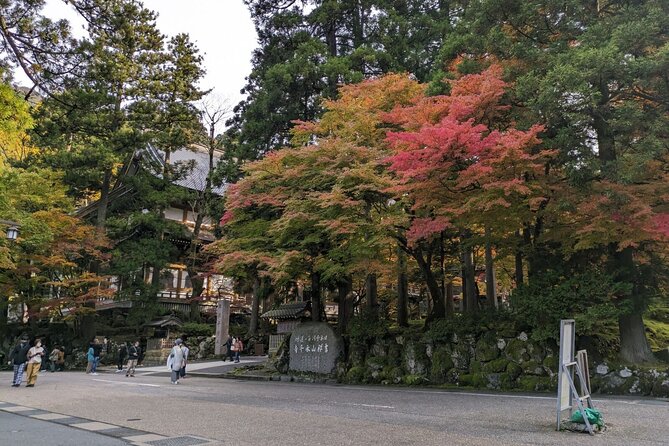
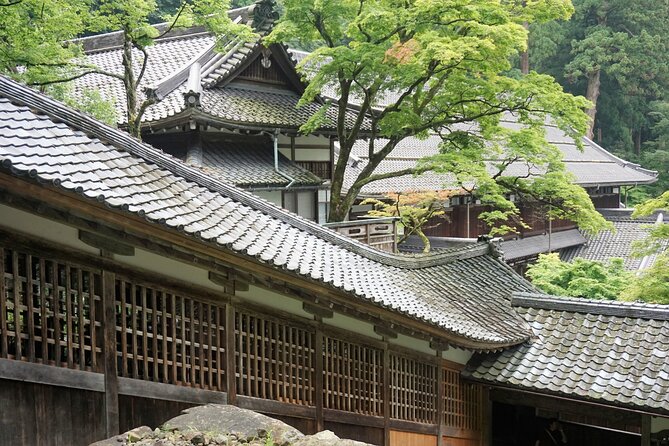
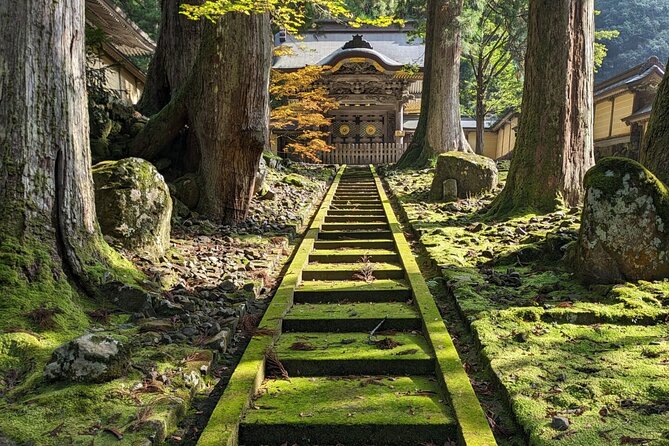
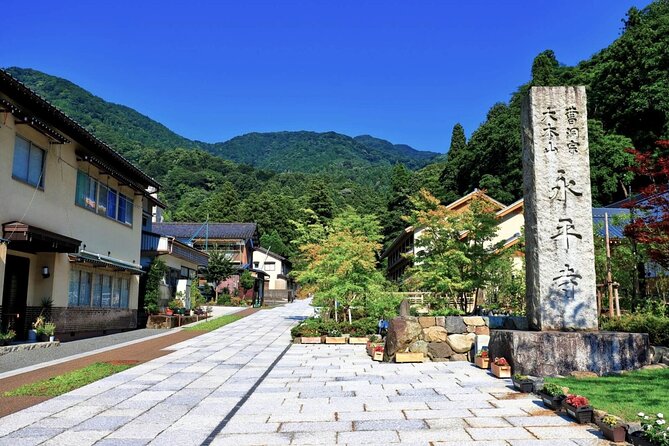
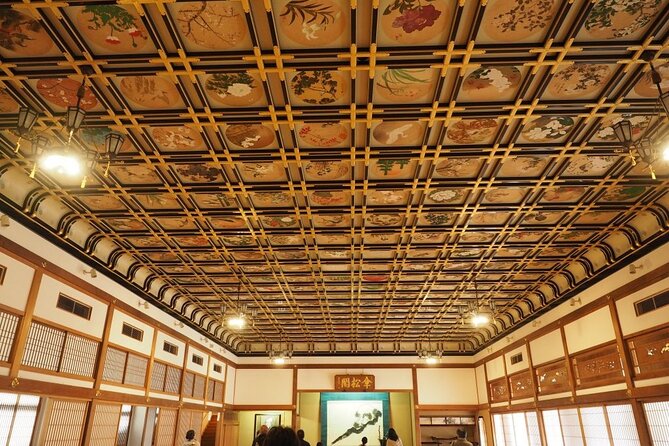
Eiheiji receives about four hours, making it the main stop. It is one of the head temples of Zen Buddhism and sits in an idyllic mountain setting away from Fukui’s city center.
The change in mood should be one of the best features of the day. The morning moves through cemeteries, castle remains, government buildings, stairs, and city views. Eiheiji offers a more focused setting where architecture, religious practice, and wooded surroundings take over.
Admission to Eiheiji is included. A guided visit is also included, which matters here because a large temple complex can be difficult to understand on your own. Your guide can explain what you are seeing and help connect the buildings to Zen Buddhist practice.
Four hours allows time for more than a quick entrance and exit. You can move through the temple grounds, take in the architecture, and absorb the quiet pace. The exact amount of free time will depend on the group and the day’s conditions, but this is clearly not meant to be a brief photo stop.
One especially memorable possibility is a private meeting with the head monk. That has been a highlight on a previous tour, but it should not be treated as guaranteed. The supplied conditions say that all activities depend on availability, and the schedule may need adjustment if a particular experience cannot take place.
That caution is important. Book this for Eiheiji itself and the guided temple visit. Treat a private audience with a senior monk as a fortunate extra, not as the central promise.
The mountain setting also gives Eiheiji a sense of distance from the city without requiring a separate overnight stay. You get a substantial temple visit, then return to Kanazawa the same day.
What the 9.5-hour schedule feels like in practice
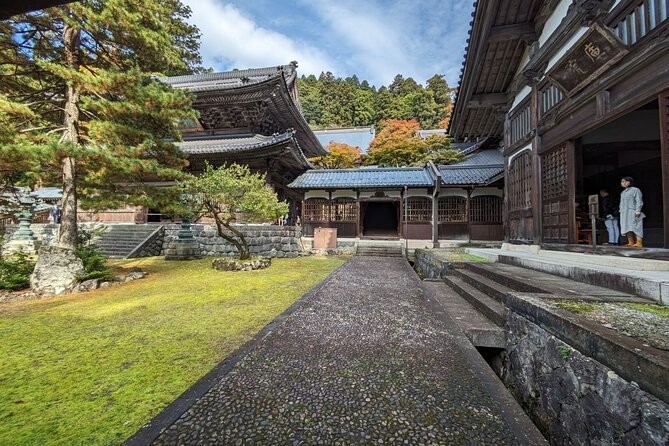
This is a structured day with several changes of setting. You begin at Kanazawa Station, spend the first part of the day around historic and religious sites, walk through castle grounds, climb Atagozaka, stop for lunch, return to Fukui Station, and take the bus to Eiheiji.
I would book it if you like variety and appreciate having someone else coordinate the moving parts. I would skip it if your ideal day means lingering at one site, choosing meals spontaneously, or returning to your hotel early.
The itinerary includes walking at cemeteries, castle ruins, city streets, and stairs. The tour is near public transportation, and most people can participate, but the listed Atagozaka stair climb makes this more demanding than a coach tour with short walks.
The group maximum of 20 is a useful middle ground. You get the social energy of a shared outing without the scale of a large bus group. The strongest praise has focused on guides who use humor and make the day feel like time spent with friendly companions rather than a formal lecture.
Still, the experience will vary with the guide, group size, weather, site access, and transport conditions. The operator notes that activities are subject to availability and that parts of the route may be changed if needed.
Who will enjoy this tour most
I would recommend this day to you if:
- You are staying in Kanazawa and want to see more of Hokuriku.
- You enjoy temples, shrines, castle remains, and local history.
- You prefer an English-speaking guide to handling transport and interpretation alone.
- You are comfortable with a full day and some uphill walking.
- You want Eiheiji to be the main feature of a wider Fukui visit.
- You enjoy small-group outings with room for questions and conversation.
I would be more cautious if you have limited mobility, dislike stairs, or want a relaxed lunch with no fixed return time. The tour is also less appealing if you have already planned an independent Fukui visit and mainly want to spend several hours at Eiheiji without other stops.
The fact that it is often booked about 82 days ahead suggests that you should not leave it until the last minute if your dates are fixed. Confirmation is provided at booking, but availability can still affect individual activities.
Free cancellation is available up to 24 hours before the start time for a full refund. Changes or cancellations inside that window are not accepted for a refund, so keep the local start time in mind when making plans.
Should you book the Fukui day trip from Kanazawa?
I would book this tour if you want a guided introduction to Fukui rather than a single temple transfer. Its best quality is the range: old religious sites, castle remains, city views, and Eiheiji all fit into one day, with transport and admission handled for you.
The strongest reason to choose it is Eiheiji paired with a guide. The strongest reason to hesitate is the long schedule, stair climbing, and separate lunch cost.
For a first visit to the area, the $158.08 price can make sense because it covers the most troublesome logistics and gives you context at several sites. If you are an experienced independent visitor who enjoys planning Japanese rail and bus connections, you may save money on your own.
Choose it for the complete day, not for a guaranteed private monk meeting or a perfectly preserved castle. If that sounds like the right balance, this is a thoughtful way to add Fukui to a Kanazawa trip.
FAQ
Where does the tour begin?
It begins at Kanazawa Station, outside the Shinkansen ticket gate, in front of the information center sign.
Where does the tour end?
The activity ends back at the meeting point at Kanazawa Station.
How long does the tour last?
The tour lasts approximately nine hours and 30 minutes.
Is lunch included?
No. Lunch is not included, but you can ask the guide for recommendations for local Fukui specialties.
Is admission to Eiheiji Temple included?
Yes. Entry to Eiheiji Temple and a guided visit are included.
How many people can join the tour?
The maximum group size is 20 people.
More Temples and Shrines in Kanazawa
- Try Mindful Calligraphy Near Kanazawa’s Ninja Temple
★ 5.0 · 50 reviews - Kanazawa: Samurai Swordsmanship Lesson at a rented temple
★ 5.0 · 21 reviews - Kanazawa Ninja Temple Half Day E-bike tour
★ 5.0 · 14 reviews - [Kyoto & Nara Day Tour] Sagano Scenic Railway & Nara Park & Fushimi Inari Taisha Thousand Torii Gates & Togetsukyo Bridge & Bamboo Grove & Kimono Forest (Departing from Osaka)
★ 4.9 · 10,942 reviews
Just added in Kanazawa
- Taste of Kanazawa (Food tasting in Omicho Market & Higashi Chaya)★ 5.0 · 58 reviews
- Shirakawago & Kanazawa from Kanazawa★ 5.0 · 51 reviews
- Takayama and Shirakawago/Photoshoot by professional photographer★ 5.0 · 67 reviews
- Kanazawa: Sushi & Japanese Cooking Class at a Historic School★ 5.0 · 66 reviews
- Private Tour of Shirakawago from Kanazawa (Half Day)★ 5.0 · 24 reviews
- Kanazawa private 1 day/Photoshoot by professional photographer★ 5.0 · 33 reviews
- Private Tour of Shirakawago and Gokayama from Kanazawa★ 5.0 · 50 reviews
- Kanazawa private half day/Photoshoot by professional photographer★ 5.0 · 38 reviews
Castles and Historic Sites, compared.

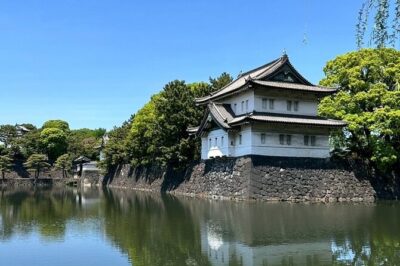
Imperial Palace and Shogun Historical Walking Tour
Read our review →
Tokyo Castle & Imperial PalaceーShogun Walking Tour
Read our review →
Nijo-jo Castle and Ninomaru Palace Guided Tour
Read our review →
Samurai Ninja Museum Guided tour and Experience
Read our review →Browse the lists this tour appears in