
Reviewed · HIKING AND TREKKING
Hike Japan Heritage Hakone Hachiri (Half Day)
Old roads lead to better Hakone views. This half-day walk follows the old Tokaido highway from Hakone-Yumoto toward Lake Ashi, mixing mossy cobbles, forest paths, village crafts, and a historic tea stop. I especially like the quiet forest section and the chance to learn from local guide Akihiro, who grew up in the area. The main catch is that transportation costs are extra, and the hike requires moderate fitness.
The route also makes a smart time trade: you walk the most attractive sections and take a bus around the steepest part. That keeps the outing manageable, but hikers seeking a hard, continuous trek may find it too gentle. Weather matters, too, since Fuji views and the tour itself depend on clear conditions.
In This Review
- Key points at a glance
- Walking Hakone’s old road instead of its crowded center
- The first hour: forest paths and old Tokaido stones
- Hatajuku and Hakone’s woodcraft tradition
- Amasake at a 400-year-old tea house
- Reaching Lake Ashi through the forest
- Hakone Checkpoint and the road’s political story
- What $114.95 buys you
- Fitness, weather, and practical limits
- Who will enjoy this walk most
- Should you book the Hakone Hachiri half-day hike?
- FAQ
- Where does the hike begin?
- Where does the tour finish?
- How long is the tour?
- Is transportation included?
- How many people can join?
- What fitness level is required?
- What happens if the weather is poor?
Key points at a glance
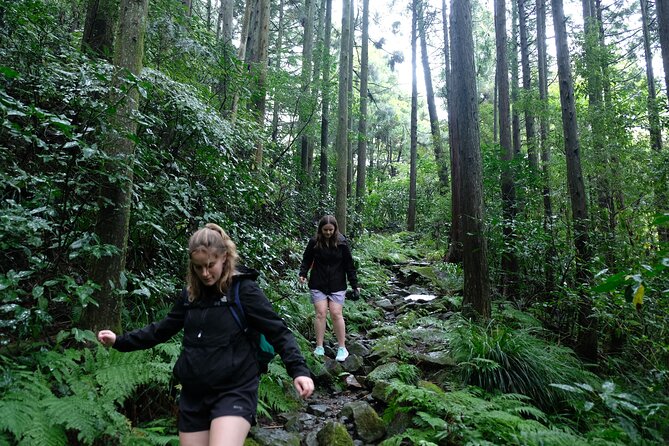
- Best-preserved cobbled section: Walk an old stretch of the Tokaido highway through quiet, primitive forest.
- Hatajuku woodcraft village: Stop after about an hour to learn about Hakone’s traditional decorative woodwork.
- 400-year-old teahouse: Take a break at Hakone Amazake Tea House for its traditional amasake drink.
- Small group setting: The tour is limited to six people, making it easier to hear the guide and ask questions.
- Lake Ashi finish: End near Motohakone, with possible views across the lake toward Mount Fuji.
- Useful onward connections: After the tour, you can continue by bus or ferry, including the famous pirate ship service.
Walking Hakone’s old road instead of its crowded center
If you know Hakone mainly as a hot-spring resort and Fuji-view stop, this hike shows you a quieter side. The old Tokaido highway once linked Tokyo and Kyoto, and this section gives you a feel for how people moved through the mountains before modern roads and railways.
The walk lasts about two to three hours, inside a tour of roughly four hours. You begin at Hakone-Yumoto Station at 9 a.m. and finish at Lake Ashi around 1 p.m. That timing is useful. You get a morning outdoor activity without giving up the rest of your day in Hakone.
I like the route because it is not simply a march from one famous viewpoint to another. You pass through forest, a craft village, a traditional tea stop, and the former Hakone checkpoint. Each place explains a different part of the area: nature, local work, travel, and government control.
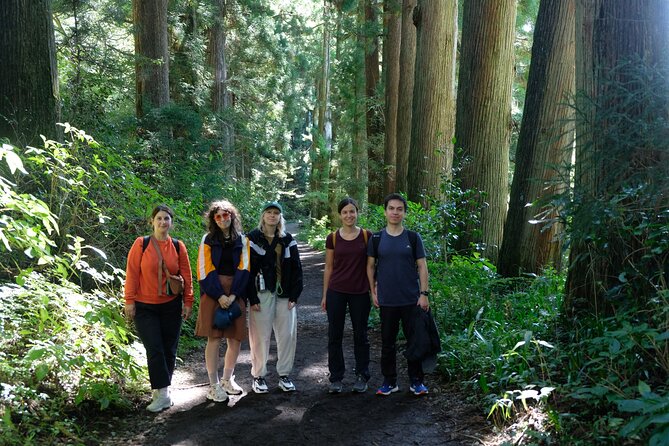
The experience is led by a certified National Mountain Guide. Akihiro is specifically praised for his strong English, friendly manner, and local knowledge. One guide, Aki, also added historical context and traditional snacks during a rest stop. Since the group is capped at six people, you should have a more personal experience than on a large bus excursion.
More Hiking and Trekking in Hakone:
- Hike Hakone Hachiri
★ 5.0 · 48 reviews - Hike Japan Heritage Hakone Hachiri with certified mountain guide
★ 5.0 · 46 reviews - Traverse Outer Rim of Hakone Caldera and Enjoy Onsen Hiking Tour
★ 5.0 · 30 reviews
The first hour: forest paths and old Tokaido stones

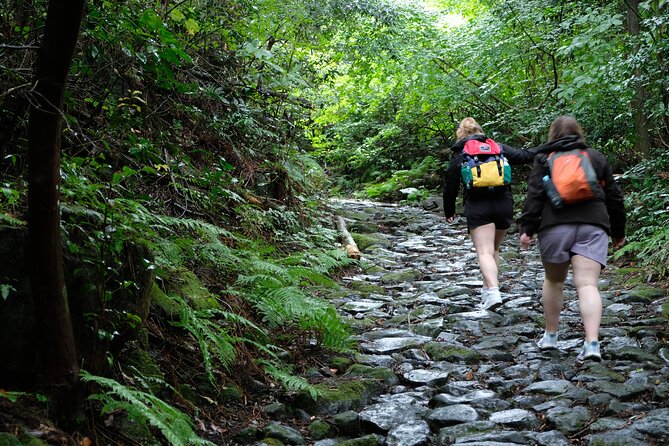
From Hakone-Yumoto, the route heads toward Hatajuku. After about an hour, you reach the woodcraft village. Along the way, expect a mixture of cobbled trail and forest path rather than a smooth paved walk.
The cobbles are a major reason to choose this outing. They give the hike a physical connection to the old highway, but they also require care. Uneven stones can be tiring, especially if you are not used to walking on rough paths. The tour calls for moderate physical fitness, so comfortable shoes with a firm sole make sense.
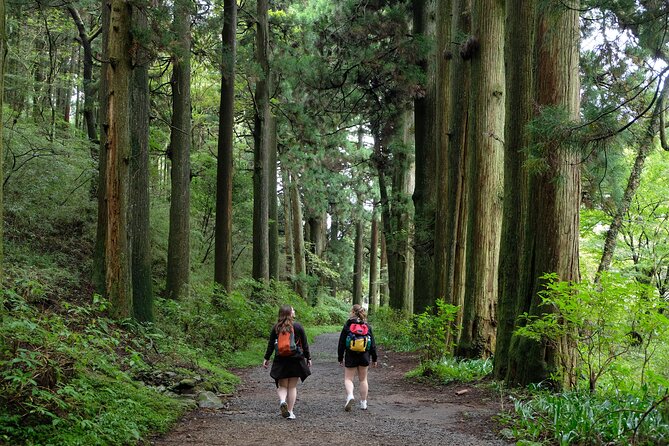
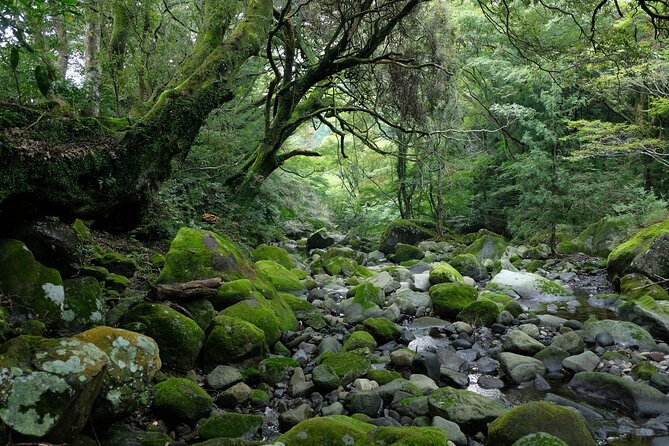
The forest section is another strong point. This part of the Hachiri route is described as more primitive and often quiet, with the group sometimes having the woods largely to itself. That makes the outing feel less like a standard sightseeing circuit. You are walking through a route with a sense of age, not simply following a marked attraction trail.
Your guide adds value here. The old road can otherwise seem like a pleasant woodland walk with stones underfoot. With someone explaining its role in the Edo-era road network, the path becomes easier to understand. Akihiro’s local connection is especially useful because he is from the Hakone area, not simply guiding from a script.
I would not book this as a strenuous mountain challenge. The aim is to connect the scenery with Hakone’s past. You get some exercise, but the guide, setting, and stops matter as much as the walking itself.
Hatajuku and Hakone’s woodcraft tradition
Hatajuku is a woodcraft village and the first named stop. You spend about two hours in this part of the route, including the approach and time connected with the village.
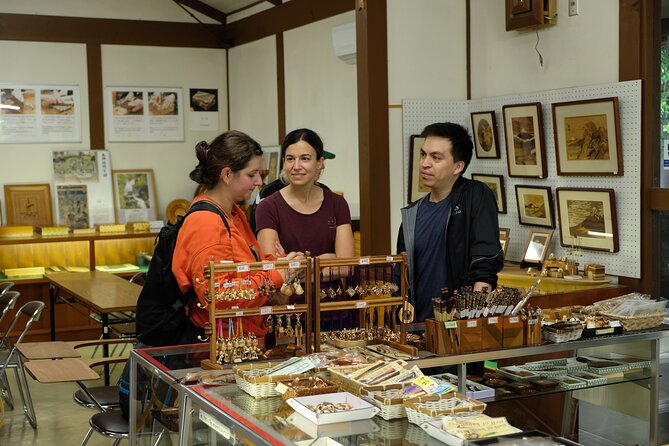
Hakone is known for traditional woodwork, especially decorative patterns made from carefully assembled pieces of different wood. The village gives you a chance to understand that craft in its home setting rather than seeing it only in a shop display.
This stop also breaks up the walk at a sensible point. You have been on the trail for about an hour, so a village visit gives you a change of pace before the next section. It is a good fit if you enjoy local skills and small communities more than a nonstop hike.
After Hatajuku, you take a bus to skip the steepest part of the trail. This is an important detail, not a minor footnote. You still walk the most scenic and historically interesting sections, but you do not have to tackle the route’s hardest climb.
The bus fare costs less than 400 yen and is not included in the tour price. The trade-off is practical: you save energy for the forest and Lake Ashi, but you lose a continuous section of the old road. If your goal is to complete every step of the Hachiri route on foot, this half-day option is not the right version.
Amasake at a 400-year-old tea house
The bus brings you to the Hakone Amazake Tea House, a stop with about 400 years of history. You spend roughly 30 minutes here and receive an amasake drink.
Amasake is a traditional sweet rice drink. Despite its name, it is not necessarily an alcoholic beverage, and it is commonly served as a warming refreshment. Here, the drink is part of the place itself, not just a convenient café break.
The tea house gives the hike a welcome human pause. You have moved from a railway station into the woods, passed through a craft village, and then arrive at a building connected to the old road. The drink helps make the route feel like a series of lived-in places rather than a nature walk with a lecture attached.
The stop may be especially appealing if you like small food and drink traditions. One account of the walk also describes barley tea and a traditional rice dessert during a rest in the village. The exact refreshment may vary, but the larger point is clear: you have time to stop, taste something local, and ask questions.
The extra bus cost is small, but remember to budget for it. The listed tour price of $114.95 per person covers the guide, not every expense along the way.
A few more options to weigh up in Hakone
- Hakone 6 hour Private Tour with Government-Licensed Guide
★ 5.0 · 218 reviews - Hakone Open-Air Museum Ticket
★ 4.9 · 133 reviews - Custom Private Tour in Hakone with a Certified Local Guide
★ 5.0 · 91 reviews - Hakone 8 hour Private Tour with Government-Licensed Guide
★ 5.0 · 63 reviews
Reaching Lake Ashi through the forest
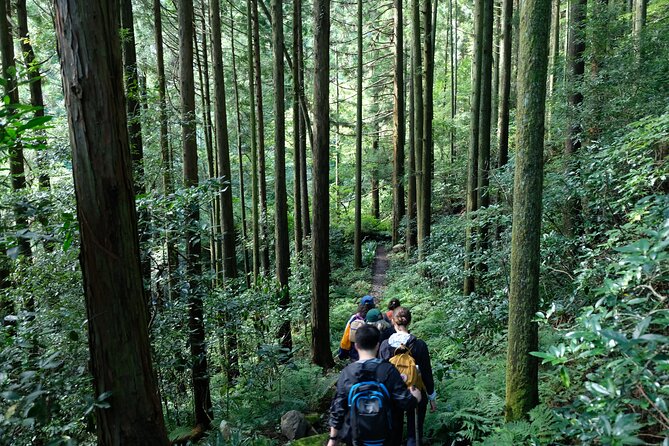
After the tea house, you continue toward Lake Ashi. This is the heart of the forest-bathing idea behind the tour. The trees and old trail provide a quieter setting than Hakone’s main transport hubs and hot-spring streets.
I like that the route ends at the lake rather than returning you to the starting station. That makes the excursion useful as part of a larger day. You finish at Motohakone around 1 p.m., where you can catch a bus toward Odawara, Hakone-Yumoto, or your Hakone hotel.
If the weather cooperates, you may see Mount Fuji across Lake Ashi. The view is never guaranteed, and the tour requires good weather, so you should not book it only for a Fuji photograph. Still, the possibility adds a strong finish to the walk.
The lake stop is allotted about an hour. That gives you room to take in the view and orient yourself for the next part of your day. It also means the walking portion is not rushed. You are not being pushed onto the next vehicle the moment you arrive.
You can also continue by ferry, including the pirate ship service from the Lake Ashi area. That can turn the hike into a convenient point-to-point outing: walk through the old forest route in the morning, then see Hakone from the water afterward.
Hakone Checkpoint and the road’s political story
The final historical stop is the Hakone Checkpoint. Your guide explains why Hakone mattered in Japan’s past and how its position along the Tokaido road gave it importance.
A checkpoint was not merely a place to pause and stretch your legs. It helped authorities monitor movement along one of Japan’s major routes. That context changes how you see the road you have just walked. The cobbles, steep mountain passage, and controlled crossing all fit together.
The stop lasts about 30 minutes. If you have already visited other Hakone sights, this may be the part that adds the most meaning. Instead of seeing the area only as a scenic resort, you begin to understand its role in travel and government.
The guide’s explanation is central here. Without it, a checkpoint can be easy to glance at and leave. With a good guide, it becomes the final piece in the story of the route from Tokyo to Kyoto.
What $114.95 buys you
At $114.95 per person, this is not a cheap way to get from Hakone-Yumoto to Lake Ashi. You also pay separately for a shared taxi to the trailhead, listed at 2,000 yen to be divided among the group, plus the bus fare of less than 400 yen.
The value is in the small-group guiding. You are paying for a certified mountain guide, route interpretation, local context, and help navigating a trail that combines uneven stones, forest paths, village roads, and public transport.
The six-person maximum matters. A guide can answer questions more easily, keep the group together, and explain details without a microphone. For a historical walk, that personal scale is worth more than it would be on a simple scenic stroll.
I would compare the price with what you want from Hakone. If you only want a walk beside Lake Ashi, you can find cheaper ways to reach the lake. If you want to understand the old Tokaido, visit Hatajuku, stop at the historic tea house, and learn why the checkpoint mattered, the price is easier to justify.
Group discounts are available, and mobile tickets make the booking side simple. The tour is often reserved well ahead, with an average booking lead time of about 59 days, so I would not leave it until the last minute if your Hakone dates are fixed.
Fitness, weather, and practical limits
You need moderate physical fitness. The trail includes cobbled paths and forest sections, and the steepest part is skipped by bus rather than walked. That makes the hike more approachable, but it does not turn it into a flat city stroll.
Wear shoes suited to uneven ground. The supplied details do not specify equipment, so I would keep your gear simple and practical: comfortable walking shoes, water, and clothing suited to the forecast.
Weather is a real planning issue. The excursion requires good conditions, and poor weather can lead to a different date or a full refund. Even if the tour runs, clouds may hide Mount Fuji, so treat the view as a bonus rather than the main reason to book.
The tour starts at Hakone-Yumoto Station, which is near public transportation, and ends at Motohakone. You should plan your onward route before setting out, especially if you have luggage or a hotel reservation later in the day.
The tour is non-refundable and cannot normally be changed after booking. That makes travel insurance or a flexible schedule worth considering, particularly during a period of uncertain weather.
Who will enjoy this walk most
I would recommend this for you if you like walking with a story attached. It suits people who want forest time, traditional places, and historical explanation in one compact outing.
Families with older children may also find it a good fit. A 16-year-old completed the walk with a parent and had an especially positive experience with the guide. The small group and bus shortcut help keep the day from becoming an endurance test.
It is also a good choice for repeat visitors to Hakone. If you have already seen the standard hot springs and lake viewpoints, this route gives you a different way to understand the area.
I would hesitate if you want a serious, uninterrupted hike. The bus section removes the steepest climb, and the experience includes village and heritage stops. That is a strength for most people, but a drawback for anyone counting elevation gain and trail miles.
Should you book the Hakone Hachiri half-day hike?
Book it if you want a small-group walk through old Hakone, with a local guide, a traditional tea stop, and a useful finish at Lake Ashi. The strongest reasons are the quiet forest, the preserved cobbles, and the chance to hear the route explained by guides such as Akihiro and Aki.
Skip it if you want guaranteed Mount Fuji views, a low-cost transfer, or a full-day mountain hike. The price is higher than arranging transport yourself, and you must allow for extra fares and weather uncertainty.
For the right kind of visitor, this is one of the better ways to spend a Hakone morning. You walk enough to feel the old road beneath your feet, but the bus saves your legs for the lake, the checkpoint, and whatever comes next.
FAQ
Where does the hike begin?
The tour begins at Hakone-Yumoto Station in Hakone, Kanagawa, at 9 a.m.
Where does the tour finish?
It finishes at Motohakone near Lake Ashi at around 1 p.m. From there, you can take a bus toward Odawara, Hakone-Yumoto, or Hakone hotels.
How long is the tour?
The full experience lasts approximately four hours. The walking portion takes about two to three hours.
Is transportation included?
Transportation to the trailhead is not included. A shared taxi costs 2,000 yen to be divided among the group, and the bus to the tea house costs less than 400 yen.
How many people can join?
The group has a maximum of six participants.
What fitness level is required?
You should have a moderate level of physical fitness. The route includes cobbled paths and forest trails, while the steepest section is skipped by bus.
What happens if the weather is poor?
The tour requires good weather. If it is canceled because of poor conditions, you will be offered another date or a full refund.
Just added in Hakone
- Hakone Open-Air Museum Ticket★ 4.9 · 133 reviews
- Forest Bathing in Temple and Enjoy onsen with healing power★ 5.0 · 17 reviews
- Odawara Castle and Town Guided Discovery Tour★ 5.0 · 15 reviews
- Traverse Outer Rim of Hakone Caldera and Enjoy Onsen Hiking Tour★ 5.0 · 30 reviews
- Private Hakone Half-day Car Tour with Hotel Pickup – Local Guide★ 5.0 · 48 reviews
- Hike Japan Heritage Hakone Hachiri with certified mountain guide★ 5.0 · 46 reviews
- Hike Hakone Hachiri★ 5.0 · 48 reviews
- Easygoing Nature Walk in Hakone Tour★ 5.0 · 15 reviews
Hiking and Trekking, compared.
Fushimi Inari Hidden Hiking Tour (Private Option Available)
Read our review →![[Nagoya Kamikochi Hiking Tour] One-Day Nature Forest Hiking Tour of Kamikochi & Taisho Pond & Tashiro Pond & Kappa Bridge & Myojin Pond & Hotaka Mountain Range & Hotaka Shrine Okumiya (Departure from Nagoya)](https://media.japanvisits.com/wp-content/uploads/nagoya-kamikochi-hiking-tour-one-day-nature-forest-hiking-tour-of-kamikochi-taisho-pond-tashiro-pond-kappa-bridge-myojin-pond-hotaka-mountain-range-hotaka-shrine-okumiya-departure-from-nagoya-k132013-400x733.jpg)
Hiroshima Local guided Hiking Tour&Open-air Tea Ceremony
Read our review →![Hiking the Historic Nakasendo Trail [1 Day Tour from Nagoya]](https://media.japanvisits.com/wp-content/uploads/hiking-the-historic-nakasendo-trail-1-day-tour-from-nagoya-400x267.jpg)
Hiking the Historic Nakasendo Trail [1 Day Tour from Nagoya]
Read our review →
Kyoto Hiking Tour: The Nature and Legends of Kurama and Kibune
Read our review →
Browse the lists this tour appears in