
Reviewed · HIROSHIMA TOURS
Mitaki Peace Tour Beyond Central Hiroshima
A quiet mountain changes Hiroshima. This small-group outing links the Atomic Bomb Dome and Peace Memorial Park with Mitaki Temple, a wooded mountainside retreat founded in 809. I like the way the tour gives you two very different views of Hiroshima: first, the hard facts of the bombing, then a calm place where local people have reflected for centuries. I also like the easy use of public transportation and the maximum group size of six. The main drawback is the walking. Paths rise through temple grounds, so this is not a good fit if you have trouble walking.
The tour costs $88.68 and lasts about three hours 25 minutes to four hours. That is a fair price if you want context, a guide, temple admission, and transportation handled together. You will not spend the whole afternoon in central Hiroshima, though, and Mitaki’s quiet setting may appeal more to you after you have already visited the major Peace Memorial sites.
The tour begins at 1 p.m. at the Hiroshima Peace Memorial Park Rest House and ends at Hiroshima Station, with the option to leave earlier at Yokogawa or Hakushima stations. Bring water, wear comfortable shoes, and expect a reflective afternoon rather than a fast sightseeing circuit.
In This Review
- Key points to know before booking
- Why the Peace Park introduction matters
- Taking the local bus from the Atomic Bomb Dome
- Walking from Mitaki area to the temple
- Seeing Mitaki Temple through its peace memorials
- What the guide adds to the visit
- Returning by train from Mitaki Station
- Is $88.68 a fair price?
- Who should choose this tour?
- Practical details worth knowing
- Should you book the Mitaki Peace Tour?
- FAQ
- Where does the Mitaki Peace Tour start?
- What time does the tour begin?
- How long does the tour last?
- What transportation is included?
- Is Mitaki Temple admission included?
- Where does the tour end?
- How many people can join the tour?
- Is the tour suitable for people with walking difficulties?
- What happens if bad weather cancels the tour?
Key points to know before booking
- A rare two-part view of Hiroshima: Start with the Atomic Bomb Dome, Rest House, and possibly the hypocenter, then consider peace and memory in a historic mountain temple.
- Mitaki Temple feels far removed from downtown: The temple is close to Hiroshima Station, yet its trees, stone statues, pagoda, and quiet paths create a very different mood.
- The group is limited to six people: That matters on narrow temple paths and gives you a better chance to ask questions.
- Public transportation is part of the experience: The tour uses a local bus from the Atomic Bomb Dome area and a train from Mitaki Station.
- Autumn can be especially beautiful: Several accounts describe late-season red leaves still scattered around the grounds in early December.
- Walking ability matters: The route includes a walk to the temple, uphill or uneven sections through the grounds, and a walk back to Mitaki Station.
Why the Peace Park introduction matters
The first hour places Hiroshima’s story in clear view. You meet at the Rest House, a building damaged by the atomic bomb, and then walk through several important areas of Peace Memorial Park with your guide.
The Atomic Bomb Dome is the best-known stop. Its exposed frame and damaged walls make the bombing feel less like a distant historical chapter and more like something that happened to a real building in a real neighborhood. The guide’s explanations help you read the site with care rather than simply taking a photograph and moving on.
Depending on time, the walk may also include the hypocenter. This is useful because it helps connect the city’s memorial sites to the actual location of the blast. The tour does not treat Peace Park as a separate sightseeing item. Instead, this first section prepares you for the second half at Mitaki Temple.
That connection is the heart of the outing. Mitaki is not only a scenic temple. It also contains preserved structures damaged by the atomic bombing, peace-related monuments, and reminders of how Hiroshima’s history reaches beyond the central memorial district.
The timing works well for a half-day plan. At 1 p.m., you have the morning free for the Hiroshima Peace Memorial Museum, Miyajima, or a slower start. If you visit the museum on the same day, remember that the tour’s explanations at Peace Park will add another layer to what you have already seen.
The first section is also the more emotionally demanding part. The subject is serious, and the guide provides historical context rather than turning the visit into a casual photo walk. You should choose this tour because you want that thoughtful approach.
A few more options to weigh up in Hiroshima
- Peaceful Hiroshima & Miyajima UNESCO 1 Day Bus Tour
★ 5.0 · 5,309 reviews - Hiroshima Peace Memorial Museum Ticket
★ 4.8 · 2,727 reviews - Hiroshima: Hiroshima and Miyajima UNESCO Sites 1-Day Tour
★ 4.9 · 2,330 reviews
Taking the local bus from the Atomic Bomb Dome
After the Peace Park walk, you take a local bus from the Atomic Bomb Dome area toward Mitaki. The bus fare is included, which removes one small but useful piece of planning from your afternoon.
I like this change of pace. You leave the memorial district and travel into a quieter part of Hiroshima, watching the city shift as you go. The ride is not presented as a special attraction, but it connects the two halves of the tour in a practical way.
The tour is capped at six people. That is a good size for public transportation and for the narrow paths around the temple. It also means the guide can keep the group together without shouting across a large crowd.
The exact bus duration is not listed, so you should think of this as part of the approximate schedule rather than a precisely timed transfer. The tour runs in good weather, and poor weather can lead to a different date or a full refund.
Walking from Mitaki area to the temple
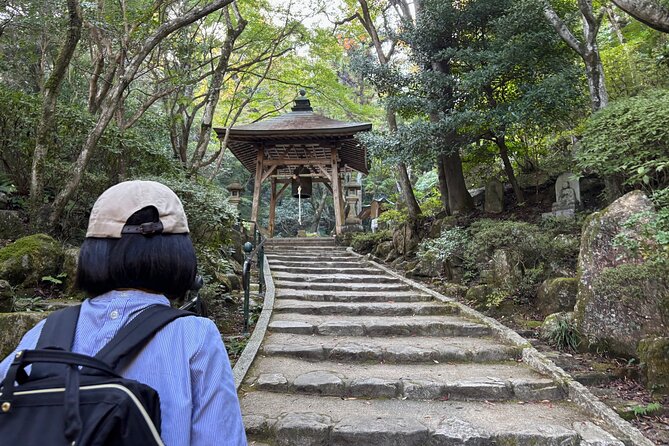
Once you leave the bus, you walk for about 10 minutes to Mitaki Temple. The pace is described as relaxed, with stops at a few points of interest along the way.
This short approach is important. You do not simply step off a bus at a major entrance and rush through a checklist. The route lets you shift your attention from the busy center to a quieter setting before the temple visit begins.
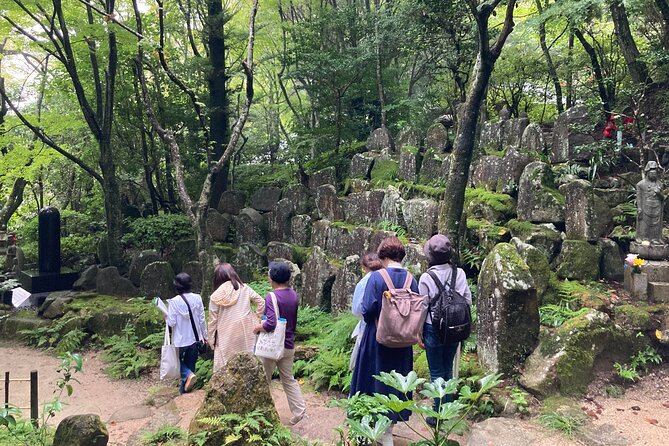
Mitaki Temple was founded in 809 and has been valued by local people for centuries. Its age is only part of the appeal. The setting, with trees, stone Buddhist figures, old structures, and mountain paths, gives the visit a strong sense of place.
You should take the word relaxed seriously, but not confuse it with completely flat or effortless. The tour is not recommended for people with walking difficulties. Comfortable shoes are a must, and water is not included, so carry a bottle or another drink.
Seeing Mitaki Temple through its peace memorials
The main temple visit lasts about two hours and 50 minutes, according to the tour schedule. That time includes the walk from the bus area, the temple visit, and the route toward Mitaki Station, so the actual time inside each section may vary.
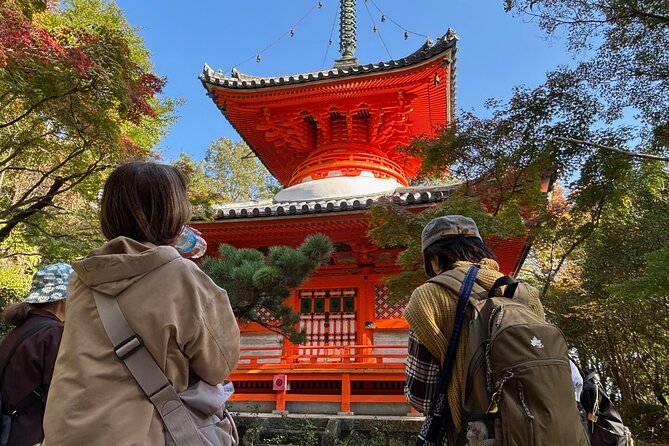
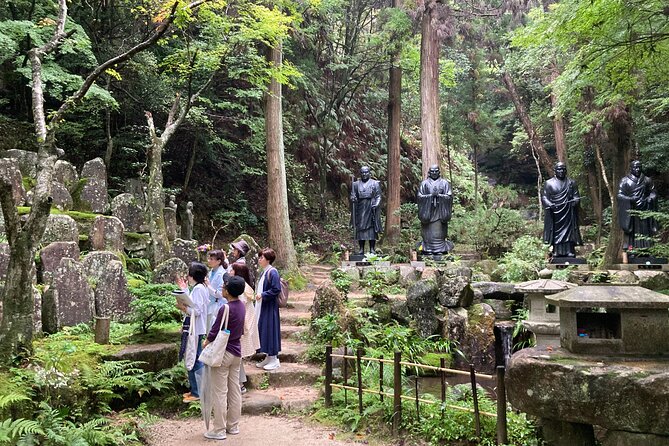
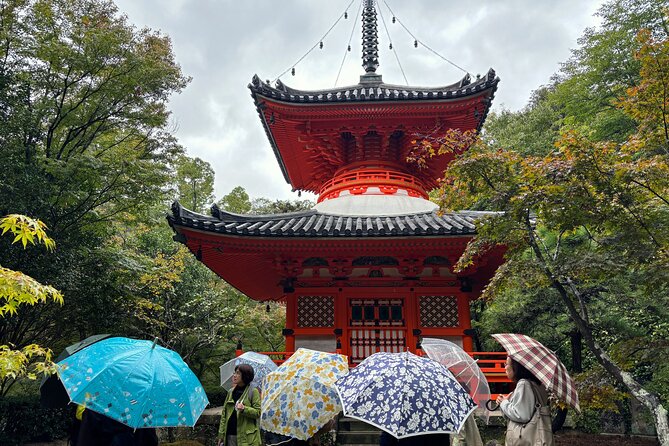
Inside the grounds, the guide points out the temple’s striking pagoda, bell hall, stone Buddhist statues, and other points of interest. These details give the visit visual variety. You may pause for photographs, but the purpose is not simply to collect attractive images.
The temple’s atomic-bomb-damaged structures and peace monuments give Mitaki a direct link to Hiroshima’s modern past. This is what makes the tour different from a standard temple visit. You can appreciate the quiet setting while also learning how the bombing affected places outside the central memorial area.
The contrast is powerful. Peace Memorial Park is open, urban, and deliberately focused on public remembrance. Mitaki is wooded, intimate, and shaped by centuries of religious practice. Seeing both in one afternoon helps you understand that Hiroshima’s story is not confined to one park or one monument.
The temple is also a good place to slow down. Several accounts describe its calm atmosphere, natural setting, and traditional Japanese feel as major strengths. The late autumn scenery can be lovely, with red leaves still scattered around the grounds in early December. Seasonal color is never guaranteed, but autumn appears to be a particularly rewarding time to go.
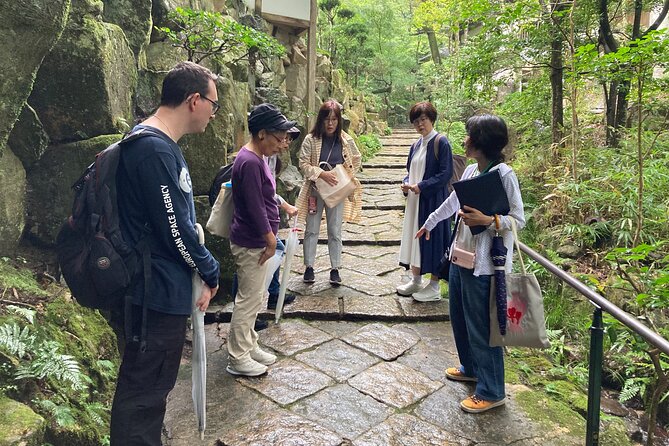
The paths are not wide, which is another reason the small group works well. You should be ready to follow the guide closely and make room for other people using the grounds. The quiet atmosphere is part of the appeal, so this is not a tour built around constant conversation or a busy schedule.
A completely different kind of day out:
- Hiroshima Peace Memorial Museum Admission
★ 4.6 · 1,308 reviews - Hiroshima / Miyajima Full-day Private Tour with Government Licensed Guide
★ 5.0 · 1,298 reviews - Hiroshima Historical Walking Tour – Why A-Bomb was Dropped
★ 4.8 · 893 reviews - Hiroshima Peace (Heiwa) Walking Tour at World Heritage Sites
★ 5.0 · 872 reviews
What the guide adds to the visit
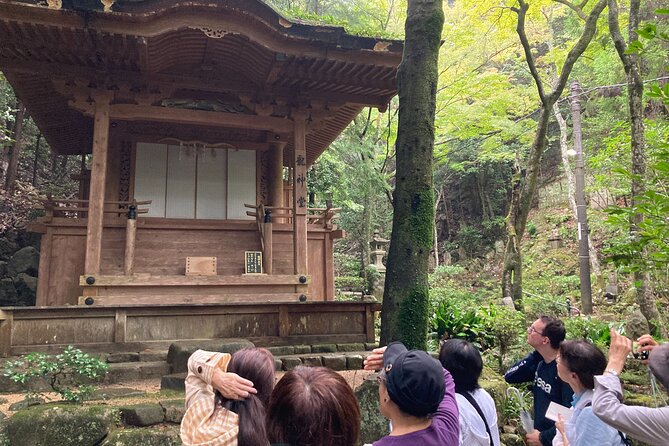
Mitaki Temple has enough visual appeal to visit on your own, but the historical connections are easier to miss without help. The guide explains the temple’s relationship to the atomic bombing and places its memorials and damaged structures in context.
That added explanation is the tour’s strongest practical benefit. Even people who have visited Mitaki before may notice more when someone points out details that are not obvious from signs or online information.
The tour includes a licensed local guide. No individual guide name is provided, so I cannot tell you who will lead your departure. What you can expect is a small-group format, local explanations, and an opportunity to ask questions as you move between the city and the temple.
The guide also helps with the transitions. Hiroshima’s public transportation is manageable, but navigating a bus transfer and a train return takes attention. Here, you can focus on the places rather than checking every step of the route.
A postcard made from recycled paper, featuring a crane and a stamp, is included. It is a small item, but it fits the subject of the tour and gives you a simple keepsake without adding another stop to the schedule.
Returning by train from Mitaki Station
After the temple visit, you walk to Mitaki Station and take the train back toward Hiroshima. The included fare covers travel to Hiroshima Station, Yokogawa Station, or Hakushima Station.
The guide accompanies the group to Hiroshima Station, which is two stops from Mitaki. You can also get off at Yokogawa, the next stop, or Hakushima, the one after that. This flexibility is useful if your hotel or evening plans are closer to one of those stations.
The official end point is Hiroshima Station, but the train options make the tour easier to fit into a wider itinerary. You might finish with dinner near the station, continue to another part of the city, or leave the train earlier to shorten your walk back to your accommodation.
The schedule gives an approximate total of three hours 25 minutes to four hours. Since the tour starts at 1 p.m., plan for an end between roughly 4:25 and 5 p.m., allowing for the actual pace of the group and transportation.
Is $88.68 a fair price?
At $88.68 per person, this is not the cheapest way to reach Mitaki Temple. You are paying for more than transportation, though. The price includes the local bus, return train, temple admission, licensed guide, small-group setting, and the planned historical connection between Peace Park and Mitaki.
I see the value in the structure. If you visit independently, you will need to research the temple, work out the bus and train connections, pay admission, and make the link between the bombing and the temple’s memorials yourself. The tour handles those pieces in one afternoon.
The value depends on your interests. If you want a quick visit to a temple and prefer to explore alone, the cost may feel high. If you want the history explained and like the idea of combining a major memorial district with a quieter local site, the price is easier to justify.
A maximum of six people is another plus. Private tours cost more, while large group tours can feel rushed or impersonal. This sits between those two options and keeps the group small enough for a narrow temple route.
Who should choose this tour?
I would recommend it to you if you have already planned time for Hiroshima’s major memorial sites and want a different setting for reflection. It also suits anyone who likes combining history, local transportation, light walking, and traditional religious sites in one outing.
It is especially good for people who want more than the standard central Hiroshima route. Mitaki is close enough to reach without a full-day commitment, yet it feels removed from the city’s main sightseeing flow.
You should think twice if you have limited mobility, dislike walking on temple paths, or want a completely unstructured afternoon. The tour follows a set route and requires walking from the bus area to the temple and then on to the station.
It may also be less suitable if you are looking for a cheerful, entertainment-focused activity. The Peace Park portion deals directly with the atomic bombing, and the Mitaki visit encourages quiet thought. That serious tone is a strength for the right person, but it is not for everyone.
Practical details worth knowing
The meeting point is the Hiroshima Peace Memorial Park Rest House, at 1-1 Nakajimacho in Naka Ward. The start time is 1 p.m., and confirmation is provided when you book.
The activity is near public transportation, and most people can participate. It is not recommended for those with walking difficulties.
Admission to Mitaki Temple is included. Bus fare from the Atomic Bomb Dome area to the Mitaki area and train fare from Mitaki Station to Hiroshima Station, Yokogawa Station, or Hakushima Station are also included.
Bring bottled water because drinks are not provided. A mobile ticket is available, which keeps the booking process simple.
Free cancellation is available if you cancel at least 24 hours before the local start time. Cancellations or changes made less than 24 hours in advance are not refunded or accepted. If poor weather causes the tour to be canceled, you will be offered another date or a full refund.
Should you book the Mitaki Peace Tour?
Book this tour if you want Hiroshima to be more than a list of memorials. The most worthwhile feature is the connection between the Atomic Bomb Dome and Mitaki Temple, where peace, local religious life, nature, and the city’s wartime past meet in one afternoon.
I especially like the small group, included transportation, and the chance to see autumn color in a quiet mountain setting. The tour asks you to walk and to engage with difficult history, but that is also what gives it purpose.
Skip it if you want a flat route, a short photo stop, or a completely independent temple visit. For most people who have time for one more meaningful Hiroshima experience beyond the center, the $88.68 price is reasonable and the change of scene is well worth it.
FAQ
Where does the Mitaki Peace Tour start?
It starts at the Hiroshima Peace Memorial Park Rest House in Nakajimacho, Hiroshima.
What time does the tour begin?
The tour begins at 1 p.m.
How long does the tour last?
The approximate duration is three hours 25 minutes to four hours.
What transportation is included?
Bus fare from the Atomic Bomb Dome bus stop area to the Mitaki area is included. Train fare from Mitaki Station to Hiroshima Station, Yokogawa Station, or Hakushima Station is also included.
Is Mitaki Temple admission included?
Yes, the entrance fee for Mitaki Temple is included.
Where does the tour end?
The guide accompanies the group to Hiroshima Station. You may also leave at Yokogawa Station or Hakushima Station.
How many people can join the tour?
The tour has a maximum of six participants.
Is the tour suitable for people with walking difficulties?
No. The tour is not recommended for people with walking difficulties because it includes walks to the temple, through the temple grounds, and to Mitaki Station.
What happens if bad weather cancels the tour?
You will be offered a different date or a full refund. Free cancellation is also available when you cancel at least 24 hours before the scheduled start time.
Just added in Hiroshima
- Hiroshima Peace Memorial Museum Ticket★ 4.8 · 2,727 reviews
- Hiroshima Peace Memorial Museum Admission★ 4.6 · 1,308 reviews
- Private Full Day Hiroshima Tour★ 4.5 · 29 reviews
- The Peace Memorial to Miyajima : Icons of Peace and Beauty★ 4.5 · 31 reviews
- Shore Excursion from Hiroshima Port : Private Tour in Hiroshima★ 5.0 · 17 reviews
- Hiroshima & Miyajima All-Inclusive Tour w/Licensed guide Pancho★ 5.0 · 54 reviews
- Hiroshima Country Cycling: Explore Rural Life 1 HR from City★ 5.0 · 22 reviews
- Hiroshima Saijo Sake Tasting Tour with visit to 7 Breweries★ 5.0 · 104 reviews
Hiroshima Tours, compared.
Peaceful Hiroshima & Miyajima UNESCO 1 Day Bus Tour
Read our review →
Hiroshima and Miyajima UNESCO Sites 1-Day Tour
Read our review →

Hiroshima / Miyajima Full-day Private Tour with Government Licensed Guide
Read our review →
Hiroshima Historical Walking Tour – Why A-Bomb was Dropped
Read our review →
Hiroshima Peace (Heiwa) Walking Tour at World Heritage Sites
Read our review →
Hiroshima in a Nutshell: Morning Bike Adventure
Read our review →Browse the lists this tour appears in