
Reviewed · WALKING TOURS
Hiroshima Peace (Heiwa) Walking Tour at World Heritage Sites
History feels close here. This five-hour Hiroshima walking tour links the Peace Memorial Museum, Atomic Bomb Dome, Children’s Peace Monument, and Orizuru Tower with a local guide who can explain both the facts and the human cost. I especially like the small group size, capped at eight people, and the included lunch, which gives you time to pause before continuing. The main concern is crowding at the museum, especially around busy holidays, when seeing the central exhibits may take extra time.
The tour is led by a MagicalTrip Certified Guide, and the strongest praise goes to guides such as Yuji, Kaori, Hiro, Etsuko, Yasue, Tommy, and Mizu. Their approach appears to be warm and serious without turning Hiroshima into a simple war-history lesson. You will hear about the bombing, but also about ordinary life, rebuilding, family memories, and the city’s continuing message of peace.
At $94.84 per person, this is not the cheapest way to walk through Peace Memorial Park. Still, the fee covers the museum, Orizuru Tower, lunch, a guide, and tour photos. If you want someone else to handle the route and add context at each stop, the price can make sense. If you prefer reading at your own pace or need a flexible, accessible route, an independent visit may suit you better.
In This Review
- What makes this Hiroshima tour worth considering
- Starting near Kamiyacho and setting the tone
- Spending an hour inside the Peace Memorial Museum
- The Cenotaph and Children’s Peace Monument
- Walking to the Atomic Bomb Dome
- Lunch and the modern view from Orizuru Tower
- The guides are the real value
- Is $94.84 a fair price?
- Who should book this walking tour?
- FAQ
- How long does the Hiroshima Peace Walking Tour last?
- What is included in the tour price?
- How many people can join the tour?
- Is the tour suitable for someone with mobility issues?
- Can the tour accommodate gluten-free meals or allergies?
- What happens if the weather is poor?
- Should you book it?
What makes this Hiroshima tour worth considering
- The museum visit anchors the day: You get about an hour at the Hiroshima Peace Memorial Museum, with a guide to help explain what you are seeing.
- The group never exceeds eight people: This is small enough for questions and personal conversation, unlike a large coach excursion.
- The route connects symbols of survival: The Aogiri tree, Children’s Peace Monument, Cenotaph, and Atomic Bomb Dome each offer a different way to understand Hiroshima.
- Orizuru Tower changes the view: The observatory gives you a broad look at today’s city after the emotionally heavy museum visit.
- Lunch is included: You do not need to find a restaurant during the tour, and the meal gives the group time to reflect.
- The tone is human, not only historical: Guides are praised for explaining daily Japanese life and sharing personal or local perspectives.
Starting near Kamiyacho and setting the tone
The meeting point is at MontbellJapan in Kamiyacho, in Hiroshima’s Naka Ward. The location is near public transportation, which helps if you are coming from another part of central Hiroshima. Confirmation is provided at booking, so check the exact meeting instructions before setting out.
The opening stop is Hiroshima Peace Memorial Park. You spend about ten minutes getting oriented before the museum visit, though the park itself deserves more than a quick glance. The park is not simply a collection of monuments. It is a place where Hiroshima asks you to remember the people who died, consider the cost of war, and think about what peace requires now.
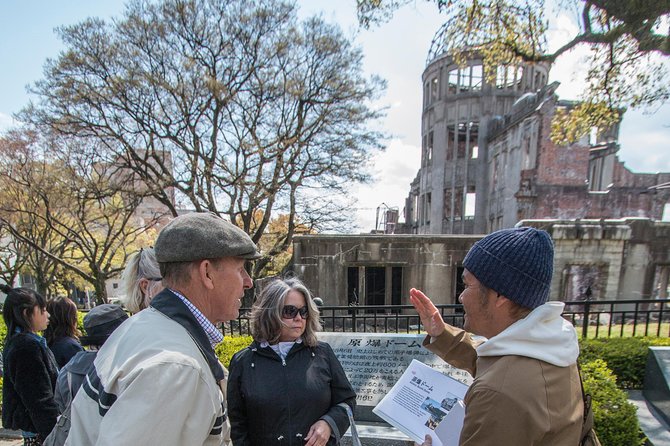
Your guide’s role matters from the first minutes. The park contains memorials with meanings that are easy to miss if you hurry from one photo stop to another. A local guide can explain why certain monuments were built and how they fit into Hiroshima’s message.
This is also the point where you should prepare yourself emotionally. The tour is respectful, but Hiroshima’s history is difficult. Some museum displays contain graphic images that may upset young children. If you have concerns, tell the guide early so the visit can be handled with care.
More Walking Tours in Hiroshima
- Hiroshima Historical Walking Tour – Why A-Bomb was Dropped
★ 4.8 · 893 reviews - Hiroshima City 4hr Private Walking Tour with Licensed Guide
★ 5.0 · 437 reviews - Hiroshima Walking Tour Why A Bomb was dropped to Hiroshima
★ 5.0 · 347 reviews
Spending an hour inside the Peace Memorial Museum
The museum is the heart of the experience. The planned visit lasts about one hour, and admission is included. You will learn about the atomic bombing at 8:15 a.m. on August 6, 1945, the immediate suffering, and the long effects on people and families.
The museum is not presented as a distant military event. The focus is on individuals, belongings, injuries, memories, and the way the bombing changed daily life. This human scale is one of the tour’s strongest features. Guides such as Hiro and Etsuko have been praised for explaining personal stories and the experiences of later generations, rather than stopping at dates and battlefield facts.
I like that the tour frames the museum within Hiroshima’s recovery. You are not asked to see the city only as a place of destruction. The guide helps connect the museum to the people who rebuilt their lives and to the city’s continuing work for peace.
Allow yourself enough mental space here. One hour is useful, but it may feel short if you want to study every display. During especially crowded periods, including the end of the year, the main exhibit can require more than an hour just to enter or view properly. That is the clearest practical weakness of a fixed group tour. The schedule keeps moving, and you may not be able to linger over every section.
If the museum is your main reason for booking, check the date and expected crowd levels before you commit. The guide can add meaning, but no guide can remove a long line or make a packed gallery spacious.
The Cenotaph and Children’s Peace Monument
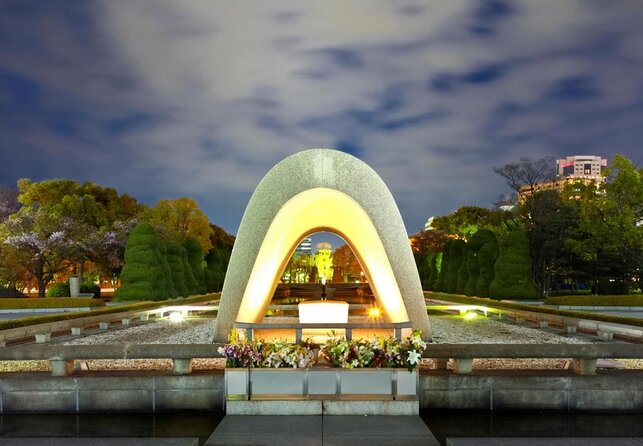
After the museum, the tour moves through two important memorials in the park. The Hiroshima Peace City Monument, commonly called the Cenotaph for the Atomic Bomb Victims, receives about five minutes. Its shape and placement are simple, but the memorial carries the names of those who died.
The short stop works best if you have already seen the museum. The Cenotaph gives you a quiet place to connect the museum’s individual stories with the wider number of victims. Your guide can explain the monument’s purpose and the wording associated with its memorial message.
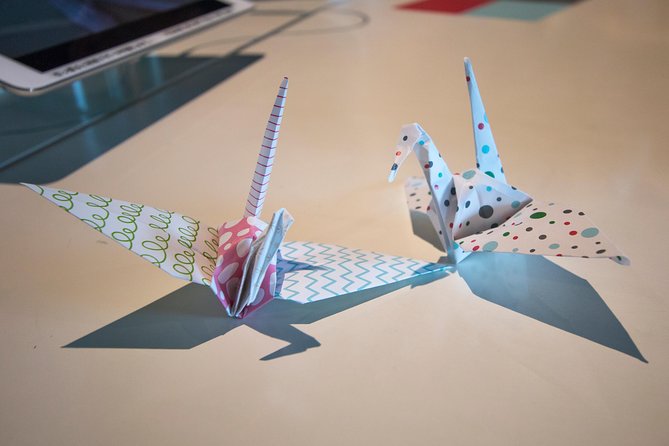
The Children’s Peace Monument follows, with about ten minutes. This monument is linked to children affected by the bombing and is covered with colorful paper cranes. Your guide explains its meaning and the role of cranes as a symbol of peace and hope.
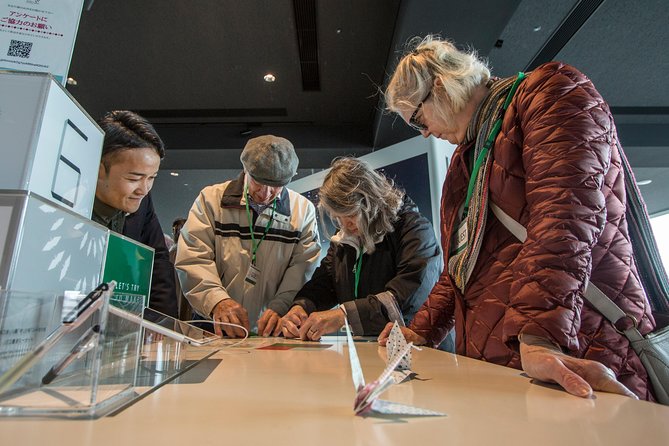
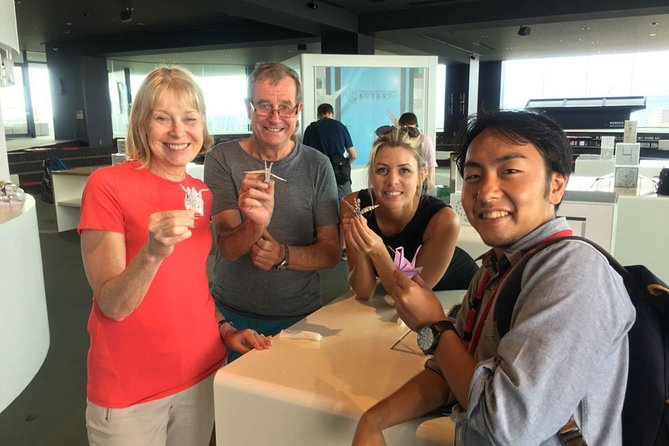
Several guides have added a personal touch here by helping people make or understand origami cranes. One group described folding cranes at a scenic city viewpoint later in the tour. That activity is not listed as a guaranteed separate stop, so you should not book the tour solely for it, but it reflects the gentle, personal style that some guides bring to the day.
The stop is brief, yet it can be one of the most affecting. Children’s memorials make the history especially direct. Families with young children should decide in advance how much detail is appropriate, since the museum and the surrounding monuments can be upsetting.
Walking to the Atomic Bomb Dome
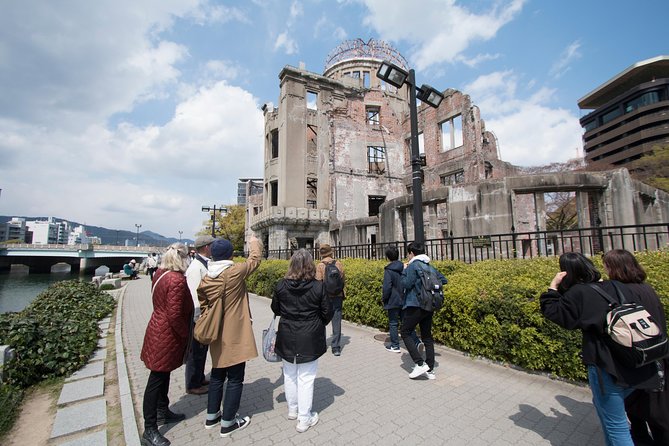
The route continues to the Atomic Bomb Dome, one of Hiroshima’s best-known sights. You spend about fifteen minutes here. The preserved structure conveys the force of the atomic bomb and has become a symbol of the city’s appeal for peace.
The Dome is visually powerful because it is not a polished memorial. Its damaged frame remains exposed. You can see the contrast between the old structure and the modern city around it, a reminder that Hiroshima was not left frozen in 1945.
A guide adds useful context at this stop. Without explanation, you may see an old building beside the river and take a few photographs. With the historical setting explained, the Dome becomes part of a larger story about destruction, survival, remembrance, and rebuilding.
The walking itself is manageable for most people, but this is not a good choice if you have serious mobility limits. The tour is not recommended for people who have difficulty walking, and a private tour is suggested instead. Bring comfortable shoes. In summer, Hiroshima can be very hot and humid, with temperatures sometimes reaching 40°C, or 110°F. Water and a hat are sensible. Winter can also be cold, with lows reported as low as -5°C, or 20°F.
A completely different kind of day out:
- Peaceful Hiroshima & Miyajima UNESCO 1 Day Bus Tour
★ 5.0 · 5,309 reviews - Hiroshima Peace Memorial Museum Ticket
★ 4.8 · 2,727 reviews - Hiroshima: Hiroshima and Miyajima UNESCO Sites 1-Day Tour
★ 4.9 · 2,330 reviews - Hiroshima Peace Memorial Museum Admission
★ 4.6 · 1,308 reviews
Lunch and the modern view from Orizuru Tower
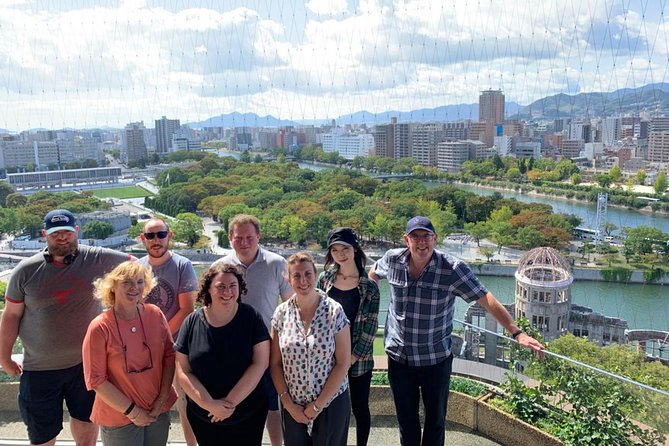
The final major stop is Hiroshima Orizuru Tower. Entrance is included, and lunch is served at or near the top of the tower, with about thirty minutes set aside. The viewpoint gives you a broad look at modern Hiroshima, creating a useful contrast with the museum and Dome.
This change of setting is more than a pleasant break. After several hours of difficult history, the view helps you see Hiroshima as a living city. The tour’s message is not only what happened here. It is also how people rebuilt, worked, raised families, and carried on.
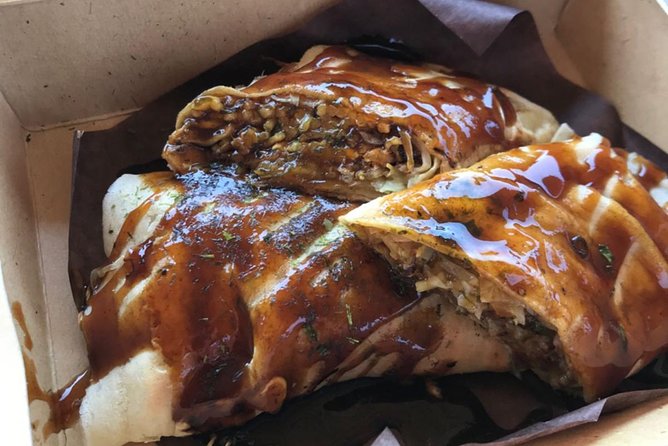
Lunch is included in the price, which makes the day easier. You do not need to search for a restaurant while trying to keep up with a group schedule. Food has been described as delicious and satisfying, though you should keep the dietary limits in mind.
MagicalTrip cannot guarantee allergy-free meals because the food is prepared in kitchens it does not operate. Gluten-free requests cannot be accommodated. Vegetarian choices are limited in many Japanese restaurants, although one vegetarian participant reported receiving two vegan choices. That suggests alternatives may sometimes be possible, but you should provide dietary information at least one day before the tour and understand that substitutions are not guaranteed.
You do not need to pay for the guide’s food or drinks. Additional food and beverages are available for purchase if you want something beyond the included meal.
The tour finishes near the lunch restaurant and Orizuru Tower area. The supplied end details also refer to the area near Chishaku-in Temple, so check the final confirmation for the precise end point if you have a tight afternoon plan.
The guides are the real value
The most praised part of this experience is not a monument. It is the guide. Names that appear repeatedly in strong feedback include Yuji, Kaori, Hiro, Etsuko, Yasue, Tommy, Mizu, Kinnei, Kaz, Angela, Mariko, and Yuri.
That range matters because the quality of a history tour depends heavily on the person leading it. Yuji is praised for combining Hiroshima’s historical sites with Japanese culture and city life. Kaori is noted for keeping a group moving smoothly and anticipating questions. Yasue receives praise for patience and careful answers. Etsuko is remembered for warmth, personal stories, and a handwritten message with a paper crane.
You should not assume you will receive a particular guide unless the operator confirms it. Still, the pattern is encouraging. The guides are not praised only for memorizing dates. They are valued for kindness, clear explanations, local connection, and respect for the subject.
This is especially important in Hiroshima. A poor guide could reduce the day to a list of facts. A good one helps you understand how the bombing affected individuals, how the city recovered, and why peace remains central to Hiroshima’s identity.
The tour has a 5.0 rating from 872 ratings and a 99 percent recommendation rate. Those figures suggest a consistently strong experience, while the crowding complaint points to the main issue that could affect your day.
Is $94.84 a fair price?
At $94.84, the tour asks you to pay for convenience and interpretation rather than admission alone. The museum and Orizuru Tower fees are included, along with lunch, a certified guide, photos, and a route through the main Peace Park sites.
For a first visit to Hiroshima, I see real value here. You get a structured half-day, a group limited to eight people, and help with the emotional and historical weight of the sites. The lunch also removes one practical decision from a busy day.
The value is weaker if you plan to spend several hours inside the museum. A self-guided visit would let you stay longer and return to displays at your own pace. You would also spend less, though you would need to arrange entry, meals, and the route yourself.
Group discounts may be available, which could help families or parties booking together. Free cancellation is allowed up to 24 hours before the start time. A cancellation made later is not refundable, and changes within that period are not accepted. Poor weather can lead to a new date or a full refund.
Who should book this walking tour?
I would recommend it most strongly for first-time visitors who want a clear introduction to Hiroshima in one morning and afternoon. It suits people who value local explanation, prefer a small group, and want the major memorials connected into one story.
It is also a good fit if you feel uneasy about navigating a heavy subject alone. Several guides are praised for creating a calm, respectful atmosphere and giving people room to process what they see.
Families should think carefully about the museum’s graphic displays. Older children and teenagers may find the visit meaningful, but young children may be disturbed. Tell the guide about your concerns.
People with limited mobility should choose a private option instead. The tour involves walking between sites and is not designed for those who find walking difficult. Anyone with strict dietary needs should also be cautious, especially with gluten-free or allergy-free requirements.
FAQ
How long does the Hiroshima Peace Walking Tour last?
The tour lasts approximately five hours.
What is included in the tour price?
The price includes admission to the Hiroshima Peace Memorial Museum and Orizuru Tower, lunch, a MagicalTrip Certified Guide, and tour photos.
How many people can join the tour?
The group has a maximum of eight participants.
Is the tour suitable for someone with mobility issues?
The tour is not recommended for people with mobility difficulties because it involves walking between several sites. A private tour is recommended instead.
Can the tour accommodate gluten-free meals or allergies?
Gluten-free requests cannot be accommodated. Allergy-free meals are not guaranteed because the food is prepared in kitchens outside MagicalTrip’s control. Tell the operator about dietary needs at least one day before the tour.
What happens if the weather is poor?
The tour requires good weather. If it is canceled because of poor weather, you will be offered another date or a full refund.
Should you book it?
Book this tour if you want Hiroshima explained by a local guide, not simply photographed. The combination of Peace Memorial Museum, memorials, Atomic Bomb Dome, Orizuru Tower, lunch, and an eight-person limit gives you a well-shaped half-day with little logistical work.
Skip it if you need hours alone in the museum, have strict dietary requirements, or cannot manage a walking route. For most first-time visitors, though, the careful guides, included admissions, lunch, and human focus make $94.84 a reasonable price for a serious and memorable introduction to Hiroshima.
Just added in Hiroshima
- Hiroshima Peace Memorial Museum Ticket★ 4.8 · 2,727 reviews
- Hiroshima Peace Memorial Museum Admission★ 4.6 · 1,308 reviews
- Private Full Day Hiroshima Tour★ 4.5 · 29 reviews
- The Peace Memorial to Miyajima : Icons of Peace and Beauty★ 4.5 · 31 reviews
- Shore Excursion from Hiroshima Port : Private Tour in Hiroshima★ 5.0 · 17 reviews
- Hiroshima & Miyajima All-Inclusive Tour w/Licensed guide Pancho★ 5.0 · 54 reviews
- Hiroshima Country Cycling: Explore Rural Life 1 HR from City★ 5.0 · 22 reviews
- Hiroshima Saijo Sake Tasting Tour with visit to 7 Breweries★ 5.0 · 104 reviews
Walking Tours, compared.
Kyoto Geisha Walking Tour: Gion District & Hidden Gems
Read our review →
Tokyo Tsukiji Fish Market Food and Culture Walking Tour
Read our review →
Gion Magical Night Walking Tour with Geisha Trivia
Read our review →
Imperial Palace and Shogun Historical Walking Tour
Read our review →
Gion Geisha District Walking Tour – Stories of Geisha
Read our review →
Shinjuku Local Bar and Izakaya Guided Walking Tour
Read our review →
Browse the lists this tour appears in