
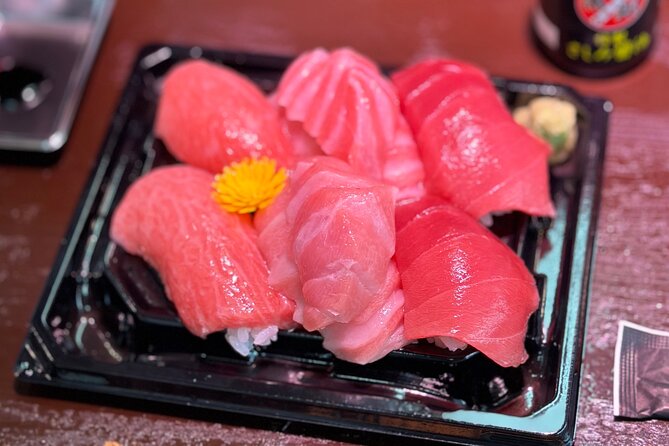
Reviewed · MARKETS AND FOOD HALLS
Tokyo: Tsukiji Fish Market Food and Walking tour
Tokyo’s tastiest shortcuts start here. This two-hour walk pairs the striking Tsukiji Hongwanji Temple with Tsukiji’s food lanes, where you choose and pay for only the dishes you want. I like the freedom of the no-set-menu format, and I like having a guide point out good stalls in a market that can feel confusing at first. The main catch is simple: food costs extra, and the temple takes the first 30 minutes.
The small-group limit of 10 makes it easier to ask questions and keep moving through crowded lanes. Guides such as Rie, Haydn, Jim, Minori, Sayaka, Shino, and Yayoi have been praised for friendly explanations and strong food advice. Bring cash in Japanese yen, and expect to spend more than the $30 tour price if you want to sample widely.
In This Review
- Key points to know before you book
- What this Tsukiji food walk is really like
- Starting at Tsukiji Hongwanji Temple
- One hour inside the Tsukiji market area
- Tsukiji Jogai Market and the food lanes
- The guides are a major part of the value
- What the $30 price includes, and what it does not
- Timing, meeting point, and group size
- Who should choose this experience?
- Should you book the Tsukiji food and walking tour?
- FAQ
- How long does the Tsukiji food and walking tour last?
- What places does the tour visit?
- Is food included in the tour price?
- Is there a fixed tasting menu?
- What kinds of food might I try?
- Where does the tour begin and end?
- How many people can join the tour?
- Can I cancel for a full refund?
Key points to know before you book
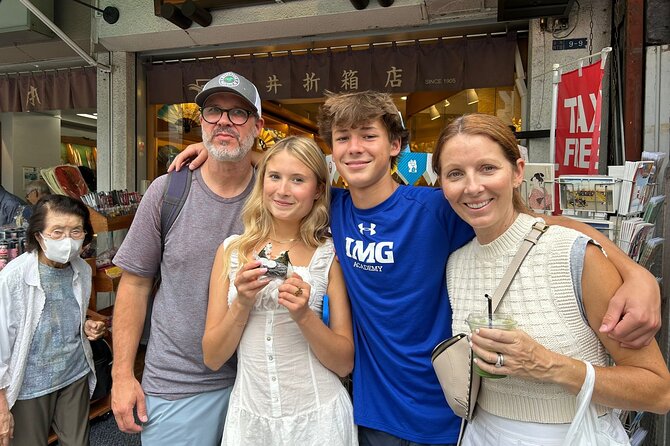
- You choose every bite: There is no fixed meal, so you pay only for the seafood, sushi, fruit, omelet, fish cakes, or other items you want.
- The market is only one hour of the tour: The route also includes 30 minutes at Tsukiji Hongwanji Temple and 30 minutes in Tsukiji Jogai Market.
- A guide makes food decisions easier: Your guide can help identify worthwhile stalls, explain unfamiliar ingredients, and steer you away from poor-value purchases.
- Plan for extra spending: Food and drinks are not included, and one practical estimate suggests carrying about 10,000 yen for tasting.
- It ends where it starts: Meet at the Starbucks Coffee by Tsukiji Station and return there after the walk.
- The group is capped at 10: That is useful in narrow, busy market lanes and gives the outing a more personal feel.
What this Tsukiji food walk is really like
Tsukiji is not one neat indoor market waiting to be toured in a straight line. It is an area of food shops, counters, specialist stalls, and narrow streets around the former wholesale market site. You can walk it alone, but the choices come quickly, the prices are not always obvious, and some foods need explanation before you order them.
That is where this experience earns its keep. The guide does not hand you a prepared tasting platter. Instead, you look, ask, choose, and buy. I prefer this approach because it lets you skip anything that does not appeal to you, while giving you a chance to try something you might otherwise overlook.
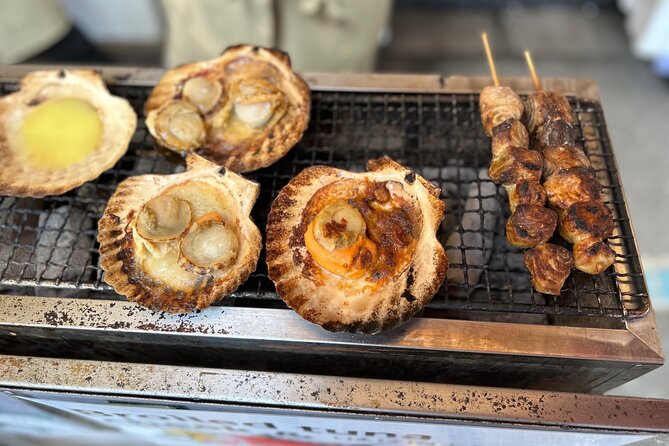
The food can include fresh seafood, sushi, fruit, Japanese omelets, fried fish cakes, eel, sea urchin, and wagyu beef. The exact selection depends on what you and the group want to see and eat that day. This is closer to a guided food crawl than a formal meal.
The pace is also flexible. The group can spend more time on foods that catch its interest, within the two-hour schedule. That flexibility is helpful for families and mixed groups, although it means the outing may feel less like a tightly scripted tour.
More Markets and Food Halls in Tokyo
- Tokyo Tsukiji Fish Market Food and Culture Walking Tour
★ 5.0 · 3,184 reviews - Senkyaku Banrai Toyosu Manyo Club Onsen Experience in Tokyo
★ 4.7 · 1,690 reviews - Tokyo: Tsukiji Fish Market Guided Walking Tour
★ 4.9 · 1,397 reviews
Starting at Tsukiji Hongwanji Temple
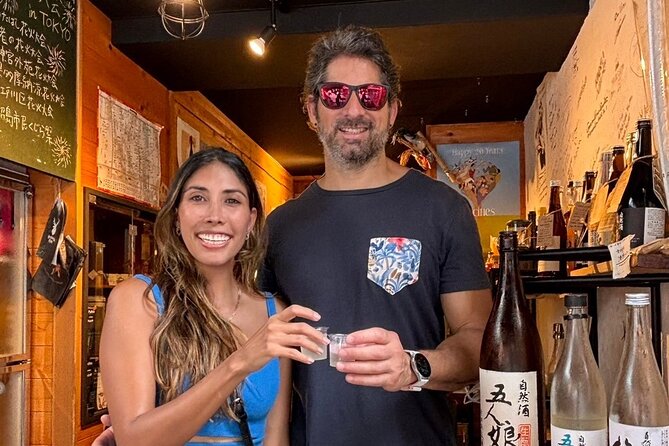
The meeting point is the Starbucks Coffee near Tsukiji Station, at 2-chome 12-8 in Tsukiji. From there, the walk begins at Tsukiji Hongwanji Temple, a notable site with unusual architecture and a calm atmosphere compared with the market streets.
You spend about 30 minutes here with the guide. This portion adds cultural context before the food stops begin, and guides such as Haydn have been praised for making the temple visit interesting and easy to follow. If you enjoy architecture, religion, and local customs, it gives the morning a useful sense of place.
Still, the temple is the tour’s most debatable feature. If you booked mainly for seafood and street food, half an hour may feel like time taken away from eating. One person specifically felt the temple could have been skipped. I would choose this experience more readily if I wanted a broader introduction to Tsukiji, not just a food sampler.
Admission to the temple is included. You do not need to arrange a separate ticket for this stop.
One hour inside the Tsukiji market area
The main market portion lasts about one hour. This is where the guide leads you through food sellers and explains ingredients connected with sushi and Japanese cooking.
Tsukiji is famous for its connection to Tokyo’s wholesale fish trade and the tuna auctions once held there. The tour helps explain that past and the area’s food culture, while taking you to places where you can actually taste what you are learning about.
The strongest part of the experience is the practical help. Rie, for example, has been praised for showing people which stalls offered good value and for pointing out places to avoid. Haydn was also praised for knowing the market well and helping the group decide what was worth buying. That matters because a dish can look appealing, yet you may not know whether it is a sensible purchase, a tourist-oriented item, or simply too much food for your budget.
You can ask questions about sushi ingredients, seafood, preparation, and local eating habits. A guide can also explain products that are difficult to identify from a sign alone. That makes the tour especially useful on your first visit to Tsukiji.
The food is not included, so this is not a sit-down tasting where you pay once and everything arrives. You buy individual items as you go. A cautious eater can keep spending low, while someone eager to try many foods can spend considerably more.
For a fuller tasting session, carry plenty of yen. One detailed tip puts the working budget at about 10,000 yen for samples, though your total depends on what you order. Cash is important because the food counters may not accept the payment method you normally use at home.
Tsukiji Jogai Market and the food lanes
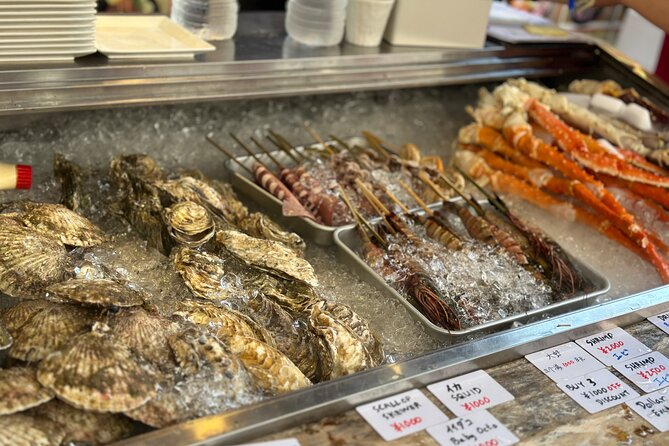
The final 30 minutes are spent walking through Tsukiji Jogai Market, an area filled with seafood shops, food counters, and stores tied to Japanese cooking. This section gives you more room to browse and compare than the formal temple stop.
You might find sushi, grilled or fried seafood, fruit, Japanese omelet, fish cakes, eel, sea urchin, or wagyu beef among the possible tastes. The guide may suggest several stops, but the group decides what to try. That makes this section feel personal rather than mass-produced.
I like the way the food plan can adapt to different appetites. You can focus on seafood, try a few small bites, or avoid a particular ingredient without wasting money on a fixed menu. Families and groups with different preferences should find this easier than a standard tasting tour.
The drawback is that two hours passes quickly. Thirty minutes at the Jogai Market is enough for a guided introduction, but not enough for a relaxed shopping trip and a long meal. If you want to buy kitchen goods, dried foods, gifts, or several larger portions, plan to return on your own.
You should also expect walking and standing. The experience is not described as especially strenuous, and most people can participate, but crowded market paths are not ideal for someone seeking a seated food tour.
More Walking Tours in Tokyo
- Tokyo: Imperial Palace and Shogun Historical Walking Tour
★ 5.0 · 2,251 reviews - Tokyo: Shinjuku Local Bar and Izakaya Guided Walking Tour
★ 4.9 · 1,794 reviews - Tokyo: Asakusa Walking Tour with Sensoji Temple Visit
★ 4.8 · 1,583 reviews - Tokyo Castle & Imperial PalaceーShogun Walking Tour
★ 4.7 · 1,068 reviews
The guides are a major part of the value
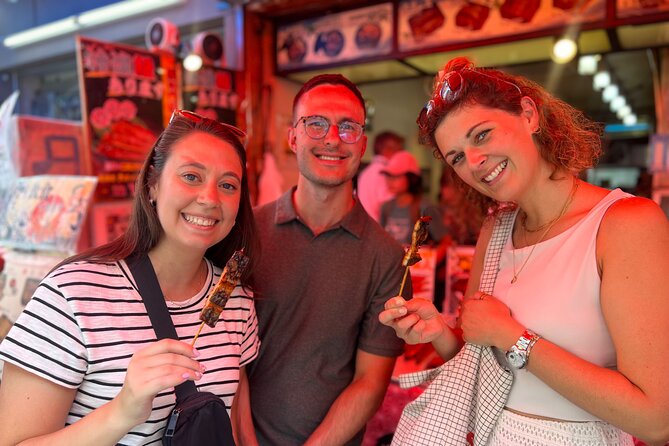
The tour’s quality depends heavily on the individual guide. That is normal for a small walking experience, and the strongest guide comments are consistent: friendly manner, good food suggestions, easy navigation, and willingness to answer questions.
Rie receives especially warm praise for her energy, care, and confidence in recommending less familiar foods such as sea urchin and eel. She also helped people avoid poor-value stalls and find similar products for less money. That kind of advice can make a real difference in a market where a few impulsive purchases add up.
Haydn has been praised for leading families through the market without making the experience too difficult for children. Jim has been noted for combining market information with wider cultural explanations. Minori, Sayaka, Shino, Yayoi, Joe, and Nicolas have also been praised for friendly guidance, clear explanations, and useful food recommendations.
The guide is not only there to point at stalls. A good guide helps you decide what deserves your limited stomach space and yen. That is the heart of the tour’s appeal.
At the same time, the experience is not guaranteed to be identical every day. The guide assigned to your departure may have a different style, and the group’s food choices will shape the route. One less satisfied participant found the market explanations too limited and felt the group could have explored independently. Keep that possibility in mind if you already know Tsukiji well.
What the $30 price includes, and what it does not
At $30 per person, the price is reasonable for a two-hour guided walk in central Tokyo, particularly if you value help with navigation and food choices. It covers the English-speaking local guide and admission for Tsukiji Hongwanji Temple, Tsukiji Fish Market, and Tsukiji Jogai Market.
It does not cover any food or drinks. This is the detail most likely to surprise someone expecting a traditional food tour. The $30 gets you the route, explanations, and guidance, while your actual tasting bill depends on your appetite.
I see this as good value for a first visit, especially if you are nervous about ordering from small counters or cannot read the food signs. It is less compelling for experienced Tokyo visitors who already know how to navigate Tsukiji and prefer to choose every stop without a group.
The no-set-menu system can save money if you are selective. It can also encourage extra spending because the food is right in front of you. Set a budget before you start, and decide whether you want a few tastes or a full morning of eating.
Timing, meeting point, and group size
The tour lasts approximately two hours and begins at the Starbucks Coffee by Tsukiji Station. It finishes back at the same meeting point, which makes planning the next part of your day straightforward.
A mobile ticket is provided, and booking confirmation is sent at the time of booking. The activity is near public transportation, and the maximum group size is 10 people.
A group of 10 is small enough for questions, but it is not a private tour. In narrow market lanes, you will need to stay with the guide and be mindful of people working and shopping around you. The flexible pace helps, but the group still has to cover three stops in a fixed two-hour window.
Service animals are allowed, and most people can participate. Since the experience involves walking and standing, consider your own comfort before booking. There is no indication that the tour includes reserved seating or a dedicated meal break.
Free cancellation is available up to 24 hours before the start time for a full refund. Changes or cancellations inside that 24-hour window are not accepted for a refund.
Who should choose this experience?
I would recommend this walk to a first-time visitor who wants an easy introduction to Tsukiji without spending the morning guessing which stalls to try. It also suits solo visitors who want company, families who need help keeping children interested, and curious eaters who would rather choose small portions than commit to a fixed meal.
It is a good fit if you want food plus culture. The temple stop and market background give you more than a list of dishes, while the guide’s suggestions make the food side less intimidating.
You may want to skip it if your only goal is maximum eating time. The 30-minute temple visit may frustrate a dedicated food hunter, and the market section is not a long, detailed look at every part of Tsukiji. You also need to be comfortable paying separately for each item.
This tour is best viewed as a useful first orientation. Afterward, you can return to the stalls you liked, spend more time shopping, or eat a second round without trying to find your way from scratch.
Should you book the Tsukiji food and walking tour?
Book it if you want a friendly guide, a flexible tasting plan, and a less stressful first look at Tsukiji. The strongest reasons are the small group, the freedom to choose your food, and the practical advice from guides such as Rie, Haydn, Jim, and Yayoi.
Skip it if you want a fixed meal, a long temple-free food crawl, or a detailed wholesale-market tour. Bring yen, keep extra food money aside, and expect the exact experience to depend on the guide and the group’s choices.
For $30, it offers a sensible way to get your bearings, learn what you are eating, and sample as much or as little as your budget allows.
FAQ
How long does the Tsukiji food and walking tour last?
The tour lasts approximately two hours.
What places does the tour visit?
The route includes Tsukiji Hongwanji Temple, Tsukiji Fish Market, and Tsukiji Jogai Market.
Is food included in the tour price?
No. Food and drinks are not included. You choose and pay for the dishes you want during the walk.
Is there a fixed tasting menu?
No. The tour has no set menu, so you decide which foods to try and how much to spend.
What kinds of food might I try?
Possible foods include fresh seafood, sushi, fruit, Japanese omelets, fried fish cakes, eel, sea urchin, wagyu beef, and other Japanese market foods.
Where does the tour begin and end?
It begins at the Starbucks Coffee near Tsukiji Station in Tokyo and ends back at the same meeting point.
How many people can join the tour?
The maximum group size is 10 people.
Can I cancel for a full refund?
Yes. You can cancel at least 24 hours before the start time for a full refund. Cancellations or changes made less than 24 hours before the start time are not accepted for a refund.
Just added in Tokyo
- A One-of-a-Kind Sushi Experience in a Special Place of Japan★ 5.0 · 15 reviews
- Tokyo Cute Bento Cooking Class – Make a Kawaii Character Lunchbox★ 5.0 · 126 reviews
- Japanese Home Cooking Class & Walk in Todoroki Temple Tokyo★ 5.0 · 88 reviews
- Japan Tokyo Tower Observatory Deck E-Ticket★ 4.0 · 34 reviews
- Catch a Baseball Game in Tokyo with a Local – Tickets Included★ 5.0 · 24 reviews
- JDM Experience with Fast&Furious RX-7 (English speaking Driver)★ 5.0 · 57 reviews
- Tokyo Private Day Tour by Car with English speaking Driver Guide★ 4.0 · 29 reviews
- Japan Classic 10 Day – One Life Adventures★ 5.0 · 129 reviews
Markets and Food Halls, compared.
Tokyo Tsukiji Fish Market Food and Culture Walking Tour
Read our review →
Senkyaku Banrai Toyosu Manyo Club Onsen Experience in Tokyo
Read our review →
Nishiki Market Brunch Walking Tour (7 Tastings + Brunch)
Read our review →
Tokyo Sushi Making Class in Tsukiji with Professional Chef
Read our review →
Tsukiji Fish Market Guided Tour and Sushi Making with Pro Chef
Read our review →Tsukiji Fish Market Food and Culture Walking Tour
Read our review →Browse the lists this tour appears in