
Reviewed · WALKING TOURS
Hiroshima Walking Tour Why A Bomb was dropped to Hiroshima
Hiroshima asks you to remember carefully. This 2.5-hour walking tour links Hiroshima Castle, the A-Bomb Dome, and Peace Memorial Park while explaining the events that led to August 6, 1945, and the city’s work for peace today. I like the small-group format, limited to about 12 to 15 people, and I like that guides use maps, photographs, family stories, and clear explanations instead of simply pointing at monuments.
The strongest guides, including Thomas, Chihiro, Katya, Emi, and Chisa, make difficult material easier to follow without turning it into a dry lecture. I also like the gentle pace, with sitting breaks and time for questions. The main consideration is that the tour includes some general Japanese history, so anyone expecting two and a half hours focused only on the atomic bombing may find parts less specific than hoped.
In This Review
- Key points before you book
- Why a guided walk helps in Hiroshima
- Starting at Hiroshima Gokoku Shrine
- Hiroshima Castle and the city before 1945
- Hiroshima Green Arena and the value of sitting down
- Orizuru Tower and the changing city
- The Atomic Bomb Dome: the hardest stop to forget
- The Children’s Peace Monument and Sadako’s story
- The Victims Memorial Cenotaph and the Peace Park
- What the guides do best
- Is $28 good value?
- Who should book this walk?
- My booking advice
- FAQ
- How long does the Hiroshima walking tour last?
- How much does the tour cost?
- Where does the tour begin?
- Where does the tour end?
- Is the Peace Memorial Museum admission included?
- What attractions are visited?
- Is bottled water provided?
- How large is the group?
- Can service animals join the tour?
- Can most people participate?
- What is the cancellation policy?
Key points before you book
- The route connects Hiroshima’s past and present: You begin near the castle and finish at the Peace Memorial Museum, moving from feudal Hiroshima to the wartime city and its peace message.
- Guides shape the experience: Thomas is praised for clear explanations and a good pace, while Chihiro and Katya bring local knowledge and personal family connections to the subject.
- The walking is manageable: The route is mostly flat, with nearby sites and a few opportunities to sit during historical explanations.
- The A-Bomb Dome and Peace Park are the emotional center: These stops provide the clearest focus on the bombing, its victims, and its lasting effects.
- The $28 price is reasonable for context: You are paying for a guided framework, not admission to a major attraction. The value depends on how much background and discussion you want.
- Allow extra time for the museum: The tour ends in front of the Peace Memorial Museum, which gives you a useful next step, but the tour itself is not described as a museum visit.
Why a guided walk helps in Hiroshima
You can reach Hiroshima’s main memorial sites on your own with little trouble. The A-Bomb Dome, Children’s Peace Monument, and Victims Memorial Cenotaph are all easy to find. What is harder is understanding how the city looked before 1945, why Hiroshima was selected, what happened in the months and years after the bombing, and how Japanese perspectives fit into the wider wartime story.
That is where this tour earns its price. A guide can place the memorials in sequence and explain what you are seeing before you move on. Several guides use maps and old photographs, which helps you compare the city before and after the bombing rather than viewing each monument as an isolated object.
The subject needs a steady hand. The best approach is clear, calm, and human. Thomas is praised for making the material easy to follow, even for families with children aged 9 and 11. Katya is praised for combining information about the bombing with the rebuilding of Hiroshima. One guide also shared family information connected to a bomb survivor, giving the history a personal dimension without making the tour feel theatrical.
The experience has a 4.8 rating from 348 ratings, with 97 percent recommending it. That is a strong result, though it does not mean every guide will teach in exactly the same way. One lower rating found the walk too focused on broad Japanese history and not focused enough on the A-bomb. If you want a tightly academic explanation of the decision to use the bomb, keep that limitation in mind.
More Walking Tours in Hiroshima
- Hiroshima Historical Walking Tour – Why A-Bomb was Dropped
★ 4.8 · 893 reviews - Hiroshima Peace (Heiwa) Walking Tour at World Heritage Sites
★ 5.0 · 872 reviews - Hiroshima City 4hr Private Walking Tour with Licensed Guide
★ 5.0 · 437 reviews
Starting at Hiroshima Gokoku Shrine
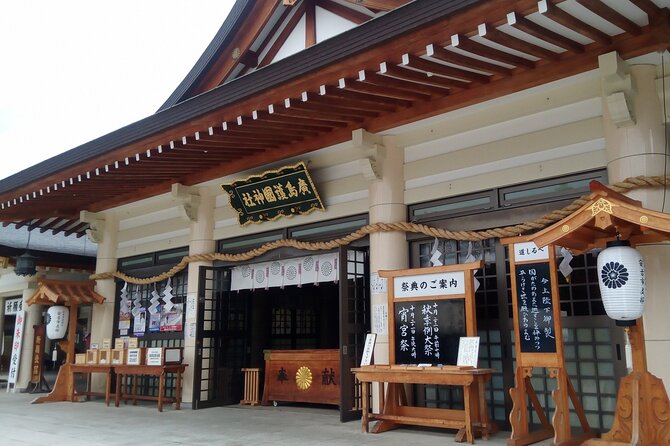
The meeting point is Hiroshima Gokoku Shrine, at 21-2 Motomachi in Naka Ward. This is a thoughtful place to begin because it introduces Hiroshima as a city with a long history before 1945.
You spend about 20 minutes at the shrine. Its traditional architecture and quiet setting offer a peaceful opening before the tour moves into more difficult subjects. The shrine was originally established to honor protective deities connected with Hiroshima domain, so your guide can begin with the city’s political and cultural roots.
I appreciate this choice because Hiroshima should not be reduced to one terrible morning. Starting here helps you see the city as a historical place with its own identity before the atomic bomb changed its course.
The shrine stop is also a useful moment to meet the group and settle into the walking pace. The group limit is listed as a maximum of 15, while the tour is described elsewhere as a maximum of 12. In practice, you should expect a small group, but the exact number may vary.
Hiroshima Castle and the city before 1945
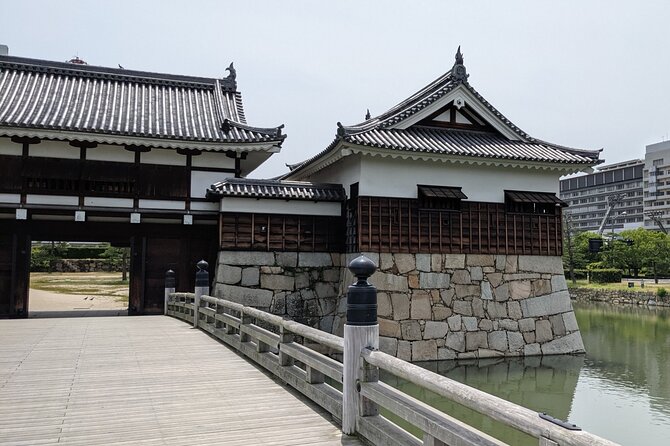
Hiroshima Castle is about a 20-minute stop. Also called Carp Castle, it was first built in the 1590s as the home of the daimyō, or feudal lord, of Hiroshima domain.
You visit the castle grounds, not the inside, so do not book this experience expecting a full castle museum visit. The value here is historical setting. The castle helps show that Hiroshima was an established center of power long before it became known around the world because of the atomic bombing.
This part may be especially useful if you do not already know the basic structure of Japanese feudal society. A guide can explain how the domain system worked and how Hiroshima developed before the modern war period.
The castle stop also gives the tour a change of mood. After the quiet shrine, you see a major landmark tied to political history. Then the route moves toward modern Hiroshima and the memorial district. That progression makes sense, though some people may find the general history slower than expected if their main interest is the bombing itself.
Hiroshima Green Arena and the value of sitting down
The itinerary allows about 30 minutes at Hiroshima Green Arena, officially Hiroshima Prefectural Sports Center. It is a multipurpose indoor arena used for sporting events and other large gatherings.
This is not one of Hiroshima’s primary historic memorials, so its role may be less obvious. The stop appears to provide a place for the guide to pause, explain more background, and connect the city’s modern life with its earlier history. One especially useful detail from the experience is that guides may break the historical talk into two roughly 10-minute sessions while allowing the group to sit.
That matters more than it sounds. Hiroshima’s story includes politics, wartime decisions, military strategy, the bombing, the immediate aftermath, and reconstruction. Hearing all of that while walking can become tiring. Short seated explanations give you time to absorb the information before the route continues.
The Green Arena stop may also help families. One guide kept younger children interested with a mix of clear history and lighter conversation, including Pokémon knowledge. That does not change the seriousness of the subject, but it can make the long walk easier for children.
A completely different kind of day out:
- Peaceful Hiroshima & Miyajima UNESCO 1 Day Bus Tour
★ 5.0 · 5,309 reviews - Hiroshima Peace Memorial Museum Ticket
★ 4.8 · 2,727 reviews - Hiroshima: Hiroshima and Miyajima UNESCO Sites 1-Day Tour
★ 4.9 · 2,330 reviews - Hiroshima Peace Memorial Museum Admission
★ 4.6 · 1,308 reviews
Orizuru Tower and the changing city
Orizuru Tower is a modern 13-story building next to Peace Memorial Park. It opened in 2016 and is known for its distinctive design.
The supplied route information does not give a stop length or say that you enter the building. Treat it as a landmark you may see near the park rather than assume that an observation deck visit is included. The tower helps show how Hiroshima has added new architecture and public spaces beside places of remembrance.
That contrast is important. Hiroshima is not preserved as a frozen memorial. It is a working city with shops, offices, sports venues, and contemporary buildings, yet the memory of 1945 remains part of public life. The tour’s best quality is its effort to hold both ideas together.
The Atomic Bomb Dome: the hardest stop to forget
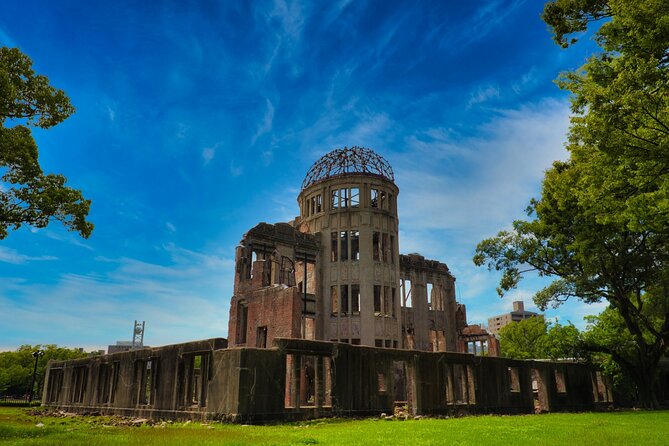
The Atomic Bomb Dome receives about 20 minutes. Before the bombing, the building was the Hiroshima Prefectural Industrial Promotion Hall. It was close to the blast’s center and survived in damaged form.
Here the tour becomes more direct. The Dome is not just a ruined building. Its location, condition, and history help you understand the scale of destruction while giving you a fixed point for the story of the city’s recovery.
A guide can also help you avoid treating the Dome as a quick photograph. You will have time for pictures, but the purpose of the stop is to understand why this structure was preserved and why it remains central to Hiroshima’s peace message.
The walk is described as mostly flat, and the sites are close enough that you are not covering huge distances between them. Still, you should wear comfortable shoes. The emotional weight, rather than steep hills, is what makes this walk demanding.
The Children’s Peace Monument and Sadako’s story
The Children’s Peace Monument is a 10-minute stop in Peace Memorial Park. It commemorates Sadako Sasaki and the thousands of children who died in the atomic bombing.
Sadako’s story has become one of the best-known personal accounts connected with Hiroshima. The monument gives the guide a way to move from statistics to individual lives, especially the lives of children. That can make the subject more understandable for younger people in the group.
This is a short stop, but it is not a throwaway stop. You may want to pause quietly after the guide finishes speaking. The monument is one of the places where Hiroshima’s message shifts from remembering the past to asking what kind of future people want to build.
The Victims Memorial Cenotaph and the Peace Park
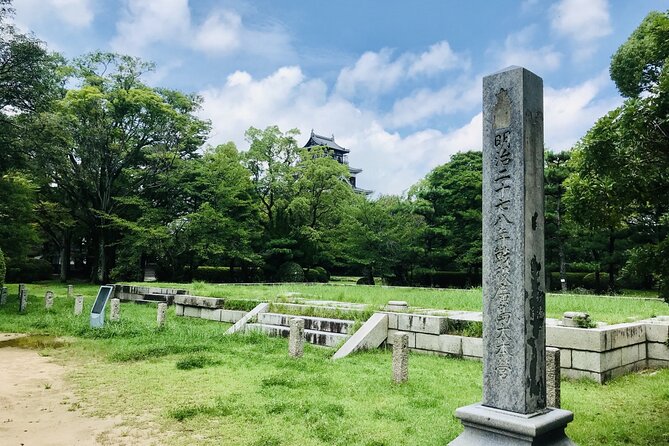
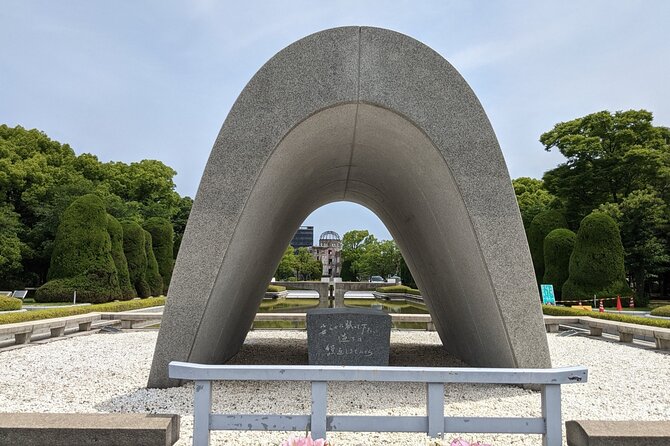
The final major stop is the Hiroshima Victims Memorial Cenotaph in Peace Memorial Park, with about 30 minutes allowed. The park is dedicated to people killed by the atomic bomb on August 6, 1945, and lies near the bombing’s epicenter.
This is where the tour’s main threads come together. You have already heard about Hiroshima before the war, walked through the castle grounds, seen the Dome, and learned about children affected by the bombing. At the Cenotaph, the focus turns to remembrance and the city’s commitment to peace.
The long stop allows time for explanation, photographs, and questions. It also gives you space to look around without being hurried from one landmark to the next. Several people valued the guides’ ability to explain the historical details clearly and sympathetically. That tone matters here.
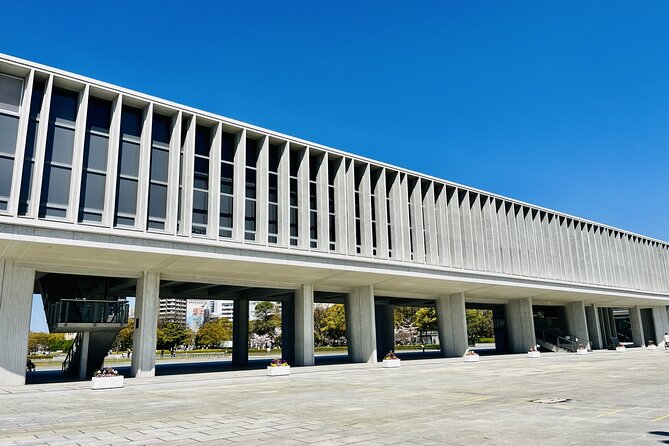
The walk ends in front of the Hiroshima Peace Memorial Museum at 1-2 Nakajimacho. The museum is well worth adding if you want a closer look at personal belongings, photographs, and the effects of the bombing, but the tour information only promises to finish outside. Plan the museum as a separate part of your day.
What the guides do best
The guide can make or break a history walk, and the names praised most often are Thomas, Chihiro, Katya, Emi, and Chisa. Their strengths are slightly different.
Thomas is repeatedly praised for a clear delivery, careful preparation, humor, and an easy manner with families. One particularly useful detail is his use of maps and photographs at different points. That turns the walk into a visual lesson rather than a stream of dates.
Chihiro is praised for local insight, strong English, and a personal connection to the subject. Chisa is praised for explaining the Japanese perspective, including the events leading up to the bombing and its long effect on Hiroshima.
Katya receives praise for enthusiasm and for explaining Hiroshima both before and after 1945. One account describes a family connection to a bomb survivor, which made the subject more personal. Emi is praised for explaining the bombing with energy and care.
The experience is not dependent on one named guide, so your exact style may vary. If you prefer a very narrow discussion of military decision-making, ask questions early and make clear what you want to understand. The guide can then spend more time on the bombing and less on general Japanese history.
Is $28 good value?
At $28 per person, this is a fair price for a two-and-a-half-hour guided walk in Hiroshima. The sites themselves are largely viewed from public areas, and admission fees are not the main reason to book. You are paying for organization, interpretation, visual material, and the chance to ask questions as the story unfolds.
I would consider it good value if you are visiting Hiroshima for the first time or if you want a clear introduction before entering the Peace Memorial Museum. The small group also matters. A cap of roughly 12 to 15 people makes it easier to hear the guide and ask questions than on a large bus tour.
The value is lower if you have already read extensively about Hiroshima and prefer to explore independently. The route is easy to follow, and one person felt a self-guided walk could cover much of the same ground. In that case, spend the $28 only if personal explanation and conversation are worth it to you.
Bottled water is not included. Bring your own, especially in warm weather. The tour is also offered in cold conditions, and one guide made a January walk enjoyable despite the weather, but you should dress for the season.
Who should book this walk?
I would recommend it to first-time visitors, families with older children, and anyone who wants the major Hiroshima sites placed in historical order. It suits you especially well if you want to ask questions about Japan, the war, the bombing, and the city’s recovery in one setting.
It also works for people who want a calm introduction before visiting the museum. The walk gives you a framework, so the museum’s exhibits may have more meaning afterward.
I would hesitate only if you want a highly specialized military-history seminar or a tour devoted almost entirely to the technical reasons behind the bombing. The experience includes broader Japanese history, and the balance can vary with the guide.
My booking advice
Book this tour if you value a clear human explanation more than a checklist of attractions. The route covers the key memorial sites, the walk is mostly flat, and the small group keeps the experience personal without making it feel exclusive or expensive.
Arrive ready to listen, bring water, wear comfortable shoes, and leave time for the Peace Memorial Museum after the walk. The free cancellation policy allows a full refund if you cancel at least 24 hours before the start time. For most first visits to Hiroshima, this is a worthwhile way to begin.
FAQ
How long does the Hiroshima walking tour last?
The tour lasts approximately 2 hours and 30 minutes.
How much does the tour cost?
The listed price is $28 per person.
Where does the tour begin?
It begins at Hiroshima Gokoku Shrine, 21-2 Motomachi, Naka Ward, Hiroshima, 730-0011, Japan.
Where does the tour end?
The tour ends in front of the Hiroshima Peace Memorial Museum at 1-2 Nakajimacho, Naka Ward, Hiroshima, 730-0811, Japan.
Is the Peace Memorial Museum admission included?
The tour ends in front of the museum. The provided information does not state that museum admission is included, so plan to treat a museum visit separately.
What attractions are visited?
The route includes Hiroshima Gokoku Shrine, Hiroshima Castle, Hiroshima Green Arena, the area around Orizuru Tower, the Atomic Bomb Dome, the Children’s Peace Monument, and the Victims Memorial Cenotaph in Peace Memorial Park.
Is bottled water provided?
No. Bottled water is not included.
How large is the group?
The experience is described as a small-group tour, with a maximum listed between 12 and 15 people.
Can service animals join the tour?
Yes. Service animals are allowed.
Can most people participate?
Yes. The additional information says most people can participate, and the tour is near public transportation.
What is the cancellation policy?
You can cancel for a full refund up to 24 hours before the experience begins. Cancellations or changes made less than 24 hours before the start time are not accepted for a refund.
Just added in Hiroshima
- Hiroshima Peace Memorial Museum Ticket★ 4.8 · 2,727 reviews
- Hiroshima Peace Memorial Museum Admission★ 4.6 · 1,308 reviews
- Private Full Day Hiroshima Tour★ 4.5 · 29 reviews
- The Peace Memorial to Miyajima : Icons of Peace and Beauty★ 4.5 · 31 reviews
- Shore Excursion from Hiroshima Port : Private Tour in Hiroshima★ 5.0 · 17 reviews
- Hiroshima & Miyajima All-Inclusive Tour w/Licensed guide Pancho★ 5.0 · 54 reviews
- Hiroshima Country Cycling: Explore Rural Life 1 HR from City★ 5.0 · 22 reviews
- Hiroshima Saijo Sake Tasting Tour with visit to 7 Breweries★ 5.0 · 104 reviews
Walking Tours, compared.
Kyoto Geisha Walking Tour: Gion District & Hidden Gems
Read our review →
Tokyo Tsukiji Fish Market Food and Culture Walking Tour
Read our review →
Gion Magical Night Walking Tour with Geisha Trivia
Read our review →
Imperial Palace and Shogun Historical Walking Tour
Read our review →
Gion Geisha District Walking Tour – Stories of Geisha
Read our review →
Shinjuku Local Bar and Izakaya Guided Walking Tour
Read our review →
Browse the lists this tour appears in