
Reviewed · MULTI-DAY TOURS THAT VISIT TAKAYAMA
Splendours of Japan (Hiroshima) by Trafalgar – 13-Day Tour – Reviews & Prices
Japan’s appeal is its quick shift from old streets and temple gates to high-speed trains and city lights. This 13-day route makes that contrast tangible, from Tokyo’s Sensoji Temple to Hiroshima’s Peace Memorial Park, with mountain villages, a ryokan stay and island scenery in between.
I like two things in particular: the range of places gives you a strong first look at Japan beyond its biggest cities, and the hands-on stops bring local skills and customs into the trip, from sushi-making to washi paper. One consideration: the route covers a lot of ground, so some days involve long coach rides and limited time at each stop.
- Tokyo to Osaka in 13 days: Start in Tokyo and finish in Osaka, with hotels, transport and a Travel Director arranged along the way.
- A taste of Japan beyond the cities: Visit Gokayama’s thatched houses, Takayama’s old streets, Kanazawa’s garden and the Seto Inland Sea islands.
- A meaningful Hiroshima visit: See Miyajima’s Itsukushima Shrine, then spend time at the Peace Memorial Park and Museum.
- Activities that add context: Make sushi, try washi paper, learn about gold leaf painting and share a meal with a local family in Kyoto.
- A traditional inn night: Stay in a Kotohira ryokan, with the option of an onsen bath and a climb to Kotohira-gu Shrine.
- Plan for walking and coach time: The activity rating is Dynamic, with some days involving four or more miles of walking and steep hills.
In This Review
- A broad first look at Japan, with a brisk pace
- Tokyo temples, shopping streets and skyline views
- Mount Fuji and the mountain towns
- Gokayama and Kanazawa’s craft traditions
- Kyoto’s shrines, temples and shared meal
- Awaji Island, Kotohira and a night at a ryokan
- Miyajima and Hiroshima’s difficult, essential history
- Osaka’s food streets and final train ride
- What the price includes, and what it does not tell you
- Who should book this Japan tour?
- FAQ
- How long is the Splendours of Japan tour?
- What is the starting price?
- Which airports can I use at the start?
- Which airports can I use at the end?
- How many people are in the group?
- What meals are included?
- How much walking should I expect?
- What are the luggage limits?
A broad first look at Japan, with a brisk pace
This Trafalgar tour is built for people who want an organized introduction to Japan, not a slow stay in one region. You move from Tokyo to the Fuji Five Lakes area, across the Japanese Alps to Takayama and Kanazawa, then south through Kyoto and the Seto Inland Sea to Hiroshima and Osaka.
A Travel Director and separate driver handle the day-to-day logistics. You travel by coach for much of the route, with express and bullet trains on selected legs. That makes the trip easier to manage than arranging each transfer yourself, but it also means you should be comfortable spending time on the road.
The group size is listed as 20 to 32, and the tour is guided in English. Past tour directors have included Yama, Mike and Kaito, but names vary by departure, so don’t book expecting a particular guide. The strongest aspect of the guided format is practical: you have someone coordinating transport and explaining the places you visit, while local specialists and hosts add detail at selected stops.
Tokyo temples, shopping streets and skyline views
Your first two days are based in Tokyo, with a centrally located hotel and an opening gathering with your Travel Director and the group. On day two, you start in Asakusa at Sensoji, a temple site founded in 628, then walk along Nakamise Street, where traditional sweets and crafts offer a change of pace from the modern city.
Tokyo Skytree gives you a high view over the city, while Ginza shifts the mood to upscale shopping streets. An optional evening visit to Shinjuku adds time in another part of the city, but you’ll need to weigh it against jet lag and an early start the next morning. Tokyo is a vast city, and this tour samples rather than exhausts it. If you have spare days before or after the tour, adding time in Tokyo is a sensible choice.
On day three, you visit the Imperial Palace Plaza and East Gardens, then browse the Tokyo National Museum before a sushi preparation class and lunch. These activities are a useful mix: the gardens bring a quieter historical setting, while the class turns lunch into an activity rather than just another stop. The schedule is full, so expect a guided overview rather than long, unhurried time at each site.
A few more options to weigh up in Tokyo
- Tokyo Disney Resort – Tokyo Disneyland & Tokyo DisneySea Park Tickets
★ 4.8 · 99,488 reviews - SHIBUYA SKY Ticket
★ 4.7 · 46,509 reviews - JR Whole Japan Rail Pass
★ 4.8 · 29,150 reviews
Mount Fuji and the mountain towns
After Tokyo, you head to the Fuji Five Lakes District and visit Oshino Hakkai, a village known for eight clear spring-fed ponds connected to Mount Fuji’s snowmelt. The scenery here is a welcome shift after the capital, but views of Fuji depend on the weather. A mountain can be right in front of you and still choose to hide behind cloud.
The next day includes a coach trip to Mount Fuji’s 5th Station at 2,300 metres, with views toward Lake Kawaguchiko and surrounding peaks when conditions cooperate. The route then crosses the Japanese Alps to Takayama. This is one of the trip’s longer travel days, so treat the coach ride as part of the experience: it links very different regions, but it leaves less time for independent exploring.
Takayama’s old streets are a highlight for traditional architecture and a slower town atmosphere. The guided walk includes a sake sample, and lunch the next day features Hida-gyu beef, a prized local variety. These are good chances to connect food with place, rather than treating each meal as fuel between sights.
Gokayama and Kanazawa’s craft traditions
From Takayama, you continue to Gokayama, a UNESCO-listed mountain village known for its steep thatched Gassho-zukuri houses. Their roof shape is designed to cope with heavy snow, and the traditional buildings offer a clear sense of how people adapted to a remote mountain setting.
A local family visit and washi paper workshop give this stop more depth than a quick photo break. You watch artisans at work and try making paper yourself; the activity also supports a small local business. It is one of the itinerary’s more distinctive experiences, though time in the village is necessarily limited within a multi-stop day.
Kanazawa gets two nights, which gives you room to see more than a single landmark. A Local Specialist introduces gold leaf painting, followed by Kenroku-en, one of Japan’s best-known gardens. Omicho Market brings the focus to seafood, while Nagamachi and the Nomura House offer a look at preserved samurai-era homes and gardens.
You can choose an optional kimono experience for photos at Kenroku-en. I’d treat it as an extra, not a must: the garden and its ponds, bridges and planted paths are the main event. The pace here is more balanced than on the transfer days, although the itinerary’s timing at each site still depends on the group schedule.
Kyoto’s shrines, temples and shared meal
An express train carries you from Kanazawa to Kyoto, where the tour visits Gion and Kinkakuji, the Golden Pavilion. Gion’s wooden machiya houses and geisha traditions are part of a living district, not a stage set, so follow your guide’s directions and keep a respectful distance from residents and workers.
Kinkakuji is famous for its golden pavilion reflected in a pond. It is an iconic sight, but also a popular one, and the experience can feel brief amid the crowds. The next day balances that spectacle with Fushimi Inari, where thousands of orange torii gates climb through woodland, and Sanjusangen-do Hall, with its 1,001 statues of Buddhist deities.
Fushimi Inari’s steps can make the walk feel more demanding than a quick shrine visit. You do not need to climb the full route to appreciate the gates, but wear shoes suited to walking. The day also includes a Be My Guest kaiseki lunch with the Nakamura family, where a shared meal offers a personal introduction to local customs. This is one of the trip’s best opportunities to connect food with everyday hospitality.
A completely different kind of day out:
- Mt Fuji and Hakone 1-Day Bus Tour Return by Bullet Train
★ 5.0 · 26,383 reviews - TOKYO SKYTREE® Ticket
★ 4.7 · 25,136 reviews - teamLab Borderless Tickets: MORI Building DIGITAL ART MUSEUM
★ 4.7 · 24,126 reviews - teamLab Planets TOKYO Ticket
★ 4.7 · 21,663 reviews
Awaji Island, Kotohira and a night at a ryokan
Leaving Kyoto, you cross the Seto Inland Sea to Awaji Island and visit Yumebutai, including its 100 Stepped Garden. The geometric flowerbeds make a striking contrast with the nearby Water Temple, where you descend toward the temple beneath a still pool. The setting is carefully designed, so this stop is more about architecture and atmosphere than old-town wandering.
That night, you stay at Kotohira Grand Sakuranosho, a traditional ryokan. The chance to try an onsen bath is included as an option, and you can climb the steps to Kotohira-gu Shrine for views over the countryside. Be ready for stairs: the shrine approach is not a flat stroll, and the tour’s Dynamic rating is worth taking seriously here.
The next morning brings Zentsuji Temple, linked to Kobo Daishi and the 88-temple Shikoku Pilgrimage. From there, you travel via Oshima Island and the Setouchi Shimanami Kaido, a road with nine bridges connecting islands across the inland sea. The route is scenic, but it is also another substantial coach day before you reach Hiroshima.
Miyajima and Hiroshima’s difficult, essential history
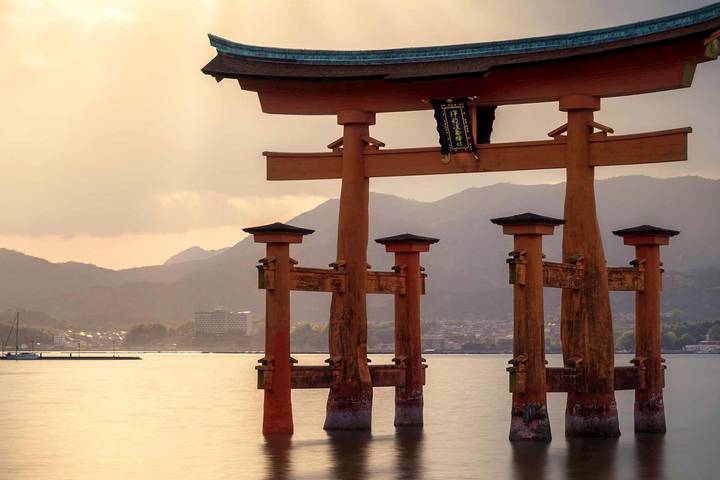
A ferry takes you to Miyajima Island, where Itsukushima Shrine and its torii gate appear to stand in the sea. You have time to explore before returning to Hiroshima. Conditions around the gate can change with the tide, so its appearance may differ from the familiar images; the island’s shrine setting is the main draw regardless.
The Peace Memorial Park and Museum provide the tour’s most sobering hours. The museum addresses the atomic bombing of 1945, while the preserved Peace Memorial is a powerful reminder of the destruction. Give this visit the attention it deserves. It is not simply another landmark to tick off, and some people may want quiet time afterward.
Dinner brings the city back to the table with Hiroshima-style okonomiyaki, a layered savory pancake made with egg, cabbage, soba noodles and a choice of meat, seafood or cheese. It is a local specialty and a fitting meal after an emotionally heavy day.
Osaka’s food streets and final train ride
On day twelve, you take the bullet train to Osaka, then have free time around Dotonbori for lunch and shopping. The area is known for its food stalls and entertainment, and nearby Hozenji Yokocho offers a narrower, stone-paved alley with traditional eateries and a small temple. Try takoyaki if you like octopus, or use the free time to choose your own meal.
Osaka Castle adds a historical stop before the final group dinner. The castle is linked to Toyotomi Hideyoshi and Japan’s unification in the late 16th century. You finish with a celebratory meal, then take an airport shuttle to Kansai International or Osaka Itami Airport the next day.
What the price includes, and what it does not tell you
The advertised starting price is $6,503 for the cheapest room. It includes four-star hotel stays, a Travel Director and driver, coach and train transport, daily breakfast, four lunches and six dinners, plus listed sightseeing, local taxes, porterage and gratuities. Included meals range from sushi prepared during a class to the hosted Kyoto lunch and selected group dinners.
That package can offer good value if you want transport, hotels and major sightseeing arranged across several regions. The local experiences, especially the family meal, paper workshop and ryokan night, add more than another hotel stop. Still, airfare is not specified in the tour details provided, and optional activities may cost extra. Check the full departure price and what it includes before comparing it with a self-planned trip.
The itinerary’s trade-off is time. You see many parts of Japan in less than two weeks, but some transfers are long and independent time is limited. If you prefer slow mornings, unplanned wandering or several nights in each city, a shorter regional trip may suit you better.
Who should book this Japan tour?
I’d consider this tour if you want a well-organized first visit and value seeing several regions without arranging every train, hotel and transfer yourself. It suits couples, families and solo participants who are comfortable in a group of 20 to 32, and who enjoy a mix of famous sights, food, crafts and guided transport.
Be realistic about the physical demands. The tour is described as Dynamic, with some days involving four or more miles of walking and steep hills, even though a separate FAQ describes the physical requirement as very low. Those descriptions don’t quite agree, so ask Trafalgar to clarify for your departure, especially if stairs or long walks are a concern.
Book it for breadth, logistics and a thoughtful mix of cultural stops, not for a leisurely pace or deep time in each city. If the price fits your budget and you are ready for busy days, the route offers a rewarding introduction to Japan. If you want to linger, add days in Tokyo or Kyoto, or choose a slower itinerary.
FAQ
How long is the Splendours of Japan tour?
It lasts 13 days, starting in Tokyo and ending in Osaka.
What is the starting price?
The listed starting price is $6,503, based on the cheapest room. Confirm the total price for your departure and room choice before booking.
Which airports can I use at the start?
You can arrive at either Narita or Haneda Airport in Tokyo. The tour includes a shuttle transfer to the designated hotel.
Which airports can I use at the end?
The departure transfer is by airport shuttle to Kansai International Airport or Osaka Itami Airport.
How many people are in the group?
The stated group size is 20 to 32 people. The tour is guided in English.
What meals are included?
The package specifies daily breakfast, four lunches and six dinners. Vegetarian, vegan, Jain, Halal and Kosher food options can be requested in advance.
How much walking should I expect?
The tour is rated Dynamic, with some days involving more than four miles of walking and possibly steep hills. A separate tour FAQ calls the physical requirement very low, so ask the operator to clarify what to expect for your departure.
What are the luggage limits?
You may bring one suitcase weighing no more than 20 kg, with total dimensions of no more than 147 cm. One carry-on item is allowed, up to 7 kg, and you are responsible for carrying it on and off the coach.
Just added in Tokyo
- Wonders Of Japan 10-Day Tour by Travel Talk★ 4.5 · 14 reviews
- Wonders of Japan end Tokyo GO 15-Day Tour by Europamundo★ 4.2 · 10 reviews
- Wonders of Japan end Tokyo 15-Day Tour by Europamundo★ 4.2 · 10 reviews
- Wonders of Japan End Osaka by Europamundo – 12-Day Tour★ 4.2 · 58 reviews
- Wonders of Japan End Osaka (including Fukuyama) 12-Day Tour by Europamundo★ 4.2 · 58 reviews
- Wonders of Japan End Osaka GO by Europamundo – 12-Day Tour★ 4.2 · 58 reviews
- Walk Japan – Kumano Kodo Trail 12-Day Tour by Explore!★ 4.7 · 20 reviews
- Visions of Japan with Hiroshima & Osaka 15-Day Tour by Globus★ 5.0 · 75 reviews
Multi-Day Tours That Visit Takayama, compared.



Tokyo to Osaka by Rail – Private Tour (14 Days) with Explore!
Read our review →
Japan: Land of the Rising Sun 12-Day Tour by Intrepid Travel
Read our review →
Stunning Japan with Shirakawa-go by Stunning Tours – 8-Day Osaka to Tokyo Tour
Read our review →
Visions of Japan with Hiroshima & Osaka 15-Day Tour by Globus
Read our review →
Best of Japan by Contiki – 13-Day Tokyo to Osaka Tour
Read our review →
14 Days Japan Panoramic (Private 3 Star Hotels) by Stunning Tours
Read our review →Browse the lists this tour appears in