Reviewed · SHOW
Traditional Japanese Music show & Experience Tour in Osaka
Music you can play yourself. This one-hour Osaka experience pairs a live Japanese music concert with hands-on time using traditional instruments. I like the close small-group format, capped at seven people, and the chance to ask professional musicians questions instead of simply watching from a seat.
I also like the clear structure: 25 minutes of music, 25 minutes of playing, and 10 minutes for photos. The main consideration is timing, since sessions run only Wednesday at 11:00 and Friday at 18:30, and at least two people must book for the activity to go ahead.
In This Review
- Key points at a glance
- A compact introduction to Japanese music in Osaka
- The opening 25 minutes: listen before you play
- The next 25 minutes: pick up a traditional instrument
- The final 10 minutes: photos with the instruments
- Why the small group matters
- Wednesday morning or Friday evening
- Is $46.12 a fair price?
- Who will enjoy this experience most?
- Practical details before you book
- My final take: book it for participation, not just a concert
- FAQ
- Where does the traditional Japanese music experience begin?
- Where does the experience end?
- How long does the experience last?
- What happens during the one-hour program?
- Which instruments may be included?
- Can I ask the musicians questions?
- Can I take photos with the instruments?
- When is the experience offered?
- How many people can join?
- Can I cancel for a full refund?
Key points at a glance
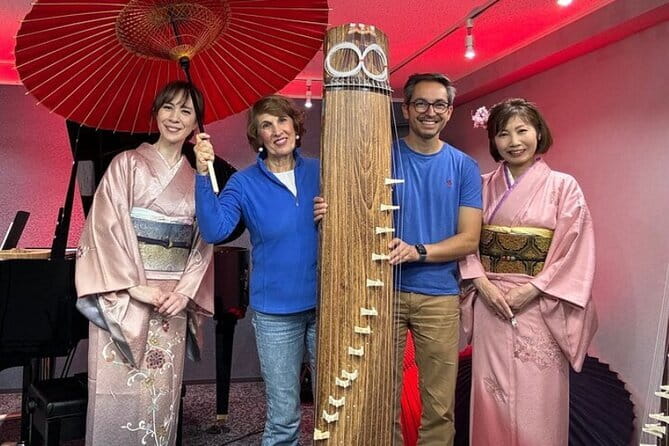
- Three classic instruments: You may hear and play the shamisen, koto, wadaiko, and other Japanese instruments.
- A concert plus participation: The first 25 minutes are a performance, followed by 25 minutes of hands-on practice.
- Small maximum group: With no more than seven participants, questions and personal attention should be manageable.
- Two weekly start times: Choose Wednesday at 11:00 or Friday at 18:30.
- Photo time included: The final 10 minutes let you pose with the instruments and performers.
- Flexible cancellation: Cancel at least 24 hours before the start for a full refund.
A compact introduction to Japanese music in Osaka
This experience offers a tidy way to meet traditional Japanese music without committing half a day to a museum, concert hall, or formal cultural course. You arrive at Alpha Shinsaibashi, at 3-5-27 Minamisenba in Osaka’s Chuo Ward, and finish at the same meeting point.
I see the format as especially useful if you want both context and participation. A standard performance can sound beautiful, but it can also leave you wondering how the instruments work. Here, you first hear professional musicians play, then handle the instruments yourself.
The program is presented in a small-group setting, with a maximum of seven people. That matters. Traditional instruments can seem mysterious from a distance, while a small room gives you a better chance to look closely, ask questions, and try a few sounds without being lost in a crowd.
The concert content changes by day. You should not expect an identical program every time, which adds variety but also means the exact mix of pieces and instruments is not fixed in advance.
A few more options to weigh up in Osaka
- Osaka: Sumo Show & Experience w/ Optional Kimono & Hot Pot
★ 4.5 · 609 reviews - Osaka: Sumo Stage Show with Bento or Snack + Fight & Photo
★ 4.3 · 364 reviews - Osaka: English Stand Up Comedy Show at Osaka Comedy Club
★ 4.7 · 203 reviews
The opening 25 minutes: listen before you play
The first section is an authentic Japanese music concert lasting about 25 minutes. Professional musicians perform a selection of traditional instruments, giving you time to hear their different tones before you are asked to pick anything up.
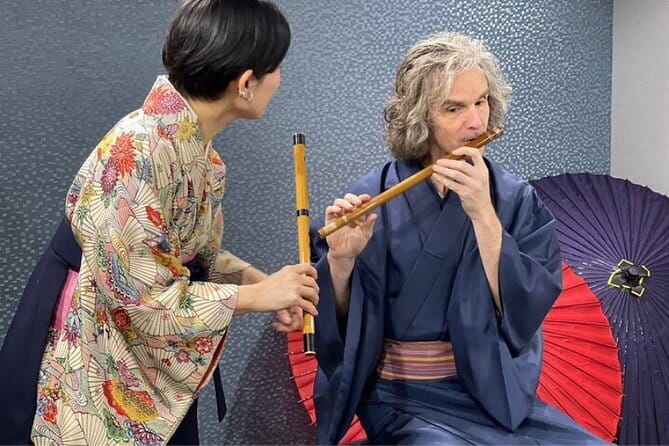
The instruments named for the experience include the shamisen, koto, and wadaiko. The shamisen is a three-stringed Japanese lute with a distinctive, crisp sound. The koto is a long zither often described in simple terms as a Japanese harp, though its structure and playing style are different from a Western harp. Wadaiko refers to Japanese drums, whose strong rhythms provide a sharp contrast to the stringed instruments.
That variety is one of the best reasons to book. You are not hearing one instrument repeated for an hour. Instead, the performance introduces several parts of the Japanese music tradition in a short period.
I would treat the concert as an active listening lesson. Notice how the instruments differ in tone, volume, and attack. Listen for the quick pluck of strings and the physical force of the drums. Since the show lasts only 25 minutes, the program should fit neatly into an Osaka day without asking too much of your schedule.
The precise concert content depends on the day. If you have a strong interest in one particular instrument, contact Harmony in Japan Tour before booking rather than assuming every session gives equal time to each one.
The next 25 minutes: pick up a traditional instrument
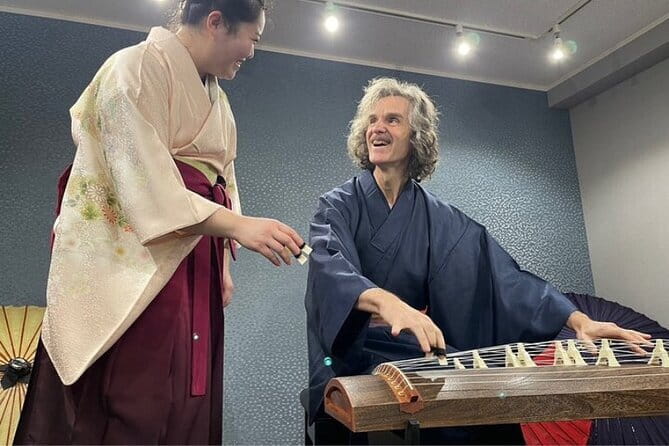
The most appealing part for many people begins after the concert. You get about 25 minutes to try traditional Japanese musical instruments yourself.
This is not simply a lecture about how the instruments are made. You are given an instrument for the experience, which turns the performance into something more memorable. Playing even a simple note can change the way you listen to the music. You begin to notice the strings, the body of the instrument, or the force needed to produce a drumbeat.
The available instruments include shamisen, koto, and wadaiko, along with others. The information does not promise that every participant will play every instrument, so you should regard the selection as dependent on the day and the session setup.
I like this part because it keeps the experience from becoming passive. You can ask the professional musicians as many questions as you like, and the small group should make it easier to speak up. If you have never handled a Japanese instrument, this is the moment to ask about technique, sound, and the role of each instrument.
Do not expect to become a shamisen player or drummer in 25 minutes. The value lies in getting a direct feel for the instruments and gaining a clearer sense of the skill behind the concert. The activity is designed as an introduction, not a full music lesson.
That distinction helps set the right expectations. You are paying for a close cultural encounter and a guided tryout, not formal training or a long workshop.
The final 10 minutes: photos with the instruments
The last section is set aside for photographs with the instruments and performers. You can hold traditional instruments and take souvenir pictures, giving you something tangible to remember the experience.
This may sound like a small addition, but it is useful. Many cultural activities end the moment the demonstration stops. Here, you have a planned 10-minute finish, so you do not need to rush out while trying to take a photo.
The photo time also works well for people who want a clear record of the hands-on portion. If you are visiting Osaka with friends or family, it gives everyone a chance to take turns with the instruments.
Because the group is limited to seven, the photo session should be easier to manage than it would be in a large class. Still, the total time is fixed at one hour, so keep your photo requests practical and be ready to share the time with the rest of the group.
A completely different kind of day out:
- Osaka Go Karting Tour with Funny Costume
★ 5.0 · 2,658 reviews - Osaka Castle: Museum and Tower Entry Ticket
★ 4.5 · 2,380 reviews - Osaka: Shinsekai Food Tour with 13-15 Dishes at 5 Eateries
★ 4.8 · 2,204 reviews - Osaka Food Tour: 13 Dishes at 5 Local Eateries
★ 5.0 · 2,149 reviews
Why the small group matters
A maximum of seven participants is a strong feature here. Traditional music can feel formal or difficult to approach, especially if you are unfamiliar with Japanese instruments. A smaller group reduces that barrier.
You can ask questions directly to the musicians rather than waiting for a large audience to move along. You also get a better chance to see the instruments at close range and take part during the playing section.
The minimum group size is two people. If that number is not reached, the activity may be canceled, with the option of a different date or experience, or a full refund. I would keep this in mind if your Osaka plans are tightly fixed.
The small size does not guarantee private instruction. This is still a shared experience, not a private concert. But seven people is a reasonable ceiling for a program that includes both demonstration and participation.
Wednesday morning or Friday evening
There are only two listed sessions each week:
- Wednesday at 11:00
- Friday at 18:30
The Wednesday session suits a daytime Osaka itinerary. You can place it before lunch and then continue sightseeing in the afternoon. The Friday evening option can work well after a day in the city, though you will need to reach the meeting point on time.
The schedule is also the main limitation. If you have only one or two days in Osaka, these narrow time choices may not fit. Check the start time carefully before arranging transportation or other reservations.
The activity lasts about 60 minutes and returns you to the starting point. Since private transportation is not included, you are responsible for reaching Alpha Shinsaibashi yourself. The location is near public transportation, which makes it practical to include in a city itinerary, but the supplied details do not specify a particular station or walking time.
I would allow extra time to find the building, especially for the evening session. Your mobile ticket can be used for entry, and confirmation is provided when you book.
Is $46.12 a fair price?
At $46.12 per person, this is not the cheapest cultural activity you will find in Osaka. It is also more than the price of simply listening to a short public performance. The value comes from the combination of a live concert, instrument access, questions with professional musicians, and a photo session.
The one-hour length keeps the cost from turning into a major financial commitment. You are not paying for a full-day tour, a meal, or transportation. That also means the activity must be judged on the quality of the focused encounter rather than on how much time it fills.
I think the price makes the most sense if you care about Japanese culture, music, or hands-on experiences. It is less compelling if you only want a quick stage performance and have no interest in handling the instruments afterward.
The program has received a five-star rating from 25 reviews, with 100 percent recommending it. One especially positive reaction focused on hearing the instruments up close and then getting the rare chance to play them. That praise points to the heart of the value: the experience does more than display Japanese music. It lets you take part.
Who will enjoy this experience most?
I would recommend it to music lovers, curious first-time visitors to Japan, and anyone who wants a cultural activity with a clear beginning and end. It can also suit people who are not specialists but would like something more personal than a standard sightseeing stop.
Families may appreciate the chance to hold instruments and take photos, though the supplied information does not give a minimum age. Ask the provider if you are booking with young children or have special needs.
The session is also a good fit for solo participants. One review describes enjoying the activity alone and wanting to return with friends. The maximum group size of seven means a solo booking should still place you in a relatively small setting, though the minimum of two means the session needs enough bookings to operate.
You can ask about special requests before the experience. That is worth doing if you have a particular interest in the shamisen, koto, wadaiko, or another instrument.
Practical details before you book
The meeting point is:
Alpha Shinsaibashi
3-5-27 Minamisenba
Chuo Ward, Osaka 542-0081, Japan
The experience ends back at the same place. Private transportation is not included, but the meeting point is near public transportation.
The activity is listed as suitable for most people, and service animals are allowed. Confirmation arrives at the time of booking. You should still check the meeting details on your confirmation and arrive prepared for a one-hour indoor cultural activity.
Cancellation is free up to 24 hours before the start time, based on local Osaka time. Cancellations or changes made within 24 hours are not refunded or accepted. Since the activity requires at least two participants, a provider cancellation for low numbers results in either another date or experience, or a full refund.
My final take: book it for participation, not just a concert
I would book this experience if I wanted a short, friendly introduction to Japanese instruments with a genuine hands-on element. The strongest features are the small group, the professional performance, and the chance to try instruments that most people cannot casually access.
The main reasons to hesitate are the limited schedule, the one-hour length, and the possibility of cancellation if fewer than two people book. You should also understand that the exact concert program changes by day, so the session is not designed around one guaranteed instrument or set list.
Choose the Wednesday morning or Friday evening time that fits your plans, and contact Harmony in Japan Tour first if you have a special request. For $46.12, this is a sensible cultural stop for anyone who wants to hear Japanese music close up and then make a little sound of their own.
FAQ
Where does the traditional Japanese music experience begin?
It begins at Alpha Shinsaibashi, 3-5-27 Minamisenba, Chuo Ward, Osaka 542-0081, Japan.
Where does the experience end?
The activity ends back at the meeting point.
How long does the experience last?
The total duration is approximately one hour.
What happens during the one-hour program?
You spend about 25 minutes watching a Japanese music concert, 25 minutes trying traditional instruments, and 10 minutes taking photos with the instruments and performers.
Which instruments may be included?
The experience includes instruments such as the shamisen, koto, and wadaiko, along with other traditional Japanese instruments.
Can I ask the musicians questions?
Yes. You can ask the professional musicians as many questions as you like.
Can I take photos with the instruments?
Yes. The final 10 minutes are set aside for photos with the instruments and performers.
When is the experience offered?
It is offered Wednesday at 11:00 and Friday at 18:30.
How many people can join?
The maximum group size is seven participants. At least two participants are required for the activity to operate.
Can I cancel for a full refund?
Yes. You can cancel at least 24 hours before the start time for a full refund. Cancellations or changes made less than 24 hours before the start are not refunded or accepted.
Just added in Osaka
- 1.5〜2 Hours Traditional Kintsugi Work Shop in Namba Osaka★ 5.0 · 75 reviews
- The Dark Side of Osaka Walking Tour★ 5.0 · 49 reviews
- Three Types of Ramen Cooking Class in Osaka★ 5.0 · 119 reviews
- Samurai Show, Tea Ceremony, Japanese Traditional Activities★ 5.0 · 56 reviews
- Traditional Home cooking Experience in Osaka, Japan★ 5.0 · 14 reviews
- Sushi and Japnese foods cooking class in Osaka★ 5.0 · 51 reviews
- Osaka Street Food Festival :Takoyaki&Okonomiyaki for Families★ 5.0 · 13 reviews
- Sumo Tournament Experience in Osaka★ 5.0 · 12 reviews
Show, compared.

Mt Fuji & Hakone Cruise, Drum Show Bullet Train 1 Day from Tokyo
Read our review →
Sumo Show Experience with Chicken Hot Pot and a Photo
Read our review →
Tokyo Shinjuku Sumo Show & Experience with Photo
Read our review →

Mt Fuji & Hakone Cruise, Drum Show Bus 1 Day from Tokyo
Read our review →