
Reviewed · CYCLING AND E-BIKE TOURS
Bike Tour in Fukuoka City【Bike is Life】Fukuoka ” Hakata ” Ride
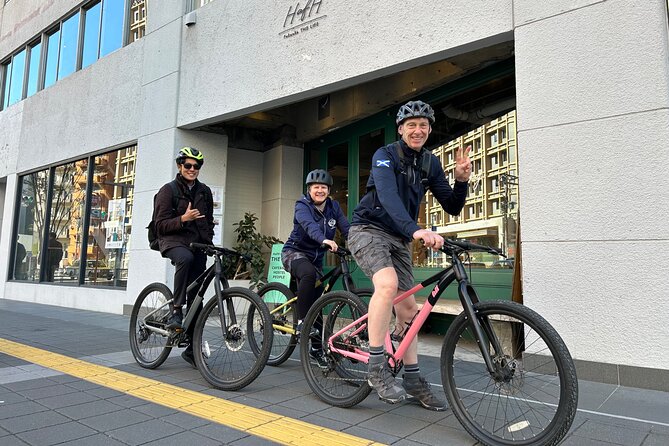
Two towns, one easy afternoon by bike. I like how this 3.5-hour ride links Hakata’s old merchant quarter with Fukuoka’s castle town, and I like that the route uses riverside paths, park lanes, and streets a car cannot reach. Guides such as Haruka and Haru add local stories, while drinks, snacks, bicycle rental, and insurance are included.
The main thing to consider is distance. The ride covers about 17 kilometers, so you need to be comfortable on a bicycle and at least 145 centimeters tall. The pace is relaxed, with breaks, but city streets and narrow lanes still require attention. Rain can also cancel the outing.
In This Review
- Key points to know before booking
- Why this ride explains Fukuoka better than a quick walk
- Starting near Kushida Shrine Station
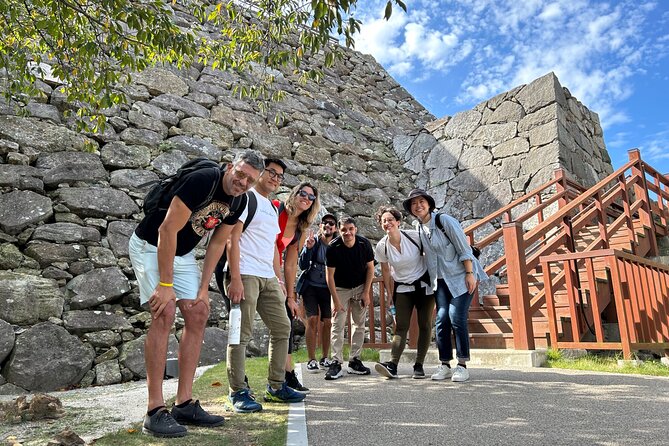
- Fukuoka Castle Remains and three kilometers of stone walls
- Ohori Park, the castle moat with room to breathe
- Shofuku-ji Temple and the beginnings of Zen in Japan
- Kushida Shrine, Hakata’s protective heart
- What the riding feels like in practice
- Guides Haruka and Haru make the difference
- Is $72.26 a fair price?
- Timing, weather, and who should book
- Should you book the Hakata Ride?
- FAQ
- How long does the bike tour last?
- Where does the tour start?
- Where does the tour finish?
- How far do you ride?
- What sites does the tour visit?
- Is bicycle rental included?
- What languages are available?
- What happens if the weather is poor?
Key points to know before booking
- Two sides of Fukuoka: See the old port town of Hakata and the castle town built by Kuroda Nagamasa.
- About 17 kilometers by bike: A useful amount of ground for one afternoon, with stops at major cultural sites.
- Castle walls and park paths: Fukuoka Castle Remains and Ohori Park are the strongest parts of the route.
- Japanese and English support: The tour is offered in Japanese and English, and some outings include a guide with an interpreter.
- Small groups: The maximum is 10 people, though some departures have been private or nearly private.
- Good value at $72.26: The fee includes the bicycle, insurance, drinks, and snacks, not just guiding.
Why this ride explains Fukuoka better than a quick walk
Fukuoka can feel like one modern city, but its roots come from two distinct places. Hakata grew as Japan’s oldest international port and a center for trade and diplomacy. Across the Naka River, Fukuoka developed around the castle and town created by Kuroda Nagamasa, a warlord of the Sengoku period, with help from his father Josui.
That contrast gives this ride a clear purpose. You are not simply checking off four sightseeing stops. You are moving between a merchant city and a samurai city, seeing how their streets, religious sites, waterways, and open spaces fit together.
I like that a bicycle makes the connection feel physical. You cover more ground than you would on foot, but you are still close enough to notice seasonal smells, changing streets, and local corners. The route also reaches paths beside rivers and through parks that are less practical by car.
The afternoon begins at 1 p.m. and runs until about 4:30 p.m. That timing works well if you want a morning at the market or a slow lunch before riding. It also means you should not plan a tightly timed evening activity immediately afterward. The end point is the same as the meeting point at Kushida Shrine Station.
More Bike Tours in Fukuoka:
- Bike Tour Exploring North Kyoto plus Lunch
★ 5.0 · 1,087 reviews - Tokyo Great Cycling Tour
★ 5.0 · 811 reviews - Tokyo Top Highlights 3h Guided E-bike Tour
★ 5.0 · 714 reviews
Starting near Kushida Shrine Station
The meeting point is at Kushida Shrine Station, 7 Gionmachi, in Hakata Ward. The tour ends back there, which makes the outing simple to fit into a day of sightseeing.
Finding the exact starting spot may take a little care. One senior couple had trouble locating it, but guide Haruka waited patiently. My practical advice is to arrive early, check your mobile ticket before leaving your hotel, and allow extra time around the station area.
The group size is capped at 10. That is small enough for the guide to keep an eye on the riders and stop for questions without turning the afternoon into a formal procession. Some departures have had only one rider or one family, and the tour still went ahead. That can make the experience feel more personal, though you should not assume every date will be private.
Before setting off, you will need to be able to ride a bicycle and meet the height requirement of at least 145 centimeters. The published information asks if you are over 140 centimeters, but the tour requirement specifies 145 centimeters, so use the stricter figure when deciding.
Fukuoka Castle Remains and three kilometers of stone walls
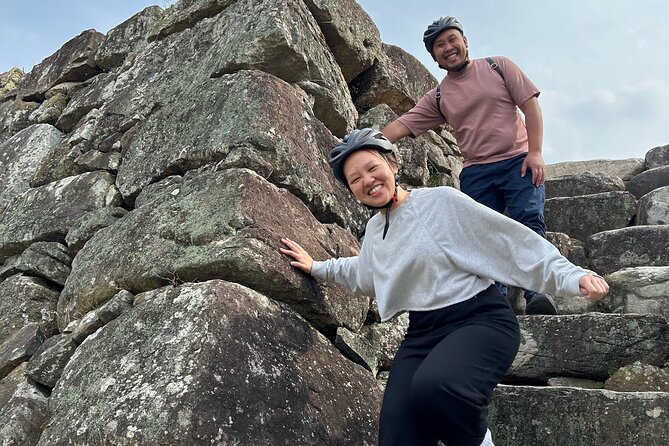
The first major section follows the remains of Fukuoka Castle, beginning at Uenobashi Imperial Gate, once used as the main entrance. The ride continues toward the castle tower area while you view stone walls stretching for more than three kilometers in total.
There is no admission charge for this stop. That matters because the value here comes from the setting and the guide’s explanation rather than an indoor exhibition. On a bicycle, you can follow the line of the walls and get a better sense of the castle’s scale than you would from a single viewpoint.
I would give this section your full attention. The walls are the clearest reminder that Fukuoka was once organized around a powerful local lord, not simply around today’s shopping streets and railway stations. The contrast with Hakata’s merchant roots becomes easier to understand once you see the defensive shape of the castle grounds.
The actual stop is listed as about 10 minutes, so expect a compact visit rather than a long ruin walk. You will ride while looking at the stonework, not spend an hour exploring every corner. If you want detailed castle archaeology or a long photo session, this tour may feel quick.
Still, the castle area is one of the afternoon’s best portions. One rider singled out the castle ruins and Ohori Park as highlights, and that makes sense: these are the places where the bicycle itself adds the most.
Ohori Park, the castle moat with room to breathe
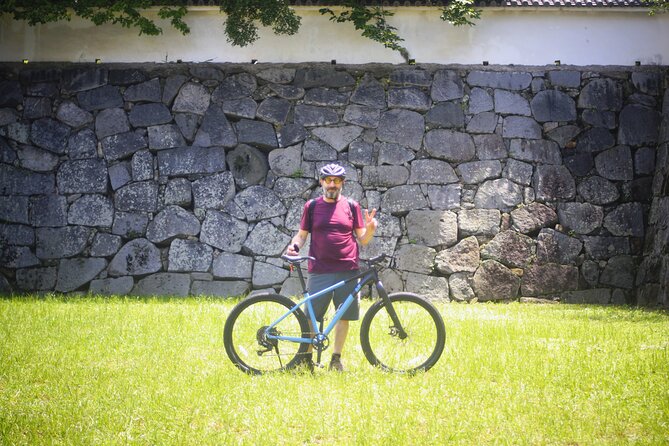
From the castle remains, the ride continues into Ohori Park. The park was the outer moat of Fukuoka Castle, so this is not just a pleasant green break. It is part of the same defensive system you have just been viewing.
You will cycle through the park and stop for about 15 minutes. The route gives you a change of pace after city streets and stone walls. Several riders especially appreciated this section, including one who enjoyed a break at a café for a sweet snack.
The included drinks and snacks are a small but useful touch here. You do not have to arrive with a full picnic, and the pause gives you time to rest your legs. Since the outing lasts three and a half hours, that matters more than it might on a short sightseeing loop.
Ohori Park is also where the tour’s relaxed rhythm becomes clear. The guide does not appear to rush from one landmark to the next. Haruka has been praised for setting a comfortable pace for older riders and adding breaks along the way. Another group described the ride as calm and easygoing.
Do not mistake relaxed for effortless, though. Seventeen kilometers is still a real afternoon ride. If you rarely cycle, the distance may be more important than the individual stops. The route includes city streets and narrow lanes, so you need to watch your surroundings and follow the guide’s instructions.
A few more options to weigh up in Fukuoka
- Kyushu: Mount Aso, Kusasenri & Takachiho Gorge Day Tour (Optional Takachiho Boat Ride Experience)
★ 4.9 · 4,957 reviews - Kyushu One-Day Tour: Yufuin no Mori Train & Yufuin Town & Nyoirin-ji Temple & Dazaifu & Hell Hot Springs (Departing from Fukuoka)
★ 4.9 · 4,474 reviews - teamLab Forest Fukuoka Ticket
★ 4.7 · 1,925 reviews - Shiraito Falls & Forest Cafe & Handmade Flower Salt Pudding & Grilled Seafood & Totoro Forest & Sakurai Futamigaura & Angel’s Wings & Coconut Tree Swing Day Tour (Departing from Hakata Station, with Mandarin, English, and Cantonese speaking guide)
★ 4.9 · 1,840 reviews
Shofuku-ji Temple and the beginnings of Zen in Japan
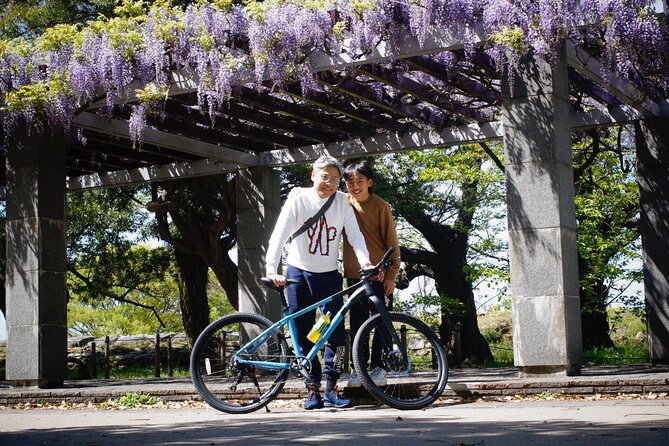
The next stop is Shofuku-ji, identified as Japan’s first Zen temple and the birthplace of Japanese tea. The visit lasts about 15 minutes and has a quieter tone than the castle and park.
This is one of the moments when the tour gives you a useful cultural link rather than only a photo stop. The temple connects Fukuoka to the arrival and development of Zen practice, while the tea reference points to a tradition that later became central to Japanese culture.
Because the stop is short, the guide’s commentary is important. Haruka has been praised for explaining places clearly and sharing his affection for Fukuoka. If English is important to you, note that the experience is offered in Japanese and English, and some outings use a guide and interpreter together. One rider described the guide’s English as adequate, while another praised the guide and interpreter as an effective pair.
That suggests the quality of communication can depend on the specific guide arrangement and the day’s group. You should expect useful explanations, but not necessarily a long academic lecture at each site. The strength is the combination of movement, context, and a few well-chosen facts.
The temple stop also helps break up the ride. After the open space of Ohori Park, a more contained religious site gives the afternoon a different texture. You are not seeing Fukuoka only as a modern urban center. You are also seeing the institutions that shaped its spiritual and cultural life.
Kushida Shrine, Hakata’s protective heart
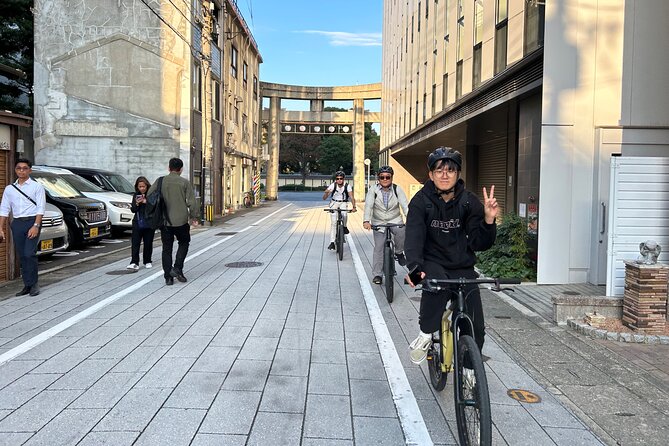
The final stop is Kushida Shrine, where you pause for about five minutes and pray for safety. The shrine is described as Hakata’s deity and a place where different religious traditions have gathered.
Its location makes a practical kind of sense. You start and finish nearby, so the shrine frames the outing and brings you back to Hakata after the castle-town portion of the route. The short stop is not intended as a full shrine tour, but it gives you a local ritual to close the ride.
Five minutes passes quickly. You will likely have time for a brief prayer and a look around, but not a long visit. If Kushida Shrine is high on your list, return separately after the tour so you can explore at your own pace.
As a finish, though, it works well. The route has taken you from Hakata’s port-centered past to the castle remains and back to one of Hakata’s religious centers. That circular shape gives the afternoon more meaning than a random collection of stops.
What the riding feels like in practice
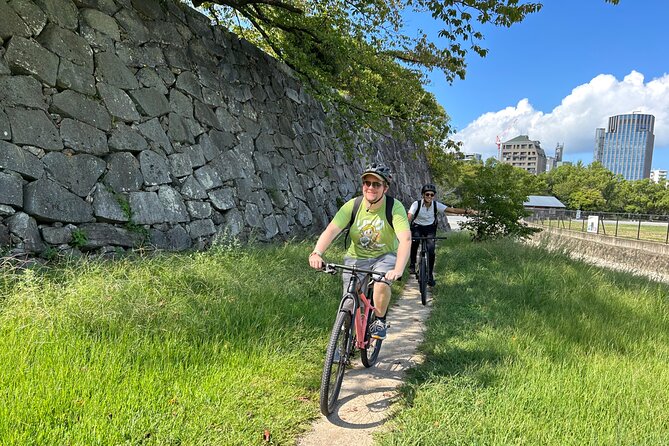
The published route does not give a technical difficulty rating, but the information and rider experiences point to a moderate city ride at a comfortable pace. The distance is about 17 kilometers, and the route includes windy streets, narrow lanes, park paths, and roads shared with urban traffic.
Safety is a major part of the guide’s job. Haruka has been praised for keeping groups together and making riders feel secure. Another rider noted that the guide adjusted the pace for seniors and included breaks. Those details are reassuring if you cycle regularly but do not want a race.
You should still be honest about your ability. Being over the height requirement is not enough by itself. You need to control a bicycle, ride for several hours, and remain alert in the city. If you can manage a normal half-day recreational ride, the format should suit you better than a demanding cycling excursion.
The tour is also a good first activity in Fukuoka. You get an overview of several districts, learn how Hakata and Fukuoka developed differently, and see which areas deserve a later visit. One rider described cycling as the best way to begin understanding a new city, and this route supports that idea without trying to cover every attraction.
Guides Haruka and Haru make the difference
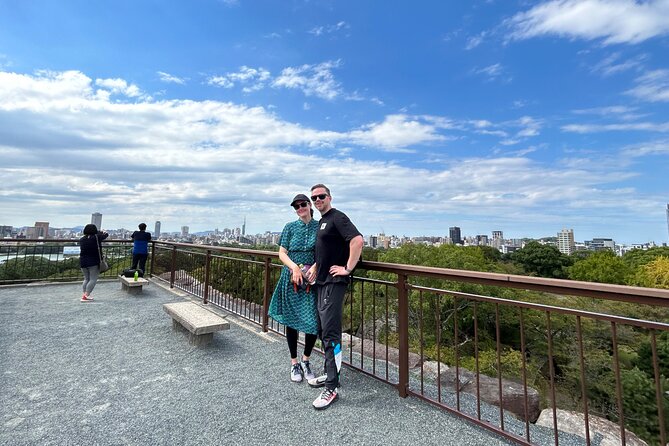
The strongest praise is directed at the guides. Haruka is described as kind, funny, patient, safety-conscious, and well informed about the city. He has continued with a tour even when only one person booked, which says something useful about the small-group approach.
Haru is also praised for keeping the group together and explaining each stop. Some departures have included two guides, with one handling interpretation. That is especially useful for an English-speaking group moving through busy streets.
The tone appears friendly rather than formal. You get facts at the stops, but also a sense that the guide enjoys showing off Fukuoka. References to cherry blossoms, local streets, ramen, and seasonal changes suggest the experience is connected to the city as it feels on the day, not just to a fixed historical script.
English ability may vary by guide. The tour does offer English, and the overall feedback on communication is positive, but one rider found the guide’s English only acceptable. If you need highly detailed English explanations at every point, keep that in mind. If you value warmth, safety, and a clear overview, the format should work well.
Is $72.26 a fair price?
At $72.26 per person, this is not the cheapest way to pass through Fukuoka. You could visit the public sites independently for little or no admission cost. The value comes from the bicycle, insurance, route planning, local guidance, snacks, drinks, and the ability to connect widely separated parts of the city in one afternoon.
The included bicycle rental is important. You do not need to arrange your own bike or work out a route through unfamiliar streets. You also avoid the time cost of figuring out how to link the castle area, Ohori Park, Shofuku-ji, and Kushida Shrine on your own.
The maximum of 10 people adds value, too. A large group can make city cycling slow and awkward. Here, the guide can keep riders together and adjust the pace more easily. On a quiet date, you might receive an almost private experience for the same listed price.
I would consider the price fair if you want an active introduction to Fukuoka and would otherwise pay for bicycle hire and a guided city experience separately. It is less appealing if you mainly want to visit the four sites at your own speed or if you do not enjoy cycling.
Timing, weather, and who should book
The 1 p.m. start is useful for an afternoon plan, but it limits flexibility. You cannot choose a morning departure from the information provided. Plan for three and a half hours, then leave some breathing room afterward for transport, dinner, or a return visit to Kushida Shrine.
The experience requires good weather. If poor weather causes cancellation, you are offered another date or a full refund. That is sensible for a bicycle tour, but it means you should avoid building your entire Fukuoka schedule around this single activity.
You can cancel for a full refund up to 24 hours before the start time. Changes or cancellations inside that window are not refunded, and the cut-off uses local time. Confirmation arrives when you book, and the meeting point is near public transport.
I would recommend this ride most to:
- First-time visitors who want a city overview with historical context
- Active couples, families with older teenagers, and small groups
- Riders who prefer a relaxed pace over a strenuous cycling workout
- Anyone interested in the contrast between Hakata’s merchant past and Fukuoka’s castle town
- People who value a local guide and do not want to plan the route themselves
I would think twice if you dislike urban cycling, cannot comfortably ride 17 kilometers, need a fully flexible schedule, or want long visits inside each attraction.
Should you book the Hakata Ride?
I would book this tour if you want to understand Fukuoka by moving through it, not just by visiting isolated landmarks. The castle walls, Ohori Park, Shofuku-ji, and Kushida Shrine create a well-shaped route, and the bicycle lets you see the relationship between old Hakata and castle-era Fukuoka.
The best reasons to choose it are the calm pace, small maximum group, safety-minded guides, and included equipment and refreshments. Haruka and Haru receive especially strong praise for making the ride friendly and manageable.
Book it when the weather looks promising, arrive early at Kushida Shrine Station, and be ready for a genuine 17-kilometer ride. If that sounds enjoyable, the $72.26 fee buys more than transport between sights. It buys a useful first look at how Fukuoka became the city you see today.
FAQ
How long does the bike tour last?
The tour lasts approximately 3 hours and 30 minutes, from 1 p.m. to 4:30 p.m.
Where does the tour start?
It starts at Kushida Shrine Station, 7 Gionmachi, Hakata Ward, Fukuoka, 812-0038, Japan.
Where does the tour finish?
The tour ends back at the meeting point near Kushida Shrine Station.
How far do you ride?
The route is about 17 kilometers, according to the ride details provided.
What sites does the tour visit?
The route includes Fukuoka Castle Remains, Ohori Park, Shofuku-ji Temple, and Kushida Shrine.
Is bicycle rental included?
Yes. The price includes bicycle rental, insurance, drinks, and snacks.
What languages are available?
The tour is offered in Japanese and English.
What happens if the weather is poor?
The tour requires good weather. If it is canceled because of poor weather, you can choose a different date or receive a full refund.
Just added in Fukuoka
- Treasures of Kyushu 7-Day Tour by Europamundo★ 5.0 · 1 review
- Kyushsu Half Island Express Tour (8 Days) by MW Tours★ 5.0 · 1 review
- teamLab Forest Fukuoka Ticket★ 4.7 · 1,925 reviews
- Fukuoka Nakasu River Cruise Ticket★ 4.6 · 164 reviews
- Shiraito Falls & Forest Cafe & Handmade Flower Salt Pudding & Grilled Seafood & Totoro Forest & Sakurai Futamigaura & Angel’s Wings & Coconut Tree Swing Day Tour (Departing from Hakata Station, with Mandarin, English, and Cantonese speaking guide)★ 4.9 · 1,840 reviews
- Uminonakamichi Marine World Admission Ticket in Fukuoka★ 4.8 · 1,298 reviews
- Fukuoka Tower Admission Ticket★ 4.8 · 1,804 reviews
- Kyushu One-Day Tour: Yufuin no Mori Train & Yufuin Town & Nyoirin-ji Temple & Dazaifu & Hell Hot Springs (Departing from Fukuoka)★ 4.9 · 4,474 reviews
Cycling and E-Bike Tours, compared.

3h Tokyo E-Bike Tour: Hidden Gems, and Local Life with guide
Read our review →
Arashiyama Bamboo Forest & Hidden Gems Bike Tour (Early Bird)
Read our review →
5 Top Highlights of Kyoto Full Day Bike Tour (E-bike option)
Read our review →

Hiroshima 2hr Peace Cycling Tour with Local Guide
Read our review →Browse the lists this tour appears in