
Reviewed · SUMO EXPERIENCES
Experience the Sumo World in Tokyo
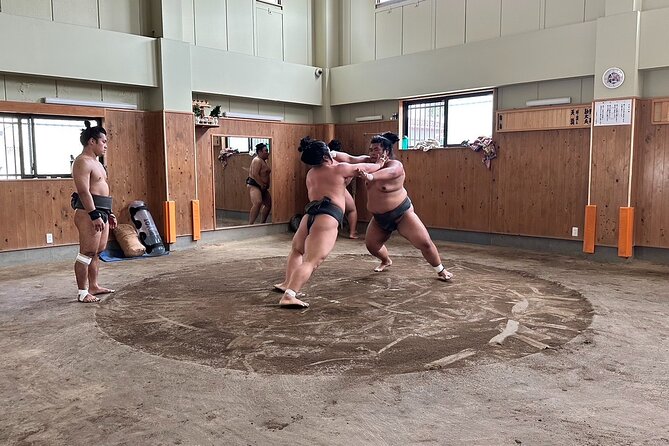
Sumo gets serious before breakfast. This four-hour Tokyo outing takes you from Ueno Station to a working sumo stable, where you can watch hard training from nearby chairs, learn the rules and customs, and meet wrestlers afterward. It offers a rare look at daily sumo life rather than a polished match-day show.
I like the front-row view of practice and the chance to try pushing a wrestler yourself, even if your victory may depend on his kindness. I also like the shared chanko nabe meal, which gives the morning a social touch. The main drawback is the early start and complicated train route, plus one reported communication problem that caused a participant to miss most of the practice.
This is a strong pick if you care about Japanese sport, family-friendly cultural activities, or experiences that put you close to a living tradition. Just treat the 7:45 AM meeting time as firm and confirm the meeting details before bed.
In This Review
- Key points to know before booking
- Why a real training stable matters
- Meeting at Ueno Station before 8 AM
- Sitting close to intense morning practice
- Trying to push a professional wrestler
- Sharing chanko nabe after practice
- Guides who make the difference
- Price, timing, and practical value
- The communication warning you should take seriously
- Who will enjoy this morning most
- Should you book the Sumo World tour?
- FAQ
- Where does the tour begin?
- What time should I meet the guide?
- How long does the experience last?
- How do I reach the sumo stable?
- Is train transportation included?
- Is lunch included?
- Can I take photographs?
- Can I try pushing a sumo wrestler?
- What is the cancellation policy?
Key points to know before booking
- Watch training inside Asahiyama stable: You sit on chairs close to the practice area and see the wrestlers work under the stablemaster’s direction.
- Try a brief sumo challenge: After practice, you may push against a wrestler and take photographs with the athletes.
- Eat chanko nabe: The meal is the hearty stew traditionally associated with sumo wrestlers, with vegetarian service available if requested at least three days ahead.
- Meet at Ueno Station at 7:45 AM: The route continues by train through Matsudo and Kunugiyama, so punctuality matters.
- Expect a small-to-medium group: The maximum group size is 26 people, though some departures may be smaller.
- Budget for train fare: Round-trip JR transportation costs ¥1,060, about $7, and is not included in the tour price.
Why a real training stable matters
A sumo tournament gives you noise, ceremony, colorful banners, and formal bouts. This morning visit gives you something different: the work behind the spectacle.
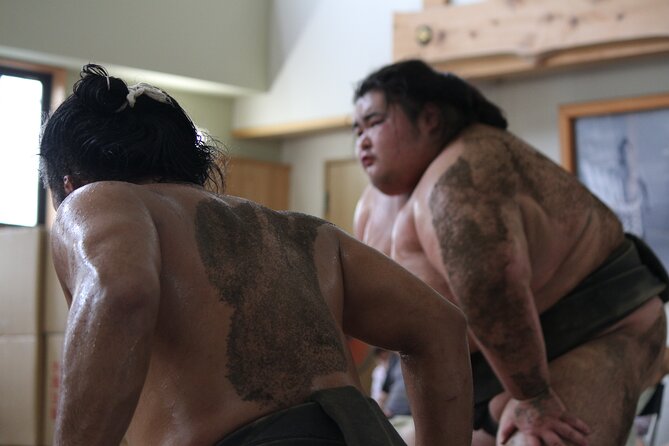
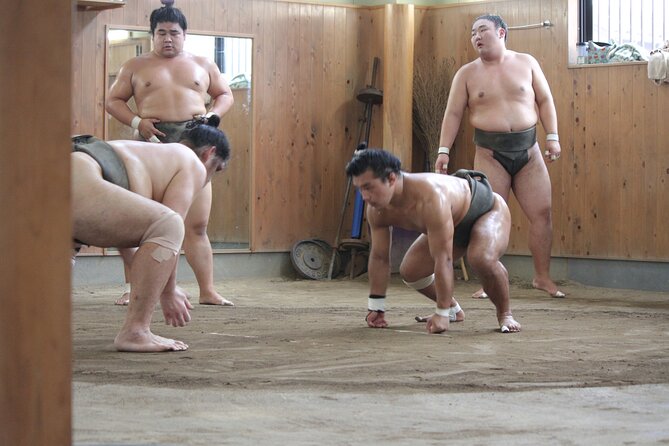
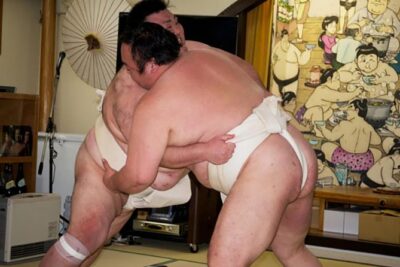
Inside Asahiyama beya, you watch wrestlers train at close range. The practice is not presented as a staged performance. You see the exertion, repetition, balance, speed, and sheer force that make a sumo bout last only seconds but require years of preparation.
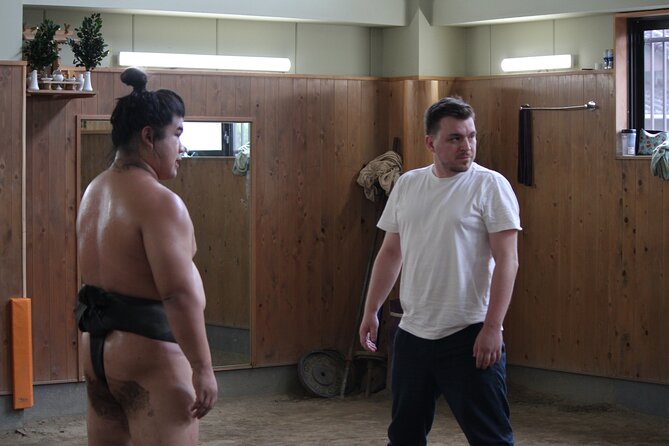
The setting also helps you understand that sumo is not only about size. One visitor described seeing agility and tactics alongside strength, a useful point for anyone who knows the sport mainly through its enormous athletes. The stablemaster directs the session from the side, and you can observe how the wrestlers respond to instruction.
The scheduled stable portion lasts about two hours, although the actual training session may be shorter. One family described roughly 45 minutes of practice, followed by stretching, photos, questions, and interaction. That means you should not assume every minute inside the stable will be a live bout.
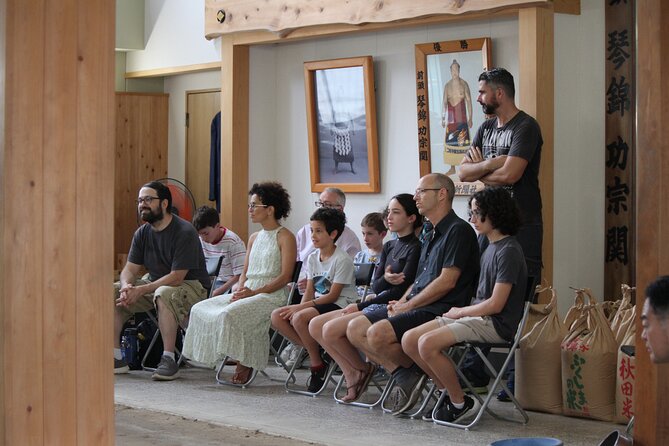
Still, the close distance is the key. You are not looking down from a stadium seat. You sit on folding chairs near the training area, which makes the sounds, movement, and physical effort much easier to appreciate.
More Sumo Experiences in Tokyo
- Tokyo: Sumo Show Experience with Chicken Hot Pot and a Photo
★ 4.8 · 6,678 reviews - Tokyo: Sumo Live Show with Photo in Shinjuku
★ 5.0 · 3,438 reviews - Tokyo: Sumo Show and Dining Experience
★ 4.8 · 2,742 reviews
Meeting at Ueno Station before 8 AM
The tour begins at 7:45 AM at the JR Information area of Ueno Station, at 7 Chome-1 Ueno in Taito City. Ueno is a practical meeting point, but Tokyo stations can be confusing, especially if you are carrying luggage or arriving after a long flight.
I would arrive early enough to locate the exact meeting area without rushing. The group leaves for the first train soon after meeting, and the schedule does not leave much room for a late arrival.
From Ueno, the route takes about 19 minutes by train to Matsudo Station. After a short connection of around five minutes, you continue for roughly 15 minutes to Kunugiyama Station. These train rides are not just transfers. Guides such as Ryoko, Haru, Tomer, Tammy, and Yassmine have used the journey to explain sumo terms, history, rules, and customs.
That is a useful arrangement. Instead of saving all the explanations for after the practice, the guide can prepare you for what you are about to see. You may learn why wrestlers perform certain movements, how a bout is decided, or how sumo fits into Japanese tradition before arriving at the stable.
The downside is clear: two trains and an early meeting require attention. The included tour does not cover your ¥1,060 round-trip rail fare. Keep a phone with the meeting details, allow extra time inside Ueno Station, and do not rely on finding the stable address at the last minute.
Sitting close to intense morning practice
At the stable, you are seated comfortably rather than left standing in a crowded room. The chairs put you close to the practice area, and the guides explain what is happening as the wrestlers work.
This is where the tour earns much of its price. A tournament ticket shows you the public face of sumo. A stable visit lets you see the discipline behind it. You may notice the contrast between explosive contact and controlled movement, or between the physical power of the wrestlers and the quiet focus required to repeat the same drills.
The schedule can change slightly because of transportation, weather, or stable arrangements. The practice itself may also vary in length. That uncertainty is part of visiting a working stable, but it is worth understanding before you pay for the outing.
You should also follow the guide’s instructions closely. Photography is allowed at the end of the session, not as an unrestricted activity throughout practice. That rule protects the training environment and keeps the visit respectful.
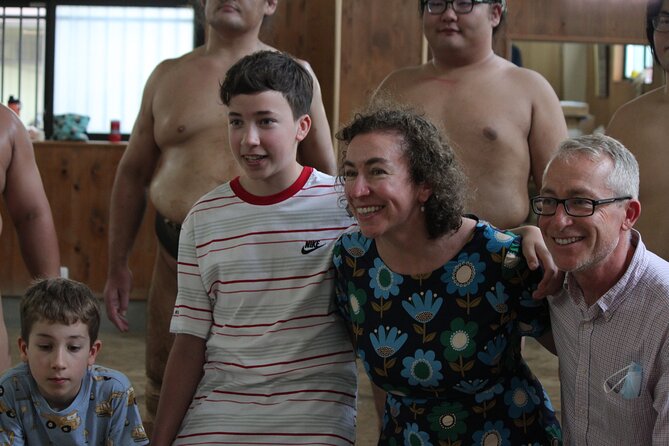
Several people described the wrestlers as friendly and welcoming after practice. That does not turn the stable into an entertainment venue. It gives you a short, thoughtful chance to meet athletes whose daily lives are usually closed to the public.
Trying to push a professional wrestler
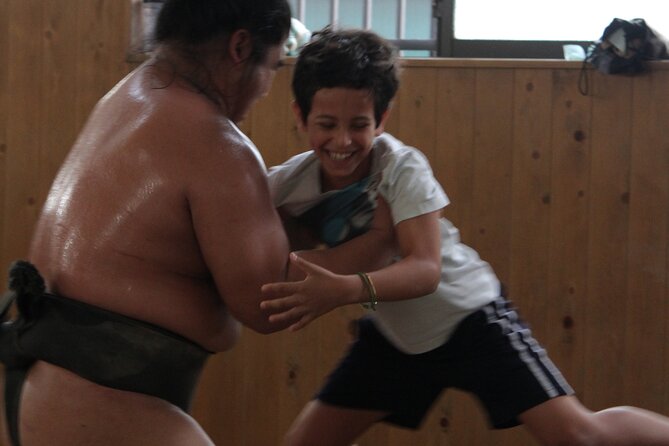
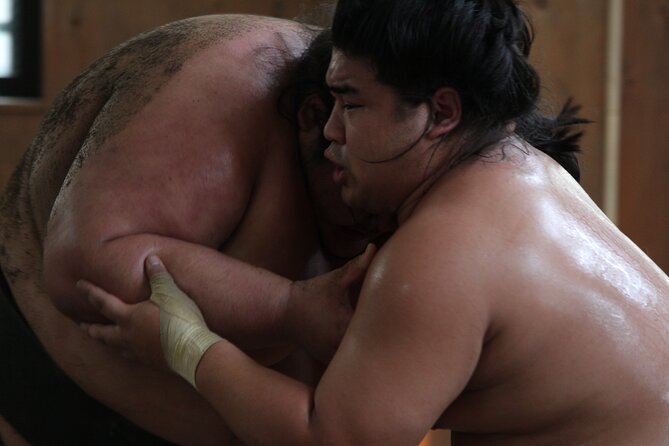
After training, the experience becomes more hands-on. You may step into a brief sumo-style challenge and try to push one of the wrestlers.
I use the word try carefully. The wrestlers are built to resist movement, and one participant joked that a win might only mean the athlete allowed it. Children and adults can take part in the playful test, and families particularly appreciated seeing younger children attempt it.
The activity is memorable because it changes your understanding of sumo. Watching an athlete push another person is impressive. Feeling how little one of these wrestlers moves when you press against him is much more revealing. You quickly learn that mass is only part of the equation. Position, balance, timing, and technique matter just as much.
This portion is not a full wrestling match, and you should not expect a competitive bout. It is a controlled interaction intended for fun and photographs. The wrestlers’ good humor helps, especially for children who may be nervous about stepping forward.
Photography takes place at the end, when you can pose with the wrestlers and capture the moment. If photos are important to you, keep your phone ready but wait until the guide signals that it is appropriate.
A completely different kind of day out:
- Tokyo Disney Resort – Tokyo Disneyland & Tokyo DisneySea Park Tickets
★ 4.8 · 99,488 reviews - SHIBUYA SKY Ticket
★ 4.7 · 46,509 reviews - JR Whole Japan Rail Pass
★ 4.8 · 29,150 reviews - Mt Fuji and Hakone 1-Day Bus Tour Return by Bullet Train
★ 5.0 · 26,383 reviews
Sharing chanko nabe after practice
Lunch is included, and the traditional dish is chanko nabe, a stew associated with the sumo diet. It is designed to provide substantial nourishment for athletes, but you do not need to be a sumo fan to enjoy the meal.
The dish has been described as a light broth with vegetables and chicken, and one family found it both tasty and surprisingly enjoyable. Another person joked that the stable should open a restaurant. That gives you a useful expectation: this is not simply a token snack added to a tour. It is part of the cultural setting.
The meal also gives the morning a slower rhythm. After the force and concentration of practice, you can sit, eat, ask questions, and hear more about the wrestlers’ lives and paths into sumo. Some athletes who speak English may answer questions directly, while the guide can translate when needed.
Vegetarian food is available, but you must notify the operator at least three days before the tour. Do not wait until the morning of the visit. The provided information does not list other dietary adaptations, so you should contact the operator in advance if you have additional food needs.
Guides who make the difference
The route and stable visit would be harder to follow without a good guide. The strongest part of the guiding is the translation between an unfamiliar sport and what you see in front of you.
Ryoko receives especially warm praise for her clear explanations, friendly manner, and willingness to help with the rest of a Tokyo itinerary. Tomer is also noted for giving a useful sumo introduction during the train ride and translating comments from the stablemaster. Haru, Tammy, and Yassmine are also named as guides who helped make the morning welcoming and easy to follow.
That personal guidance matters because sumo has its own language and rituals. Terms, rankings, customs, and training habits can pass quickly if you do not have someone to explain them. The guides also help with the trains, which is valuable on a morning when a missed connection can cost you much of the practice.
The group can include up to 26 people. That is not an intimate private tour, but it is still small enough for a guide to explain the action and organize the photos and pushing activity. Some departures have been much smaller, though you should book on the assumption that the full group is possible.
Price, timing, and practical value
The price is $105.71 per person, plus ¥1,060 for round-trip train fare. That makes the basic cost roughly $113 per person before any other personal spending.
I would not call it a cheap morning. You are paying for the guide, access to a stable that is not normally open to the public, the sumo interaction, and lunch. The value depends on what you want from Tokyo. If you only want to see sumo once, a tournament ticket may suit you better when a tournament is taking place. If you want to understand how wrestlers train and live, this outing gives you access that a public match cannot provide.
The four-hour length is also useful. You leave early, return to the Ueno meeting point, and still have much of the day available. The activity ends back where it began, which makes it easier to continue sightseeing afterward.
The tour is booked, on average, about 23 days ahead. I would not leave it until your final Tokyo morning, especially if you need a vegetarian lunch or have a fixed itinerary. Free cancellation is available up to 24 hours before the start time. Cancellations or changes inside that window are not accepted for a refund, and the operator may offer another date or a full refund if minimum participation is not reached.
The communication warning you should take seriously
One reported problem involved a late arrival at Ueno and confusion over last-minute instructions. The participant reached the meeting point at 7:58 AM, then had difficulty contacting the operator and did not receive the stable address until later. The result was a costly taxi journey and missing most of the practice.
The tour operator explained that information had been sent through Viator and WhatsApp, but a technical problem delayed the response. This appears to be an unusual failure, yet the lesson is practical: check every message before the tour, confirm whether WhatsApp is being used, and make sure you know exactly where to meet.
If you arrive after the group leaves, do not assume you can simply make your own way to the stable. The stable location is not the meeting point, and the train route is part of the organized transfer. A few minutes can make a large difference on this early schedule.
Who will enjoy this morning most
I would recommend the tour to you if you fit one or more of these descriptions:
- You want access to a real sumo training stable rather than only a stadium bout.
- You enjoy cultural activities that include explanation, food, and personal contact.
- You are visiting Tokyo with children who will enjoy trying to push a professional wrestler.
- You are curious about the discipline and daily effort behind sumo.
- You want a four-hour activity that leaves the rest of the day free.
It may be less suitable if you dislike early starts, complicated station transfers, or tightly timed group activities. It is also not the right choice if you expect a full tournament or continuous wrestling action. Training can be shorter than the stable visit, and the schedule may change.
Should you book the Sumo World tour?
Yes, if you want a rare and personal look at sumo. The strongest reasons are the close seating during practice, the chance to ask questions, the playful push against a wrestler, and the chanko nabe meal afterward.
Book it with realistic expectations. You are visiting a working stable, not attending a staged show. Arrive well before 7:45 AM, confirm all communication channels, prepare for two train rides, and request vegetarian food at least three days ahead.
For families, first-time visitors to Japan, and anyone fascinated by Japanese sport, this is one of the more distinctive ways to spend a Tokyo morning. The price is fair for the access, lunch, guide support, and small-group format, though the transport surcharge and early logistics deserve attention.
FAQ
Where does the tour begin?
The meeting point is the JR Information area at Ueno Station, 7 Chome-1 Ueno, Taito City, Tokyo 110-0005, Japan.
What time should I meet the guide?
The start time is 7:45 AM. You should arrive early because the group travels by train soon afterward.
How long does the experience last?
The tour lasts approximately four hours and ends back at the Ueno meeting point.
How do I reach the sumo stable?
The group travels from Ueno Station to Matsudo Station, then continues by train to Kunugiyama Station before visiting Asahiyama beya.
Is train transportation included?
No. The round-trip JR train fare costs ¥1,060, approximately $7, and is paid separately.
Is lunch included?
Yes. Lunch includes chanko nabe, and vegetarian service is available if requested at least three days in advance.
Can I take photographs?
Yes. Photography is allowed at the end of the training session, including during the photo opportunity with the wrestlers.
Can I try pushing a sumo wrestler?
Yes. Participants may take part in a brief sumo wrestling experience and try pushing one of the wrestlers.
What is the cancellation policy?
You can cancel up to 24 hours before the experience start time for a full refund. Cancellations or changes made less than 24 hours before the start time are not accepted for a refund.
Just added in Tokyo
- A One-of-a-Kind Sushi Experience in a Special Place of Japan★ 5.0 · 15 reviews
- Tokyo Cute Bento Cooking Class – Make a Kawaii Character Lunchbox★ 5.0 · 126 reviews
- Japanese Home Cooking Class & Walk in Todoroki Temple Tokyo★ 5.0 · 88 reviews
- Japan Tokyo Tower Observatory Deck E-Ticket★ 4.0 · 34 reviews
- Catch a Baseball Game in Tokyo with a Local – Tickets Included★ 5.0 · 24 reviews
- JDM Experience with Fast&Furious RX-7 (English speaking Driver)★ 5.0 · 57 reviews
- Tokyo Private Day Tour by Car with English speaking Driver Guide★ 4.0 · 29 reviews
- Japan Classic 10 Day – One Life Adventures★ 5.0 · 129 reviews
Sumo Experiences, compared.
Sumo Show Experience with Chicken Hot Pot and a Photo
Read our review →
Tokyo Shinjuku Sumo Show & Experience with Photo
Read our review →
Asakusa Sumo Club Sumo Show Admission with Chankonabe in Tokyo
Read our review →
Tokyo Ginza Sumo Experience: Performance vs Pure Practice
Read our review →Browse the lists this tour appears in