
Reviewed · CYCLING AND E-BIKE TOURS
Naha: Guided E-Bike Tour of the 12 Zodiac Temples
Shuri’s quiet lanes hide Okinawa’s best surprises. I like the way this small-group e-bike tour reaches tucked-away temples that are easy to miss, and I like the helmet intercom, which lets you hear your guide without shouting through traffic. The main consideration is simple: you need to ride a bicycle confidently, and Okinawa’s heat can make three hours feel longer than expected.
The route mixes Buddhist temples, shrines, royal sites, old houses, sacred trees, and a spring. Guides such as Maki, Maria, Hiro, Reiji, and Jojo have earned praise for clear explanations, friendly care, and helpful cycling advice. At $95 per person, the tour is not a bargain-basement ride, but the quality e-bike, guide, small group, and access to obscure Shuri sites make it a fair buy for curious first-time visitors.
In This Review
- Key points to know before you book
- Why an e-bike is the right way to see Shuri
- Shuri Kannon Temple and the first look at old Okinawa
- Ankokuji Temple, old houses, and a giant gajumaru
- Shureimon Gate and the classic Okinawa photograph
- Daruma Temple and the meaning behind its red figures
- Seikoji Temple, Jizo statues, and a quieter mood
- Saki Kasahigawa, a spring in the forest
- Sogenji Temple and the former royal mausoleum
- What the guide adds to the ride
- Is $95 a fair price?
- Heat, clothing, and cycling comfort
- Who will enjoy this most?
- Should you book the 12 Zodiac Temples e-bike tour?
- FAQ
- Where does the tour start and finish?
- How long does the tour last?
- What is included in the price?
- What languages are available?
- How many people can join?
- What should I bring?
- Are sandals allowed?
- What happens in bad weather?
Key points to know before you book
- Small groups of up to five: You get a more personal ride, with room for questions and adjustments.
- Electric bikes handle Shuri’s hills: Several stops connect through sloping streets, so pedal assistance matters.
- The helmet intercom is genuinely useful: You can hear directions and stories while riding instead of stopping every few minutes.
- The route reaches quiet religious sites: Shuri Kannon, Ankokuji, Daruma Temple, Seikoji, Saki Kasahigawa, and Sogenji offer a side of Naha that is easy to overlook.
- Shureimon Gate supplies the classic photo: Your guide can help position the bike for a memorable red-gate picture.
- Bring water and sun protection: Comfortable shoes, sunscreen, and a hat matter more here than fancy cycling gear.
Why an e-bike is the right way to see Shuri
Shuri is not a flat sightseeing district. Its temples and historic corners sit along backstreets and hills, and walking between them would take more time and effort than this three-hour outing allows. A regular bicycle could also turn the ride into a workout. The electric bicycle gives you a practical middle ground: you still move under your own power, but the hills are less punishing.
That matters because the tour is built around several short rides rather than one long push. The listed riding sections take about 15 to 20 minutes each, with visits in between. You get the pleasure of moving through the neighborhood, then a chance to stop, listen, look around, and catch your breath.
I especially like the helmet intercom system. It lets you stay connected with the guide while riding, and several people praised it as one of the fun and useful parts of the experience. In a small group, that can make the whole ride feel more relaxed. You do not need to bunch up around the guide or miss half the explanation because of road noise.
The ride begins and ends at the same bike shop, a five-minute walk from Monorail Makishi Station, next to the post office. That location makes the tour easy to fit into a day in central Naha. You meet at the shop, get fitted for the e-bike and helmet, and then head toward Shuri’s side streets.
More Temples and Shrines in Naha:
- Zodiac Shrines and Naha Backstreets Cycling Tour
★ 5.0 · 29 reviews - [Kyoto & Nara Day Tour] Sagano Scenic Railway & Nara Park & Fushimi Inari Taisha Thousand Torii Gates & Togetsukyo Bridge & Bamboo Grove & Kimono Forest (Departing from Osaka)
★ 4.9 · 10,942 reviews - Mount Fuji & Hakone – Lake Ashi Torii Gate, Hakone Shrine, Hakone Pirate Ship, Hakone Ropeway, Owakudani, Lake Yamanaka & Oshino Hakkai Day Trip: Sea, Land, and Air Panoramic Tour from Tokyo
★ 4.8 · 7,989 reviews
Shuri Kannon Temple and the first look at old Okinawa
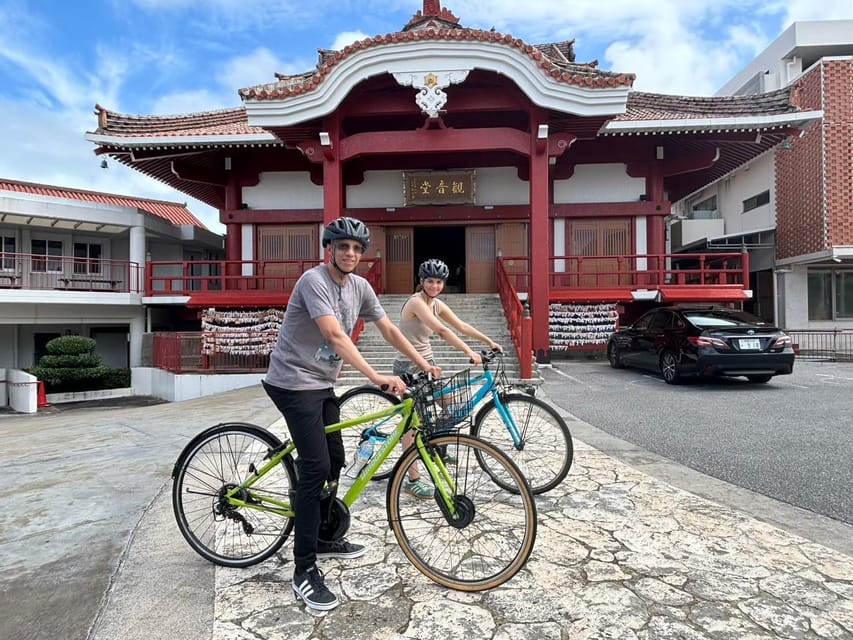
Shuri Kannon Temple is one of the strongest opening stops. It served as a guardian temple during the Ryukyu Kingdom, and its bright red appearance gives the visit an immediate sense of place. You can look closely at the carvings and decorative details, then enjoy views across Shuri from the temple grounds.
This stop is more than a quick photo opportunity. The guide helps explain how Buddhist and local Okinawan religious traditions appear in the area, giving you a better frame for the temples that follow. If you are new to Okinawan culture, this background is valuable because the sites can otherwise blend together.
The red temple also gives you an early reminder that this is not a standard city bicycle tour. You are not simply passing major monuments from the street. You are stopping at religious places with their own customs and atmosphere. Be respectful, keep your voice down, and remember that donations and temple offerings are not included in the price.
Ankokuji Temple, old houses, and a giant gajumaru
The next stop is Ankokuji Temple, a smaller local site with traditional houses nearby. Its ancient gate and large gajumaru tree give it a quieter feel than Shureimon Gate, which is one reason the guided route earns its keep.
You might pass close to this kind of place on your own and never realize what you are seeing. The guide provides the context, points out details, and explains the local setting. That turns a brief stop into something you can remember later.
Ankokuji is listed as a five-minute visit, so do not expect a long temple stay here. That is not necessarily a weakness. The short stop keeps the tour moving and leaves room for several different kinds of sites. Still, if you prefer lingering at every temple, three hours may feel tightly scheduled.
Shureimon Gate and the classic Okinawa photograph

Shureimon Gate is the most recognizable landmark on the route. Its red structure is closely associated with Okinawa, and the tour gives you time to stop and take a photograph with your e-bike in front of it.
The bike adds a pleasant twist to the usual gate picture. It shows how you reached the site and gives the image a more personal feel than a standard standing portrait. Your guide may also help with photos. Maki was praised for taking memorable pictures and for shaping the ride around the interests of the group.
Do not mistake this stop for the whole Shuri experience. Shureimon is the most famous point, but the smaller temples and side streets are what give the tour its character. The gate works best as one bright, familiar landmark within a broader look at the district.
More Bike Tours in Naha:
- Afternoon Adventure: Okinawa Local Cycling with Spectacular Views
★ 5.0 · 92 reviews - E-Bike Nature Tour in Shuri
★ 5.0 · 25 reviews - Bike Tour Exploring North Kyoto plus Lunch
★ 5.0 · 1,087 reviews - Tokyo Great Cycling Tour
★ 5.0 · 811 reviews
Daruma Temple and the meaning behind its red figures
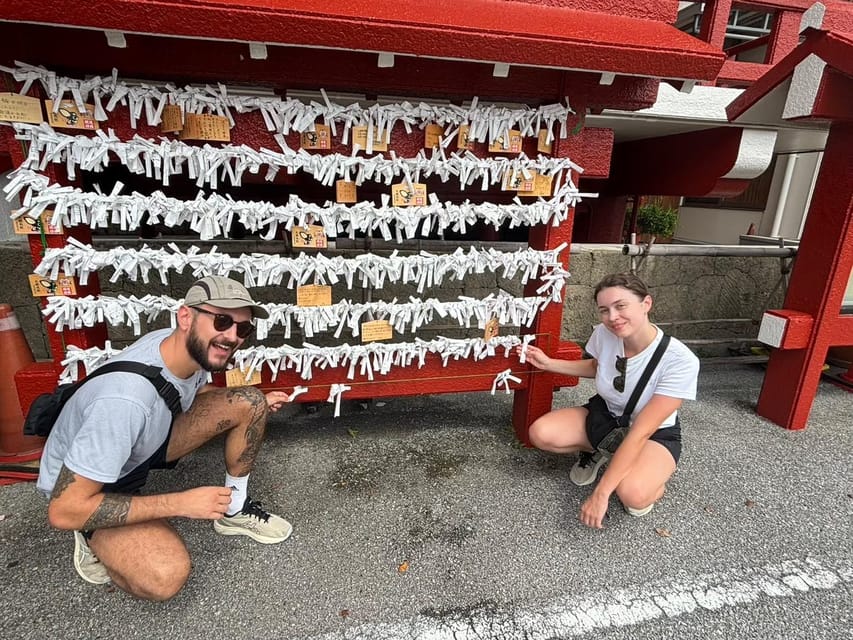
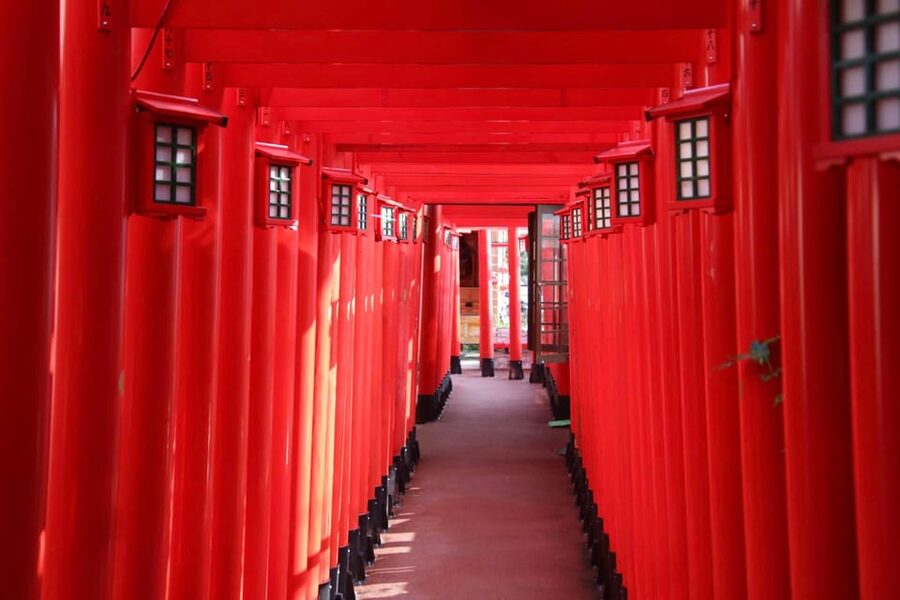
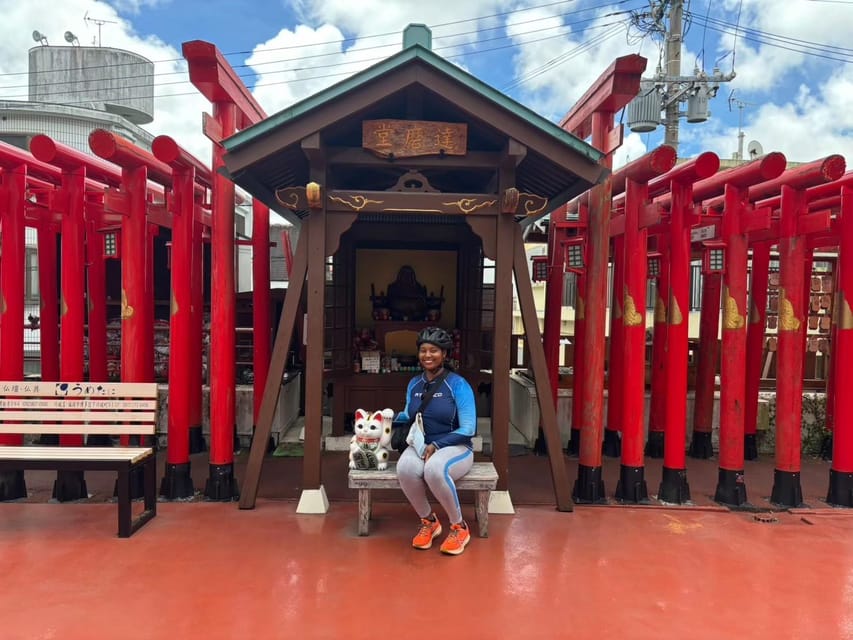
Daruma Temple is a popular place for prayers connected with health and pregnancy. The red daruma dolls and torii gate make this another highly visual stop, but the appeal goes beyond color.
Your guide can explain how religious customs differ from site to site and why people come to these places to pray. That kind of explanation is one of the main reasons to choose a guided ride rather than simply following a map. You see the objects, but you also learn how they fit into daily life.
The visit is scheduled for about 20 minutes, which gives you enough time to take in the gate, notice the daruma figures, and ask questions. As with the other religious sites, behave thoughtfully. Offerings are not included, and you should not assume that every temple or shrine follows the same practice.
Seikoji Temple, Jizo statues, and a quieter mood
Seikoji Temple changes the pace. It is described as peaceful, with a sacred atmosphere, Jizo statues, and a modern building. After the bright colors of Shuri Kannon and Daruma Temple, this stop gives you a calmer visual and spiritual pause.
The visit lasts about 10 minutes. That is enough for a short look and an explanation, but not enough for a long private meditation. I see this as part of the tour’s rhythm: ride, stop, learn, and continue before the heat or the schedule becomes too demanding.
The Jizo statues are worth your attention. Ask the guide about their role and the customs connected with them. The guide’s explanations are central here because the modern structure and modest grounds may not explain themselves to someone seeing them for the first time.
Saki Kasahigawa, a spring in the forest
Saki Kasahigawa is a miracle spring flowing from a deep forest. The water provides a change from temples and gates, and it brings the area’s natural side into the route.
The description of the spring points to something important about this experience. The tour is not only a checklist of religious buildings. It follows the older character of Shuri, where water, trees, homes, temples, and royal sites form part of the same local story.
You should not expect a large attraction with extensive facilities. This is a stop for atmosphere and a sense of continuity. Look at the flowing water, listen to the guide, and notice how different it feels from the city streets.
Sogenji Temple and the former royal mausoleum
The final major stop is Sogenji Temple, a former royal mausoleum. Its park is described as having clean, pure air, with a gate and another large gajumaru tree to see.
This is a fitting place to end the cultural portion of the ride. The temple connects the route back to the Ryukyu royal past, while the park gives you a little breathing room before returning to the shop. The combination of gate, tree, and open park makes it a pleasant final pause.
The route description and timing suggest that not every named site receives the same amount of time. Some are brief stops, while others allow a longer look. If a particular temple matters greatly to you, tell the guide early. In a group of no more than five, there is a better chance of getting useful answers or small adjustments than on a large bus tour.
What the guide adds to the ride

The strongest part of this experience is the human guidance. Maki, Maria, Hiro, Reiji, Jojo, and other guides have been praised for explaining local history and customs in an easy, friendly way. Several guides also checked that people were comfortable, staying hydrated, and handling the bikes safely.
That practical care matters in Okinawa. You may be dealing with sun, hills, traffic, unfamiliar road layouts, and a busy sightseeing day. A guide who gives clear riding directions and checks on the group can make the difference between a fun outing and a tiring one.
The listed languages are English, Chinese, and Japanese. English ability can vary by guide, but specific feedback praises Maria’s English and describes guides such as Maki and Reiji as clear and engaging. The helmet intercom also helps remove some of the usual language and traffic problems.
The small-group limit of five is another major advantage. You can ask why a gate looks a certain way, how to behave at a temple, or what a statue represents without holding up a large crowd. Solo visitors and couples may find this particularly comfortable, while families or friends can enjoy a more private-feeling outing.
Is $95 a fair price?
At $95 per person, you are paying for more than bicycle rental. The price includes the electric bicycle, helmet, intercom system, and a three-hour guided route through several parts of Shuri. You also get the benefit of local navigation, which is valuable because many of the temples sit in side streets and are difficult to locate efficiently on your own.
A self-guided ride would cost less if you already had a bicycle and knew the area. But it would not provide the same explanations, traffic guidance, or cultural context. You would also spend time finding the smaller sites, and you might pass them without understanding what makes them important.
The value is strongest if you want both activity and interpretation. You get moving, but you are not left to decode the temples by yourself. Meals, drinks, temple offerings, and donations are extra, so budget for those separately if you plan to make an offering or stop for food afterward.
One useful detail comes from a guide adding a bakery stop when time allowed. Do not count on this as part of the fixed route, but it suggests the experience can have a little flexibility when the schedule and group permit.
Heat, clothing, and cycling comfort
Wear comfortable shoes and clothing made for riding. Sandals and flip flops are not allowed, and this rule makes sense given the hills, traffic, and need for secure footing.
Bring water, sunscreen, and a hat. Okinawa can be hot and bright, and you will spend time outdoors at every stop. The guide may remind you to drink, but you should arrive prepared rather than wait until you feel overheated.
You do not need to be a serious cyclist, but you must be able to ride a bike. The e-bike reduces the effort on hills, not the need to balance, steer, brake, and follow road directions. If you are uneasy on a bicycle, this is the wrong tour.
Smoking is not allowed during the ride. Food and drinks are also not included, so plan your meal before or after the three-hour outing. If rain is a concern, the operator may change plans when the precipitation probability exceeds 70 percent or severe weather is expected. You should receive notice the day before in that case.
Who will enjoy this most?
I would recommend the tour to you if you want a close look at Naha beyond its main shopping streets. It suits first-time visitors who want an introduction to Shuri, active sightseers who prefer cycling to walking, and anyone interested in Okinawan Buddhist and Shinto traditions.
It is also a strong choice if you value quiet local corners over famous attractions alone. Shureimon Gate gives you the signature image, but the temples, old houses, trees, and spring make the route more personal.
You may want to skip it if you cannot ride a bicycle, dislike outdoor activity in warm weather, or prefer to spend long periods at one temple. The schedule keeps moving, and several visits are short. You should also consider another activity if you want a fully private tour, since the small group can include up to five people.
Should you book the 12 Zodiac Temples e-bike tour?
Book it if you want an active, well-guided introduction to Shuri and would rather find small temples with local help than follow the usual Naha sightseeing path. The e-bike, intercom helmet, and small group solve practical problems, while the guides add the stories and customs that turn a ride into a worthwhile cultural outing.
The best reason to choose it is the combination: you see Shureimon Gate, but you also reach places you might otherwise miss, including Ankokuji, Daruma Temple, Seikoji, Saki Kasahigawa, and Sogenji. At $95, it is good value for a three-hour experience if you are comfortable on a bicycle and prepared for sun and hills.
FAQ
Where does the tour start and finish?
The tour starts and ends at the same bike shop, listed as ダイショウビル. The shop is a five-minute walk from Monorail Makishi Station, next to the post office.
How long does the tour last?
The tour lasts three hours. Starting times vary, so you need to check availability when booking.
What is included in the price?
The price includes an electric bicycle rental and a guided tour with a helmet fitted with an intercom system.
What languages are available?
The tour is offered in English, Chinese, and Japanese.
How many people can join?
The tour is limited to five participants, making it a small-group experience.
What should I bring?
Bring comfortable shoes, water, sunscreen, and a hat. Wear clothing suitable for cycling.
Are sandals allowed?
No. Sandals and flip flops are not allowed. You need secure, comfortable footwear.
What happens in bad weather?
If the precipitation probability exceeds 70 percent or severe weather is expected, the plans may change. The operator will contact you the day before if that happens.
Just added in Naha
- Northern Okinawa: Churaumi Aquarium & Kouri Island & Cape Manza & American Village Day Tour (Departing from Naha & Chatan)★ 4.8 · 1,115 reviews
- (Okinawa’s No. 1 Popular Northern Day Trip) Chinese-speaking guide · Includes admission tickets · 1 person can book: Churaumi Aquarium · Cape Manzamo · Kouri Island · American Village★ 4.7 · 1,846 reviews
- E-Bike Nature Tour in Shuri★ 5.0 · 25 reviews
- Zodiac Shrines and Naha Backstreets Cycling Tour★ 5.0 · 29 reviews
- Sushi Making Experience Class in Naha Makishi Public Market★ 5.0 · 35 reviews
- Tokashiki Island Day Trip from Naha★ 4.0 · 15 reviews
- Port Pick-Up: Naha Private Tour Licensed Guide& Vehicle★ 4.5 · 16 reviews
- Okinawa:Kerama Islands experience Diving/Snorkeling/WhaleWatching★ 4.5 · 16 reviews
Cycling and E-Bike Tours, compared.


3h Tokyo E-Bike Tour: Hidden Gems, and Local Life with guide
Read our review →
Arashiyama Bamboo Forest & Hidden Gems Bike Tour (Early Bird)
Read our review →
5 Top Highlights of Kyoto Full Day Bike Tour (E-bike option)
Read our review →

Hiroshima 2hr Peace Cycling Tour with Local Guide
Read our review →Browse the lists this tour appears in