
Reviewed · TEMPLES AND SHRINES
Osaka: Temple Tour and Traditional Calligraphy Lesson
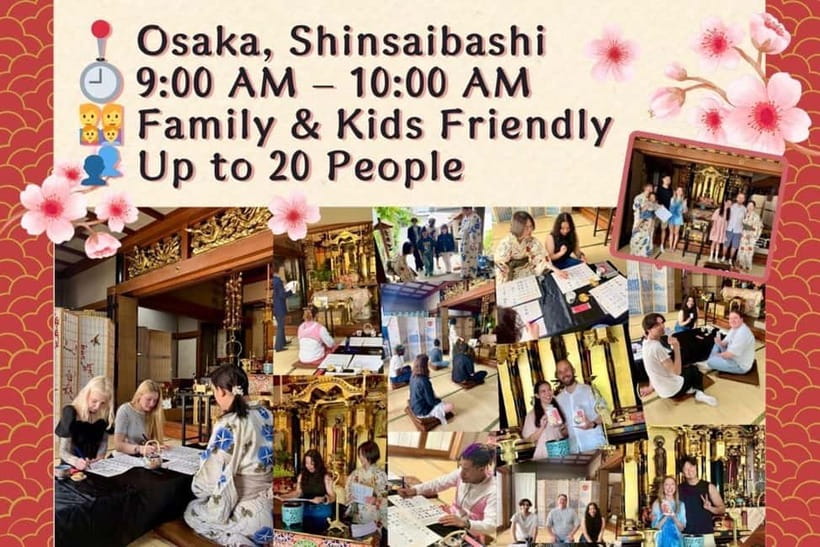
Clear your mind in central Osaka. At Saishoji Temple, you trade the city’s bright signs for a quiet hour of meditation, brushwork, and Japanese cultural lessons. I like the peaceful temple setting and the chance to take home a personal kanji name card, not just a generic souvenir.
I also like the low $20 price, especially since materials, instruction, and a small ceramic plate are included. The main consideration is time: one hour moves quickly, and the exact balance between history, meditation, calligraphy, and tea may feel brisk if you want a long lesson in any one subject.
This is a gentle, beginner-friendly activity for solo visitors, couples, families, and anyone who wants a calmer side of Osaka. The small-group format and English instruction make it easy to join without Japanese language skills.
In This Review
- Key points to know before booking
- Arriving at Saishoji Temple in Horie
- The opening history and language lesson
- Zazen meditation before calligraphy
- Learning the brush and ink
- Choosing a kanji for your mini shikishi
- The matcha element and temple customs
- The small ceramic plate and other inclusions
- Why the $20 price works
- Solo visits, families, and different comfort levels
- What the strongest praise tells you
- Practical planning for your Osaka day
- Should you book the Saishoji Temple calligraphy experience?
- FAQ
- Where does the temple and calligraphy experience take place?
- How do I reach Saishoji Temple?
- How long does the activity last?
- Is the activity conducted in English?
- What do I receive during or after the activity?
- Can I cancel or pay later?
Key points to know before booking
- Three minutes from Yotsubashi Station: Saishoji Temple is easy to reach from Osaka’s central shopping districts.
- A quiet setting near Shinsaibashi: You practice inside a historic Zen temple rather than in a busy workshop or tourist shop.
- Meditation comes before the brush: Zazen helps you slow down, focus on breathing, and approach calligraphy with a clearer mind.
- Your finished kanji is personal: You write one favorite character on a mini shikishi and receive a name card explaining your Japanese kanji name.
- Useful keepsakes are included: The package provides all activity materials plus a small ceramic plate measuring about 8 centimeters across.
- Good value for a one-hour stop: At $20 per person, this is an affordable cultural activity, though the short schedule leaves little room to linger.
Arriving at Saishoji Temple in Horie
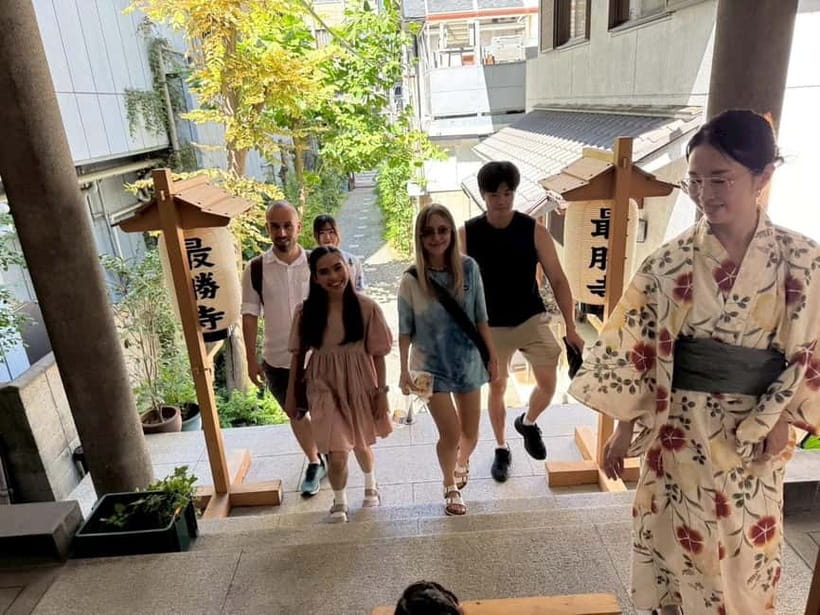
Saishoji Temple is at 1-6-18 Kitahorie, Nishi-ku, Osaka. The simplest route is from Yotsubashi Station on the Osaka Metro Yotsubashi Line. Use Exit 4, then allow about three minutes on foot.
You can also walk from Shinsaibashi Station in about 10 minutes, or from Namba Station in roughly 15 minutes. That makes this a useful add-on to a day around Shinsaibashi, Horie, or Namba. I would plan to arrive with enough time to locate the temple calmly rather than rushing in from a shopping street.
The setting matters. You are not being asked to perform calligraphy at a crowded counter while other shoppers pass behind you. The activity takes place in the quiet surroundings of Saishoji, where the change in mood begins as soon as you leave the city streets.
The temple is close to major Osaka sights, but the program also gives you a short introduction to local places. The opening lesson covers Shinsaibashi, Yotsubashi, and Osaka Castle, along with the difference between Japanese temples and shrines. That context is helpful if this is your first visit to Japan, since the two types of religious sites can look similar at a quick glance while serving different traditions.
More Temples and Shrines in Osaka
- Osaka: Katsuo-ji Temple
★ 4.9 · 996 reviews - Osaka: Minoh, Katsuoji Temple, & Minoh Falls Full-day Tour
★ 4.9 · 172 reviews - Sagano Romantic Train & Arashiyama, Kiyomizudera, Fushimi Inari Taisha Day Tour
★ 4.5 · 171 reviews
The opening history and language lesson
The first part combines Japanese history with basic language instruction. You learn about the local area and Osaka Castle, then practice conversational phrases and cultural expressions in English with an instructor.
Do not expect a full history lecture. This is a compact introduction designed to prepare you for the cultural activities that follow. For a first-time visitor, that is a sensible choice. You get enough background to understand where you are without spending the whole hour sitting through a classroom talk.
The language element also gives the session a practical angle. You are not only watching a demonstration. You have a chance to learn how Japanese communication works in everyday cultural settings, including expressions that do not translate neatly word for word.
The instruction is in English, and the activity is designed for both beginners and more advanced learners. That broad level range is useful for mixed groups, although anyone hoping for serious Japanese language study should keep expectations modest. The language section is a supporting part of the hour, not a stand-alone Japanese course.
Zazen meditation before calligraphy
The meditation portion is one of the strongest reasons to choose this activity. You take part in Zazen, a form of seated meditation associated with Zen practice, with guidance on clearing your mind and paying attention to your breathing.
The goal is not to master meditation in a few minutes. Instead, it gives you a brief pause before the brush comes out. Osaka can be loud, fast, and full of visual distractions. Sitting quietly in a temple creates a useful break from that rhythm.
This part also explains why the calligraphy feels different from simply writing Japanese characters at a craft table. You are encouraged to move slowly and concentrate. The reviews repeatedly praise the calm atmosphere, the chance to forget daily pressure, and the feeling of focusing on one small action at a time.
If you are comfortable with quiet reflection, you will likely appreciate this section. If you prefer nonstop activity, meditation may feel like a delay before the main event. I would not book this expecting an energetic group workshop. The appeal is precisely the slower pace.
Learning the brush and ink
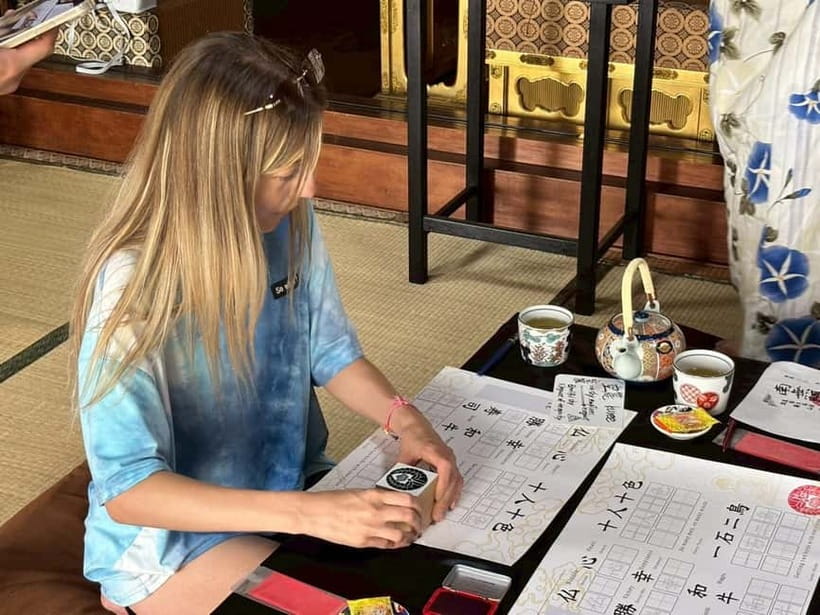
After meditation, you practice basic calligraphy. The instructors guide you through the essential movements, making this suitable for a first attempt. You do not need prior experience, artistic training, or Japanese reading ability.
Calligraphy can look simple from a distance: ink, brush, paper, character. In practice, the pressure of the brush, the direction of each stroke, and the empty space around the character all matter. The short lesson lets you discover that physical side of Japanese writing without requiring you to produce museum-quality work.
The activity is called calligraphy copying in the program description, and the supplied information also describes writing a favorite kanji on a mini shikishi. A shikishi is a small square board or card often used for calligraphy and artistic inscriptions. Your final piece is compact enough to carry home, but personal enough to remind you of the session.
The atmosphere is a big part of the appeal. Several accounts describe the scent of ink, the feel of the brush, and the quiet of the temple as calming. That sensory detail is worth noting because it is what separates this from buying a printed character in a souvenir shop. You handle the brush yourself, make your own marks, and take home the result.
Your work may not look perfect. That is not a flaw in this kind of activity. The value is in learning how the brush behaves and seeing how concentration changes the way you write.
More Temples and Shrines in Japan:
- [Kyoto & Nara Day Tour] Sagano Scenic Railway & Nara Park & Fushimi Inari Taisha Thousand Torii Gates & Togetsukyo Bridge & Bamboo Grove & Kimono Forest (Departing from Osaka)
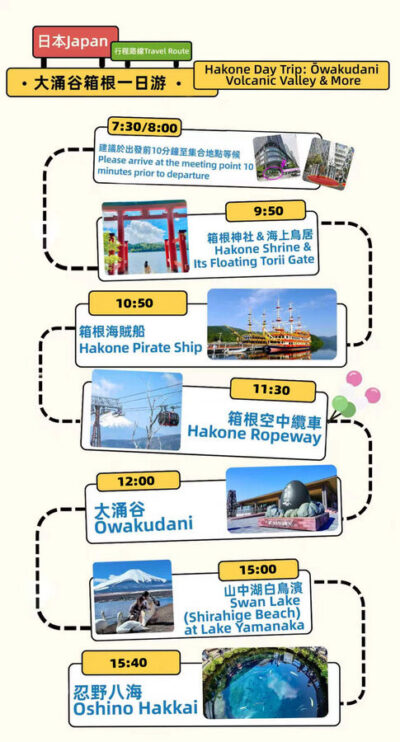
★ 4.9 · 10,942 reviews - Mount Fuji & Hakone – Lake Ashi Torii Gate, Hakone Shrine, Hakone Pirate Ship, Hakone Ropeway, Owakudani, Lake Yamanaka & Oshino Hakkai Day Trip: Sea, Land, and Air Panoramic Tour from Tokyo
★ 4.8 · 7,989 reviews - Kyushu One-Day Tour: Yufuin no Mori Train & Yufuin Town & Nyoirin-ji Temple & Dazaifu & Hell Hot Springs (Departing from Fukuoka)
★ 4.9 · 4,474 reviews - Kyoto: Fushimi Inari, Kinkakuji, Bamboo Grove 1 Day Bus Tour
★ 4.8 · 4,316 reviews
Choosing a kanji for your mini shikishi
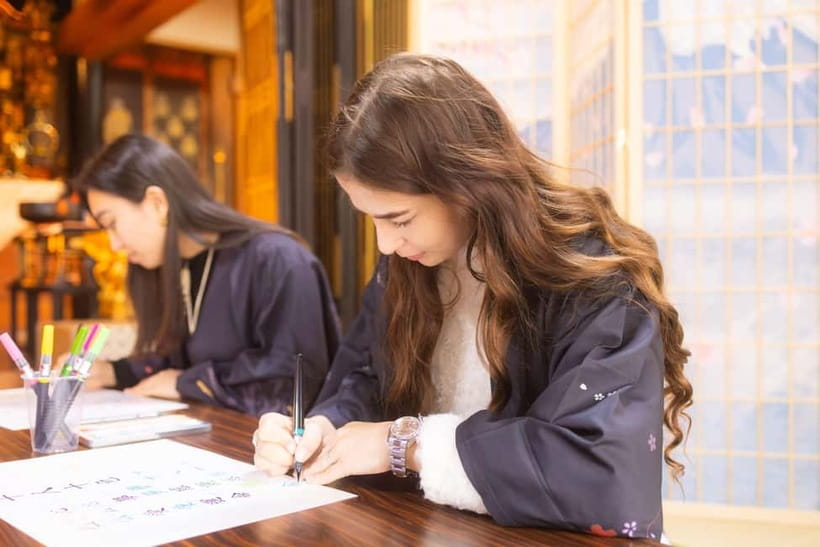
One favorite kanji becomes the focus of your finished piece. The supplied information does not give a fixed menu of characters, so you may want to think ahead about a word or idea that matters to you.
A kanji can express a concept such as peace, strength, love, or hope, but the precise choice and explanation depend on the instruction provided during your session. Ask about the meaning before you commit your final character. A character that looks attractive may carry a narrower meaning than you expect.
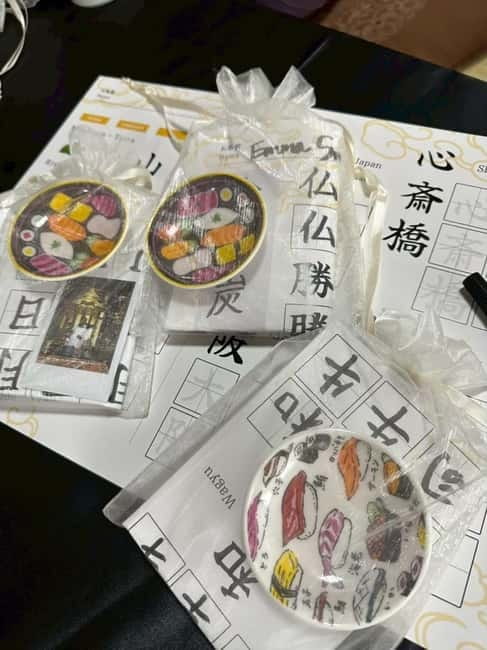
You receive a name card with a Japanese kanji name and its meaning. This is a particularly nice touch for people who want something personal but do not know how to choose a Japanese name. It also gives you a small conversation piece to show friends at home.
I would keep the card and the shikishi together when packing. The mini format is convenient, but it can still bend or mark if placed loose in a full suitcase.
The matcha element and temple customs
The activity description includes a traditional matcha tea ceremony among the cultural activities. The main highlights focus more strongly on meditation and calligraphy, so you should treat the tea portion as part of the planned cultural program rather than assume it will take up a large part of the hour.
Matcha is valuable here because it shows another side of Japanese attention and ceremony. Like calligraphy, it rewards patience and careful movement. If you have never taken part in a tea ceremony, the brief introduction can help you notice details that might otherwise pass by during a larger sightseeing program.
The time limit is the key issue. A one-hour session that includes history, language, meditation, calligraphy, and tea cannot give each topic extensive treatment. I see that as a fair trade at this price, but you should choose a longer specialist class if your main goal is a full tea ceremony or advanced brush instruction.
The small ceramic plate and other inclusions
The included gifts make the price easier to justify. Along with the mini shikishi and kanji name card, you receive a small ceramic plate about 8 centimeters in diameter.
That plate is not a large piece of tableware, but it is a useful memento. It takes little room in your luggage and connects the visit to an everyday Japanese object rather than a mass-produced key ring. Pack it carefully, since ceramic is naturally more fragile than paper.
All materials for the activities are included. You do not need to bring brushes, ink, paper, or other supplies. The guided history and language lesson, cultural activities, and interaction with resident monks are also part of the price.
The mention of resident monks is important. This is not only a calligraphy class using a temple as a backdrop. The religious setting and contact with temple staff give the hour a stronger connection to Japanese tradition. Still, you should approach the space respectfully. Keep your voice low, follow instructions, and remember that the building is a place of worship as well as an activity venue.
Why the $20 price works
At $20 per person, this is one of the easier cultural activities to fit into an Osaka schedule. You receive instruction, materials, several cultural components, a personal name card, a mini shikishi, and a ceramic plate.
The value is strongest if you want variety. In a single hour, you get a little local history, language practice, meditation, brushwork, and a taste of traditional culture. Buying a separate class for each subject would cost more and require additional travel.
The value is less clear if you want depth. A committed calligraphy student may find the lesson too short. Someone focused on Zen meditation may want more uninterrupted sitting. Someone interested mainly in matcha may prefer a dedicated tea ceremony.
For most visitors, though, the price is reasonable because the setting does much of the work. A simple brush lesson becomes more memorable when it takes place in a historic temple near the center of Osaka.
Solo visits, families, and different comfort levels
The experience works especially well for solo participants. The calm format does not require a partner, and the small-group structure allows for personal attention. Several of the supplied accounts describe arriving alone and feeling comfortable from beginning to end.
That matters in Osaka, where many activities are built around food tours, nightlife, or group sightseeing. Here, you can spend an hour doing something quiet without feeling out of place.
Families can also enjoy the session, particularly if children are old enough to follow instructions and sit quietly during meditation. The provided information does not specify a minimum age, so families should confirm suitability before booking for young children.
Couples and friends may like the shared souvenir angle. You can each choose a different kanji, compare your brushwork, and leave with small keepsakes. The activity is not competitive, and the focus stays on concentration rather than producing a perfect result.
The English instruction makes the program accessible to international visitors. If you have never used a Japanese calligraphy brush, that is not a problem. The staff are described as polite, kind, and clear in their explanations, which helps reduce the usual first-time nerves.
What the strongest praise tells you
The most consistent praise centers on three things: polite staff, the peaceful temple atmosphere, and the calming effect of slow calligraphy.
That combination gives you a clear picture of the experience. You are paying less for a grand sightseeing spectacle and more for an hour of careful attention. The strongest moments may be small ones: smelling the ink, holding the brush correctly, breathing quietly, or watching a single character take shape.
The activity also seems well suited to people who want a spiritual reset without committing to a long retreat. You get a taste of Zazen and temple customs, but you remain close to Osaka’s transport network and urban sights.
One useful detail is that people found the activity through several routes, including hotel brochures, online searches, Google Maps, Viator, and social media. That variety does not change the program itself, but it suggests the experience can fit easily into a last-minute Osaka plan when a free hour appears.
Practical planning for your Osaka day
Book this as a calm break between active sightseeing stops. The temple is near Shinsaibashi and within walking distance of Namba, so you can pair it with shopping, dining, or a visit to the Horie area.
Allow extra time for the journey, especially if you are coming from another part of Osaka. The meeting point is specific, but a temple entrance can be easy to pass when you are watching station signs and street numbers.
Wear clothing that lets you sit comfortably and move your arms freely. The supplied information does not set a dress code, but a quiet religious site calls for respectful clothing and behavior.
The activity lasts one hour, with starting times varying by availability. That short length is convenient for a packed itinerary, but it also means late arrival could cost you an important part of the program. Cancellation is free up to 24 hours before the activity, and you can reserve while paying later, which helps if your Osaka schedule is still changing.
Should you book the Saishoji Temple calligraphy experience?
Book it if you want a personal, low-cost cultural activity in central Osaka. It is especially good for first-time calligraphers, solo visitors, couples, families with older children, and anyone who wants a quiet hour away from shopping streets.
Choose something else if you want advanced calligraphy training, a long meditation session, or a full tea ceremony with plenty of time for questions. The one-hour schedule gives you a thoughtful introduction, not a complete course.
For $20, the balance is hard to fault. You get a real temple setting, English guidance, contact with resident monks, a chance to slow your breathing, and several small mementos to take home. If your ideal Osaka memory involves doing something with your hands rather than simply taking pictures, this is a smart and manageable choice.
FAQ
Where does the temple and calligraphy experience take place?
It takes place at Saishoji Temple, 1-6-18 Kitahorie, Nishi-ku, Osaka, 550-0014, Japan.
How do I reach Saishoji Temple?
The temple is a three-minute walk from Yotsubashi Station, Exit 4, on the Osaka Metro Yotsubashi Line. It is about 10 minutes on foot from Shinsaibashi Station and 15 minutes from Namba Station.
How long does the activity last?
The activity lasts one hour. Starting times depend on availability.
Is the activity conducted in English?
Yes. The instructor language is English, and the program includes an English-guided Japanese history and language lesson.
What do I receive during or after the activity?
You receive the materials needed for the activities, a name card with Japanese kanji and its meaning, a mini shikishi featuring one favorite kanji, and a small ceramic plate measuring about 8 centimeters in diameter.
Can I cancel or pay later?
You can cancel up to 24 hours in advance for a full refund. A reserve-now, pay-later option is also available.
Just added in Japan
- A One-of-a-Kind Sushi Experience in a Special Place of Japan★ 5.0 · 15 reviews
- Tokyo Cute Bento Cooking Class – Make a Kawaii Character Lunchbox★ 5.0 · 126 reviews
- Japanese Home Cooking Class & Walk in Todoroki Temple Tokyo★ 5.0 · 88 reviews
- Japan Tokyo Tower Observatory Deck E-Ticket★ 4.0 · 34 reviews
- Catch a Baseball Game in Tokyo with a Local – Tickets Included★ 5.0 · 24 reviews
- Tokyo Private Day Tour by Car with English speaking Driver Guide★ 4.0 · 29 reviews
- Japan Classic 10 Day – One Life Adventures★ 5.0 · 129 reviews
- JDM Experience with Fast&Furious RX-7 (English speaking Driver)★ 5.0 · 57 reviews
Temples and Shrines, compared.
![[Kyoto & Nara Day Tour] Sagano Scenic Railway & Nara Park & Fushimi Inari Taisha Thousand Torii Gates & Togetsukyo Bridge & Bamboo Grove & Kimono Forest (Departing from Osaka)](https://media.japanvisits.com/wp-content/uploads/kyoto-nara-day-tour-sagano-scenic-railway-nara-park-fushimi-inari-taisha-thousand-torii-gates-togetsukyo-bridge-bamboo-grove-kimono-forest-departing-from-osaka-k110001-400x257.jpg)
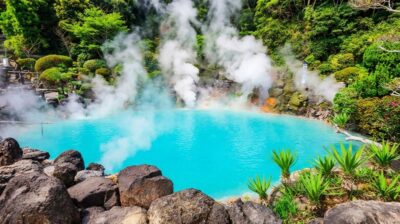
Kyushu One-Day Tour: Yufuin no Mori Train & Yufuin Town & Nyoirin-ji Temple & Dazaifu & Hell Hot Springs (Departing from Fukuoka)
Read our review →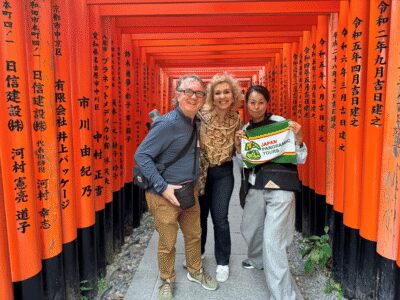
Fushimi Inari, Kinkakuji, Bamboo Grove 1 Day Bus Tour
Read our review →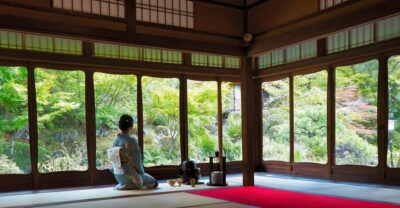
Tea Ceremony in a Traditional Tea House in Kiyomizu
Read our review →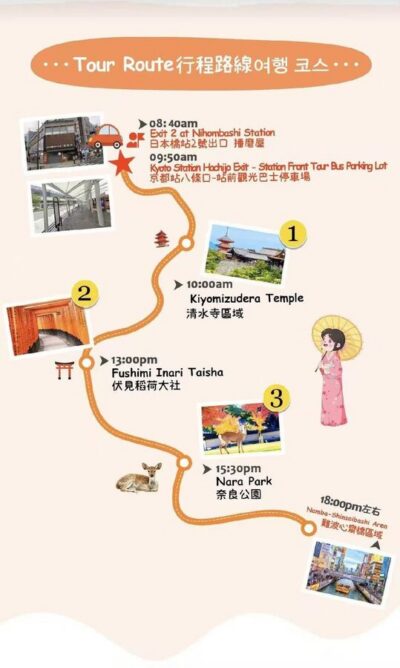
Kyoto Nara Day Trip │ Kiyomizu-dera Temple + Fushimi Inari-taisha Shrine + Nara Park (Departing from Osaka/Kyoto)
Read our review →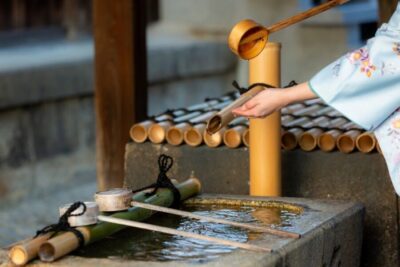
Browse the lists this tour appears in