Reviewed · FULL-DAY
Private Full-day Tokyo Walking Subway Tour by Japan Gray Line
Tokyo rewards a good route. This private day tour links Meiji Shrine, Shibuya Crossing, Tokyo Tower, Tsukiji, and Asakusa with a guide who handles the subway and explains what you are seeing. I like the efficient mix of modern Tokyo and older traditions, and I like that hotel pickup, a Metro pass, and Tokyo Tower admission are included. The tradeoff is clear: seven hours means plenty of walking, outdoor time, and a fairly quick look at each stop.
You pay $203.63 per person, with discounts available for groups. That is not a cheap sightseeing day, but a private guide can save you hours of route planning and help you learn Tokyo’s train system for the rest of your trip. Lunch is extra, and the tour may change or omit stops in poor weather or for operational reasons.
In This Review
- Key points before you book
- Why this route works for a first Tokyo day
- Meiji Shrine: a quiet beginning among the trees
- Shibuya Crossing: twenty minutes at Tokyo’s famous intersection
- Tokyo Tower: a clear city view from 150 meters
- Tsukiji Outer Market: food, movement, and a useful lunch break
- Asakusa and Senso-ji: the traditional finish
- What the private format adds
- Public transport, walking, and the physical effort
- Is $203.63 good value?
- Who should book this Tokyo tour?
- Final verdict: book it for orientation, not for a slow day
- FAQ
- What time does the tour start?
- How long does the tour last?
- Is this a private tour?
- Is hotel pickup included?
- What transportation is included?
- Is Tokyo Tower admission included?
- Is lunch included?
- What should I wear and bring?
Key points before you book
- Private guide and hotel pickup: Your group travels alone with an English-speaking guide, beginning at about 9:30 a.m.
- A practical subway lesson: The included one-day Metro pass lets you see how Tokyo’s public transport works instead of simply watching the city pass from a bus window.
- Six very different stops: The day moves from a forested shrine to neon Shibuya, a city landmark, a food market, and two traditional districts.
- Tokyo Tower’s 150-meter Main Deck: Admission is included, giving you a city view without arranging the ticket yourself.
- A physically active schedule: Expect outdoor walking, station transfers, stairs or long corridors, and standing. Comfortable shoes are essential.
- A useful first-day choice: Guides such as Yuki, Yuko, Yoshi, and Reiko have been praised for patience, route guidance, family help, and adapting the pace.
Why this route works for a first Tokyo day
Tokyo is not difficult because its sights are obscure. It is difficult because the city spreads wide, the rail network has many lines, and each neighborhood has its own rhythm. A private guide removes much of the friction.
You start at your hotel, take public transport to the first stop, and continue by subway between districts. This matters more than it may sound. You learn how stations connect, how to move through the city, and how to judge travel time. Several people who took the tour later felt more comfortable exploring on their own, which is one of the best reasons to choose this format.
The route also gives you a broad first impression. Meiji Shrine brings quiet and ceremony. Shibuya supplies the famous crossing and city energy. Tokyo Tower offers a high view. Tsukiji brings food and market culture. Asakusa closes with one of Tokyo’s major Buddhist temples and a traditional shopping street.
The pace is efficient rather than leisurely. The listed sightseeing time is about three and a half hours, leaving the rest of the seven-hour day for hotel pickup, subway rides, walking between stations and sights, and transitions. You will see a lot, but you will not have unlimited time for shopping, long meals, or extended museum visits.
A few more options to weigh up in Tokyo
- Tokyo Disney Resort – Tokyo Disneyland & Tokyo DisneySea Park Tickets
★ 4.8 · 99,488 reviews - SHIBUYA SKY Ticket
★ 4.7 · 46,509 reviews - JR Whole Japan Rail Pass
★ 4.8 · 29,150 reviews
Meiji Shrine: a quiet beginning among the trees
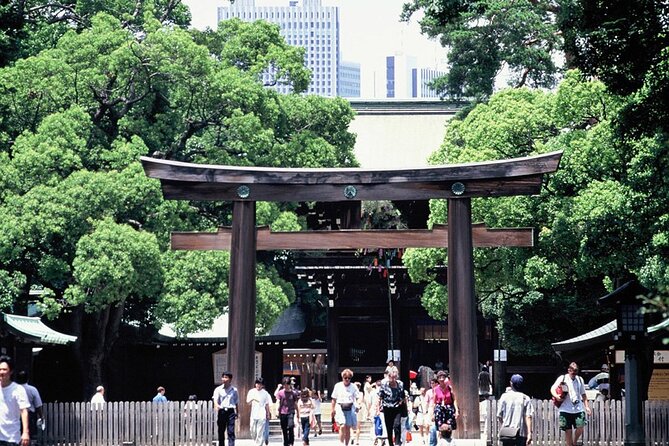
The day begins at Meiji Jingu Shrine, reached by subway from the station nearest your hotel. Completed in 1920, the shrine honors Emperor Meiji, an important figure in Japan’s move into the modern era during the 19th century.
The scheduled visit is about 40 minutes. That gives you enough time to walk through the grounds, notice the shrine approach, and learn basic customs from your guide. You may see people pausing at the entrance, offering a quiet prayer, or following the usual purification steps.
This is a strong opening stop because it gives you space before the louder parts of Tokyo. The shrine grounds offer a calmer setting than the commercial districts later in the day, and guides can explain the difference between a Shinto shrine and a Buddhist temple before you visit Senso-ji.
Do not expect an extended spiritual retreat. Forty minutes passes quickly, especially if the route includes walking from the station. Still, the contrast with Shibuya makes the stop worthwhile. I would pay close attention to the guide here, since a little explanation makes the rituals and layout much easier to understand.
Shibuya Crossing: twenty minutes at Tokyo’s famous intersection
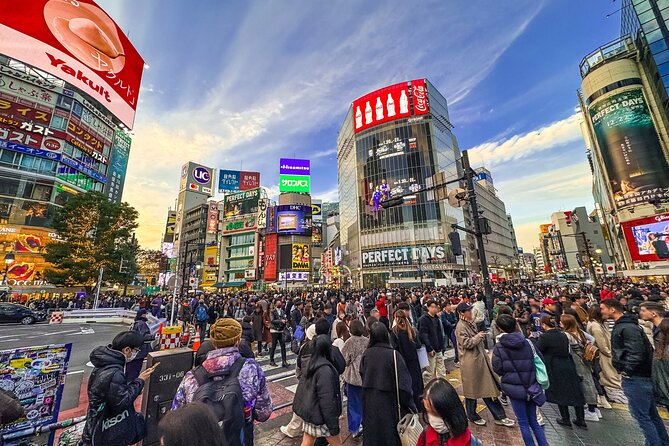
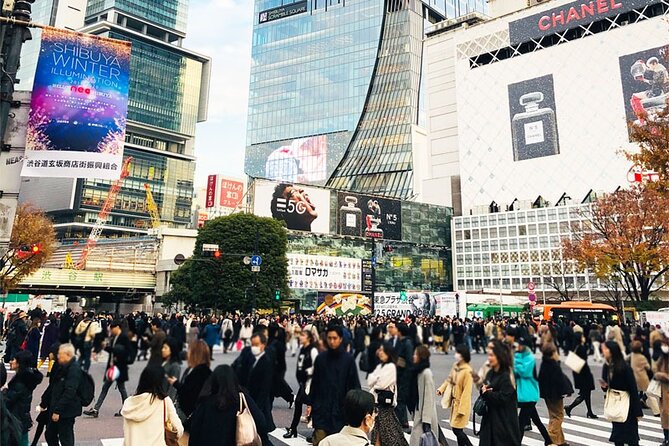
From Meiji Shrine, you continue to Shibuya Station. The ride takes only a few minutes, but the station itself can feel like a small city. Your stop at Shibuya Crossing lasts about 20 minutes and is free.
This is a photo stop and a quick lesson in modern Tokyo. You can watch the crossing fill when the signal changes, see the surrounding towers and signs, and get a sense of why Shibuya has become one of the city’s best-known meeting points.
The short time is appropriate for the basic experience. If you want department stores, fashion shops, cafés, or a longer look at the district, you will need to return later. The tour is designed to introduce Shibuya, not cover every corner of it.
A guide is useful here because you do not have to waste time finding the best approach or figuring out which exit to use. That small advantage adds up throughout the day.
Tokyo Tower: a clear city view from 150 meters
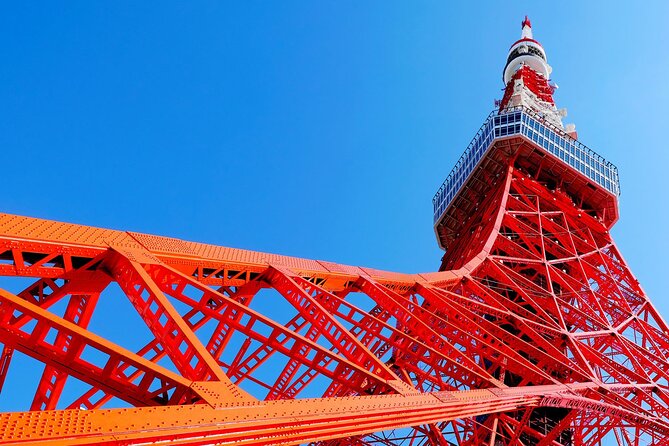
Tokyo Tower was built in 1958 and was once the world’s tallest structure. The tour includes admission to its 150-meter Main Deck, reached by a high-speed elevator, and allows about 40 minutes at the stop.
The deck gives you a straightforward view across Tokyo. On a clear day, you might spot major buildings and see how densely the city is arranged. The view also helps you understand the distances you have covered by subway.
Including the ticket is a practical benefit. You do not need to arrange a separate reservation for the listed observation level, and the guide can keep the visit moving within the day’s schedule. For first-time visitors, this is a good way to add a high viewpoint without giving up half a day.
The limitation is time. Forty minutes is enough for the elevator, the view, and photographs, but not for lingering over every angle or exploring all of Tokyo Tower. Weather also matters. Clouds, rain, or haze can reduce the payoff, and the operator notes that weather or other operating conditions can lead to changes or omitted visits without a fare refund unless the tour itself is canceled for poor weather.
A completely different kind of day out:
- Mt Fuji and Hakone 1-Day Bus Tour Return by Bullet Train
★ 5.0 · 26,383 reviews - TOKYO SKYTREE® Ticket
★ 4.7 · 25,136 reviews - teamLab Borderless Tickets: MORI Building DIGITAL ART MUSEUM
★ 4.7 · 24,126 reviews - teamLab Planets TOKYO Ticket
★ 4.7 · 21,663 reviews
Tsukiji Outer Market: food, movement, and a useful lunch break
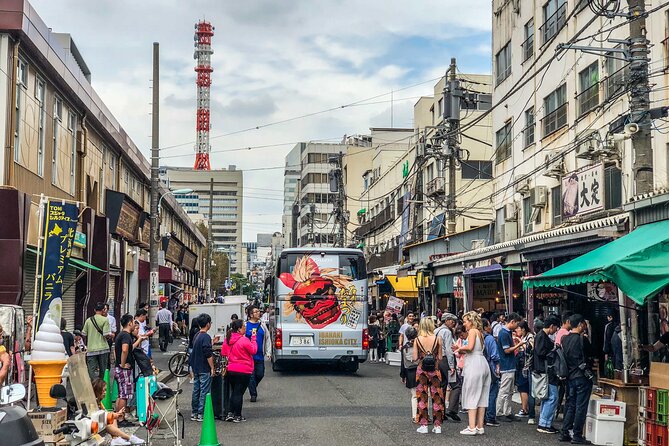
Tsukiji’s wholesale fish market moved to Toyosu in 2018, but the Tsukiji Outer Market remains in its original area. The tour spends about 50 minutes here, and admission is free.
This is one of the day’s most useful stops for anyone interested in Japanese food. The market area is known for seafood, sushi, small shops, and street foods. You can look at ingredients, sample something if you wish, and see a side of Tokyo that feels more practical and local than a major observation deck.
Lunch is not included, so Tsukiji is a sensible place to eat. Your guide can help you understand the choices and may be able to assist with dietary needs. One guide, Yuki, was praised for finding a lunch venue suited to a specific need, while another family enjoyed eating lunch with Yoshi.
Keep the clock in mind. Fifty minutes is not a long market visit, especially if you stop to order food. If lunch is important to you, tell the guide early and be ready to make a quick choice. The tour price covers the guide and listed transportation, not your meal.
Tsukiji also provides a welcome change of pace after Tokyo Tower. Instead of looking across the city, you are looking closely at ingredients, stalls, and the everyday food culture that shapes Japanese life.
Asakusa and Senso-ji: the traditional finish
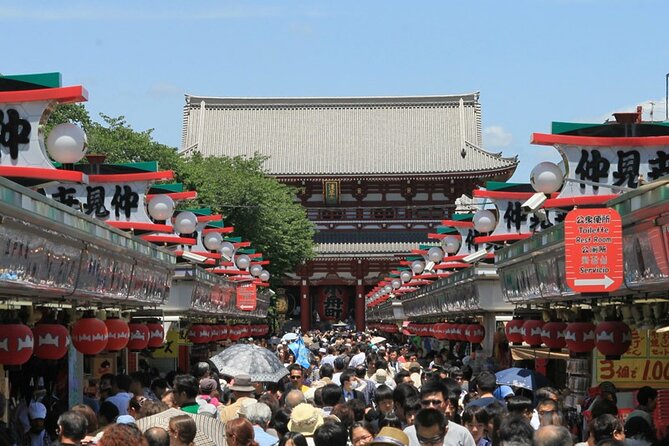
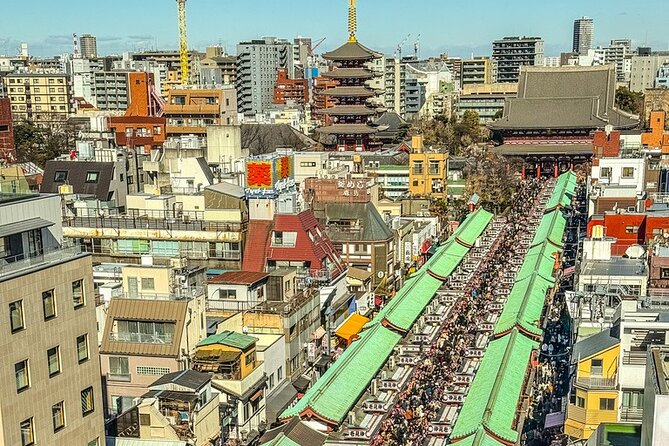
The final part of the route takes you to Asakusa, a district known for traditional crafts, souvenirs, street foods, and older Tokyo atmosphere. The scheduled time in Asakusa is about 20 minutes, followed by roughly 40 minutes at Senso-ji Temple.
The district can feel crowded, especially around the temple approach. Shops sell snacks and gifts, and you may find items that are more connected to traditional Japanese culture than the merchandise in a modern shopping district. You might want to save a little spending money for this section, though purchases are not part of the tour price.
Senso-ji dates to 628 and is one of Tokyo’s oldest and largest Buddhist temples. The temple complex gives the guide another chance to explain religious customs, architecture, and the difference between the Buddhist site here and Meiji Shrine earlier in the day.
The 20-minute Asakusa portion is brief, but the additional 40 minutes at Senso-ji makes this the most substantial traditional stop. I would treat the area as a focused introduction rather than a complete visit. If you want to shop, eat street food, or explore nearby streets at length, plan to return on your own.
The sequence works well. You finish with a temple and an older district rather than ending at a busy station or a modern shopping center. It leaves you with a more rounded idea of Tokyo.
What the private format adds
The private setup is the main reason to consider this tour instead of a cheaper group outing. Only your own party participates, so the guide can respond to your pace, questions, and priorities.
This flexibility has practical value. A guide named Yoshi was praised for working well with children and showing a family extra sights along the way. Another guide adjusted the route when a group wanted to skip one location. Yuki helped one party with directions to a baseball stadium after the tour, and Reiko was praised for helping with photographs and subway navigation.
Those details point to the real benefit: not simply information, but help. You can ask questions without waiting for a large group. You can explain a food concern. You can slow down briefly for a child or older family member, although the overall schedule remains active.
Guide quality still matters. The most frequently praised traits are patience, friendliness, clear explanations, and confidence with the trains. Yuki, Yuko, Yoshi, and Reiko are among the guides singled out for those strengths. Your assigned guide may differ, but the tour’s value depends heavily on that person’s ability to manage both Tokyo’s transport and your group’s needs.
Public transport, walking, and the physical effort
The tour includes a one-day Metro pass, which removes one small transport expense and lets you ride with your guide. It also teaches a skill you can use later. Tokyo’s subway is often faster and more practical than a sightseeing bus, but stations can involve long walks and confusing exits.
This is not a ride-and-watch excursion. You will walk outdoors between stations, through shrine grounds, around markets, and across temple areas. The schedule specifically calls for a moderate level of fitness, and people who enjoyed it most were prepared for a high step count.
Wear sneakers or other comfortable walking shoes. Carry water, especially in hot weather. One group completed the tour on an extremely hot day by staying hydrated, but heat can make the same itinerary feel much harder. Bring an umbrella or raincoat as well.
Hotel pickup and drop-off make the morning and end of the day easier. The normal pickup range matters, though. If your hotel is outside that range and a subway connection is not practical, you may have to pay the guide’s transportation fare to the first stop and back from the final stop.
Is $203.63 good value?
At $203.63 per person, the tour is best judged as a private orientation, not just a list of admissions. The price includes an English-speaking guide, hotel pickup and drop-off, a one-day Metro pass, and Tokyo Tower’s 150-meter Main Deck ticket.
For a couple, the total cost is significant. For a family or small group, the private format may make more sense, especially with group discounts. You are paying to avoid planning a complicated route, to move efficiently between far-flung districts, and to receive personal help with the rail system.
The value is strongest on your first full day in Tokyo. You can cover key areas quickly, learn the transport network, and then return to the neighborhoods that deserve more time. If you already know Tokyo’s subway and prefer slow independent visits, the tour may feel rushed and expensive.
Lunch, snacks, shopping, and gratuity are not included. Gratuity is not obligatory. Build your food budget separately, especially if you plan to eat at Tsukiji.
Who should book this Tokyo tour?
I would recommend it to first-time visitors who want a strong overview without spending their first day studying maps. It also suits families, active couples, and small groups that value a private guide and want help with the subway.
It is a good fit if you want temples, food, city views, and famous neighborhoods in one day. It is less suitable if you dislike walking, need a slow pace, want long shopping sessions, or prefer to spend an entire morning at one shrine or market.
The tour starts at 9:30 a.m. and lasts about seven hours. Free cancellation is available up to 24 hours before the start time. Changes made inside that window are not accepted, and poor weather can lead to a different date or full refund if the tour is canceled. Weather-related changes to individual visits may still occur, so keep your plans flexible.
Final verdict: book it for orientation, not for a slow day
Book this tour if your priority is to see Tokyo’s main contrasts in one day and learn the subway well enough to continue independently. The strongest points are the private attention, the efficient route, the useful rail guidance, and the guide’s ability to adjust for families, food needs, or a different pace.
Skip it if you already have a detailed Tokyo plan and want unhurried time at each stop. For everyone else, the price buys more than transport and sightseeing. It buys a confident start in a huge city, with a real person beside you when the station signs become a little too much.
FAQ
What time does the tour start?
The tour starts at 9:30 a.m.
How long does the tour last?
The experience lasts approximately seven hours.
Is this a private tour?
Yes. Only your group participates in the activity.
Is hotel pickup included?
Yes. Hotel pickup and drop-off are included within the designated pickup range.
What transportation is included?
A one-day Metro pass is included, and the tour uses public transportation between attractions.
Is Tokyo Tower admission included?
Yes. Admission to Tokyo Tower’s 150-meter Main Deck is included.
Is lunch included?
No. Lunch is not included in the tour price.
What should I wear and bring?
Wear sneakers or other comfortable shoes because the tour involves substantial outdoor walking. Bring rain gear, such as an umbrella or raincoat, in case of bad weather.
Just added in Tokyo
- A One-of-a-Kind Sushi Experience in a Special Place of Japan★ 5.0 · 15 reviews
- Tokyo Cute Bento Cooking Class – Make a Kawaii Character Lunchbox★ 5.0 · 126 reviews
- Japanese Home Cooking Class & Walk in Todoroki Temple Tokyo★ 5.0 · 88 reviews
- Japan Tokyo Tower Observatory Deck E-Ticket★ 4.0 · 34 reviews
- Catch a Baseball Game in Tokyo with a Local – Tickets Included★ 5.0 · 24 reviews
- JDM Experience with Fast&Furious RX-7 (English speaking Driver)★ 5.0 · 57 reviews
- Tokyo Private Day Tour by Car with English speaking Driver Guide★ 4.0 · 29 reviews
- Japan Classic 10 Day – One Life Adventures★ 5.0 · 129 reviews
Full-Day, compared.

Mount Fuji Full-Day Private Tour from Tokyo (Customizable)
Read our review →
Hiroshima / Miyajima Full-day Private Tour with Government Licensed Guide
Read our review →
Mount Fuji Full-Day Small Group driver-guide tour (with Pick-up option)
Read our review →

5 Top Highlights of Kyoto Full Day Bike Tour (E-bike option)
Read our review →