
Reviewed · HIROSHIMA TOURS
The Journey of Hiroshima from Tragedy to Peace
History feels different here. The Journey of Hiroshima from Tragedy to Peace is a thoughtful walking tour through Hiroshima Peace Memorial Park, led by an English-speaking guide with a degree in Peace Studies. I like its focus on people and personal stories, not only dates and monuments, and I like that the route includes the Atomic Bomb Dome, the Children’s Monument, the Peace Cenotaph, and the bombing’s exact hypocenter. The main consideration is emotional weight: this is a serious experience, and the walking route is not suitable for people with mobility impairments.
I also appreciate the small-group feel described by past participants, along with the chance to ask questions along the way. Guides including Ali, Wajid, and Zunera have been praised for clear explanations, warm conversation, and a comfortable pace. At $30 per person, the tour offers good value if you want context and guidance, though you will need to pay separately for food and the Peace Memorial Museum.
In This Review
- Five details that shape the experience
- Meeting the guide at Hiroshima’s Gates of Peace
- Mother and Baby in Storm: beginning with human loss
- Dr. Marcel Junod and Norman Cousins: aid and advocacy
- The Peace Cenotaph and Flame of Peace
- Hiroshima National Peace Memorial Hall and personal stories
- The Rest House and a survival story 170 meters from the hypocenter
- Children’s Monument and Sadako Sasaki
- The Korean Monument and a wider account of Hiroshima
- Ringing the Peace Bell
- The Atomic Bomb Dome, Hiroshima’s most recognizable site
- The hypocenter: ending at the exact point below the blast
- What $30 includes, and what it does not
- Pace, language, and who should book
- Should you book The Journey of Hiroshima from Tragedy to Peace?
- FAQ
- Where does the Hiroshima peace walking tour begin?
- Where does the tour end?
- Is the tour conducted in English?
- Is entrance to the Hiroshima Peace Memorial Museum included?
- Is food included?
- Is the tour suitable for people with mobility impairments?
Five details that shape the experience
- The route begins at the Gates of Peace, in front of the Italian restaurant Mario, and returns to the same meeting point.
- The Peace Cenotaph and Flame of Peace give the tour its central message: remembrance linked with the hope of ending nuclear weapons.
- The Hiroshima Peace Memorial Hall adds personal stories and records about people who died, including what their lives were like before the bombing.
- The Peace Park Rest House explains how one resident survived only 170 meters from the hypocenter.
- The Atomic Bomb Dome and hypocenter provide two very different views of the bombing: one iconic and visible, the other quiet and exact.
- The $30 price excludes museum admission, so plan your budget if you want to visit the museum too.
Meeting the guide at Hiroshima’s Gates of Peace
The tour begins at the Gates of Peace, in front of Mario, an Italian restaurant. That clear landmark matters in a large park, where a first meeting can otherwise become a mild travel puzzle.
You meet your English-speaking guide here before walking into the memorial grounds. The experience is offered as a group tour, but the feedback points to a friendly, discussion-based approach rather than a rushed procession from one plaque to the next. Ali is praised for personal explanations and a passion for Hiroshima’s story. Wajid receives credit for making communication easy before and during the tour, while Zunera is praised for her strong command of the subject and comfortable pace.
The route ends back at the starting point. That makes the tour easier to fit into a day of sightseeing, since you do not have to work out where you will finish or arrange transport from a distant stop.
One practical point: the supplied information does not give a fixed duration. One participant specifically liked a 4:30 pm departure because it helped avoid the heat, but you should confirm your booked start time. Hiroshima’s summers can be hot, and even a moderate walking route feels different in afternoon heat.
A few more options to weigh up in Hiroshima
- Peaceful Hiroshima & Miyajima UNESCO 1 Day Bus Tour
★ 5.0 · 5,309 reviews - Hiroshima Peace Memorial Museum Ticket
★ 4.8 · 2,727 reviews - Hiroshima: Hiroshima and Miyajima UNESCO Sites 1-Day Tour
★ 4.9 · 2,330 reviews
Mother and Baby in Storm: beginning with human loss
The first major stop is the Mother and Baby in Storm statue. It offers an immediate shift away from military strategy and toward family life, fear, and care after the bombing.
That choice sets the tone well. You are not simply being shown a famous structure and handed a date. The guide uses the statue to discuss the human response to the disaster, including the love and compassion that emerged in its aftermath.
This is also where the guide’s role becomes important. A plaque can tell you what a monument is called. A good guide can explain why it was placed here and how it fits into Hiroshima’s larger message of peace. The tour’s strongest praise goes to guides who explain clearly and invite questions, so this early stop is a useful chance to settle into the pace and ask for context.
Dr. Marcel Junod and Norman Cousins: aid and advocacy
The Dr. Marcel Junod Memorial honors a Swiss physician who became a humanitarian figure after the bombing. His memorial brings attention to medical aid and the urgent work that followed the attack.
The tour then moves to the Norman Cousins Peace Memorial. Cousins was an American author and peace activist who argued for nuclear disarmament. These two stops widen the story beyond Hiroshima itself. One focuses on medical response, the other on public advocacy and the effort to prevent another nuclear catastrophe.
I like this part of the route because it shows that Hiroshima’s story did not end when the bomb exploded. The city’s aftermath involved doctors, aid workers, writers, activists, survivors, families, and officials. You get a clearer sense of how remembrance became an active call for peace.
The Peace Cenotaph and Flame of Peace
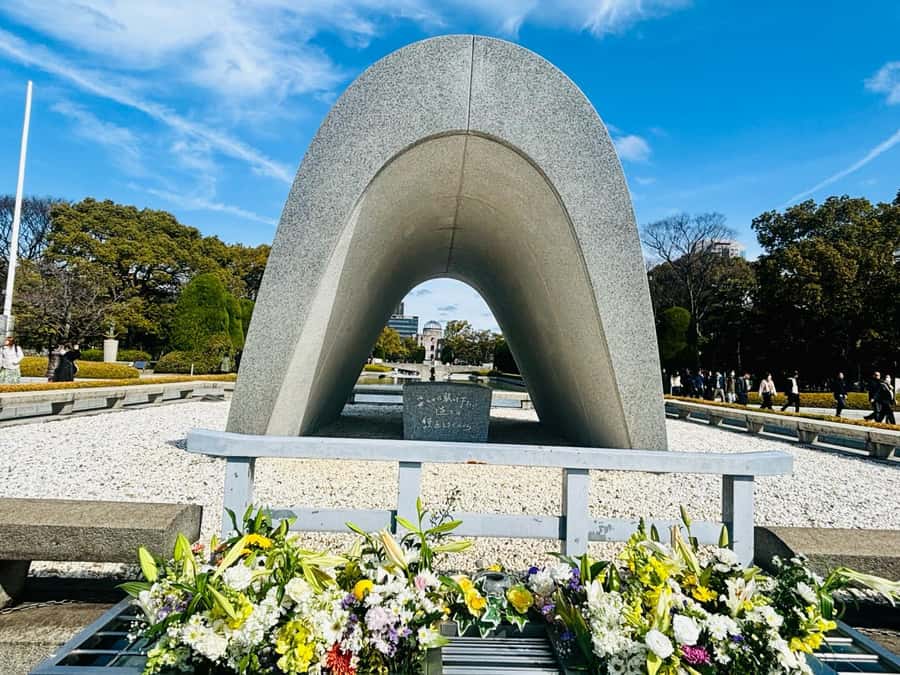
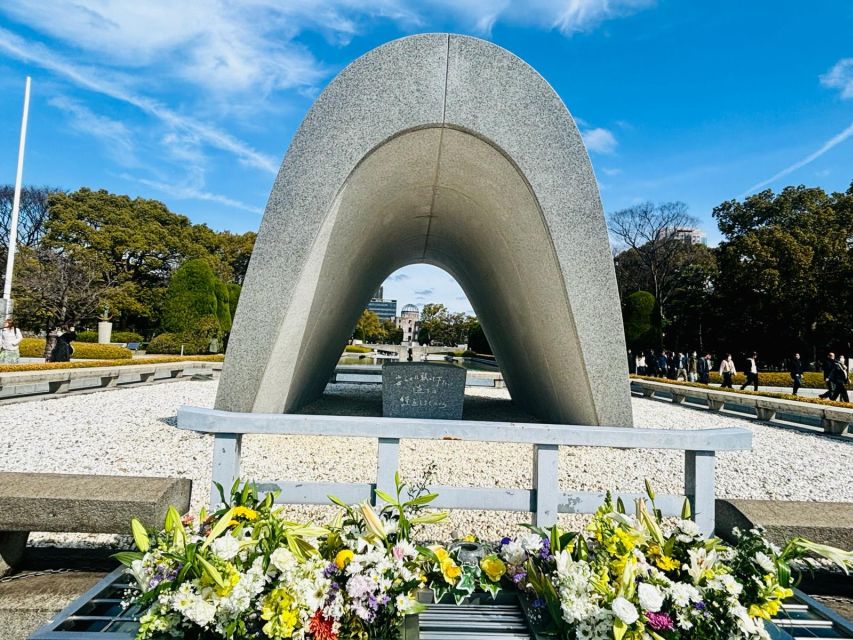
The Peace Cenotaph is one of the park’s most important memorials. Its curved stone form shelters the names of the atomic bomb victims, and its Flame of Peace carries a promise that it will burn until the last nuclear weapon is gone from the earth.
Your guide explains the meaning behind both features. The cenotaph is not just a place for names. It connects individual lives with a wider hope for disarmament. The flame gives that hope a physical presence, and it also creates one of the tour’s quietest moments.
This stop can feel solemn, especially when you consider how many names are represented. The guide’s job here is to provide context without turning grief into a performance. The positive feedback about the tour’s calm pace and opportunities for discussion suggests that the experience allows time for reflection instead of pushing you onward too quickly.
The Flame of Peace is included in the tour. You should not expect a long formal ceremony, but you will have the chance to see an important symbol at the center of Hiroshima’s peace message.
A completely different kind of day out:
- Hiroshima Peace Memorial Museum Admission
★ 4.6 · 1,308 reviews - Hiroshima / Miyajima Full-day Private Tour with Government Licensed Guide
★ 5.0 · 1,298 reviews - Hiroshima Historical Walking Tour – Why A-Bomb was Dropped
★ 4.8 · 893 reviews - Hiroshima Peace (Heiwa) Walking Tour at World Heritage Sites
★ 5.0 · 872 reviews
Hiroshima National Peace Memorial Hall and personal stories
The Hiroshima National Peace Memorial Hall for the Atomic Bomb Victims adds depth to the outdoor monuments. It houses an extensive archive and memorial material about people who died in the bombing.
A particularly valuable feature is the attention to victims’ lives before the attack. That detail matters. Numbers can become abstract, while ordinary biographical information restores a sense of individuality. People had jobs, families, routines, and plans before August 1945. The memorial hall helps place those lives back into view.
The tour includes the hall, but the supplied information does not state that every interior archive feature is explored in detail. The experience is mainly a walking tour, so think of the guide as helping you understand the memorial site and its meaning. If you want a longer museum-style visit, set aside extra time and budget for the Hiroshima Peace Memorial Museum, whose entrance fee is not included.
The Rest House and a survival story 170 meters from the hypocenter
At the Hiroshima Peace Park Rest House, you hear about a resident who survived despite being only 170 meters from the hypocenter. This is one of the tour’s most striking details because it turns distance into something you can picture.
The bombing’s destruction is often discussed in broad terms. A survival story close to the center gives the event a more immediate scale. It also shifts the focus toward endurance and the difficult work of rebuilding.
This part of the tour can be especially useful if you are visiting the park with young adults. One group of four, including two young adults, found the route informative and good value, with enough time for questions and photographs. The guide’s explanation helps make the story accessible without reducing its seriousness.
Children’s Monument and Sadako Sasaki
The Children’s Monument is dedicated to Sadako Sasaki and other children affected by the atomic bomb. Colorful paper cranes surround the memorial, offering a visual contrast to the park’s darker history.
Sadako’s story has become closely linked with Hiroshima and the paper crane as a symbol of peace. Your guide explains the meaning behind the monument and the way children are remembered within the park.
This stop often provides a moment of emotional release after the heavier memorials. The bright cranes do not soften what happened, but they show how remembrance can also include hope, care, and action. You can expect time for photos, though this remains a memorial site, so a quiet and respectful approach is appropriate.
The Korean Monument and a wider account of Hiroshima
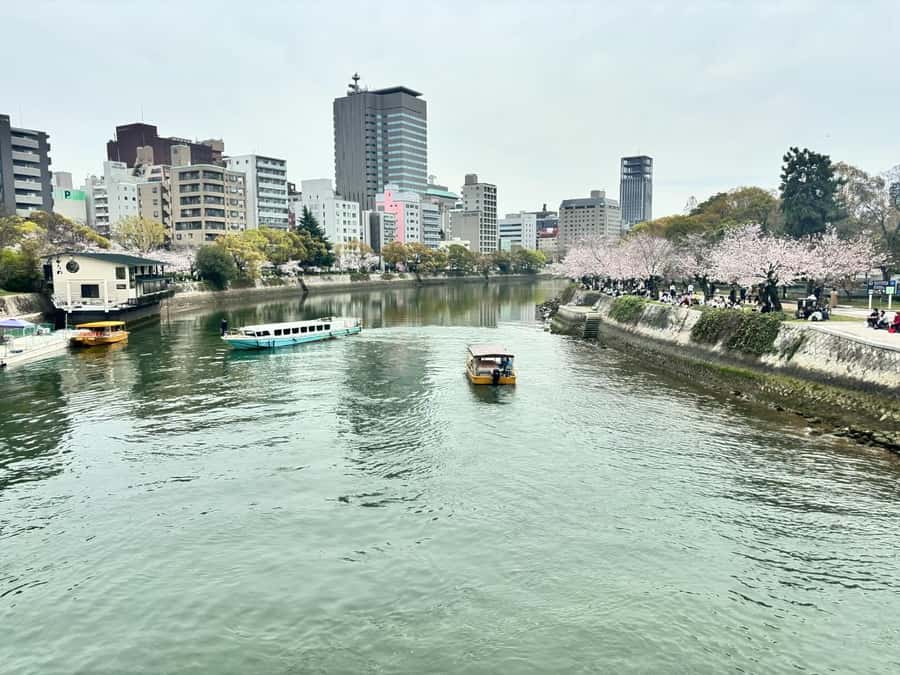
The Korean Monument honors Korean victims of the bombing. Its inclusion is important because the story of Hiroshima affected people from more than one national background.
This stop asks you to look beyond a single national narrative. Korean victims suffered in the same explosion, and their memory belongs within the history of the city. The monument also points toward reconciliation and the need to remember difficult shared histories honestly.
I consider this one of the route’s most valuable choices. A tour can easily focus only on the best-known Japanese stories and famous sites. Including the Korean Monument gives you a broader understanding of who was present in Hiroshima and who suffered there.
Ringing the Peace Bell
The Peace Bell gives you a chance to take part in the park’s message rather than only observe it. Visitors may ring the bell in remembrance, and each toll is meant as a call for peace.
It is a simple action, but that is part of its strength. You are not asked to make a speech or take part in a formal ritual. You ring the bell, listen to its sound, and consider the promise behind it.
The experience works best if you treat this as a reflective stop rather than a photo opportunity. The guide can explain how the bell fits with the Cenotaph, the flame, the cranes, and the park’s other memorials.
The Atomic Bomb Dome, Hiroshima’s most recognizable site
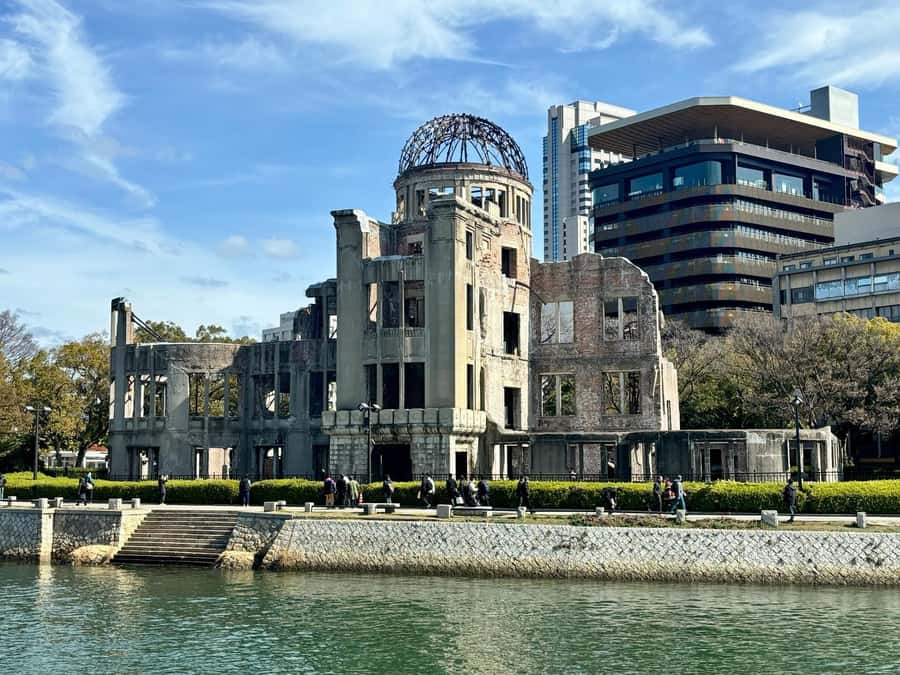
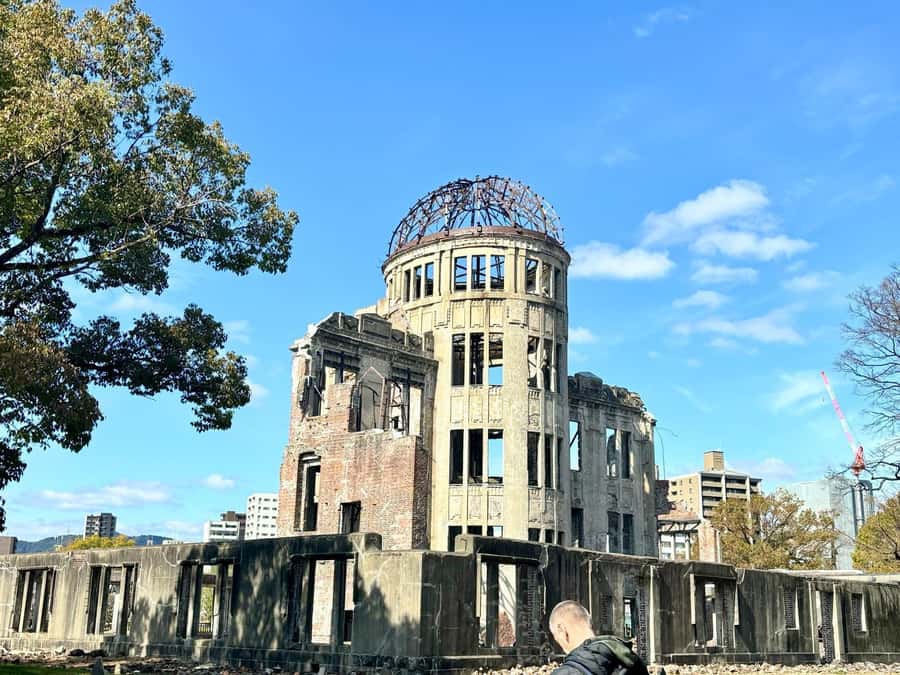
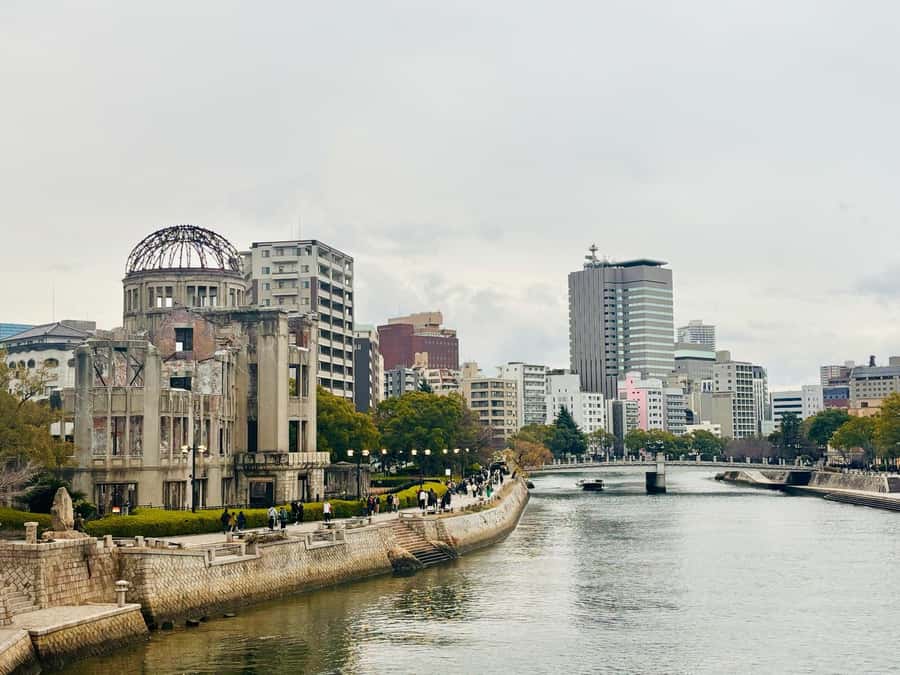
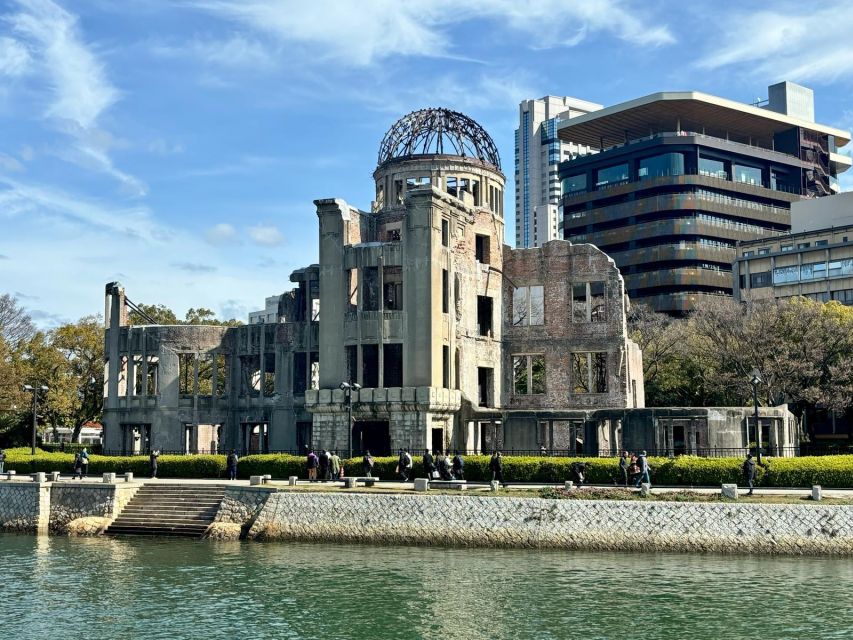
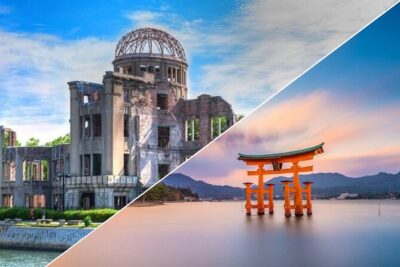
The Atomic Bomb Dome is the tour’s best-known landmark and a UNESCO World Heritage Site. It survived close to the explosion while much of the surrounding city was destroyed, leaving a stark shell beside the river.
Your guide explains what the building was before the bombing and why its remains were preserved. The Dome is powerful partly because it does not need much decoration. Its damaged structure provides a direct visual reminder of the force of war and the cost paid by civilians.
This is a good place to ask questions about Hiroshima before, during, and after the bombing. The tour’s stated aim is to cover all three periods, and the Dome gives that story a physical anchor.
The area can attract plenty of attention because the building is so famous. You may find it harder to have a quiet moment here than at some of the smaller memorials, but the guide helps you focus on the site’s meaning rather than simply taking a quick photograph.
The hypocenter: ending at the exact point below the blast
The final stop is the hypocenter, the point directly below the explosion. It is not the same visual experience as the Atomic Bomb Dome. The Dome is dramatic and instantly recognizable. The hypocenter is defined by precision and absence.
Ending here gives the tour a strong structure. You begin with memorials to people and aid workers, move through names and personal stories, and finish at the exact location where the destruction began.
The guide invites a moment of reflection at this point. That ending will not suit everyone, especially if you prefer light sightseeing or a fast-moving city walk. But if you want to understand Hiroshima as a place shaped by loss and a continuing appeal for peace, the final stop brings the route’s message together.
What $30 includes, and what it does not
At $30 per person, this is a reasonable price for a guided walk through a major historic site. You are paying for an English-speaking professional guide, the route through Hiroshima Peace Memorial Park, and explanations that connect the monuments to one another.
The value is strongest if you want interpretation. You can walk through the park independently, but it is easy to see the Dome, take a few pictures, and leave without understanding the people and ideas represented by the smaller memorials. This tour gives those places a narrative.
Included attractions are:
- Hiroshima Peace Memorial Park
- Atomic Bomb Dome
- Hiroshima Peace Memorial Hall for the Atomic Bomb Victims
- Children’s Monuments
- Flame of Peace
Food is not included, and entrance to the Hiroshima Peace Memorial Museum is also excluded. That is not a flaw, but it affects your planning. If you want a full museum visit, treat this walk as one part of a larger Hiroshima day rather than your only activity.
Pace, language, and who should book
The tour is conducted in English. The strongest comments focus on clear explanations, friendly guides, a comfortable pace, and chances to ask questions. Ali, Wajid, and Zunera are each praised for different strengths, including personal attention, communication, and subject knowledge.
It suits you best if you want:
- A serious introduction to Hiroshima’s wartime history
- A guided visit to the Peace Memorial Park
- Context for smaller memorials that are easy to overlook
- Time for questions and photographs
- A peace-focused account that includes Japanese and Korean victims
- A walking experience instead of a transport-based sightseeing tour
It may not suit you if you want a casual activity with little emotional material. The subject is tragic, and the route asks you to pay attention. It is also not suitable for people with mobility impairments, according to the supplied information.
The pace appears moderate rather than rushed. One participant specifically praised the balance between walking and explanation, while another liked a late afternoon start. Still, the exact duration is not provided, so confirm the timing before booking, especially if you have a train, meal, or museum visit planned afterward.
Should you book The Journey of Hiroshima from Tragedy to Peace?
I would book this tour if you want more than the famous photograph of the Atomic Bomb Dome. The route covers the major memorials, but its real value is the explanation linking them: victims’ lives, medical aid, children’s suffering, Korean victims, survival, disarmament, and the city’s continuing peace message.
At $30, it is particularly worthwhile for first-time visitors who want a clear introduction without arranging their own research. Families with older children or young adults may also appreciate the steady pace and open discussion.
Skip it if you only want a quick look at the Dome, or if you plan to spend your time inside the museum without a walking tour. For most visitors who want a respectful, human account of Hiroshima, this is a well-priced and carefully focused way to begin.
FAQ
Where does the Hiroshima peace walking tour begin?
Meet the guide at the Gates of Peace, in front of the Italian restaurant Mario.
Where does the tour end?
The activity ends back at the meeting point at the Gates of Peace.
Is the tour conducted in English?
Yes. The tour is offered in English.
Is entrance to the Hiroshima Peace Memorial Museum included?
No. Entrance to the museum is not included in the $30 price.
Is food included?
No. Food is not included.
Is the tour suitable for people with mobility impairments?
No. The experience is listed as unsuitable for people with mobility impairments.
Just added in Hiroshima
- Hiroshima Peace Memorial Museum Ticket★ 4.8 · 2,727 reviews
- Hiroshima Peace Memorial Museum Admission★ 4.6 · 1,308 reviews
- Private Full Day Hiroshima Tour★ 4.5 · 29 reviews
- The Peace Memorial to Miyajima : Icons of Peace and Beauty★ 4.5 · 31 reviews
- Hiroshima & Miyajima All-Inclusive Tour w/Licensed guide Pancho★ 5.0 · 54 reviews
- Shore Excursion from Hiroshima Port : Private Tour in Hiroshima★ 5.0 · 17 reviews
- Hiroshima Country Cycling: Explore Rural Life 1 HR from City★ 5.0 · 22 reviews
- Hiroshima Saijo Sake Tasting Tour with visit to 7 Breweries★ 5.0 · 104 reviews
Hiroshima Tours, compared.
Peaceful Hiroshima & Miyajima UNESCO 1 Day Bus Tour
Read our review →
Hiroshima and Miyajima UNESCO Sites 1-Day Tour
Read our review →
Hiroshima / Miyajima Full-day Private Tour with Government Licensed Guide
Read our review →
Hiroshima Historical Walking Tour – Why A-Bomb was Dropped
Read our review →
Hiroshima Peace (Heiwa) Walking Tour at World Heritage Sites
Read our review →
Hiroshima in a Nutshell: Morning Bike Adventure
Read our review →Browse the lists this tour appears in