
Reviewed · SUMO EXPERIENCES
Tokyo Sumo Morning Practice Tour at Stable
Wake up early for something truly Japanese. This two-hour visit brings you inside a working sumo stable, where wrestlers train for real competitions rather than perform a staged dinner show. I like the close view of repeated practice bouts, and I like how the guides explain the rituals, rankings, and demanding daily life behind the sport.
The main drawback is the format. You must watch in silence, seating can affect your view, and the headsets have not always been easy to hear. At $83.57 per person, this is a fair price for rare access, but only if you value an authentic cultural encounter more than a polished, interactive tour.
In This Review
- Key points before you book
- Why morning practice beats a staged sumo show
- Meeting near Ryogoku Station at 7:45am
- Ryogoku and the story behind sumo
- Inside the stable: close seats and strict silence
- What you actually watch during the training
- The guide makes the difference
- Photography and the short ending
- Summer heat and practical comfort
- Is $83.57 a fair price?
- Who should book this sumo experience?
- Final verdict: book it for access, not spectacle
- FAQ
- Where does the tour meet?
- What time should I meet the guide?
- How long does the experience last?
- Can children join the tour?
- How many people can join?
- Can I take photographs inside the stable?
- Can I talk during practice?
- Can I eat or drink inside the stable?
- Can I cancel for a full refund?
Key points before you book
- Practice takes place inside a working sumo stable, not at a theatrical dinner show or museum.
- Meet at 7:45am near Ryogoku Station, then walk or take a train to the stable, depending on the day’s arrangements.
- Expect close-up training, including warmups, drills, and practice bouts between wrestlers.
- English commentary explains sumo customs, rankings, rituals, and tournaments, often through an earpiece.
- The experience is limited to people aged 12 and older, and the group can include up to 20 participants.
- Summer heat matters: there is no air conditioning, though water and sports drinks are allowed in summer.
Why morning practice beats a staged sumo show
Tokyo offers several ways to encounter sumo, but they are not all equal. A dinner performance may be easy to fit into your evening, yet it can feel designed mainly for an audience. This visit takes you to a place where wrestlers are doing the work that prepares them for official bouts.
That difference matters. You are not watching a tidy presentation built around jokes, costumes, or a set menu. You are observing athletes repeat movements, absorb impact, recover, and go again. Some practice sessions include many bouts, with far more action than you might see during a formal tournament once ceremonies and introductions are included.
I especially like the chance to see wrestlers at different stages of their careers. You might notice younger men working through basic exercises while more experienced wrestlers take part in harder sparring. The session can become longer or shorter depending on the training schedule, so the morning has a real, unscripted quality.
This is also a quieter experience than a tournament. At a tournament, the crowd, announcements, music, and formal rituals create excitement. At the stable, the focus is on repetition and discipline. You get less spectacle, but often a clearer sense of how much work sits behind a few seconds in the ring.
More Sumo Experiences in Tokyo
- Tokyo: Sumo Show Experience with Chicken Hot Pot and a Photo
★ 4.8 · 6,678 reviews - Tokyo: Sumo Live Show with Photo in Shinjuku
★ 5.0 · 3,438 reviews - Tokyo: Sumo Show and Dining Experience
★ 4.8 · 2,742 reviews
Meeting near Ryogoku Station at 7:45am
The morning begins near Ryogoku Station, the Tokyo district most closely associated with sumo. The listed meeting point is the Ryogoku Station Gallery area, although the exact location can vary by booking option. Read your confirmation carefully rather than relying only on a map pin.
The early start is part of the deal. Sumo training takes place in the morning, and you should arrive ready to move promptly with the guide. The group may take a train to the stable after meeting, so leave enough time for the station and do not plan a leisurely breakfast immediately beforehand.
A small but useful tip: use the restroom before reaching the meeting point. You are expected to remain inside and watch the practice through to the end as much as possible. Leaving halfway through is discouraged, and once you exit the stable, you cannot go back in.
There has been some confusion at the station for at least one booking, with a participant finding no guide and walking to the stable independently. That is not a reason to skip the tour, but it is a reason to check the meeting instructions twice and keep your phone available before the start.
Ryogoku and the story behind sumo
Before you take your seat, the guide provides an introduction to sumo. This is more useful than it may sound. Without some background, a training session can look like a series of enormous men pushing one another around. With context, the movements begin to make sense.
You learn about sumo’s links to Shinto traditions and its long history in Japan. The sport preserves rituals connected with purification, sacred space, and respect. The ring is not simply a platform. The sandy area and ring are treated as sacred, which explains the strict rules about where you may sit and how you should behave.
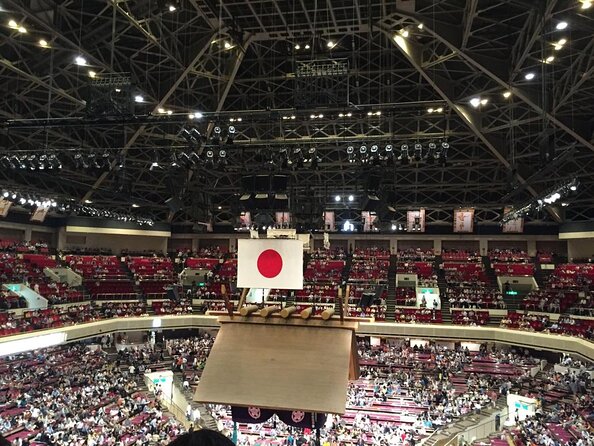
The guide also discusses Japan’s six annual Grand Tournaments. Each tournament lasts 15 days. Three take place in Tokyo, while Osaka, Nagoya, and Fukuoka each host one.
That information gives you a useful framework for following sumo later. You begin to understand why rankings matter, how wrestlers prepare for competition, and why a training session can be just as revealing as a day at the tournament. Some participants arrive knowing almost nothing about the sport and leave ready to follow the wrestlers on television.
The introduction may be delivered through an audio headset once practice begins. Several guides have been praised for clear, engaging explanations, including Seiji, Yumi, Noriko, Nobu, Cameo, and other English-speaking guides. The exact guide depends on the date, but strong communication is one of the tour’s major assets.
Inside the stable: close seats and strict silence
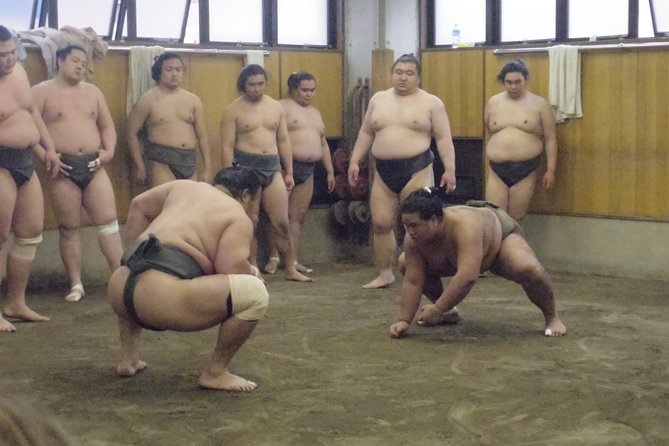
The stable is a working training space, not a visitor center. You sit close to the action and watch the wrestlers carry out their routine. Seating has varied by session. Some participants describe stools, while others mention sitting on the floor or mats. Front places may be reserved for sponsors or other important visitors, so arriving early can improve your chance of getting a better position.
Even from farther back, the viewing distance is usually short. Still, the seating arrangement can affect your line of sight, particularly if the person in front of you is tall. The group size can reach 20, which remains fairly small but is not the same as a private visit.
The rules are serious and practical:
- Keep your cellphone on silent.
- Do not use flash photography or shutter sounds.
- Do not record video.
- Do not eat or drink, except for permitted water and sports drinks during summer.
- Do not wear sunglasses or hats inside.
- Do not step into the ring or onto the sandy area.
- Do not stretch your legs toward the ring, since showing the soles of your feet is impolite.
- Do not distract the wrestlers or ask for photographs during practice.
The silence is not a minor detail. The wrestlers need concentration, and the stable is their workplace. You are being allowed to observe a private training setting, so respectful conduct is part of the experience, not an optional extra.
A completely different kind of day out:
- Tokyo Disney Resort – Tokyo Disneyland & Tokyo DisneySea Park Tickets
★ 4.8 · 99,488 reviews - SHIBUYA SKY Ticket
★ 4.7 · 46,509 reviews - JR Whole Japan Rail Pass
★ 4.8 · 29,150 reviews - Mt Fuji and Hakone 1-Day Bus Tour Return by Bullet Train
★ 5.0 · 26,383 reviews
What you actually watch during the training
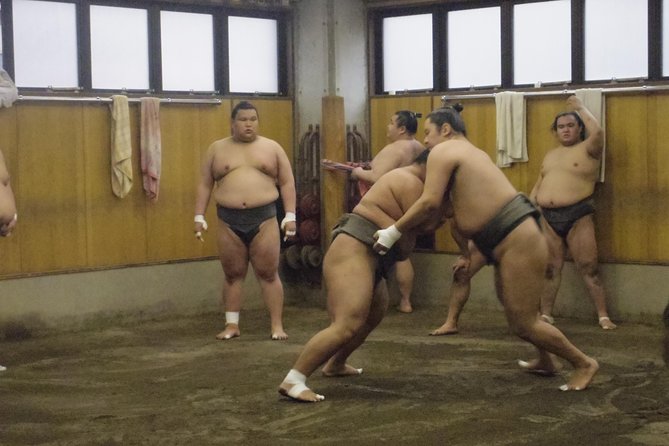
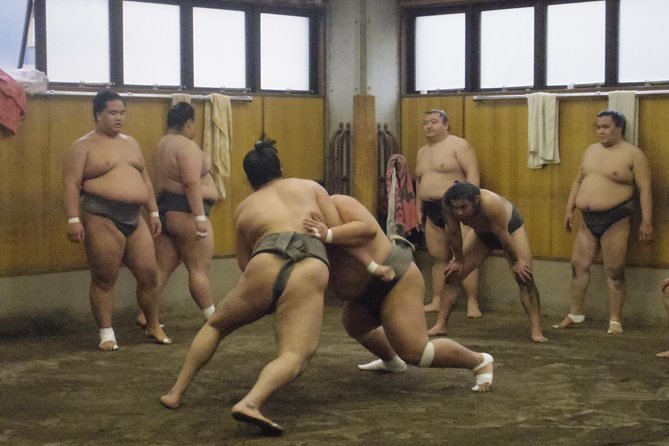
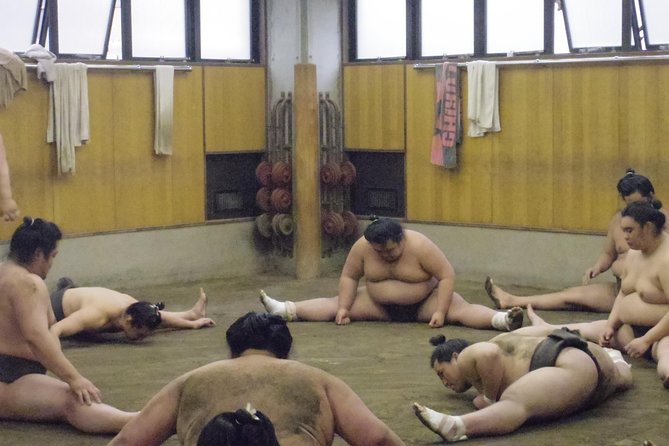
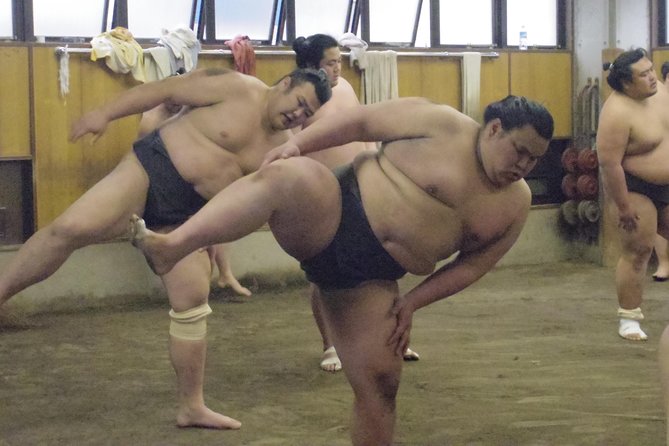
The practice is not a single exhibition bout. You may see warmups, repeated exercises, technical work, and practice sparring. The exact mix depends on what the stable schedules that morning.
The most gripping moments come when two wrestlers face each other and train at close range. You can see the force of the collision, but you also notice the control. Sumo requires balance, timing, footwork, grip, and the ability to use body weight efficiently. The training reveals this more clearly than a quick match on television.
Some mornings may include long, intense exchanges involving the more seasoned wrestlers. On another day, the practice could be shorter or less dramatic. That uncertainty is an important part of the bargain. You are not buying a guaranteed championship-level performance. You are buying access to a genuine training session.
The guide helps identify what is happening and may point out techniques or explain why certain exercises matter. The best version of the commentary adds meaning without taking your eyes away from the ring. One concern raised about the audio format is that too much narration can compete with the practice itself, especially when the headset produces static.
I would treat the commentary as support, not the main event. Watch first. Listen for explanations of a move, a ritual, or a wrestler’s role. If the equipment is unclear, tell the guide as soon as possible rather than struggling through the whole session.
The guide makes the difference
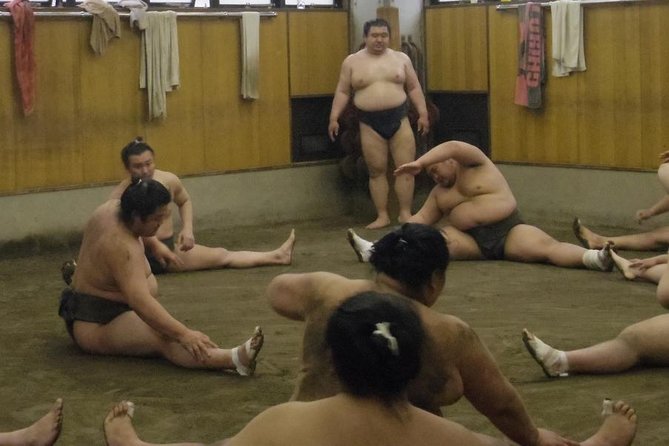
A good guide turns a silent observation into an understandable cultural experience. The guides praised most highly have been friendly, passionate, and able to explain unfamiliar customs in clear English.
Seiji has been singled out for his calm explanations and strong grasp of the wrestlers’ routines. Yumi has been praised for discreet commentary through an earpiece. Noriko received particularly warm feedback for explaining the stable rules before the group sat down. Cameo was noted for organizing a useful question period after practice.
Guide quality can vary slightly by date, but the tour depends heavily on this role. A stable is not arranged like a museum with labels beside every activity. You need someone to explain rankings, daily routines, Shinto elements, and the difference between practice and tournament combat.
The question period is not guaranteed in the same form every day. Some sessions have allowed questions after practice, while one participant wished there were a better way to ask questions during the training. That is worth knowing if you enjoy interactive tours. The stable’s rules mean you cannot simply chat with the guide or call out to the wrestlers while practice is under way.
Photography and the short ending
Photography is allowed under strict conditions. Your cellphone must be silent, and flash and shutter sounds are prohibited. Video is not allowed, and photographs cannot be used without permission in ways that violate privacy or image rights.
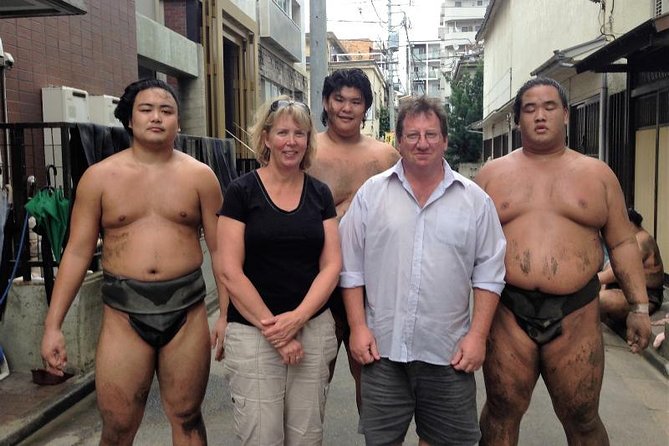
A photograph with wrestlers may be offered after practice, but the timing and number of wrestlers can vary. Some participants have had a short photo opportunity with one or two wrestlers from the stable. It can be a memorable finish, but do not book this expecting a long personal meeting or an extended autograph session.
The end can feel abrupt. Once the training is over, the group is generally guided back toward the station and the visit ends. That brisk departure makes sense in a working stable, but it may disappoint anyone expecting a long social period afterward.
Your best approach is to regard the photograph as a bonus. The real value is watching the practice, not collecting a posed image.
Summer heat and practical comfort
There is no air conditioning inside the stable. Tokyo mornings can be hot and humid in summer, and sitting quietly in a warm room for up to two hours can be uncomfortable.
During summer, water and sports drinks are allowed inside. Bring one, along with a cold towel or small ice pack if you are sensitive to heat. Wear suitable clothing, but remember that hats and sunglasses must be removed inside.
The tour asks you to stay quiet and seated for much of the practice. If you are feeling unwell, do not attend. This is not a good morning for pushing through heat exhaustion, illness, or a rushed schedule.
The age limit is firm: participants must be at least 12 years old. Children aged 11 and under cannot enter the stable. Most adults and older children can take part, but the rules and sitting arrangements may not suit someone who needs frequent movement breaks.
Is $83.57 a fair price?
At $83.57 per person, this is not a bargain activity in the usual Tokyo sightseeing sense. You are paying for access that is limited by the stable’s schedule, a guide who handles the meeting and cultural explanation, and a small-group setting of up to 20 people.
The value is strongest if you already plan to see a tournament or want to understand sumo beyond its public image. Watching dozens of practice bouts can provide more continuous action than a tournament session, where formal ceremony takes up considerable time. You also see training rather than only the polished final contest.
The price feels less convincing if you mainly want a long, interactive lesson, guaranteed photo time, or a polished show. The practice may be shorter than expected. Commentary may be difficult to hear. Seating is not fully under your control, and the experience does not promise a question period every time.
I would rate the price as reasonable for rare access, but not automatically excellent value for every type of visitor. This is a specialist cultural visit. It rewards curiosity, patience, and respect more than a desire for comfort or entertainment.
Who should book this sumo experience?
I would recommend it to first-time visitors who want a strong introduction to sumo and to sports fans who prefer seeing training over a staged presentation. It also suits anyone interested in Japanese religious customs, disciplined daily routines, and the lives behind a national sport.
It is particularly good for you if:
- You can start early at 7:45am.
- You are happy to watch quietly.
- You want close views of real training.
- You are comfortable with a changing schedule.
- You value cultural access more than luxury.
- You are aged 12 or older.
I would think twice if you need air conditioning, dislike sitting still, or expect a guaranteed conversation with the wrestlers. You may also prefer a tournament if the ceremony, crowd atmosphere, and formal competition are central to your interest.
The tour is available with free cancellation up to 24 hours before the start time. Cancellations or changes inside that window are not accepted for a refund, so keep the local cut-off time in mind.
Final verdict: book it for access, not spectacle
This Tokyo sumo morning practice tour offers something hard to arrange on your own: a close look at wrestlers training inside a real stable. I value the steady action, the Shinto context, the explanation of tournament structure, and the chance to see how much discipline goes into each contest.
The weak points are real. Audio quality can be uneven, the commentary may compete with the practice, seating is not identical for everyone, and the ending can feel rushed. Yet the experience remains unusually direct. You are watching people work, not actors recreating a tradition for a crowd.
Book it if you want the working world behind sumo. Skip it if you want a relaxed, highly interactive show. For the right person, this early morning in Ryogoku can become one of Tokyo’s most memorable cultural encounters.
FAQ
Where does the tour meet?
The listed meeting point is near Ryogoku Station, at the Ryogoku Station Gallery area. The exact meeting location can differ by booking option, so check your confirmation email carefully.
What time should I meet the guide?
The meeting time is 7:45am.
How long does the experience last?
The tour lasts about two hours. The practice itself may be a little shorter or longer depending on that morning’s training.
Can children join the tour?
Only participants aged 12 and older can enter the stable. Children aged 11 and under cannot take part.
How many people can join?
The maximum group size is 20 participants.
Can I take photographs inside the stable?
Yes, photography is allowed without flash or shutter sounds. Video is not allowed, and photographs must not be used in ways that violate image or privacy rights.
Can I talk during practice?
You should watch silently and respectfully. Avoid distracting the wrestlers, and do not ask them for photographs while practice is continuing.
Can I eat or drink inside the stable?
Eating and drinking are not allowed. During summer, water and sports drinks are permitted because the stable has no air conditioning.
Can I cancel for a full refund?
You can cancel up to 24 hours before the experience start time for a full refund. Cancellations or changes made less than 24 hours in advance are not accepted.
Just added in Tokyo
- Tokyo: Meiji Shrine Walking Tour — Shintoism & Imperial System★ 5.0 · 209 reviews
- Bar Hopping Tour with a local Guide in Shinjuku★ 5.0 · 21 reviews
- Tokyo life after 5 – Foods & Drinks★ 5.0 · 32 reviews
- Tokyo: Shinjuku Food Tour Highlights (Best Eats)★ 5.0 · 100 reviews
- Tokyo Shinjuku Night Tour with Pachinko Gaming Experience★ 5.0 · 14 reviews
- Tokyo: Shinjuku Local Bar Hopping Walking Tour★ 5.0 · 186 reviews
- Shinjuku Go Karting Tour with Funny Costume★ 5.0 · 21 reviews
- Tokyo Shibuya Crossing & Hidden Streets Walking Tour★ 5.0 · 103 reviews
Sumo Experiences, compared.
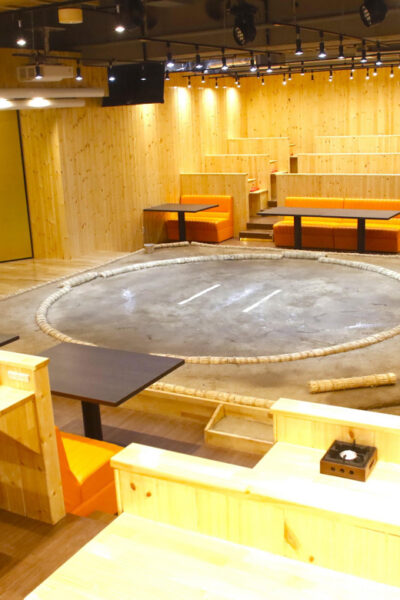
Sumo Show Experience with Chicken Hot Pot and a Photo
Read our review →
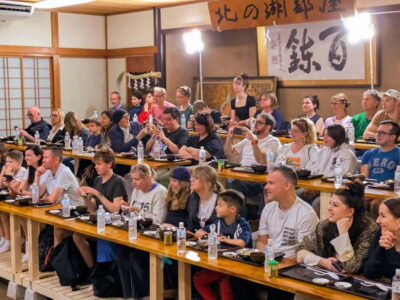
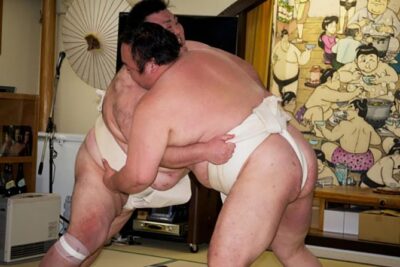
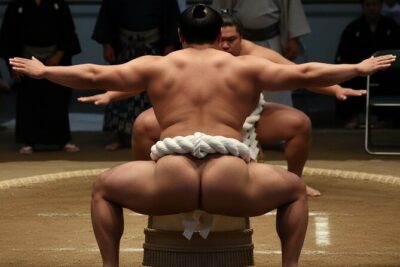
Tokyo Shinjuku Sumo Show & Experience with Photo
Read our review →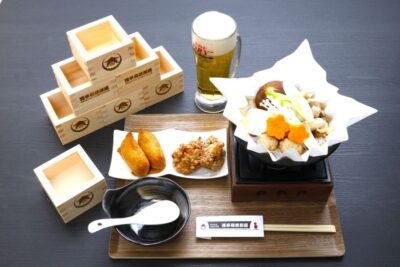
Asakusa Sumo Club Sumo Show Admission with Chankonabe in Tokyo
Read our review →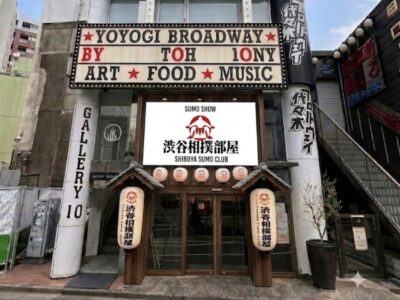
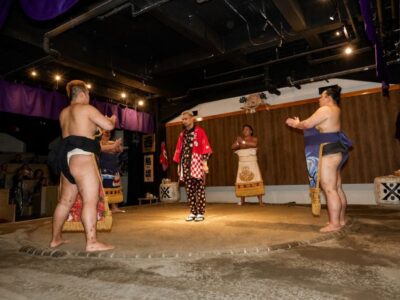
Tokyo Ginza Sumo Experience: Performance vs Pure Practice
Read our review →Browse the lists this tour appears in