
Reviewed · SUMO EXPERIENCES
Sumo Morning Training Watch in Tokyo,Hotel-pickup w/English guide
Sumo starts before breakfast. This three-hour Tokyo experience takes you into a genuine sumo stable, where you can watch professional wrestlers stretch, practice techniques, and face one another in serious bouts. I like the close view of the training and the access to a working stable, not a staged performance. I also like having an English-speaking guide explain the rituals, rules, and small details that are easy to miss.
The early hotel pickup makes the morning much easier, especially when you are still learning Tokyo’s train system. Guides such as Hiromi, Koichiro, Midori, Mari, Hiro, and Kyoko have helped visitors reach the stable on time and answered questions along the way. The main consideration is that pickup does not include a ride back to your hotel, and the journey may involve walking, subway, and bus connections.
In This Review
- Key Points Before You Book
- Why Watching Practice Beats Watching Only a Tournament
- Meeting Your Guide at 7:30 a.m.
- Entering a Working Sumo Stable
- The Rituals, Drills, and Practice Bouts
- What the Guide Adds Between the Bouts
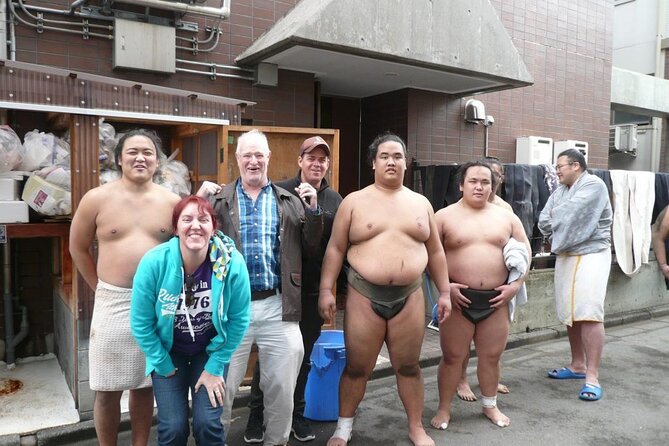
- Photos With Wrestlers After Training
- Is the $159.88 Price Fair?
- Who Will Enjoy This Most
- Final Call: Book It If You Want the Real Training Room
- FAQ
- How long does the sumo morning training experience last?
- What time does the tour start?
- Is hotel pickup included?
- How do you get to the sumo stable?
- Is an English-speaking guide included?
- Can you take photos with the sumo wrestlers?
- What happens if you need to cancel?
Key Points Before You Book
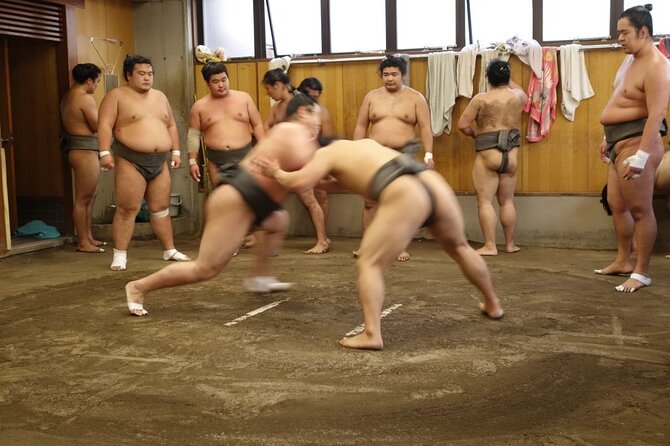
- Training happens at close range: You may sit only a few feet from the wrestlers as they work through drills and practice bouts.
- The guide is part of the experience: A good guide explains the movements before training and uses notes, sketches, or a dry erase board during the quiet session.
- Hotel pickup means meeting your guide, not private transport: You typically continue by public transportation, so comfortable shoes and a Suica card are useful.
- Silence is required inside the stable: You watch quietly while the wrestlers train, then ask questions before or after the session.
- Photo opportunities may follow training: Photos with wrestlers are possible, but depend on the stable’s schedule and the wrestlers’ availability.
- The tour is small: The maximum group size is 15, which helps you see and hear more clearly than at a large group activity.
Why Watching Practice Beats Watching Only a Tournament
Tokyo’s grand sumo tournaments are thrilling, but tickets can be hard to find and the matches show only the finished product. At morning training, you see the work behind the competition: repeated footwork, leg exercises, pushing drills, stretches, and bouts that can look remarkably forceful even without a tournament crowd.
That difference matters. You are not watching a performance arranged for tourists. You are watching wrestlers prepare inside their own stable, under the eye of senior wrestlers and the stable master. The atmosphere is serious and workmanlike.
The practice session can include basic exercises for the legs, hips, and upper body. You may also see muscle-building routines and repeated technique work before two wrestlers enter a bout. Some sessions last around 90 minutes, while the full morning experience takes about three hours once you include pickup, transit, explanations, and the return toward the station.
I especially like the chance to watch wrestlers at different stages of training. One person may be stretching while another works on a pushing drill. A bout may begin with the familiar crouch and initial charge, then end quickly. Another may continue with repeated attempts to force an opponent backward or out of the ring.
You do not need prior sumo knowledge to enjoy this. A good guide gives you enough background to understand what you are seeing without turning the morning into a lecture.
More Sumo Experiences in Tokyo
- Tokyo: Sumo Show Experience with Chicken Hot Pot and a Photo
★ 4.8 · 6,678 reviews - Tokyo: Sumo Live Show with Photo in Shinjuku
★ 5.0 · 3,438 reviews - Tokyo: Sumo Show and Dining Experience
★ 4.8 · 2,742 reviews
Meeting Your Guide at 7:30 a.m.
The scheduled start is 7:30 a.m., and the guide meets you at your hotel. This is one of the strongest practical reasons to choose this option rather than trying to locate a stable alone.
Tokyo’s sumo stables are working facilities, not standard sightseeing attractions with large signs and ticket booths. Finding the correct entrance can be difficult, especially when you are trying to arrive quietly and on time. Guides including Atsushi, Tadashi Umebayashi, Yuka, and Koichiro have been praised for arriving promptly and managing the route carefully.
Do not read hotel pickup as a private car service. Several outings have involved walking to a station, riding trains, and sometimes taking a bus. One useful tip is to have a Suica card ready and wear shoes that can handle a fair amount of walking. The exact route depends on the stable and the hotel location.
The transit time is not wasted. Guides often explain the basics of sumo on the way, answer questions about Tokyo, and point out customs or sights along the route. Some have added a short visit to a neighborhood shrine or temple after the training, though this is an extra possibility rather than a guaranteed part of the program.
The early departure also gives you a practical Tokyo morning. If you are jet-lagged, the start may feel demanding. If you can manage it, the quiet streets and early train ride form a fitting lead-in to a sport built on routine and discipline.
Entering a Working Sumo Stable
Inside the stable, you should expect a simple training room rather than a polished attraction. The seating may be on cushions close to the practice ring. Chairs can sometimes be brought in, but they are low, so standing up may be awkward for anyone with limited knee or hip mobility.
Your guide will explain the rules of the stable before training begins. Silence is important once the wrestlers start working. You should not expect a running commentary from the guide during every bout, because talking can disturb the practice.
The best guides solve this neatly. Hiro, for example, used a dry erase board so questions could be passed back and forth without breaking the quiet. Other guides have sketched techniques or written short explanations during the session. This lets you ask about a wrestler’s position, a particular movement, or the purpose of a drill while the action continues.
The quality of the explanation can vary. Many guides, including Koichiro and Mari, have been praised for giving clear background before entering the stable and pointing out details during training. One guide offered little more than a sheet of stable rules, leaving the group to watch without much context. That appears to be the exception, but it is a fair reminder that the guide can shape the experience.
If your guide explains less than expected, ask questions before the session starts or after it ends. The tour works best when you take an active role. Ask about the wrestlers’ ranks, the meaning of the rituals, how a bout is won, and what the stable master is watching.
The Rituals, Drills, and Practice Bouts
Morning training is not just two large men pushing each other around. The repeated motions have purpose, and the guide helps you see it.
The session may begin with exercises designed to strengthen the legs, hips, and upper body. Sumo depends heavily on balance, stance, and the ability to drive forward from a low position, so the warm-up itself becomes part of the lesson.
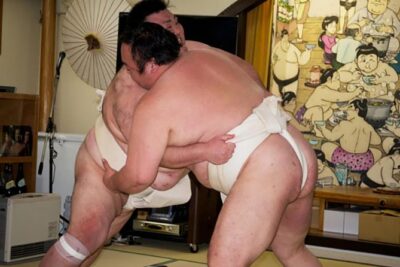
You may then see practice bouts between two wrestlers at a time. These are not ceremonial demonstrations. The action can be fast, physical, and surprisingly loud at close range. A bout may end almost instantly, while another turns into a determined struggle across the ring.
The surrounding wrestlers remain part of the scene. Some stretch, practice techniques, or push one another across the floor while waiting for their turn. A senior figure may correct a mistake or speak with a wrestler after a bout. That glimpse of instruction gives you a better sense of sumo as a demanding profession rather than a show put on for an audience.
One account described sitting roughly two feet from the wrestlers. That kind of distance is what makes this experience memorable. You can see the effort in their faces and bodies, and you do not have the barrier of a large arena between you and the practice.
The quiet can feel unusual at first. There is no cheering, no announcer, and no constant explanation. Give yourself a few minutes to adjust. The silence allows you to notice the rhythm of the stable and the concentration of the wrestlers.
A completely different kind of day out:
- Tokyo Disney Resort – Tokyo Disneyland & Tokyo DisneySea Park Tickets
★ 4.8 · 99,488 reviews - SHIBUYA SKY Ticket
★ 4.7 · 46,509 reviews - JR Whole Japan Rail Pass
★ 4.8 · 29,150 reviews - Mt Fuji and Hakone 1-Day Bus Tour Return by Bullet Train
★ 5.0 · 26,383 reviews
What the Guide Adds Between the Bouts
A licensed English-speaking guide is worth paying for here because sumo has its own vocabulary, ranking system, gestures, and etiquette. Without help, you can still see powerful athletes training, but you may miss why a particular movement matters.
The strongest guides combine sumo instruction with practical Tokyo help. Mari explained sumo during the train ride, answered questions about Japan, and helped the group navigate unfamiliar connections. Midori used handouts to explain the sport and the stable rules. Other guides, including Kyoko and Hiro, were praised for patience, humor, and careful attention to the group.
You can make the most of this by preparing a few questions. Ask why wrestlers repeat a movement, what the stable master is correcting, and how training changes during a grand tournament. Ask about the significance of the pre-bout gestures and the difference between a practice session and an official match.
The timing of your visit can affect what you see. During a hon-basho, one session was described as lighter, though some wrestlers had more time to chat and take photos afterward. Training conditions are controlled by the stable, so the exact order, length, and intensity cannot be promised.
Photos With Wrestlers After Training
After the session, you may have a chance to take photos with some of the wrestlers. This is a special finish, especially after sitting so close during practice, but it is not guaranteed. The schedule and the stable’s wishes come first.
Several guides have helped arrange these photos, sometimes by asking a wrestler to join the group after training. The wrestlers have been described as kind and willing when time allowed. Keep your request polite and brief. You are entering their workplace at the end of a demanding practice.
Do not assume you can take photos throughout the training. Follow the stable rules and your guide’s instructions. In some sessions, pictures may be limited or delayed until training ends.
A small gift from home is not required, and you should not feel obliged to bring one. One person later wished they had brought a gift, but the important point is respectful behavior, not a present.
Is the $159.88 Price Fair?
At $159.88 per person, this is not a cheap way to fill a morning. The price pays for more than a seat beside the ring. It includes a nationally licensed English-speaking guide, hotel pickup, route planning, translation help, and access to a genuine training stable.
The value is strongest if you would struggle to find the stable or navigate Tokyo’s transit before 8 a.m. The guide also helps turn a silent training session into an understandable cultural experience. You are paying for access and interpretation, not just transportation.
The value is weaker if you already know sumo well, speak Japanese, and are comfortable finding an unfamiliar stable alone. You may prefer to attend an official tournament if your main goal is a full day of formal matches and arena atmosphere.
The group limit of 15 is another plus. The group may be smaller, and one outing had only two people. A small group gives you a better chance to sit where you can see, ask questions, and receive help with transit.
Food and drinks are not included. Hotel drop-off is also not included, so plan your next destination from the station or area where the tour ends. The tour takes roughly three hours, but allow flexibility if you have a fixed morning reservation afterward.
Who Will Enjoy This Most
I would recommend this to anyone with even a passing interest in sumo, especially if you want to understand the sport beyond a quick photo or tournament highlight. It is also a strong choice for first-time visitors who want a cultural experience that feels connected to everyday Japanese practice.
Families with older children may enjoy the close action, though the quiet rules require patience. Athletics fans will appreciate the repetition, coaching, and physical work. Photographers should remember that photography rules may limit what you can capture during training, with the best photo chance often coming afterward.
This is less suitable if you dislike early starts, cannot manage walking and public transportation, or need guaranteed seating with easy access. The low cushions and low chairs may be uncomfortable for some people.
The tour is also not available on these 2025 date ranges: May 10 to June 5, June 26 to August 6, September 13 to October 8, and October 23 to December 3. Availability is subject to confirmation within 48 hours of booking, so check the date before building your morning around it.
Final Call: Book It If You Want the Real Training Room
I would book this tour if your idea of sumo includes the training, ritual, discipline, and quiet work behind the official bouts. The strongest parts are the close seating, the genuine stable setting, and guides such as Koichiro, Hiro, Mari, Midori, and Kyoko, who have made the route and the sport easier to understand.
Go in with realistic expectations. You may travel by subway and bus, you may not get a photo, and your guide’s level of explanation can vary. Still, at its best, this is one of Tokyo’s most unusual mornings: you sit close to serious athletes, watch them prepare, and leave with a better sense of why sumo matters in Japan.
Free cancellation is available up to 24 hours before the start time for a full refund. After that point, changes and refunds are not accepted.
FAQ
How long does the sumo morning training experience last?
The experience lasts approximately three hours, including hotel pickup, transportation, the training session, explanations, and the end of the visit.
What time does the tour start?
The scheduled start time is 7:30 a.m.
Is hotel pickup included?
Yes. Hotel pickup is included. Hotel drop-off is not included.
How do you get to the sumo stable?
The guide takes you from your hotel using public transportation. The route may include walking, subway, and bus travel, depending on the stable and hotel location.
Is an English-speaking guide included?
Yes. A nationally licensed English-speaking guide is included.
Can you take photos with the sumo wrestlers?
You may have a chance to take photos with the wrestlers after training. This depends on the schedule and the stable’s arrangements.
What happens if you need to cancel?
You can cancel up to 24 hours before the experience’s start time for a full refund. Cancellations or changes made less than 24 hours before the start time are not accepted for a refund.
Just added in Tokyo
- Very popular in Harajuku♡Animal petting zoo★ 4.6 · 39 reviews
- Yokohama Port: Private Customizable Tour with Transfer★ 5.0 · 19 reviews
- Wagyu & Sake 8 Course Tasting Dinner in Shinjuku★ 4.9 · 20 reviews
- Warner Bros. Studio Tour Tokyo – The Making of Harry Potter★ 4.8 · 181 reviews
- Yanaka District: Historical Walking Tour in Tokyo’s Old Town★ 4.8 · 117 reviews
- Tokyo: Classic Tsukiji Food Tour★ 4.9 · 78 reviews
- Tokyo: Tsukiji Fish Market Tour with 6 Stops & Seafood Lunch★ 4.5 · 165 reviews
- Tokyo Wagyu & Sake Pairing Tasting Experience with Local Flavors★ 5.0 · 108 reviews
Sumo Experiences, compared.
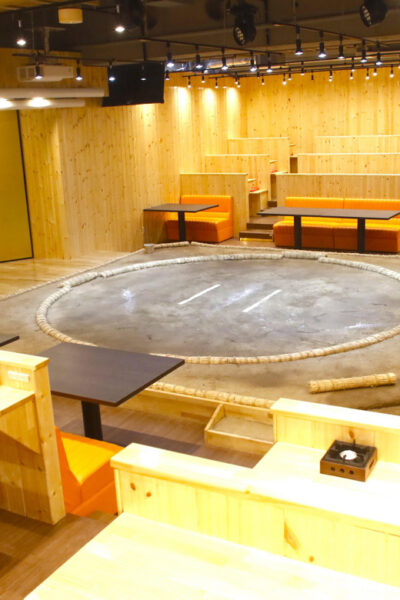
Sumo Show Experience with Chicken Hot Pot and a Photo
Read our review →
Tokyo Shinjuku Sumo Show & Experience with Photo
Read our review →
Asakusa Sumo Club Sumo Show Admission with Chankonabe in Tokyo
Read our review →
Tokyo Ginza Sumo Experience: Performance vs Pure Practice
Read our review →Browse the lists this tour appears in