
Reviewed · SUMO EXPERIENCES
Tokyo Sumo Morning Practice: Viewing & Exclusive Interaction
Sumo gets personal here. Instead of watching from high seats during a tournament, you sit close to professional wrestlers during a real morning practice in Sumida. I like the raw, unscripted feel, and I like that the guides explain the rituals before you enter the stable. The main drawback is value: at $95.77 per person, the price feels high if your session is short or the interaction is limited.
The morning schedule also works well for a Tokyo sightseeing day. You finish back near Narihira Park, with time left for other plans, and the optional Japanese brunch adds a useful local meal. Just remember that practice length can vary, and some activities, such as entering the ring, are restricted by long-standing sumo customs.
In This Review
- What makes this morning practice special
- Why a practice session can beat a Tokyo tournament
- Meeting near Narihira Park in Sumida
- Watching the wrestlers train up close
- Meeting the wrestlers after practice
- Returning to the park with a banzuke
- Adding the Japanese brunch
- Who will get the most from this experience
- Price, timing, and practical value
- Should you book the Tokyo sumo morning practice?
- FAQ
- How long does the sumo morning practice experience last?
- Where does the experience begin and end?
- What is included in the price?
- Can I take photos with the wrestlers?
- Is brunch included?
- Can everyone enter the sumo ring?
What makes this morning practice special
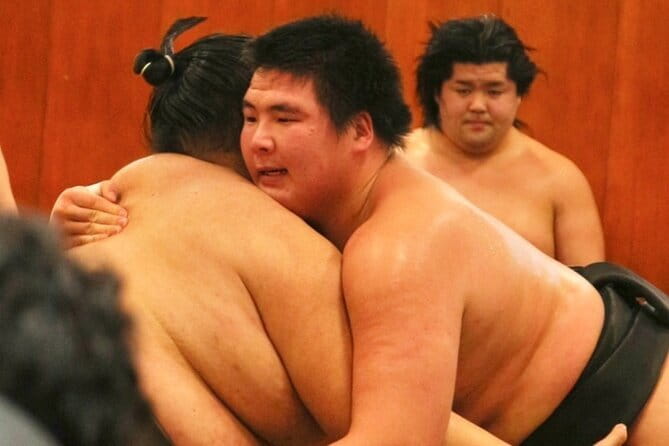
- You sit only a few meters from real training: Watch wrestlers perform powerful exercises and practice bouts without a staged show.
- The pre-practice briefing adds useful context: Your guide explains sumo history, rituals, stable etiquette, and what to watch for.
- The wrestler interaction is a major highlight: After practice, you can ask questions and take personal photos with the athletes.
- Some male participants may enter the ring: Several people had the chance to push or wrestle lightly with a sumo wrestler.
- A souvenir gives the morning some lasting value: You receive an official banzuke, or ranking sheet, in an original folder.
- Optional brunch extends the experience: Guides help explain the Japanese dishes, making this a good add-on if you want a local meal.
Why a practice session can beat a Tokyo tournament
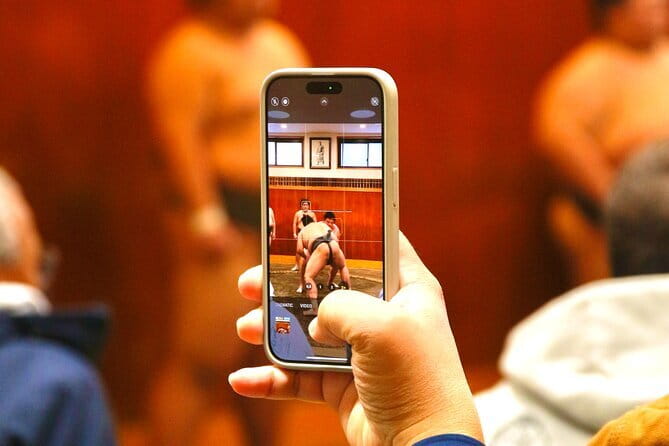
Tokyo’s official sumo tournaments take place only a few times each year. If your visit falls outside those dates, this morning experience offers a practical alternative. You do not get the spectacle of a full competition day, but you see the work that makes tournament sumo possible.
That difference matters. At a match, you watch athletes enter a large arena, perform formal rituals, and compete under bright lights. Here, you see training as part of daily life. The room is quieter, the distance is shorter, and the emphasis is on repetition, technique, strength, and discipline.
I especially like that this is not presented as a theatrical demonstration. The wrestlers are carrying out their own practice. You might see several bouts, but the purpose is training rather than entertainment. That makes the experience more authentic, although it also means the exact pace and length are not fully predictable.
The atmosphere calls for patience. One guide advised that children may find the session difficult because you must sit quietly for up to two hours, depending on how long and intense the practice becomes. Families have enjoyed it, especially when children were allowed to interact with the wrestlers, but young children who need constant activity may struggle.
More Sumo Experiences in Tokyo
- Tokyo: Sumo Show Experience with Chicken Hot Pot and a Photo
★ 4.8 · 6,678 reviews - Tokyo: Sumo Live Show with Photo in Shinjuku
★ 5.0 · 3,438 reviews - Tokyo: Sumo Show and Dining Experience
★ 4.8 · 2,742 reviews
Meeting near Narihira Park in Sumida
The meeting point is at Narihira Park, near the multipurpose restroom, at 2-chōme-3-番 Narihira, Sumida City. Your guide begins with an orientation lasting about 20 minutes. This is more than a simple check-in. You receive background on sumo, the stable you are about to visit, the rituals, and the proper behavior expected inside.
That briefing is important because the practice can look confusing at first. Sumo has repeated movements, formal gestures, and long pauses that make more sense once someone points out their purpose. Guides such as Sarah, Momo, Haru, Peach, Moana, and Taka have been praised for making the opening explanation clear and personal.
Some guides also send a message the day before with meeting instructions and pre-reading. That is useful in Tokyo, where a small location error can waste a morning. If you are staying in Shinjuku and have an early 8 a.m. session, one practical tip is to allow enough time for the trip to Sumida. One person specifically recommended using a taxi or ride service from Shinjuku for the early start.
There is one important caution: confirm the exact meeting location before setting out. One participant reported that the location printed on the ticket was incorrect. I would rely on the provider’s latest message and check the map pin carefully rather than assuming the ticket details are perfect.
Watching the wrestlers train up close
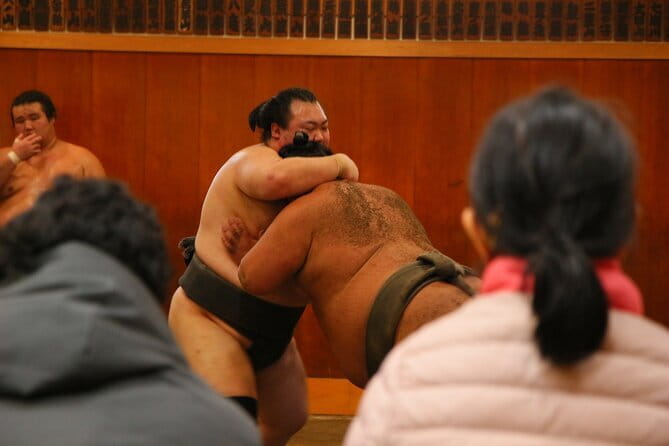
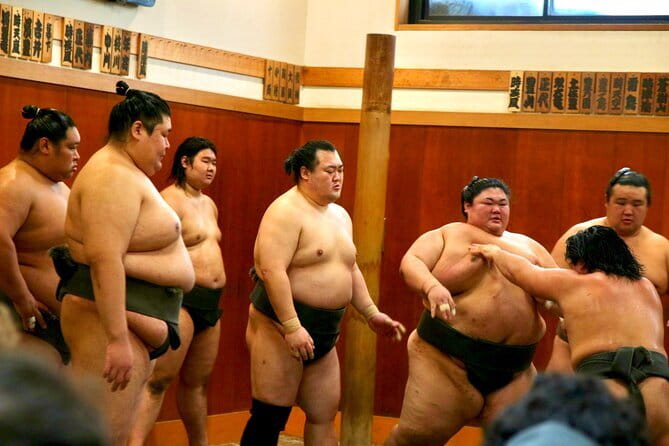
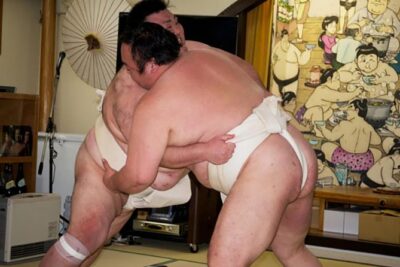
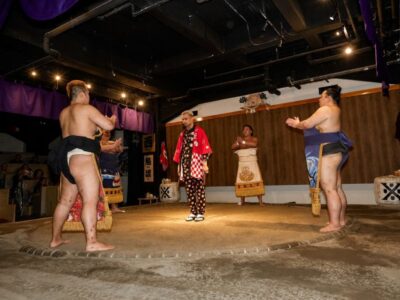
The practice viewing lasts about 90 minutes, though the total time can vary. You sit close to the training area and watch wrestlers work through their exercises and practice matches. The physical force is striking. The sound of bodies hitting the floor and the repeated pushing drills give you a much clearer idea of the sport than television can.
This is where the experience earns its strongest praise. You see the athletes’ concentration, individual styles, and willingness to repeat difficult movements. It is not only about size. Balance, timing, footwork, posture, and controlled force all become easier to notice from a short distance.
The training is not a competition, even when it looks intense. You should not expect a tournament bracket or a polished show with a fixed running order. Some mornings may include several practice bouts. Other sessions may be shorter or involve fewer wrestlers, depending on the stable’s schedule and who is present.
That uncertainty is the central trade-off. One group of eight had seven wrestlers available, creating an especially intimate meeting. In another session, some wrestlers were away on tour, and the group included three children. The quality of the experience depends partly on the morning you receive.
The room may also be quiet for long periods. That can feel slow if you came expecting nonstop action, but it is part of seeing genuine training. I would tell you to read the pre-tour material before arriving. You will get more from the practice if you already understand a little about the rules and rituals.
Meeting the wrestlers after practice
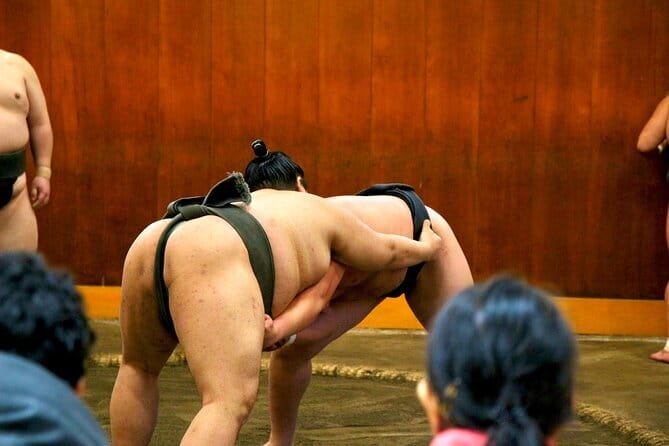
After the viewing, the group has about 30 minutes for questions and photographs. This personal contact is one of the clearest advantages over attending a tournament. You can speak directly with the wrestlers, hear about their experiences, and take photos together.
The wrestlers have been described as friendly and open. Families particularly enjoyed the chance for children and adult men to interact with them. In some sessions, a male participant was invited into the ring to push against a wrestler or take part in a brief playful bout. The wrestler controlled the encounter, of course, but it gave the moment a memorable sense of fun.
You should not assume every participant will wrestle. The opportunity depends on the stable, the schedule, the group, and the customs in effect that day. Women are not permitted to enter the ring because of traditional restrictions, which disappointed at least one participant who wanted to try the same activity as the male visitors.
That limitation is worth knowing before you book. Women can still watch the practice, ask questions, and take photos, but ring participation is not open to everyone. The experience is strongest when you view the interaction as a respectful meeting rather than a guaranteed hands-on activity.
The question period may also be limited. One person expected more direct access to the oyakata, the stable master, but did not have the chance to ask him questions. In some sessions, the guide translates questions between English and Japanese. That service is useful, though the amount of explanation can differ by guide and by group.
A completely different kind of day out:
- Tokyo Disney Resort – Tokyo Disneyland & Tokyo DisneySea Park Tickets
★ 4.8 · 99,488 reviews - SHIBUYA SKY Ticket
★ 4.7 · 46,509 reviews - JR Whole Japan Rail Pass
★ 4.8 · 29,150 reviews - Mt Fuji and Hakone 1-Day Bus Tour Return by Bullet Train
★ 5.0 · 26,383 reviews
Returning to the park with a banzuke
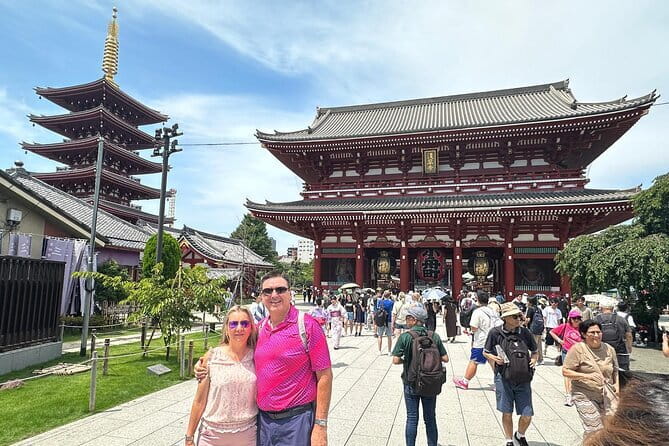
The final 30-minute session takes place back at the park. You can ask extra questions, discuss what you saw, and receive an official banzuke in a specially designed original folder.
A banzuke is a ranking sheet for sumo wrestlers. It is a small souvenir, but it connects the morning to the sport’s formal structure. I like that it is more meaningful than a generic key ring because it helps you remember the wrestlers’ place within the sumo world.
The closing session also gives you a chance to clear up questions that came to mind during practice. That is helpful because the action moves quickly, and you may not want to interrupt the quiet training environment with questions.
The advertised total duration is roughly two and a half to three hours. Still, one participant said the entire experience lasted closer to an hour. Practice schedules are not fully under the guide’s control, so you should treat the duration as an estimate rather than a firm promise.
That is the biggest concern for anyone judging the $95.77 price. If you receive a full practice, a lively question period, photos, and ring interaction, the cost may feel fair for a rare cultural experience. If practice is brief and the question period is short, you may feel you paid a lot for a limited visit.
Adding the Japanese brunch
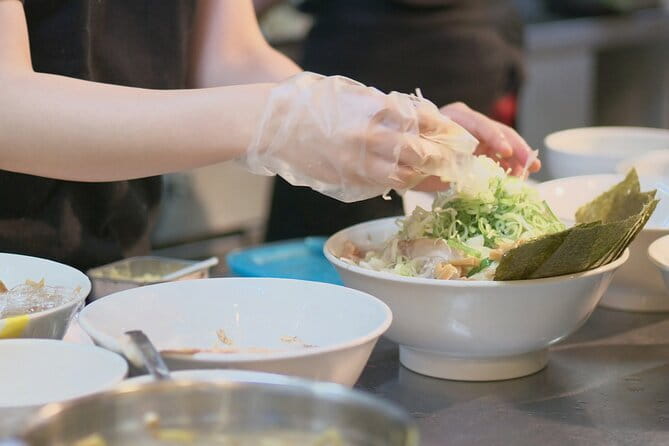
Brunch is optional, which is a sensible arrangement. You can finish the sumo visit and continue with your Tokyo plans, or stay for a meal with the guides.
The meal has been praised as delicious and useful for people who want help choosing unfamiliar Japanese dishes. The guides explain what you are eating and help you select from the menu. One useful note is that the meal may feel more like lunch than European brunch, and the food cost can be around 1,000 to 2,000 yen depending on what you order.
I would add the brunch if you have time and want a gentle continuation of the morning. It gives you a chance to talk about the practice after the quiet observation period. It is less useful if you have a tight schedule or a restaurant reservation elsewhere.
Because brunch is not included in the listed tour inclusions, bring extra money if you choose it. The sumo viewing fee, English-speaking guide, and souvenir set are included, but the meal is an additional choice.
Who will get the most from this experience
I would recommend this to you if you want cultural context rather than a quick photo stop. The opening explanation, quiet observation, and question period help you understand sumo as a demanding way of life, not just a large athlete’s sport.
It also suits families with older children who can sit quietly and follow instructions. The chance to see real training and possibly interact with wrestlers can be memorable for children, but the long seated viewing period is not ideal for everyone.
This is a good choice for first-time sumo viewers, especially if your Tokyo dates do not match a tournament. It is also useful for people who already know the sport but want to see the daily work behind the public matches.
I would hesitate if you mainly want a guaranteed performance, a long one-to-one conversation, or a fixed three-hour schedule. The session depends on the stable’s practice, and the group can be as large as 45 people. Some mornings are intimate, while a larger group may make the interaction feel less personal.
The guide can make a real difference. Haru was praised for warmth and clear information. Momo was noted for going out of her way to answer questions, while Taka brought strong enthusiasm for sumo history. Still, the guide’s role may sometimes be mainly translation and orientation rather than a long lecture.
Price, timing, and practical value
At $95.77 per person, this is not a cheap morning activity. You are paying for access to a working sumo stable, interpretation, a rare close view, the post-practice interaction, and the souvenir set.
The value is strongest when you care about authenticity. You cannot recreate this kind of access by watching a tournament from the stands or reading about sumo at a museum. The close distance lets you hear and feel the training in a way that a formal match may not.
The value is weaker if you measure the price by minutes alone. The experience can end earlier than expected, and the final amount of interaction depends on the day. I would book it for access and insight, not for a guaranteed number of practice bouts.
The early start is a benefit for sightseeing. Once you return to Narihira Park, you still have much of the day available. Just plan the journey carefully, confirm the meeting point, and avoid scheduling something that requires you to leave the group before the closing session.
Free cancellation is available up to 24 hours before the start time. Cancellations or changes inside that window are not refunded, so keep the local Tokyo cut-off time in mind.
Should you book the Tokyo sumo morning practice?
Book this experience if you want a close, genuine look at sumo training, especially when no Tokyo tournament fits your schedule. The powerful practice, personal photos, Q&A, and possible ring encounter can make this one of the most memorable cultural activities in the city.
I would book with realistic expectations. The wrestlers are not performing a tourist show, practice length can change, women cannot enter the ring, and the group may be larger than expected. If those limits sound acceptable, the chance to sit quietly near real athletes and see their discipline at close range is worth serious consideration.
FAQ
How long does the sumo morning practice experience last?
The stated duration is approximately two and a half to three hours. The schedule includes about 20 minutes of orientation, 90 minutes of practice viewing, 30 minutes with the wrestlers, and 30 minutes for the closing session. The actual practice can vary.
Where does the experience begin and end?
It begins at Narihira Park in Sumida City, near the multipurpose restroom, at 2-chōme-3-番 Narihira, Tokyo 130-0002. The experience ends back at the same meeting point.
What is included in the price?
The price includes an English-speaking guide, the sumo morning practice viewing fee, and an official sumo souvenir set containing a banzuke and original folder.
Can I take photos with the wrestlers?
Yes. The experience includes time after practice for personal photos with the wrestlers, along with a question session.
Is brunch included?
No. Japanese brunch is optional and costs extra. The meal may be more like lunch than European brunch, and the food cost can be about 1,000 to 2,000 yen depending on what you order.
Can everyone enter the sumo ring?
No. Long-standing traditions restrict ring entry to men. Men in some groups have been allowed to push or wrestle lightly with the wrestlers, but this is not guaranteed for every session.
Just added in Tokyo
- Very popular in Harajuku♡Animal petting zoo★ 4.6 · 39 reviews
- Yokohama Port: Private Customizable Tour with Transfer★ 5.0 · 19 reviews
- Wagyu & Sake 8 Course Tasting Dinner in Shinjuku★ 4.9 · 20 reviews
- Warner Bros. Studio Tour Tokyo – The Making of Harry Potter★ 4.8 · 181 reviews
- Yanaka District: Historical Walking Tour in Tokyo’s Old Town★ 4.8 · 117 reviews
- Tokyo: Classic Tsukiji Food Tour★ 4.9 · 78 reviews
- Tokyo: Tsukiji Fish Market Tour with 6 Stops & Seafood Lunch★ 4.5 · 165 reviews
- Tokyo Wagyu & Sake Pairing Tasting Experience with Local Flavors★ 5.0 · 108 reviews
Sumo Experiences, compared.
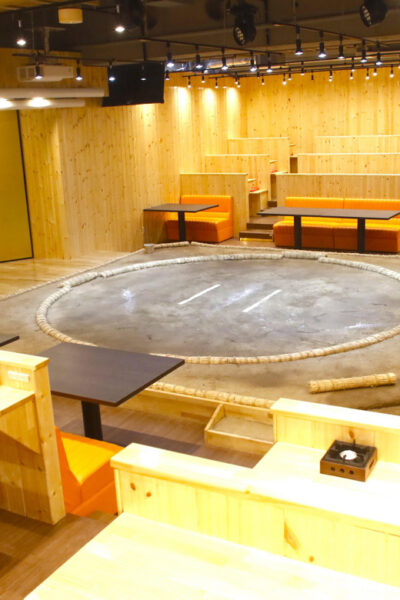
Sumo Show Experience with Chicken Hot Pot and a Photo
Read our review →
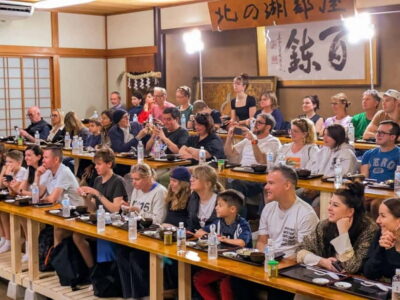
Tokyo Shinjuku Sumo Show & Experience with Photo
Read our review →
Asakusa Sumo Club Sumo Show Admission with Chankonabe in Tokyo
Read our review →
Tokyo Ginza Sumo Experience: Performance vs Pure Practice
Read our review →Browse the lists this tour appears in