
Reviewed · WORKSHOPS
Calligraphy Workshop in Namba, Dotonbori
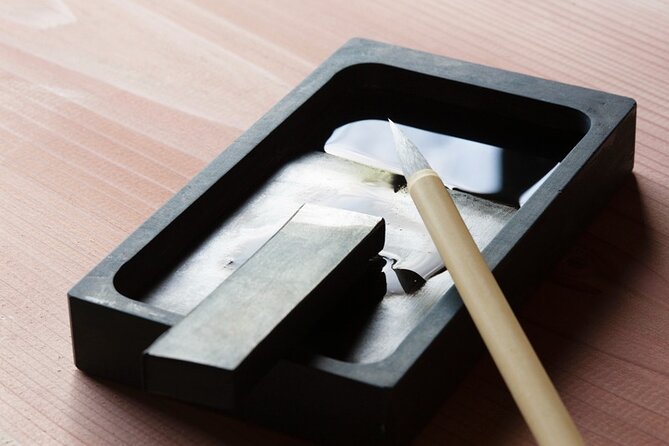
Brush, ink, and a little patience go far. This two-hour calligraphy workshop in central Osaka gives you a calm cultural break from the noise of Namba, with step-by-step instruction, an introduction to Japanese calligraphy, and a handmade souvenir to take home. I especially like the small group size, capped at six people, and the chance to write your own name in kanji or katakana rather than copying a generic phrase. The workshop also earns strong marks for its warm instruction, with Teacher Nao joined by English-speaking support from instructors such as Stephen or Stephan.
The main consideration is that calligraphy is harder than it looks. You should not expect to produce perfect work right away, and the class may feel intense if you want only a quick craft activity. Still, the patient teaching, cultural background, and finished name board or luggage tag make this a good-value choice at $49.54 per person.
In This Review
- Key points at a glance
- Why calligraphy makes a good Osaka activity
- Finding the class in Nanbanaka
- The first lesson: what shodo means
- Practicing brush, ink, and kanji
- Writing your name in Japanese
- Pairing the class with Dotonbori and Kuromon Market
- Is $49.54 a fair price?
- Who will enjoy this most?
- Booking, timing, and cancellation
- My verdict on this Namba workshop
- FAQ
- How long does the calligraphy workshop last?
- Where does the activity begin?
- Where does the activity end?
- How many people can join the workshop?
- Is the workshop suitable for beginners?
- What will I make during the workshop?
- Can I cancel for a refund?
Key points at a glance
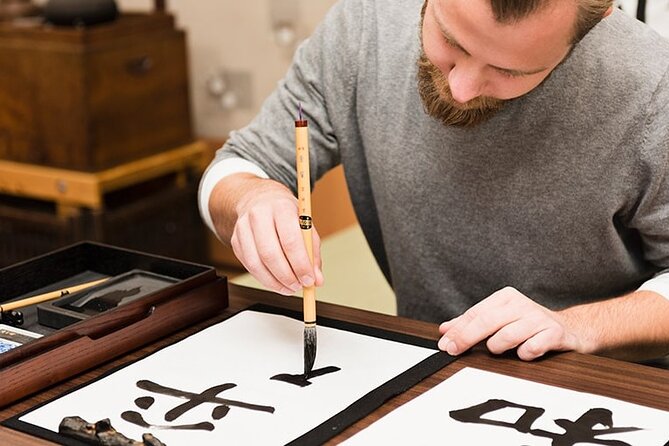
- Write your own name in Japanese: Choose kanji or katakana, then create a personal keepsake on colored paper or a luggage tag.
- A genuinely small class: The maximum group size is six, allowing the instructor to offer close guidance.
- Teacher Nao leads the calligraphy: The teaching is calm, patient, and focused on both technique and meaning.
- English help is available: An interpreter or English-speaking instructor explains the cultural background and writing process.
- Easy to pair with sightseeing: Dotonbori, Nihonbashi, and Kuromon Market are close enough to visit before or after class.
- A quiet pause in Namba: The workshop offers a peaceful two hours in one of Osaka’s busiest areas.
Why calligraphy makes a good Osaka activity
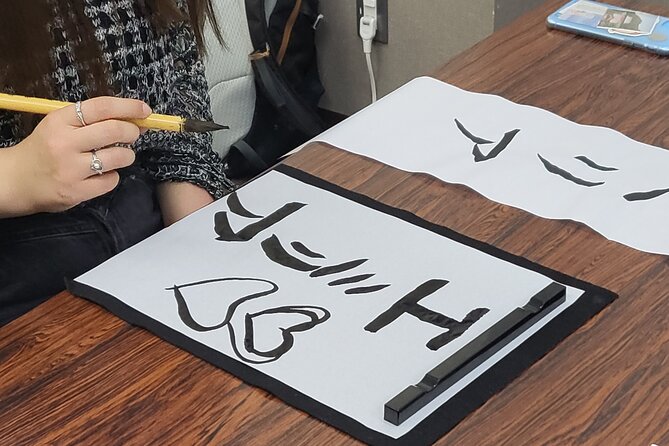
Osaka is famous for food, shopping, neon signs, and fast-moving streets. Those are all good reasons to visit, but they can fill a day with noise and motion. This workshop gives you a slower activity that asks you to pay attention to one brush stroke at a time.
Japanese calligraphy is called shodo, meaning the way of writing. It is not simply handwriting with a brush. The shape, pressure, balance, and order of each stroke matter. You learn that a character has meaning as well as form, which makes the activity more useful than a quick souvenir-making session.
I like this kind of class because you do not need prior experience. The instructor starts with the basics and gives directions step by step. Several participants found the work more difficult than expected, but also found the challenge satisfying. That is the right expectation: you are learning a traditional art, not buying a polished artwork made by someone else.
The workshop also works well for families. Children as young as nine have taken part successfully, and teenagers can enjoy the hands-on nature of the class. Adults who think they have poor handwriting should not worry. The teacher’s job is to help you understand the brush, ink, and characters, not to judge your penmanship.
A few more options to weigh up in Japan
- Universal Studios Japan Studio Pass
★ 4.8 · 89,883 reviews - Universal Studios Japan Express Pass
★ 4.7 · 53,138 reviews - Osaka Amazing Pass
★ 4.7 · 21,697 reviews
Finding the class in Nanbanaka
The meeting point is at Isuku English Academy Japan, 3F, Takeda Building, 1-chome 6-1 Nanbanaka, Naniwa Ward, Osaka 556-0011. The activity begins and ends at this same location.
The address places you in the Namba area, close to major shopping streets and several well-known food districts. Since the class is near public transportation, it is practical to fit into a day of sightseeing. You should allow time to find the building and the third-floor room, especially if you are not familiar with Osaka’s dense streets and signs.
One useful detail is that the entrance has caused some confusion for a few participants. The building may be easier to identify by looking for the nail salon sign and then checking for the workshop direction toward the hall or elevator. The operator has worked on adding clearer signage, but I would still arrive a little early rather than rushing in at the start time.
A mobile ticket keeps the booking simple. You receive confirmation when you book, then show up at the stated meeting point. There is no separate sightseeing transfer or hotel pickup, so you are responsible for reaching the academy.
The first lesson: what shodo means
The opening part of the class explains what Japanese calligraphy is and why it matters. This introduction is important because it gives context to the movements you are about to practice.
You learn about the meaning behind kanji and the ideas connected with shodo. The focus is not just on producing attractive symbols. The instructors explain the culture and thought behind the characters, then connect that explanation to the physical act of writing.
This is where the English support matters. The class has included an interpreter who explains the teacher’s instructions and answers questions clearly. Instructors such as Stephen or Stephan have helped bridge the language gap, while Teacher Nao provides the calligraphy instruction. The combination lets you ask about both the technique and the meaning of what you are writing.
The atmosphere is described as friendly and relaxing, though the work itself requires concentration. That balance is one of the class’s strengths. You can chat with the instructors, but you also get quiet time to focus on the brush. The teaching is patient rather than hurried.
Practicing brush, ink, and kanji
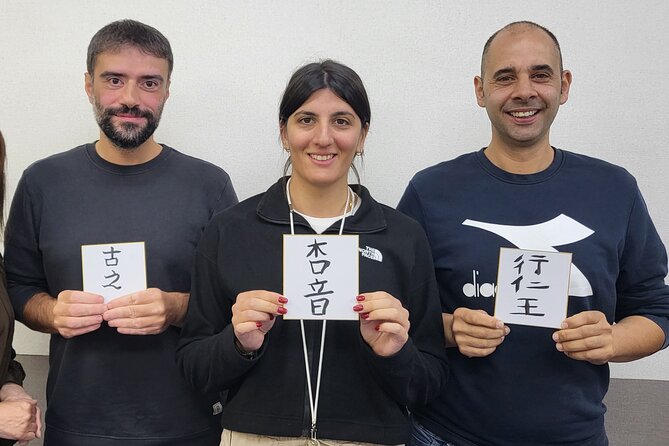
After the introduction, you begin practicing. The class gives you time to handle the brush and ink and learn the basic motions before working on your final piece.
Calligraphy looks simple when an experienced teacher does it. Once you hold the brush yourself, controlling pressure and keeping the strokes balanced takes real effort. You may make uneven lines or characters that do not look quite as you hoped. That is part of the value. The instructor can point out how to improve, and each attempt becomes a little more deliberate.
The workshop is not presented as a formal advanced course. It is a short introduction designed for people who want to try shodo during an Osaka visit. You get enough practice to understand the craft and enough guidance to produce something personal.
Small groups make a real difference here. With a maximum of six people, the instructor can watch your technique and offer individual corrections. One person even attended alone on a quiet date and received instruction from two teachers. That kind of attention cannot be guaranteed on every booking, but the group limit gives you a better chance of receiving personal help than a large class would.
The class has earned particular praise for making calligraphy feel less intimidating. That is useful if you are nervous about trying a traditional art in front of other people. You are encouraged to keep working, and the teaching makes room for mistakes.
A completely different kind of day out:
- Tokyo Disney Resort – Tokyo Disneyland & Tokyo DisneySea Park Tickets
★ 4.8 · 99,488 reviews - SHIBUYA SKY Ticket
★ 4.7 · 46,509 reviews - Mt. Fuji Instagram-Worthy Spots Day Tour: Ladder Town, Oshino Hakkai, Lake Kawaguchi, Lawson Convenience Store (Departing from Tokyo Station or Shinjuku Station)
★ 4.8 · 35,467 reviews - JR Whole Japan Rail Pass
★ 4.8 · 29,150 reviews
Writing your name in Japanese
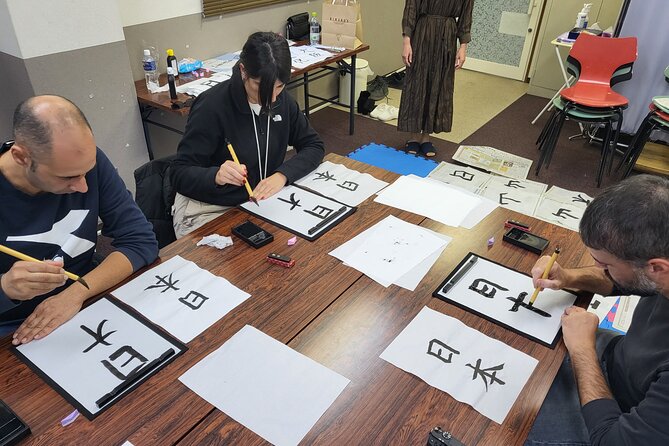
The most personal part of the workshop is choosing how to write your name. You learn how your name can be represented in kanji or katakana, depending on the approach selected with the instructors.
Katakana is commonly used for foreign names, while kanji carries character meanings. The class gives you a chance to learn about the name you are writing instead of treating it as a random group of symbols. That added meaning is a major reason the finished piece feels personal.
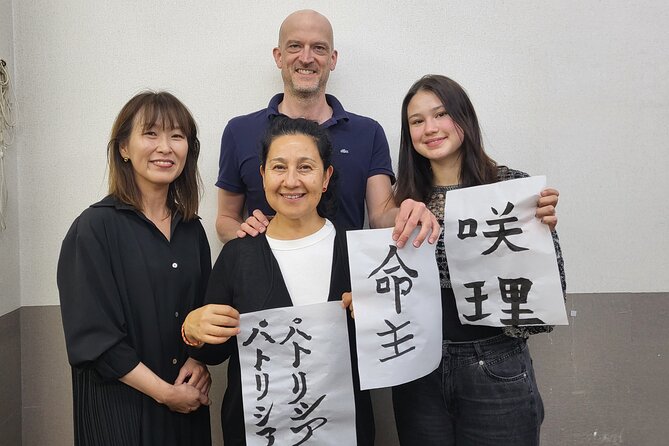
You then prepare your name for the final souvenir. The exact format can be colored paper or a name tag, also described as a luggage tag. This gives you a useful choice: you can make a display piece or something you might attach to your luggage.
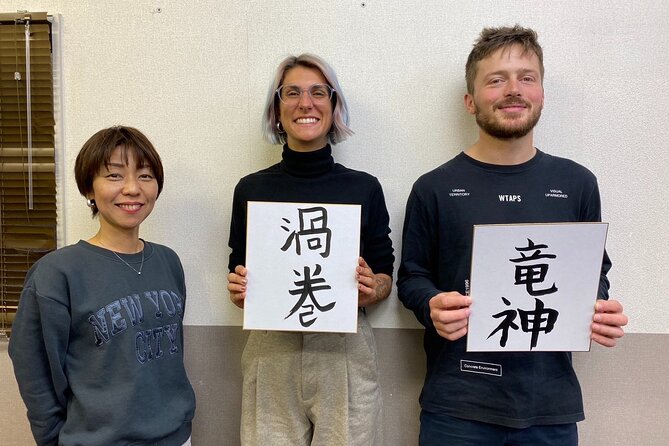
The finished work is handwritten by you. It will not look like professional calligraphy, and that is the point. A slightly uneven stroke shows that you made it during your time in Osaka. You leave with a small reminder of the class, not a mass-produced item from a shop.
Families can make this part into a shared activity. Each person can work on a name and compare the different characters and styles. Children may enjoy seeing their names transformed into Japanese writing, while adults often appreciate the chance to bring home something tied to the meaning of the trip.
Pairing the class with Dotonbori and Kuromon Market
The location makes this easy to combine with other Namba sights. Dotonbori, Nihonbashi, and Kuromon Market are nearby, so you can plan the workshop as part of a full day rather than making a special trip across Osaka.
A practical plan is to visit Kuromon Market before class, then take the workshop as a quieter middle or late-day activity. Another option is to eat around Dotonbori afterward, when the lesson gives you something different to talk about while you explore the food streets.
Do not pack the schedule too tightly. The class lasts about two hours, and you will get more from it if you are not checking the clock every few minutes. Allow time to reach the meeting point, find the building, and settle into the lesson.
The workshop itself ends back at the academy. You are not escorted to Dotonbori or the market, so the sightseeing portion remains flexible. That is a benefit if you like planning your own day, but you need to use a map and manage your own route.
Is $49.54 a fair price?
At $49.54 per person, this is not the cheapest activity you can add to an Osaka itinerary. The value comes from the personal instruction, the small maximum group, the cultural explanation, and the handmade souvenir.
You are paying for more than materials. The teacher explains the meaning of shodo, demonstrates the writing process, helps you practice, and guides you through creating your name. English interpretation or support is also part of what makes the class approachable for international visitors.
The price makes the most sense if you want a real cultural activity rather than a quick photo opportunity. If you only want to purchase Japanese calligraphy, you can find finished pieces elsewhere. If you want to understand the basics and make something yourself, the two-hour format gives you a solid introduction.
The value is also better for families and couples who want a shared memory. A group of six can take part without the class feeling like a crowded demonstration. Solo participants may receive especially close attention on quieter dates, though that depends on how many people book.
Who will enjoy this most?
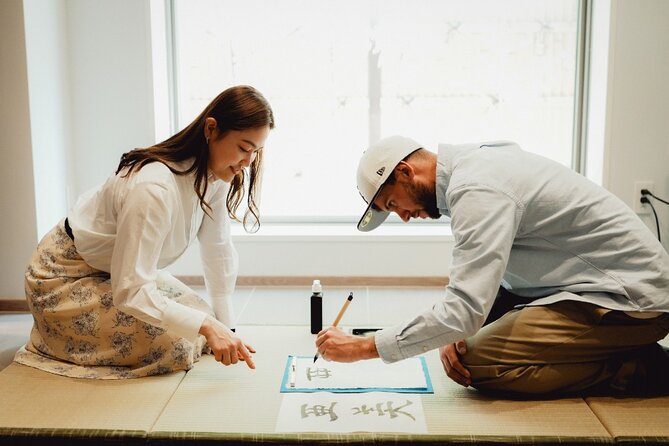
I would recommend the workshop to first-time visitors who want to see a quieter side of Japanese culture. It suits people who enjoy learning the meaning behind an art form, not just taking part in a craft.
Families are a strong match. Children and teenagers can participate, and the class gives everyone a physical souvenir rather than another photograph. Parents should be prepared for the fact that concentration is part of the activity. It is fun, but it is not a noisy entertainment show.
Couples and solo visitors can also get a lot from the format. The small group helps the session feel personal, and the writing process gives you something to focus on together. Solo participants may appreciate the friendly instruction and the chance to ask questions without feeling lost.
This may not suit you if you want a completely casual activity with no challenge. Brush control takes effort, and the class asks you to sit, listen, practice, and repeat. It is also not the right choice for someone seeking an advanced course in Japanese calligraphy. The workshop is aimed at beginners and short-term visitors.
Booking, timing, and cancellation
The activity lasts approximately two hours and accepts a maximum of six participants. Most bookings are made about 38 days in advance, so reserving ahead is sensible if your Osaka dates are fixed.
Confirmation is provided at the time of booking, and the ticket is available on your mobile device. The class is near public transportation, and most people can participate.
You can cancel for a full refund up to 24 hours before the local start time. Cancellations or changes made less than 24 hours before the activity are not refunded or accepted. The class also requires a minimum number of participants. If that minimum is not reached and the activity is canceled, you are offered another date or experience, or a full refund.
My verdict on this Namba workshop
This is one of the better short cultural activities to add to an Osaka schedule. The teaching is patient, the group is small, and the lesson gives you useful context before asking you to pick up the brush. Teacher Nao and the English-speaking support team make the art approachable without making it feel watered down.
I especially like that you write your own name and take home a piece you made yourself. The nearby location also lets you connect the class with Dotonbori, Nihonbashi, and Kuromon Market.
Book it if you want a calm, hands-on introduction to Japanese culture and do not mind working for your souvenir. Skip it if you prefer passive sightseeing or need a highly polished finished product. For families, couples, and curious first-time visitors, the $49.54 price is reasonable for two hours of instruction and a keepsake with a personal meaning.
FAQ
How long does the calligraphy workshop last?
The workshop lasts approximately two hours.
Where does the activity begin?
It begins at Isuku English Academy Japan in the Takeda Building, 3F, at 1-chome 6-1 Nanbanaka, Naniwa Ward, Osaka 556-0011.
Where does the activity end?
The workshop ends back at the same meeting point.
How many people can join the workshop?
The activity has a maximum of six participants.
Is the workshop suitable for beginners?
Yes. The Japanese calligraphy instructor provides detailed, step-by-step instructions, and most people can participate.
What will I make during the workshop?
You will practice Japanese calligraphy and write your own name in kanji or katakana. The final work can be made on colored paper or a name tag, also described as a luggage tag.
Can I cancel for a refund?
Yes. You can receive a full refund if you cancel at least 24 hours before the local start time. Cancellations made less than 24 hours in advance are not refunded.
Just added in Japan
- A One-of-a-Kind Sushi Experience in a Special Place of Japan★ 5.0 · 15 reviews
- Tokyo Cute Bento Cooking Class – Make a Kawaii Character Lunchbox★ 5.0 · 126 reviews
- Japanese Home Cooking Class & Walk in Todoroki Temple Tokyo★ 5.0 · 88 reviews
- Japan Tokyo Tower Observatory Deck E-Ticket★ 4.0 · 34 reviews
- Catch a Baseball Game in Tokyo with a Local – Tickets Included★ 5.0 · 24 reviews
- Tokyo Private Day Tour by Car with English speaking Driver Guide★ 4.0 · 29 reviews
- Japan Classic 10 Day – One Life Adventures★ 5.0 · 129 reviews
- JDM Experience with Fast&Furious RX-7 (English speaking Driver)★ 5.0 · 57 reviews
Workshops, compared.

Sushi Making Tokyo Roll and Authentic Japanese Sushi Class
Read our review →
Gion Make Your Own Chopsticks with Engraving Option
Read our review →
Roll and Authentic Sushi Making Class in Asakusa
Read our review →
Ramen Cooking Class at Ramen Factory in Kyoto
Read our review →
Tokyo Asakusa Chopsticks Workshop: Make Your Own Pair
Read our review →
Ring Making Workshop : Vintage Japanese Coin Ring
Read our review →Browse the lists this tour appears in