Reviewed · KIMONO AND CULTURAL DRESS
Learning Zen of Japanese Calligraphy in kimono near Osaka Castle
Brushes, ink, and a kimono make a fine Osaka memory. This one-hour class combines Japanese shodo calligraphy with traditional dress, so you are not simply watching a demonstration. You practice brush control, choose a kanji character, write a final piece, and pose for photos with your work. I especially like the patient instruction for beginners and the personal touch of having your name translated into kanji.
The $43.59 price is fair for a small-group activity that includes clothing, teaching, photography, and a souvenir. The main caution is practical: the meeting place can be difficult to spot, and a few serious complaints involved closures or communication problems, so arrive early and confirm the appointment details before setting out.
In This Review
- Key points at a glance
- Why this Osaka class is more than a costume photo
- Finding the small storefront near Osaka Castle Park
- Changing into kimono, hakama, or traditional dress
- Learning how Japanese shodo differs from decorative lettering
- Choosing a kanji character with a personal meaning
- Writing your name in kanji on a wooden tag
- Creating the final calligraphy piece
- Taking photos without rushing the class
- Is $43.59 a good value?
- Who should book this experience?
- Practical booking advice before you go
- Should you book the kimono calligraphy class?
- FAQ
- How long does the Japanese calligraphy experience last?
- What is included in the price?
- Is the class suitable for beginners and children?
- Is the class taught in English?
- Can I choose my own kanji character?
- Are photographs included?
- Is the optional hair and kanzashi styling included?
- What happens if I arrive late or need to cancel?
Key points at a glance
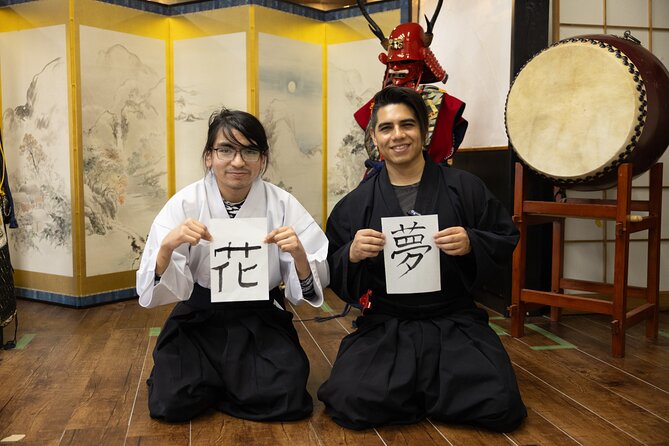
- Kimono before calligraphy: You change into traditional clothing before sitting down to practice.
- A real brush lesson: You learn the basic movements called tome, hane, and harai, not just how to copy a finished character.
- Your name becomes a keepsake: The teacher writes participants’ foreign names in kanji on wooden tags.
- Small group setting: The maximum is 10 people, which allows room for individual help.
- Photos are included: Digital images of you in kimono with your artwork are sent to your email.
- Osaka Castle pairing: The class works well after a walk around Osaka Castle or Osaka Castle Park.
Why this Osaka class is more than a costume photo
Many short cultural activities in Japan give you a costume, a quick explanation, and a few minutes to pose. This class adds a hands-on skill. You sit with ink and brush, try the movements yourself, and gradually turn a set of unfamiliar strokes into a character with meaning.
That difference matters. Japanese calligraphy is not simply decorative writing. The teacher explains how posture, pressure, speed, and brush direction affect the final mark. You learn that a confident stroke is not made by rushing. It comes from controlling the brush and paying attention to the beginning and end of each movement.
The class is designed for all skill levels. Children can take part, and you do not need to read Japanese. The default language is English, with translation support when available. Other languages, including Chinese, Italian, Spanish, French, Thai, and Indonesian, may be possible by request, but staff availability is limited. English is the safest choice when booking.
I also like the calm tone of the activity. It offers a quiet break after the crowds and wide paths around Osaka Castle. Sitting on tatami in traditional clothing, focusing on a single brushstroke, gives the hour a slower rhythm.
More Castles and Historic Sites in Osaka
- Osaka Castle Ticket
★ 4.7 · 12,450 reviews - Osaka Castle: Museum and Tower Entry Ticket
★ 4.5 · 2,380 reviews - Ultimate Osaka Walking Tour: Castle, Dotonbori & Hidden Gems
★ 5.0 · 862 reviews
Finding the small storefront near Osaka Castle Park
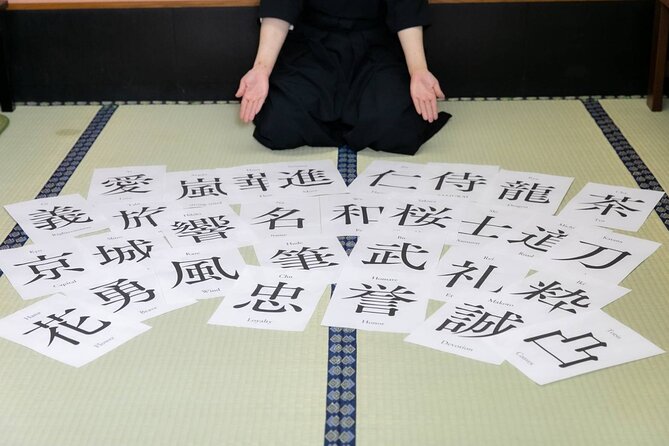
The meeting point is at 2-chome 3-19 Shiginonishi, Joto Ward, Osaka, postal code 536-0014. The activity ends at the same location, and no hotel pickup or station transfer is included.
The operator describes the venue as close to Osaka Castle Park Station, about a one-minute walk away. Still, allow extra time. The storefront is small, and it can be easy to walk past it. One useful practical detail is that map directions are reported to be accurate, but the entrance may not look like a large cultural center.
I would arrive at least 15 minutes early. The late-arrival rule is strict: if you are more than 30 minutes late, entry may be refused, even if you have contacted the operator. Osaka has plenty of train connections, but locating a small address while wearing a daypack and following station signs can take longer than expected.
Use the restroom before changing. Once you are dressed, moving around is less convenient, and the clothing is fitted in several layers.
Changing into kimono, hakama, or traditional dress
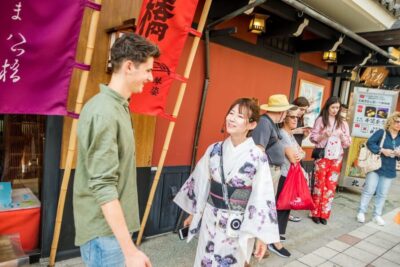
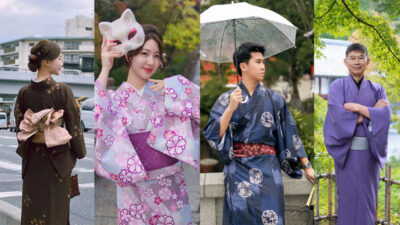
The clothing comes first. Depending on the arrangement, you may wear a kimono, hakama, or another form of traditional Japanese attire. Staff help with the change, which is useful because a kimono is not just one garment. It is wrapped, tied, and adjusted so that you can sit properly for the lesson.
This part takes a little time, but it is not filler. It gives you a sense of how much care goes into traditional dress. You also get the visual setting that makes the final photographs special. The class is held in a tatami-style environment, and the combination of clothing, floor mats, brushes, and paper creates a clear sense of occasion.
The optional wagami package adds collected hair and a kanzashi hair ornament for ¥3,300 per person. That cost is not included, so decide before the class if you want a more formal appearance. The basic kimono or traditional outfit is included.
Comfort is worth considering. The clothing can feel warm, especially if you are practicing for the full hour. The activity is not recommended for people with back problems or heart conditions, and the venue is not stroller accessible. Service animals are allowed, but ordinary pets are not suitable for the activity.
Learning how Japanese shodo differs from decorative lettering
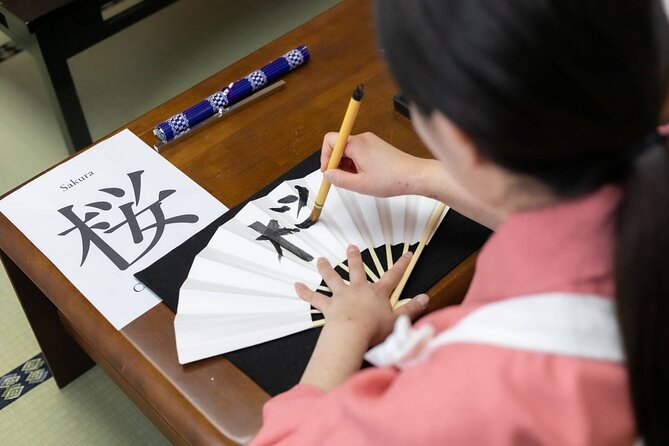
The teacher begins with the mindset behind shodo. You learn that Japanese calligraphy has its own discipline and visual language, rather than being simply an attractive form of handwriting.
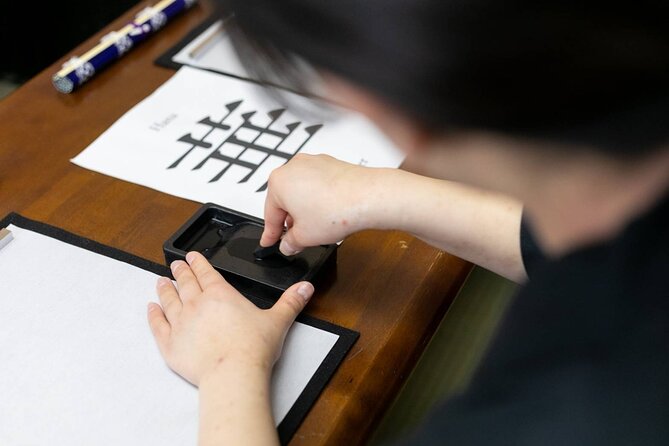
The teacher then introduces the tools and shows how to hold the brush. For a first-time student, this basic instruction is important. A brush does not behave like a pencil. It bends, spreads, and changes the width of a line depending on pressure and angle.
You practice the three basic movements:
- Tome, the controlled stopping of the brush
- Hane, a lifted or flicked finish
- Harai, a sweeping stroke that tapers away
These words give you something concrete to watch for. Instead of being told to make a character look beautiful, you can focus on how each stroke starts, changes, and finishes.
The lesson also introduces stroke order. Japanese characters may look like compact pictures to a first-time visitor, but the order of the strokes helps create balance and structure. You will not become a calligraphy expert in one hour, but you should leave understanding why the order matters and how the brush produces different effects.
One limitation is that the background explanation may feel brief if you want a full lesson on hiragana, katakana, and kanji. The focus is on basic shodo technique and the selected kanji, not a complete introduction to every Japanese writing system.
More Kimono Experiences in Osaka
- Osaka: Sumo Show & Experience w/ Optional Kimono & Hot Pot
★ 4.5 · 609 reviews - Samurai dress-up and shows, plus Tea Ceremony & Calligraphy
★ 5.0 · 27 reviews - Osaka: Kimono or Yukata Rental &Photos Service Options
★ 4.9 · 25 reviews - Kimono photoshoot-Includes 100 photo data
★ 5.0 · 21 reviews
Choosing a kanji character with a personal meaning
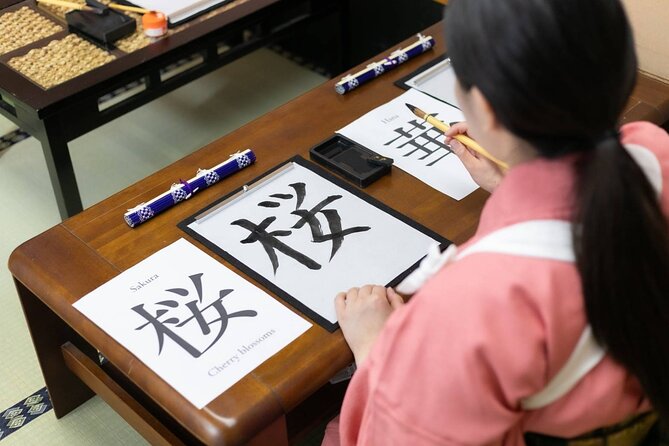
The most personal part of the class is choosing a kanji character. Each character carries meaning, and the teacher helps you select one to practice. The supplied information does not give a fixed menu, so the choices may depend on the class and the teacher.
This is where the activity becomes more than a handwriting exercise. You are not copying a random symbol. You are thinking about the meaning you want to take home, then trying to express it with the brush.
Kanji can be difficult because a character’s meaning can shift with context. The teacher helps connect the shape with its meaning, which makes the finished piece easier to remember. If you are taking the class with a child, this choice can be a good way to make the lesson feel personal rather than academic.
After selecting the character, you practice it repeatedly. Expect imperfect attempts. That is part of the point. The teacher watches your brush movement and offers hands-on help, rather than leaving you alone with a worksheet.
Writing your name in kanji on a wooden tag
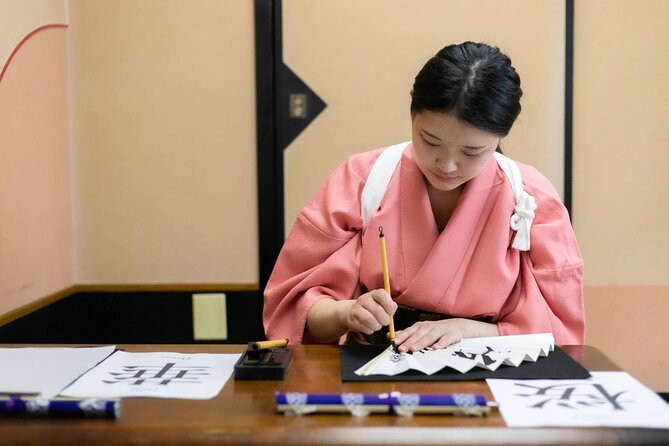
A particularly nice surprise comes when the teacher writes each foreign name in kanji on a wooden tag. This is separate from the character you practice, and it gives you a small, personal souvenir connected to the lesson.
The result is not a direct alphabetical spelling in the same way you might write your name in Roman letters. Kanji characters carry sound and meaning, so the teacher’s choice becomes part translation and part interpretation. Take a moment to ask about the meanings of the characters used for your name.
This detail received some of the strongest praise because it turns a standard souvenir into something made for you. It also helps bridge the gap between Japanese writing and your own identity.
Creating the final calligraphy piece
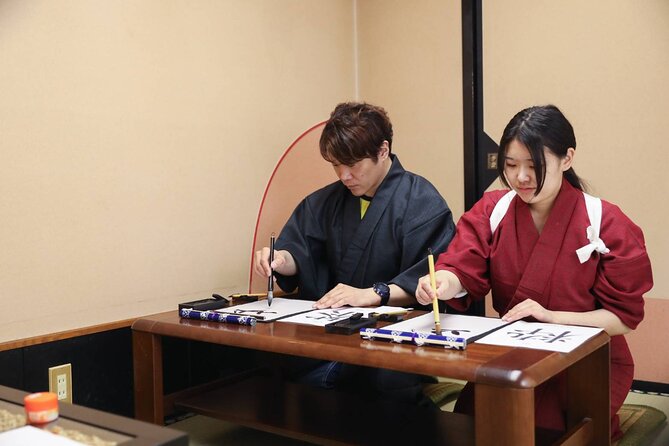
After the practice sheets, you move to a final draft. You use what you have learned about posture, stroke order, pressure, and brush movement.
Some arrangements include a fan or scroll as the final surface, while the core experience promises a finished artwork and a teacher’s souvenir. The exact item can vary, so do not assume every booking includes both a fan and a scroll. Your practice sheets may also be gathered into a bag to take home.
This final attempt is not about producing museum-quality calligraphy. It is about seeing a difference between your first strokes and your last one. The teacher’s corrections make the process feel guided, but you still create the mark yourself.
That balance is the best reason to book this rather than simply buying a calligraphy souvenir. Your finished work may be uneven, and that is precisely why it has a travel story attached to it.
Taking photos without rushing the class
The photo session comes after the writing. Staff take pictures of you in traditional clothing with your artwork, then send the digital files to the designated email address.
Personal smartphone photography is permitted, but you should not take selfies or photograph other participants. Fixed tripods and video recording are not allowed because they can disturb the group. Staff photographs are the easiest way to get useful images without interrupting the lesson.
The included photo service adds real value to the price. Kimono rental alone can cost money and time elsewhere, while this activity combines dressing, instruction, and photographs in one stop. You also avoid having to ask a stranger to frame a picture of you holding a wet or delicate calligraphy piece.
The experience is capped at 10 people. That is small enough for the teacher to correct individual brushwork, though the amount of attention will depend on the group and the number of participants booked that day.
Is $43.59 a good value?
At $43.59 per person, I consider this a reasonable buy for Osaka, especially if you want a cultural activity rather than another sightseeing stop. The fee covers the traditional clothing, introductory through advanced instruction, photography, taxes, gratuities, and the teacher’s souvenir.
You are paying for several small services at once: help with dressing, a guided lesson, practice materials, a final piece, name translation, and digital photos. If you only want to try calligraphy, the class is more expensive than buying a brush and paper. If you want the full setting and a keepsake, the price makes better sense.
The one-hour length keeps the activity easy to fit into a day. It is short enough for families and people with limited time, though serious art students may wish it lasted longer. Some class descriptions and experiences have run closer to 1.5 hours, so allow a little flexibility rather than planning a train departure immediately afterward.
The class is often reserved well in advance, with bookings averaging about 36 days ahead. That suggests you should reserve early if your Osaka dates are fixed, especially if you want a particular time.
Who should book this experience?
I would recommend it to first-time visitors who want a structured introduction to Japanese culture. It is also a strong choice for families, couples, and parent-child trips because the activity produces both photographs and a physical artwork.
You will get the most from it if you enjoy trying something with your hands. The class rewards patience more than talent. You do not need artistic confidence, and the staff are used to beginners.
It may be less suitable if you want a long historical lecture, a serious study of all Japanese scripts, or a completely private session. It is also a poor fit if you have difficulty sitting on tatami or wearing fitted traditional clothing.
The class pairs naturally with Osaka Castle. After walking through the castle grounds, you can shift from military history and grand architecture to a quieter cultural activity. The connection is not forced: the operator frames calligraphy, tea, and related activities around traditional Japanese and samurai culture.
Practical booking advice before you go
Confirm the meeting address and start time before leaving your hotel. Because there have been serious problems during a temporary closure period in 2025, I would also check that your reservation is active and that the operator can be reached before making a long journey across Osaka.
Free cancellation is available up to 24 hours before the start time. Cancellations or changes made inside that window are not refunded, and the cut-off follows local Osaka time.
Choose comfortable clothing underneath the kimono. Avoid arriving overheated, and use the restroom first. Bring the email address you want the photos sent to, and keep enough room in your bag for practice sheets and the finished souvenir.
Should you book the kimono calligraphy class?
Book it if you want a friendly, hands-on cultural hour near Osaka Castle, especially if you value personal instruction and photographs. The best features are the patient brush coaching, the kanji name tag, and the chance to create your own final piece rather than simply posing in costume.
I would be cautious only about the hard-to-spot storefront and past closure-related complaints. Confirm the appointment, arrive early, and do not cut the timing close. With those checks in place, this is a good-value choice for beginners, families, and anyone who wants an Osaka memory that fits in a suitcase.
FAQ
How long does the Japanese calligraphy experience last?
The advertised duration is approximately one hour. Some descriptions indicate that the full activity may take closer to 1.5 hours, so allow extra time if you have another booking afterward.
What is included in the price?
The price includes calligraphy lessons, traditional Japanese attire such as kimono or hakama, photography, digital photos sent to your designated email address, taxes, gratuities, and a teacher’s souvenir.
Is the class suitable for beginners and children?
Yes. The class is open to all skill levels, and children can participate. You learn basic brush handling, stroke techniques, and the stroke order of your selected kanji.
Is the class taught in English?
English is the default language. Translation support may be available for Chinese or other requested languages, including Italian, Spanish, French, Thai, and Indonesian, but availability is limited.
Can I choose my own kanji character?
You can choose a favorite Japanese kanji character to practice. The teacher helps you learn its strokes and meaning. The teacher also writes foreign participants’ names in kanji on wooden tags.
Are photographs included?
Yes. Staff take photographs during the experience, including images of you in traditional clothing with your artwork. The digital files are sent to the designated email address.
Is the optional hair and kanzashi styling included?
No. The wagami option, which includes collected hair and a kanzashi ornament, costs ¥3,300 per person. Traditional clothing is included, but this hair styling option is extra.
What happens if I arrive late or need to cancel?
You may be refused entry if you are more than 30 minutes late. You can cancel for a full refund up to 24 hours before the start time. Cancellations or changes made less than 24 hours before the start time are not refunded.
More Temples and Shrines in Japan
- [Kyoto & Nara Day Tour] Sagano Scenic Railway & Nara Park & Fushimi Inari Taisha Thousand Torii Gates & Togetsukyo Bridge & Bamboo Grove & Kimono Forest (Departing from Osaka)
★ 4.9 · 10,942 reviews - Mount Fuji & Hakone – Lake Ashi Torii Gate, Hakone Shrine, Hakone Pirate Ship, Hakone Ropeway, Owakudani, Lake Yamanaka & Oshino Hakkai Day Trip: Sea, Land, and Air Panoramic Tour from Tokyo
★ 4.8 · 7,989 reviews - Kyushu One-Day Tour: Yufuin no Mori Train & Yufuin Town & Nyoirin-ji Temple & Dazaifu & Hell Hot Springs (Departing from Fukuoka)
★ 4.9 · 4,474 reviews - Kyoto: Fushimi Inari, Kinkakuji, Bamboo Grove 1 Day Bus Tour
★ 4.8 · 4,316 reviews
More Temples and Shrines in Osaka
- Osaka: Katsuo-ji Temple
★ 4.9 · 996 reviews - Osaka: Minoh, Katsuoji Temple, & Minoh Falls Full-day Tour
★ 4.9 · 172 reviews - Sagano Romantic Train & Arashiyama, Kiyomizudera, Fushimi Inari Taisha Day Tour
★ 4.5 · 171 reviews - Osaka Temple Cool Foot Bath & Matcha Experience〈45min〉
★ 4.9 · 82 reviews
Just added in Japan
- A One-of-a-Kind Sushi Experience in a Special Place of Japan★ 5.0 · 15 reviews
- Tokyo Cute Bento Cooking Class – Make a Kawaii Character Lunchbox★ 5.0 · 126 reviews
- Japanese Home Cooking Class & Walk in Todoroki Temple Tokyo★ 5.0 · 88 reviews
- Japan Tokyo Tower Observatory Deck E-Ticket★ 4.0 · 34 reviews
- Catch a Baseball Game in Tokyo with a Local – Tickets Included★ 5.0 · 24 reviews
- JDM Experience with Fast&Furious RX-7 (English speaking Driver)★ 5.0 · 57 reviews
- Tokyo Private Day Tour by Car with English speaking Driver Guide★ 4.0 · 29 reviews
- Japan Classic 10 Day – One Life Adventures★ 5.0 · 129 reviews
Kimono and Cultural Dress, compared.
![[Kyoto & Nara Day Tour] Sagano Scenic Railway & Nara Park & Fushimi Inari Taisha Thousand Torii Gates & Togetsukyo Bridge & Bamboo Grove & Kimono Forest (Departing from Osaka)](https://media.japanvisits.com/wp-content/uploads/kyoto-nara-day-tour-sagano-scenic-railway-nara-park-fushimi-inari-taisha-thousand-torii-gates-togetsukyo-bridge-bamboo-grove-kimono-forest-departing-from-osaka-k110001-400x257.jpg)

Tokyo Asakusa Kimono&Yukata Rental at Kimono Miyabi Asakusa Station
Read our review →
Kyoto Geisha Walking Tour: Gion District & Hidden Gems
Read our review →
Gion Magical Night Walking Tour with Geisha Trivia
Read our review →
Gion Geisha District Walking Tour – Stories of Geisha
Read our review →
Best of Kyoto: Gion, Geisha, Pagodas & Cobblestones
Read our review →