
Reviewed · WORKSHOPS
Japanese flower arranging (Ikebana) Experience/Workshop in Tokyo
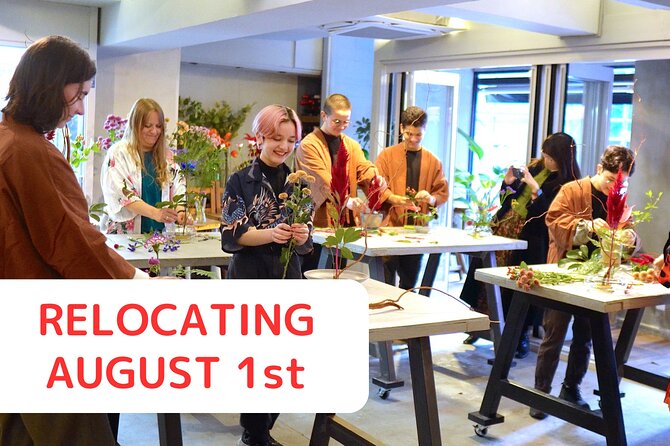
Tokyo gets quieter when flowers take over. This 90-minute ikebana workshop gives you a calm break from city noise, with hands-on arranging in the welcoming Hanadouraku florist in Chiyoda City. I like the playful approach and the chance to work with fresh flowers rather than simply watch a demonstration. I also like that instructor Ruby or Aki can offer personal advice while still letting you make your own creative choices.
The main consideration is price. At $100 per person, this is not a bargain craft class, especially since the container and kenzan are extra if you want to purchase them. Still, flowers, tools, instruction, and event photos are included, and the experience earns a strong 4.9 rating from 52 reviews, with 98 percent recommending it.
In This Review
- Key points at a glance
- A calm hour and a half in central Tokyo
- Learning what ikebana is really about
- Choosing flowers and building your arrangement
- Guidance from Ruby and Aki
- Why the creative pace feels relaxing
- Photos and what you can take home
- Is $100 a fair price?
- Who should book this workshop?
- Should you book the Hanadouraku ikebana class?
- FAQ
- Where does the ikebana workshop take place?
- How long does the experience last?
- How much does the workshop cost?
- What is included in the price?
- Are the container and kenzan included?
- Do I need previous ikebana experience?
- Are children allowed to join?
- Can I receive photos from the workshop?
- How many people can join the class?
- Can I cancel for a full refund?
Key points at a glance
- A hands-on 90-minute class: You arrange flowers yourself instead of sitting through a long lecture.
- A free and playful style: The session focuses on self-expression, asymmetry, and connection with each bloom rather than strict rules.
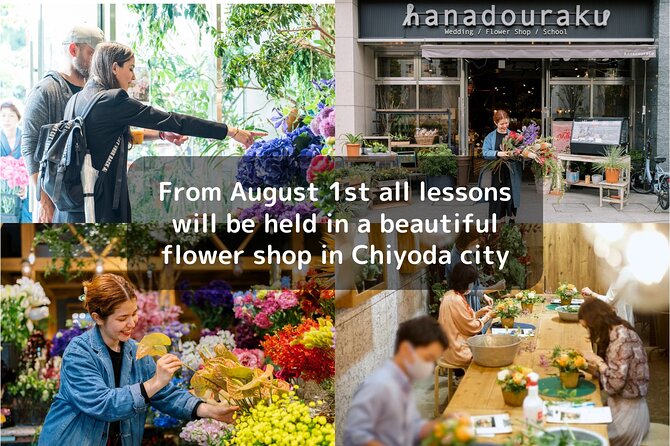
- A florist setting in Chiyoda City: Hanadouraku surrounds you with flowers and foliage while you work.
- Personal help from Ruby or Aki: Both instructors receive praise for clear English, warmth, and practical advice.
- Photos are included: You receive pictures of yourself and your group creating the arrangements.
- Containers and kenzan cost extra: The tools used during class are provided, but take-home purchases are separate.
A calm hour and a half in central Tokyo
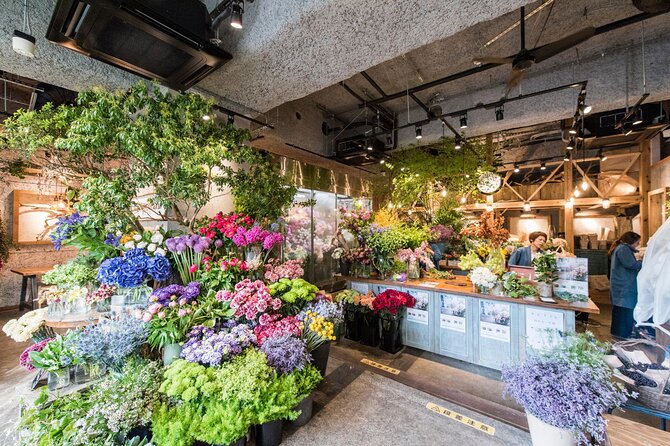
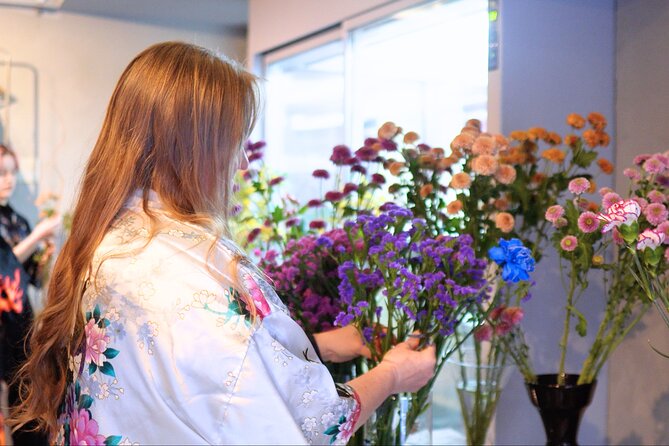
The workshop begins at 102-0083 Tokyo, Chiyoda City, Kōjimachi, 6-chōme 46, and ends at the same meeting point. The setting is a Tokyo florist called Hanadouraku, described as a pleasant place filled with flowers, foliage, and materials for creative work.
That setting matters. You are not arranging flowers in a plain meeting room. You are surrounded by the raw materials of the craft, which helps make the lesson feel connected to everyday Japanese floral culture. The shop environment also gives you something to look at while you wait or think through your design.
The total time is about one and a half hours. That is long enough to learn the basic ideas, choose materials, make an arrangement, and receive useful advice without taking a full morning or afternoon away from sightseeing. I see this as a good fit for a free space between major Tokyo plans.
The group can have as many as 15 people. That is a small group by tour standards, but it is not a private lesson. Personal instruction is part of the experience, although the amount of one-to-one time can depend on the number of people attending. Some sessions may be much smaller. One participant had a workshop alone, which allowed plenty of time to create and ask questions.
A few more options to weigh up in Tokyo
- Tokyo Disney Resort – Tokyo Disneyland & Tokyo DisneySea Park Tickets
★ 4.8 · 99,488 reviews - SHIBUYA SKY Ticket
★ 4.7 · 46,509 reviews - JR Whole Japan Rail Pass
★ 4.8 · 29,150 reviews
Learning what ikebana is really about
Your instructor begins with the background of ikebana and explains why flowers have mattered to people through the ages. This gives the activity more meaning than simply placing attractive stems in a vase.
You also learn about the flowers themselves and what they can symbolize. One particularly useful part of the class is the attention given to asymmetry. Many visitors first expect a balanced bouquet with an even, rounded shape. Ikebana asks you to look at line, space, direction, and the character of each branch or bloom.
The lesson does not focus on strict, precise rules. Instead, it uses the spirit of ikebana as a tool for self-expression. That makes the class less intimidating if you have never arranged flowers before, and it also leaves room for children and families to take part.
I think this balance is one of the workshop’s best features. You get enough Japanese context to understand what you are doing, but you are not forced to copy a perfect model. You can make choices, receive suggestions, and see how a few changes affect the whole arrangement.
Choosing flowers and building your arrangement
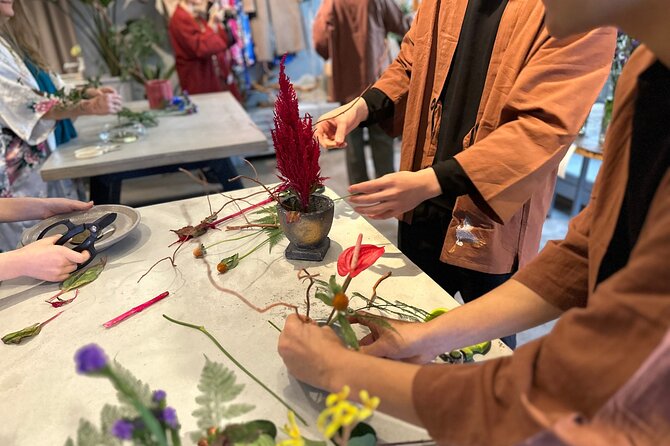
All flowers used in the arrangement are included, as are the ikebana tools and other necessary equipment. The exact flowers are not specified in advance, so your selection may depend on what is available at the florist on the day.
That uncertainty is part of the fun. You might find yourself choosing based on color, shape, texture, or the way a stem bends. The workshop encourages you to connect with each bloom, rather than treating flowers as identical pieces in a formula.
The class is practical. You work with the stems, position them, and adjust the arrangement with guidance from the instructor. A kenzan, the spiked holder traditionally used to secure stems, is part of the working process, but the kenzan used in the arrangement is not included as a take-home item. You can purchase one separately.
The same is true of the container. You can use the necessary equipment during the class, but a container to take home is not part of the $100 price. If you love your finished piece, you may want to buy a vase before leaving. One participant purchased vases and carried the arrangements back to an Airbnb for the rest of the Tokyo stay.
That creates a useful practical choice. If you only want the memory and the photos, you can keep your costs at the advertised price. If you want to continue enjoying the arrangement at your accommodation or practice at home, budget extra for a container and possibly a kenzan.
Guidance from Ruby and Aki
The instructors are a major reason this class works. Ruby is described as an experienced florist with strong English communication and a warm, engaging teaching style. Aki also receives praise for clear guidance, flower knowledge, and her ability to explain the process without taking over.
You can ask for help when you need it, then return to your own ideas. That is important in a creative class. Too little instruction leaves you confused, while too much makes your arrangement feel like the instructor’s work. The tone here appears to favor gentle correction and encouragement.
Aki explains the types of flowers, the background of ikebana, and how to use the materials. Ruby is praised for giving useful insight while allowing participants to find their own inner floral arranger. Both instructors are also noted for kindness and proficient English, which should make the class comfortable for international visitors.
The teaching seems especially useful for first-timers. You do not need previous flower-arranging experience, and the workshop is designed as an introduction rather than an advanced certification lesson. At the same time, the focus on asymmetry and flower symbolism gives experienced craft lovers something to think about.
A completely different kind of day out:
- Mt Fuji and Hakone 1-Day Bus Tour Return by Bullet Train
★ 5.0 · 26,383 reviews - TOKYO SKYTREE® Ticket
★ 4.7 · 25,136 reviews - teamLab Borderless Tickets: MORI Building DIGITAL ART MUSEUM
★ 4.7 · 24,126 reviews - teamLab Planets TOKYO Ticket
★ 4.7 · 21,663 reviews
Why the creative pace feels relaxing
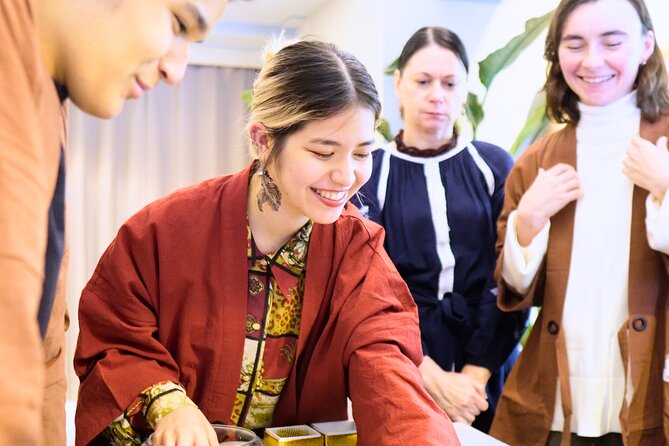
Ikebana asks you to slow down. You look closely at a stem, consider its direction, and decide where it belongs. That is a different rhythm from moving through Tokyo’s stations, shops, and sightseeing sites.
The workshop is described as a mindful activity, and that claim makes sense from the structure of the class. Your attention stays on a small number of physical tasks: selecting flowers, trimming or positioning them, and adjusting the balance of the arrangement. The work is quiet and focused without requiring you to sit still and meditate.
I would not book this expecting a formal mental health program. It is a flower-arranging class, not therapy. But if you want a peaceful creative pause, the process can offer a welcome change of pace.
The relaxed atmosphere also helps families. Children are welcome, and the playful format is less demanding than a strict traditional lesson. Parents should still be ready to supervise younger children around sharp tools, though the supplied information does not specify age limits or safety arrangements.
Photos and what you can take home
Photos taken during the event are shared with you after the workshop. These are not just pictures of the finished flowers. The description promises photos of you and your group while you are creating, so you have a record of the process as well as the result.
That is a useful extra. A finished arrangement may not survive a long journey home, but a good photo will. The pictures also show the creative work in progress, which is often more personal than a standard souvenir snapshot.
You can take your arrangement with you if you buy a suitable container. This may be easiest if you are staying nearby, since the arrangement is made from fresh flowers and may be delicate. The workshop information does not promise packaging or long-distance transport, so I would ask the instructor about carrying it safely before making your purchase.
Pets are welcome, and service animals are allowed. That is unusual for a creative activity, although you should still consider the comfort of other participants and the presence of tools and flowers.
Is $100 a fair price?
The price is $100 per person. That places the class in the paid cultural activity category rather than the casual drop-in craft category.
For that amount, you receive a 90-minute guided session, flowers, use of ikebana tools, instruction from a florist, and shared photos. The small maximum group size also gives the price more weight, especially if your session is lightly attended and you receive plenty of individual advice.
The extra costs are clear but important. Containers are not included, and kenzan are not included as take-home items. If you want to recreate the arrangement during the rest of your stay or continue at home, your final cost will be higher.
I think the price makes the most sense if you value a personal cultural activity and want more than a quick photo stop. It is less attractive if your main goal is simply to buy flowers or learn a few basic cuts. You are paying for the setting, instruction, creative focus, and a memory you can carry beyond the arrangement itself.
The 98 percent recommendation rate and 4.9 score suggest that the class delivers a strong experience for its audience. The high praise centers on the instructors, the relaxed setting, the flowers, and the freedom to create. Those are precisely the parts that justify the price.
Who should book this workshop?
I would recommend it to first-time ikebana students, flower lovers, couples, families, and solo visitors who want a quiet activity in Tokyo. It also suits anyone looking for a cultural experience that does not require a full day or a high level of physical fitness.
Solo visitors may find the format especially rewarding. One session had a single participant, who had plenty of time to create an arrangement in the florist. A private-feeling class is not guaranteed, but the possible group size and instructor-led format leave room for individual attention.
This is also a good choice for people who enjoy making things with their hands. If you dislike creative tasks or feel uncomfortable making choices without a fixed model, the free style may feel less reassuring. The instructor helps, but you still have to make decisions about shape, space, and placement.
You should also think about your schedule. The class lasts about 90 minutes, then returns you to the meeting point. It is compact, but you should allow enough time to reach Kōjimachi and avoid booking another activity so tightly that a small delay causes trouble.
Confirmation arrives at booking. Most people can participate, the meeting point is near public transportation, and service animals are allowed. Free cancellation is available up to 24 hours before the local start time. A cancellation inside that window is not refunded, and the activity requires a minimum number of participants. If that minimum is not reached, you are offered another date or experience, or a full refund.
Should you book the Hanadouraku ikebana class?
Book it if you want a hands-on Japanese activity with a calm pace, friendly English-speaking instruction, and something creative to remember. The florist setting, flower selection, personal advice, and included photos give the session more substance than a basic demonstration.
I would especially choose it early in a Tokyo visit, when you need a gentle way to settle into the city, or midway through a packed itinerary when temples, trains, and shopping have begun to blur together. Keep extra money available for a vase or kenzan if you want to take the arrangement home.
Skip it if you want a formal, rule-heavy study of a particular ikebana school, or if $100 feels too high for a short class with optional purchases. For everyone else, this looks like a thoughtful, compact introduction to Japanese flower arranging, with Ruby and Aki providing the human warmth that makes the activity memorable.
FAQ
Where does the ikebana workshop take place?
The meeting point is at Japan, 102-0083 Tokyo, Chiyoda City, Kōjimachi, 6-chōme 46. The workshop takes place at the Hanadouraku florist and ends back at the meeting point.
How long does the experience last?
The workshop lasts approximately one hour and 30 minutes.
How much does the workshop cost?
The listed price is $100 per person.
What is included in the price?
The price includes the flowers used in the arrangement, use of ikebana tools, necessary equipment during the workshop, instruction, and photos taken during the event.
Are the container and kenzan included?
No. Containers and kenzan used for taking the arrangement home are not included in the price, but they are available for purchase.
Do I need previous ikebana experience?
No previous experience is stated as a requirement. The class is presented as a first introduction and focuses on free, playful self-expression rather than strict rules.
Are children allowed to join?
Yes. Kids and families are welcome to participate.
Can I receive photos from the workshop?
Yes. Photos taken during the event are shared with you.
How many people can join the class?
The maximum group size is 15 participants.
Can I cancel for a full refund?
Yes, if you cancel at least 24 hours before the experience start time. Cancellations or changes made less than 24 hours in advance are not refunded or accepted.
Just added in Tokyo
- Exclusive Ramen Kitchen Experience★ 5.0 · 13 reviews
- Experience Award-Winning Spa Treatments in Downtown Tokyo★ 5.0 · 21 reviews
- Japanese Wine Omakase in Shibuya – Guided Tasting, Not Sake★ 5.0 · 15 reviews
- Tokyo – Grand Sumo Tournament★ 4.5 · 76 reviews
- Enjoy plus size Kimono★ 4.5 · 14 reviews
- Tokyo’s Authentic and Finest Taiko Drumming Workshop★ 5.0 · 22 reviews
- Tokyo: Exclusive Geisha Dinner Experience★ 5.0 · 14 reviews
- Hands-on Japanese Cooking in a Shinjuku Home Kitchen with Satoru★ 5.0 · 19 reviews
Workshops, compared.
Sushi Making Tokyo Roll and Authentic Japanese Sushi Class
Read our review →
Gion Make Your Own Chopsticks with Engraving Option
Read our review →
Roll and Authentic Sushi Making Class in Asakusa
Read our review →
Ramen Cooking Class at Ramen Factory in Kyoto
Read our review →
Tokyo Asakusa Chopsticks Workshop: Make Your Own Pair
Read our review →
Ring Making Workshop : Vintage Japanese Coin Ring
Read our review →Browse the lists this tour appears in