
Reviewed · DAY TRIPS
Discover Kyoto by Bike Full Day Tour
Kyoto reveals itself between the landmarks. This full-day ride links major temples, riverside paths, old geisha quarters, and quiet lanes that buses cannot reach. I like the small private group and the way the route mixes famous sights with places many visitors miss. The e-bike also makes a long day possible without turning every hill into a personal argument.
I also like the local focus. You ride through Miyagawacho, along the Kamo River, and past the Lake Biwa Canal, not just from one postcard stop to the next. The main caution is simple: 32 kilometers is a serious ride, even with electric assistance, and narrow paths require steady bike handling. Lunch is not included, though one five-star rating specifically praised the meal and the overall full-day experience.
In This Review
- Key points to know before booking
- Why this Kyoto bike tour works so well
- Starting at Toji and moving through southern Kyoto
- Nishi Honganji and Kyoto’s Buddhist center
- Along the Kamo River to Miyagawacho
- Heian Shrine and the Lake Biwa Canal
- Nanzen-ji and the Philosopher’s Path
- Quiet Honen-in, then the Silver Pavilion
- Finishing in Gion
- What the $128.48 price buys you
- Who should book, and who should think twice
- Final call: a strong day for active Kyoto sightseeing
- FAQ
- How long is the Discover Kyoto by Bike Full Day Tour?
- How far do you ride?
- Is an electric bicycle included?
- Where does the tour start?
- What time does the tour begin?
- Where does the tour finish?
- Is lunch included?
- Can I cancel for a full refund?
Key points to know before booking
- A 32-kilometer Kyoto day: This is active sightseeing, not a gentle spin around one neighborhood.
- Private experience with Jaime: Only your group takes part, allowing for a more personal pace and conversation.
- Famous sights plus quieter Kyoto: You visit Toji, Nishi Honganji, Nanzen-ji, Ginkakuji, and Gion, while also riding through Honen-in, Miyagawacho, and along the Kamo River.
- Electric bicycle included: The e-bike helps with distance and Kyoto’s occasional rises, but you still need moderate fitness.
- Free cancellation up to 24 hours ahead: Poor weather can also lead to a new date or a full refund.
- Start and finish near Kyoto Station: Meet at the 7-Eleven at 44-1 Higashikujō Kamitonodachō at 9:00 a.m., then return to the same spot.
Why this Kyoto bike tour works so well
Kyoto is compact on a map, but its sights spread across several districts. A bus can move you quickly, yet it often leaves you waiting in traffic and looking at the city through glass. A bicycle gives you a better feel for the spaces between temples: a canal path, a residential lane, a university campus, or a row of wooden townhouses.
This route covers roughly 32 kilometers over seven to eight hours. That is enough distance to connect southern Kyoto with the eastern temple district, central river paths, and Gion. You get a broad view of the city in one day, but you should not mistake the relaxed tone for an easy outing.
The e-bike is a valuable part of the package. It reduces the effort needed for a long ride and makes the route more practical for people who cycle from time to time but do not want a full day of hard pedaling. Still, electric assistance does not remove the need to brake, steer, balance, and share narrow paths safely.
The private format adds another advantage. Only your group participates, so the experience does not have the fixed feel of a large departure. Guide Jaime can provide local context and, within the route’s limits, adjust the rhythm to your group. The tour still has many scheduled stops, so this is not a completely free-form day.
More Day Trips in Kyoto
- [Kyoto & Nara Day Tour] Sagano Scenic Railway & Nara Park & Fushimi Inari Taisha Thousand Torii Gates & Togetsukyo Bridge & Bamboo Grove & Kimono Forest (Departing from Osaka)
★ 4.9 · 10,942 reviews - Kyoto Nara Day Trip │ Kiyomizu-dera Temple + Fushimi Inari-taisha Shrine + Nara Park (Departing from Osaka/Kyoto)
★ 4.7 · 3,408 reviews - Day Trip to Amanohashidate & Ine no Funaya & Miyama Thatched Village in the Sea of Kyoto (Departure from Osaka or Kyoto)
★ 5.0 · 1,212 reviews
Starting at Toji and moving through southern Kyoto
The morning begins at 9:00 a.m. near Kyoto Station, at the 7-Eleven on Higashikujō Kamitonodachō. That location is practical for a day focused on cycling because you start in southern Kyoto rather than spending the first hour crossing town to reach the first sight.
Toji provides a strong opening. Its five-story pagoda is the tallest wooden tower in Japan, and the temple is a UNESCO World Heritage Site. You have about 15 minutes in the grounds, enough to get a sense of the site and hear why Toji mattered to Kyoto’s religious and political life.
Do not expect a long temple visit here. The short stop works as an introduction, not a full study of the complex. If Toji is high on your personal list, you may want to return independently for more time. On the tour, the emphasis is on seeing the pagoda, understanding the setting, and getting on the bike before the day’s longer stretches.
The route then passes through Umekoji Park. This shift from temple grounds to open green space helps break up the morning. The park is used by local residents and includes seasonal flowers, trees, and a pond, offering a quieter contrast to Kyoto’s more heavily visited monuments.
You also pass Ryukoku University’s Omiya Campus. Founded by the Nishi Hongwanji sect of Buddhism, the university gives you a glimpse of present-day Kyoto. It is a small stop, around 10 minutes, but it helps connect the city’s Buddhist past with ordinary education and daily life.
Nishi Honganji and Kyoto’s Buddhist center
Nishi Honganji receives about 30 minutes, making it one of the more substantial early stops. This major Jodo Shinshu temple is another UNESCO World Heritage Site, known for its large wooden buildings and broad courtyard.
The value here is scale. Some Kyoto temples feel enclosed by gardens or hills. Nishi Honganji opens out, giving you room to appreciate the architecture and the role the temple played in Jodo Shinshu Buddhism. Jaime’s explanations are useful because a quick visit can otherwise become a blur of gates, halls, and rooflines.
Cycling between these places is part of the lesson. You are not simply collecting temple names. You are seeing how religious sites sit beside schools, parks, homes, and working city streets. That mix is one reason the bicycle format feels more revealing than a route made only of major attractions.
Along the Kamo River to Miyagawacho
The ride beside the Kamo River is one of the day’s most appealing changes of pace. The river is part of daily Kyoto, used by people jogging, relaxing, and enjoying the outdoors. Riding here lets you watch the city from a quieter corridor while still remaining close to its central districts.
River paths can be narrow, so you need to ride with care and follow Jaime’s lead. The route calls for safe maneuvering, not racing. This is also where the e-bike earns its keep by allowing you to save some energy for the eastern temples later in the day.
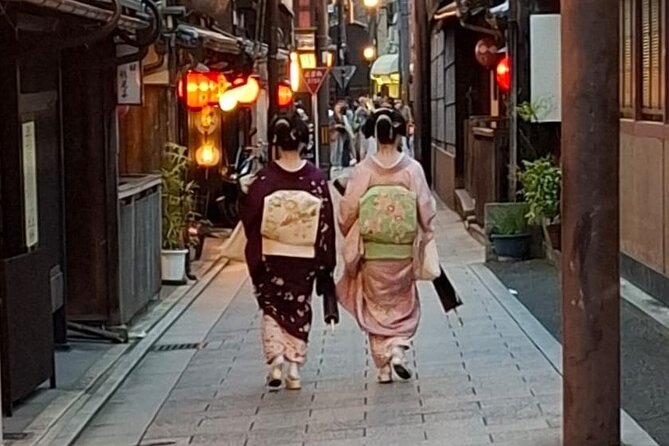
Miyagawacho offers a more intimate look at Kyoto’s traditional entertainment districts. It is less famous than Gion but has similar wooden architecture and old lanes connected with geiko and maiko culture. A bicycle is particularly useful here because you can pass through a larger area than you would comfortably cover on foot, though you must slow down and respect the residential setting.
The contrast with Gion matters. Gion is Kyoto’s best-known geisha district and can feel crowded around its most photographed streets. Miyagawacho gives you a quieter look at the same cultural world. Neither district should be treated as a stage set. Ride carefully, keep the pace respectful, and listen to the explanations rather than treating the lanes as a photo backdrop.
A completely different kind of day out:
- PERFECT KYOTO 1-Day Bus Tour
★ 5.0 · 13,518 reviews - Kyoto: Fushimi Inari, Kinkakuji, Bamboo Grove 1 Day Bus Tour
★ 4.8 · 4,316 reviews - Kyoto: Tea Ceremony in a Traditional Tea House in Kiyomizu
★ 4.9 · 3,519 reviews - Kyoto: Gion Make Your Own Chopsticks with Engraving Option
★ 5.0 · 3,465 reviews
Heian Shrine and the Lake Biwa Canal
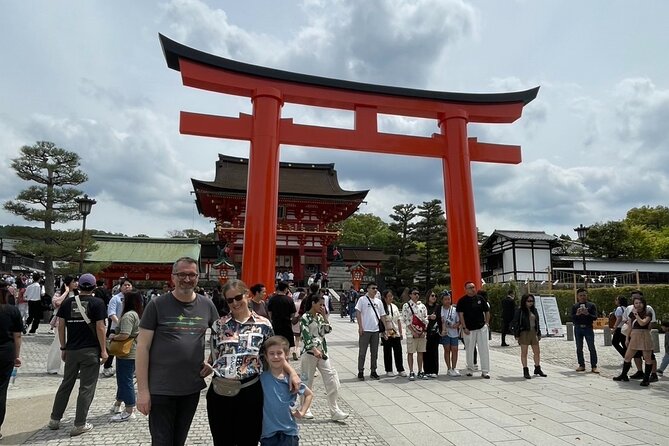
Heian Shrine is a brief stop of about 10 minutes. Its large vermilion gate and palace-style buildings were created in 1895 to mark Kyoto’s 1,100th anniversary. The shrine is not an ancient surviving imperial palace, and that distinction makes the site especially interesting: it reflects how later Kyoto looked back toward its imperial beginnings.
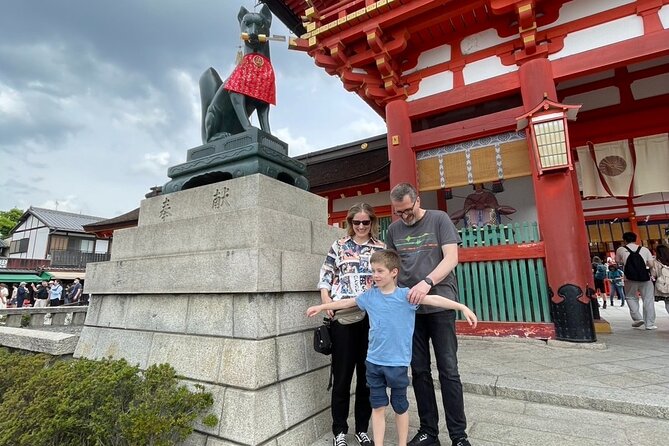
You will also see one of Japan’s largest torii near the shrine. The short visit gives you time for photographs and a quick look at the architecture, but not a long garden visit. If you prefer slow, detailed sightseeing, this is another place where the tour’s broad coverage comes with less time at each stop.
The Lake Biwa Canal section shifts from religion and old districts to engineering. At the Biwa Aqueduct Museum, you spend about 10 minutes learning how the canal project of the 1890s supplied Kyoto with water and electricity and helped the city recover after the capital moved to Tokyo.
This stop adds useful context to the route. Kyoto is often presented as a preserved old city, but its survival also depended on modern infrastructure and adaptation. The canal is a reminder that the city’s story includes engineering, industry, and civic planning, not only temples and traditional houses.
Nanzen-ji and the Philosopher’s Path
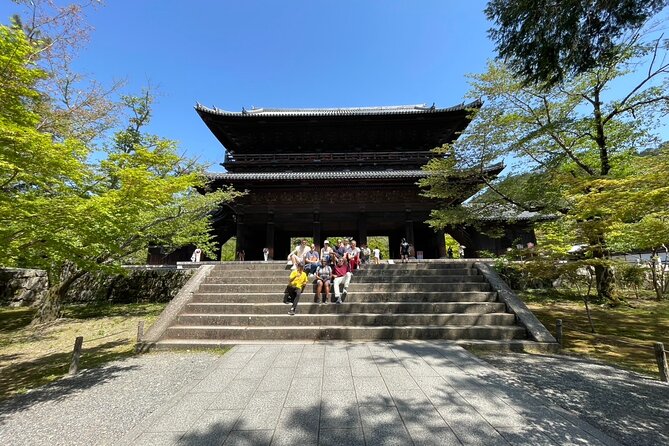
Nanzen-ji is one of the day’s central temple visits, with around 25 minutes to see the setting. Founded in the 13th century, it is one of Japan’s important Zen temples. The massive Sanmon gate gives the approach a sense of ceremony, while the temple’s gardens offer a quieter, more measured atmosphere.
The red brick aqueduct running through the temple grounds is an unusual sight. It links the spiritual setting to the same canal system introduced earlier, so the day’s stops connect rather than feeling random. You get old Zen architecture, landscaped temple grounds, and a piece of 19th-century public works in one place.
From Nanzen-ji, the route follows the Philosopher’s Path. This stone walkway runs beside a canal lined with cherry trees and takes its name from Kyoto University professor Nishida Kitaro, who used the route while thinking and walking.
Spring is the obvious time for the cherry trees, but the path has appeal beyond blossom season. The canal and narrow walkway create a calm ride through the eastern hills. You will need to pay attention to pedestrians and other cyclists, especially on busy days. This is not a place for speed, and the tour’s relaxed pace is a good match.
Quiet Honen-in, then the Silver Pavilion
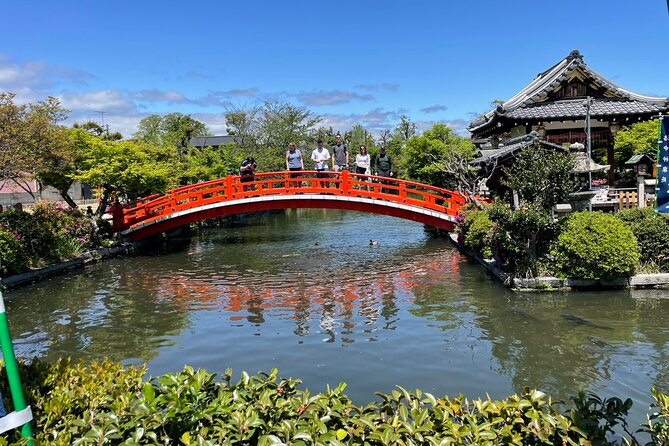
Honen-in is one of the most peaceful stops, with about 20 minutes in the temple grounds. The mossy entrance and white sand designs give it a restrained, almost hushed character. The temple was founded in the 1600s to honor the Buddhist priest Honen, whose teachings shaped the Pure Land tradition.
Compared with the larger temples, Honen-in feels less formal and less grand. That is precisely its appeal. You get a sense of Kyoto’s smaller religious spaces, where texture, shade, and carefully placed sand can matter as much as monumental buildings.
Ginkakuji, the Silver Pavilion, follows with a 25-minute visit. The pavilion was built in the late 1400s by shogun Ashikaga Yoshimasa. Despite its name, it was never covered in silver, a useful bit of historical correction for anyone expecting a gleaming metal building.
The site is known for its gardens and the pavilion’s elegant proportions rather than flashy decoration. Twenty-five minutes is enough for a focused visit, though the area around Ginkakuji can be crowded. You may find the stop more rewarding if you accept that the tour is giving you a well-chosen sample, not an unhurried museum-style inspection.
Because Ginkakuji comes late in the day, your energy level matters. The ride has already covered temples, river paths, and city streets. The electric bike should help, but you need to arrive prepared for a final stretch rather than treating the Silver Pavilion as the end of the physical effort.
Finishing in Gion
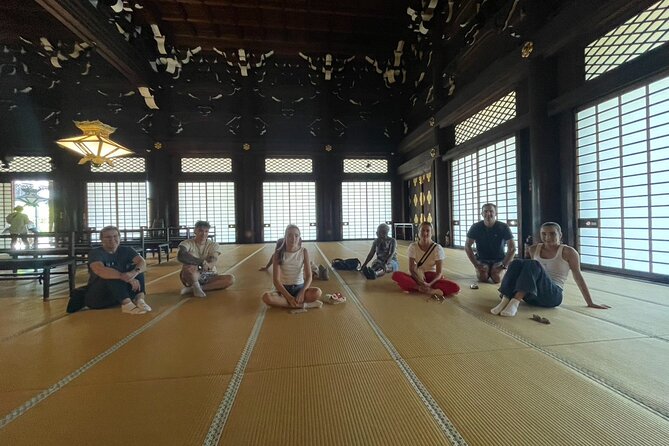
The final stop is Gion, where the route returns to Kyoto’s best-known traditional district. The area is recognized for wooden machiya houses, lantern-lit lanes, and its connection to geiko and maiko culture. You spend about 15 minutes riding through the district and hearing about its customs.
Gion can be crowded, so this is not the moment to expect an empty street or a long photo session. The bike allows you to see the district in a short period, but you need to move slowly and respectfully. Narrow lanes, pedestrians, and local businesses all call for patience.
Ending in Gion gives the day a fitting final note. You have seen a less familiar geisha quarter earlier, then finish in the district most people associate with Kyoto. That comparison helps you notice the difference between a quieter local lane and a famous cultural center.
The tour ends back at the original meeting point. Since lunch is not included, plan for that cost and ask Jaime about the day’s meal arrangements before setting out. One five-star account praised the lunch, but the supplied details do not state a fixed restaurant or lunch price, so you should not assume a particular menu or dining stop.
What the $128.48 price buys you
At $128.48 per person, this tour is not the cheapest way to see Kyoto. Its value depends on how you use the day. You are paying for an e-bike, a private guide, a carefully connected route, and access to several districts that are awkward to combine by public transport in one day.
The price makes more sense for you if you want orientation as well as sightseeing. Jaime’s local explanations can help you understand the links between Buddhist temples, modern Kyoto, the canal system, the river, and traditional entertainment districts. You also avoid planning a complicated sequence of trains, buses, and walking routes.
The tradeoff is time. You see many places, but most stops last between 10 and 30 minutes. If your ideal Kyoto day means sitting quietly in one garden for an hour, this route will feel rushed. If you want a broad first look and enjoy being active, the coverage is strong.
The private format improves the value for couples, families, or friends who want a shared day without strangers setting the pace. It may be less economical for a solo visitor, although the personal guidance and e-bike still have clear benefits.
Who should book, and who should think twice
I would recommend this tour to you if you want to cover a lot of Kyoto by bicycle and already feel comfortable riding in city settings. It suits visitors who like temples but also want river paths, university grounds, canal works, and traditional neighborhoods.
It is also a good choice for a repeat visitor who has already seen the main central sights. The route still includes major names, but its real strength is the movement between them and the quieter districts along the way.
You should think twice if you have limited cycling fitness, trouble handling narrow paths, or little interest in spending most of a day outdoors. The stated requirement is moderate physical fitness and the ability to ride 32 kilometers safely. A light drizzle or poor weather can also affect the outing, since the tour depends on good conditions.
Book at least a few weeks ahead if your Kyoto dates are fixed. The average booking point is 27 days before the tour, which suggests that popular dates may not remain open until the last minute. You receive confirmation at booking, and free cancellation is available until 24 hours before the 9:00 a.m. start. Changes or cancellations inside that window are not refunded.
Final call: a strong day for active Kyoto sightseeing
I would book this tour if I wanted one active day that connected Kyoto’s famous temples with its ordinary streets and quieter cultural districts. The route is broad, the private format is appealing, and the e-bike makes 32 kilometers more manageable.
I would skip it only if I wanted slow temple visits or an easy ride. For the right rider, this is a smart way to see how Kyoto fits together, with Jaime’s guidance adding meaning to the spaces between the big sights.
FAQ
How long is the Discover Kyoto by Bike Full Day Tour?
The tour lasts approximately seven to eight hours.
How far do you ride?
You need to be fit enough to ride about 32 kilometers and maneuver safely on narrow paths.
Is an electric bicycle included?
Yes. Use of an e-bike is included in the tour price.
Where does the tour start?
Meet at the 7-Eleven at 44-1 Higashikujō Kamitonodachō, Minami Ward, Kyoto, 601-8002, Japan.
What time does the tour begin?
The start time is 9:00 a.m.
Where does the tour finish?
The activity ends back at the original meeting point.
Is lunch included?
No. Lunch is not included in the tour price.
Can I cancel for a full refund?
Yes, if you cancel at least 24 hours before the experience start time. Poor weather or failure to meet the minimum number of participants may also result in a different date or a full refund.
Just added in Kyoto
- The “Golden Route” and Ancient Japan by DIAMIR Erlebnisreisen – 14-Day Tour★ 2.0 · 2 reviews
- Japan: Castles & Cuisine by G Adventures – 6-Day Kyoto to Osaka Tour★ 4.5 · 4 reviews
- Cycle Japan by Explore! – 13-Day Kyoto to Tokyo Tour★ 4.7 · 12 reviews
- Cycle Japan by Intrepid Travel – 11-Day Kyoto to Tokyo Tour★ 4.8 · 2 reviews
- Classic Japan by Intrepid Travel – 11-Day Kyoto to Tokyo Tour★ 4.4 · 14 reviews
- Ancient & Modern Japan 14-Day Tour by Exodus Adventure Travels★ 4.4 · 40 reviews
- 5 Day Cultural Adventure of Kyoto, Nara & Osaka by Tourist Journey★ 2.5 · 2 reviews
- 12 Days Kinosaki Onsen Escape: A Journey Through Japan’s Timeless Towns by UME Travel★ 4.8 · 5 reviews
Day Trips, compared.
![[Kyoto & Nara Day Tour] Sagano Scenic Railway & Nara Park & Fushimi Inari Taisha Thousand Torii Gates & Togetsukyo Bridge & Bamboo Grove & Kimono Forest (Departing from Osaka)](https://media.japanvisits.com/wp-content/uploads/kyoto-nara-day-tour-sagano-scenic-railway-nara-park-fushimi-inari-taisha-thousand-torii-gates-togetsukyo-bridge-bamboo-grove-kimono-forest-departing-from-osaka-k110001-400x257.jpg)
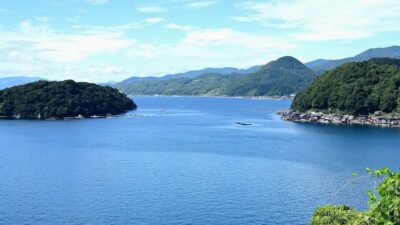
Kyoto Amanohashidate & Ine Funaya & Ine Bay Scenic Day Trip (Departing from Osaka or Kyoto)
Read our review →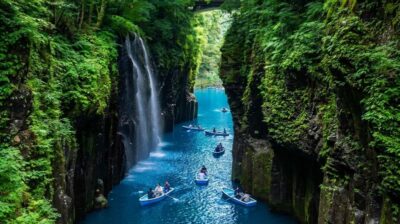
Kyushu: Mount Aso, Kusasenri & Takachiho Gorge Day Tour (Optional Takachiho Boat Ride Experience)
Read our review →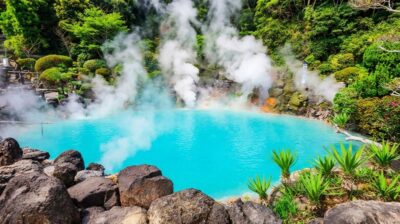
Kyushu One-Day Tour: Yufuin no Mori Train & Yufuin Town & Nyoirin-ji Temple & Dazaifu & Hell Hot Springs (Departing from Fukuoka)
Read our review →
Browse the lists this tour appears in