
Reviewed · TEA CEREMONIES
Experience Japanese calligraphy & tea ceremony at a traditional house in Nagoya
Quiet rooms tell big stories. This small-group experience brings you into a real kominka farmhouse in Nagoya, where tatami mats, shoji screens, and a garden provide the setting for calligraphy and tea. I like the warm, personal welcome from Yuzo Mori and his wife, and I like that your finished calligraphy is framed as a keepsake.
The 15-minute Sengoku-period briefing gives the activities useful context, especially if you know little about Nagoya’s samurai past. The main consideration is the price, $179.63 per person, which is a serious spend for two and a half hours, even with a maximum of six people, tea, sweets, instruction, and calligraphy supplies included.
In This Review
- Key details at a glance
- Entering a Nagoya kominka
- A short lesson on Nagoya’s Sengoku past
- Making ink the traditional way
- Learning the guest’s role in tea ceremony
- What the price includes, and what it does not
- Who will enjoy this experience most
- Practical details before you reserve
- Is this Nagoya culture experience worth booking?
- FAQ
- Where does the Japanese calligraphy and tea ceremony experience take place?
- How long does the experience last?
- Does the experience begin and end at the same location?
- How many people can join the experience?
- Is the experience conducted in English?
- What is included in the calligraphy session?
- Is matcha included?
- Should I report food allergies in advance?
- Can I cancel or change the booking?
Key details at a glance
- A real traditional home: You visit a kominka rather than a purpose-built sightseeing facility.
- Two hands-on activities: You learn basic brush technique, then prepare and serve matcha.
- Nagoya’s samurai past: A short slide presentation covers the Sengoku period and the Owari district.
- A framed calligraphy souvenir: Your finished work is cleaned up and framed for you.
- Small groups of up to six: The format allows for direct help in a quiet setting.
- English guidance: The experience is designed to explain both the actions and their cultural meaning.
Entering a Nagoya kominka
The address is 4-chome-32 Yamawakicho in Showa Ward, Nagoya, near public transportation. The activity begins and ends at the same place, so you do not need to work out a second pickup point or arrange transport between separate venues.
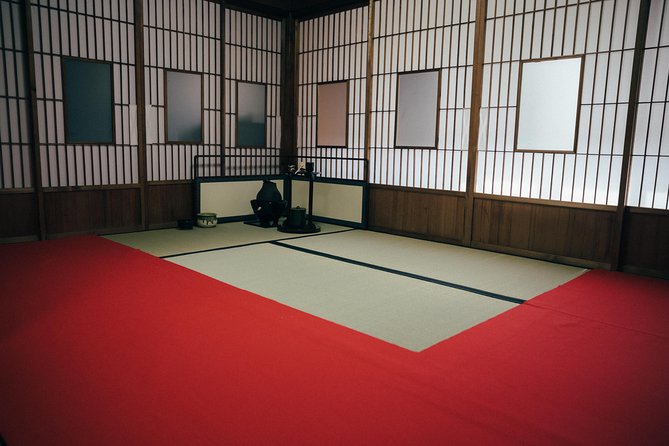
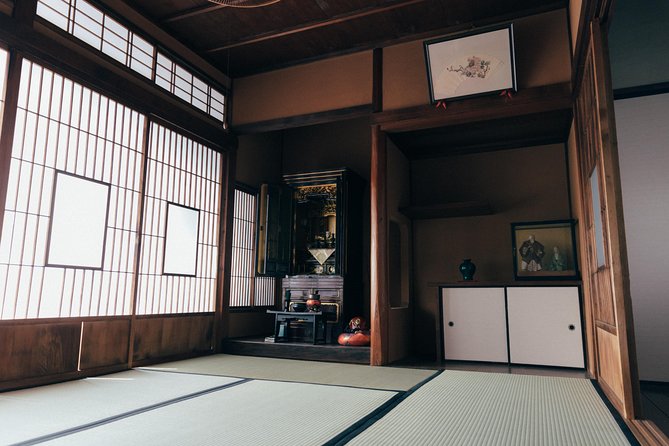
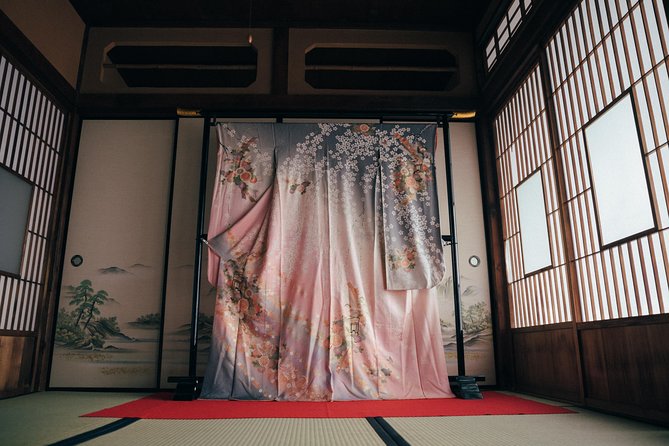
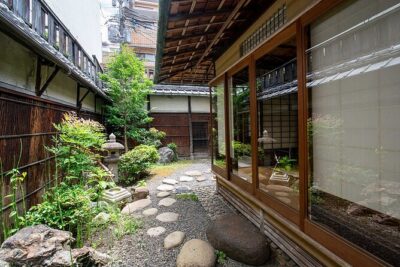
What matters most is the setting. This is described as a house where people actually lived, not a recreation built only for sightseeing. Once inside, you can expect the visual details associated with an older Japanese home: tatami flooring, shoji paper screens, and a traditional garden.
That setting changes the mood. Calligraphy can feel rushed in a modern classroom, and a tea demonstration can become a quick photo stop. Here, the quiet house gives both activities room to breathe. You are not simply watching someone perform a Japanese custom. You are learning how the objects, movements, and rooms fit together.
The group limit of six is a real advantage. With a larger crowd, brush instruction and tea preparation can become hard to follow. In this small format, you should have a better chance to ask questions and receive help with the practical parts.
There is one useful point to remember before you book. The experience lasts about two hours and 30 minutes, and the meeting point is specific. Plan enough time to reach the house without rushing. The location is reasonably easy to find, but it is still worth checking the route before the appointment.
More Tea Ceremonies in Nagoya:
- Nagoya: Japanese Traditional Sweets making and Tea Ceremony
★ 4.9 · 76 reviews - Kyoto: Tea Ceremony in a Traditional Tea House in Kiyomizu
★ 4.9 · 3,519 reviews - Kyoto: Tea Ceremony Ju-An at Jotokuji Temple
★ 4.9 · 3,207 reviews
A short lesson on Nagoya’s Sengoku past
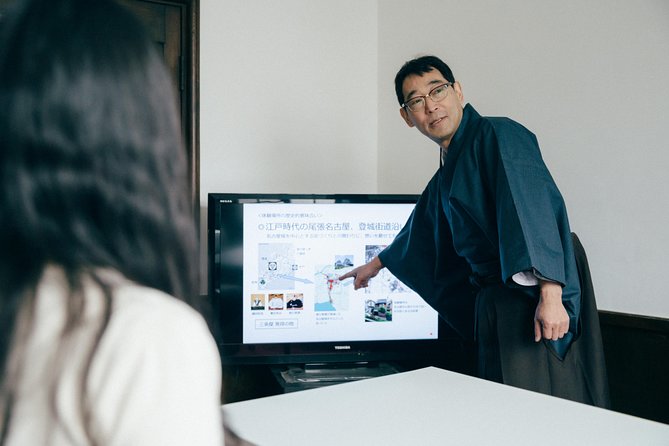
The experience begins with about 15 minutes of history commentary and an easy-to-follow slide presentation. The focus is the Sengoku period, the 16th-century era when competing samurai lords fought for control of Japan.
Nagoya and the wider Owari district have an important place in that story. The area is associated with three major figures: Oda Nobunaga, Toyotomi Hideyoshi, and Tokugawa Ieyasu. All three played major roles in the long process that led toward a more unified Japan.
You do not need a strong background in Japanese history to follow this introduction. In fact, it is aimed at giving you enough basic context to understand the cultural setting. That is a sensible choice. Calligraphy and tea ceremony can otherwise seem like a set of beautiful actions without much meaning behind them.
I appreciate the short length. Fifteen minutes is enough to establish the setting without taking over the experience. You get a reason to connect Nagoya with samurai culture, then move on to activities that use your hands and attention.
If you already know the Sengoku period well, this part may feel familiar. Its value is less about detailed scholarship and more about orientation. It helps you place the house, the city, and the customs in a broader Japanese story.
Making ink the traditional way
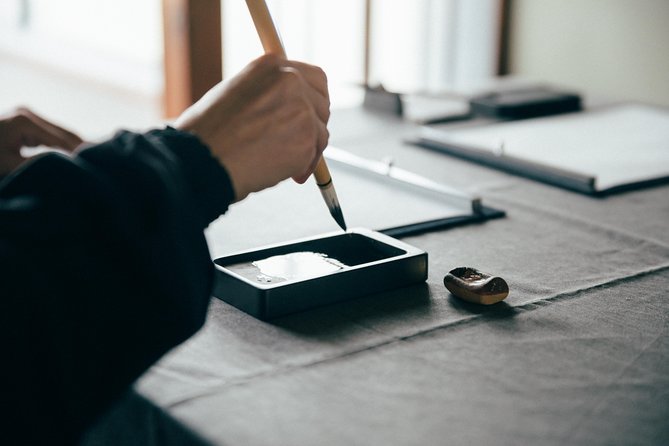
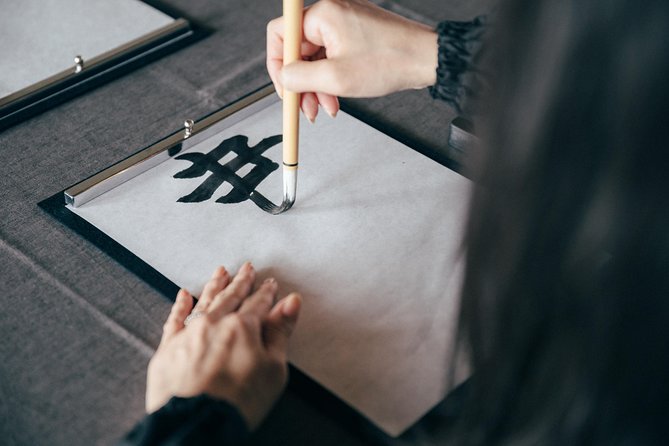
The calligraphy session starts with the materials rather than a ready-made bottle of ink. You drip water onto an inkstone and slowly rub an ink stick against it. That simple preparation is one of the most memorable parts because it asks you to slow down before you write.
The scent of the ink, the quiet room, and the repeated motion of grinding all help create concentration. This is not a fast craft activity where you rush toward a finished souvenir. The preparation is part of the lesson.
You then learn the basics of Japanese brush writing. That includes how to hold the brush and how to move it across the paper. These details matter because the result depends on pressure, direction, and rhythm, not just on copying the shape of a character.
After the introduction, you choose symbols from sample designs. The symbols have different meanings, so you can select something that appeals to you rather than producing exactly the same piece as everyone else.
This choice gives the activity a personal element without requiring you to invent a design from scratch. If you have never studied Japanese calligraphy, having samples to guide you should make the task less intimidating. You can focus on brush control and form instead of worrying about what to write.
The final work is transferred to a clean copy and framed as a souvenir. That is a useful touch. You leave with something made during the session, but it is presented in a way that makes it easier to display or take home.
All calligraphy tools are included. You do not need to bring brushes, ink, paper, or an inkstone. You should still expect to get involved physically. This is not a demonstration where the instructor does the work while you watch.
Learning the guest’s role in tea ceremony
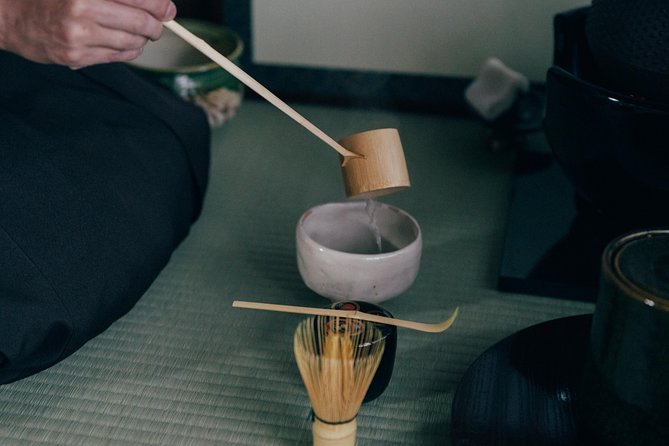
After calligraphy, you move into the tea room. The host explains the room’s arrangement and the utensils used in the ceremony. This introduction helps you notice that tea ceremony is not only about drinking matcha. The room, objects, and order of movements all matter.
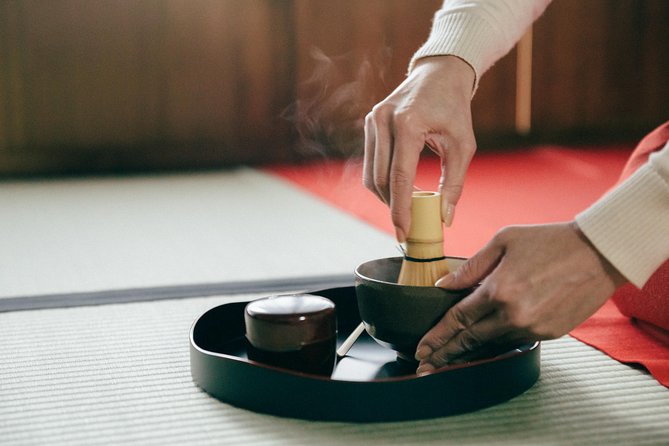
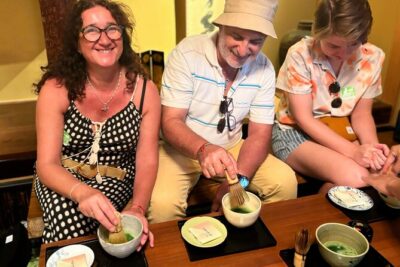
First, you receive a bowl of matcha and Japanese sweets as the guest. This gives you time to watch and get used to the setting. For many people, that first bowl is the easiest way to understand the ceremony because you can pay attention to the host’s movements without also worrying about your own.
Then you have the chance to serve tea yourself. This is where the experience becomes more than a presentation. You must pay attention to the steps, the utensils, and the calm pace. The point is not to perform perfectly. It is to feel the care and focus built into the custom.
The tea experience includes one bowl of matcha and Japanese sweets. If you have an allergy, you should tell the provider in advance. The supplied information does not specify the kinds of sweets or alternate options, so advance notice is important.
I like the sequence of the two activities. Calligraphy begins with solitary concentration, while tea ceremony adds a host-and-guest relationship. One asks you to control the brush. The other asks you to consider how an action is offered and received.
The experience also explains the tea room and utensils before asking you to take part. That is helpful if you are concerned about etiquette. You are not expected to arrive already knowing how to behave.
A few more options to weigh up in Nagoya
- LEGOLAND® Japan Ticket
★ 4.7 · 11,787 reviews - Port of Nagoya Public Aquarium Ticket
★ 4.8 · 4,343 reviews - Shirakawa-go & Takayama Old Town Day Tour (Optional Hida Beef Lunch)
★ 4.6 · 3,936 reviews - Hida Takayama & Shirakawa-go Gassho Village Day Trip (Departing from Nagoya, optional observatory tour included)
★ 4.7 · 2,837 reviews
What the price includes, and what it does not
At $179.63 per person, this is not a budget activity. You are paying for a private-feeling cultural session in a traditional home, English explanations, a small group capped at six, all calligraphy tools, matcha, Japanese sweets, and a framed piece of your work.
The value depends on what you want from your time in Nagoya. If you only want a quick taste of matcha or a basic souvenir, the price may be difficult to justify. Nagoya offers many lower-cost ways to see Japanese culture.
If you want a focused activity with personal instruction and a strong sense of place, the cost makes more sense. The house is part of the experience, and the session combines history, a craft, and tea ceremony rather than offering only one short demonstration.
The framed calligraphy adds practical value. A souvenir bought in a shop may be attractive, but this one is connected to the time you spent learning the technique. You choose the symbol, make the piece, and take home the finished result.
Coffee and tea are listed as included, specifically a bowl of matcha with Japanese sweets. Souvenirs beyond the framed calligraphy are not included. Since the experience is non-refundable and cannot be changed for any reason, I would book only after checking your schedule carefully.
Who will enjoy this experience most
I would recommend it most to someone who wants cultural contact in a calm, small setting. You will likely get the most from it if you enjoy making things, asking questions, and paying attention to small details.
It also suits first-time visitors who want help understanding customs that can otherwise seem formal or mysterious. The English guidance and short historical presentation give you a clear starting point.
Families with older children may find the brush activity appealing, though the supplied information only says that most people can participate. It does not give a minimum age or specific child policy, so you should confirm those details before booking for young children.
Couples and solo visitors can also fit well into the format. A maximum of six people keeps the session personal, and the framed work gives you a tangible reminder of the visit.
I would be less likely to recommend it to someone who prefers a fast-paced sightseeing schedule. Two and a half hours in a quiet house requires patience. You will spend time preparing ink, listening to explanations, watching tea preparation, and repeating careful movements.
Practical details before you reserve
The experience is near public transportation, and the same address is used for the start and finish. The meeting point is in Nagoya’s Showa Ward, so you should confirm the route and allow time to arrive without stress.
A mobile ticket is provided. Booking confirmation usually arrives at the time of booking, unless you book within seven days of the activity. In that case, confirmation can take up to 48 hours and depends on availability.
The experience is often booked about 17 days ahead. That timing is useful to keep in mind, especially because the group limit is only six people. If your Nagoya dates are fixed, booking earlier gives you a better chance of getting the day you want.
The activity has a five-star average based on 16 ratings, with 100 percent recommending it. The praise centers on the history briefing, the writing session, the taste of the tea, the warm hosts, and the location. Those details point to the experience’s real strength: it connects good instruction with a welcoming home setting.
The hosts are Yuzo Mori and his wife. Their warm approach is an important part of the visit, but the experience still asks you to participate. You will get more from it if you arrive ready to listen, handle the tools, and try the tea steps yourself.
Is this Nagoya culture experience worth booking?
I would book this experience if you want a personal introduction to Japanese calligraphy and tea ceremony, and if the traditional house matters as much to you as the activities. The combination of a Sengoku-era introduction, handmade ink preparation, brush practice, matcha, sweets, and a framed keepsake gives the session a clear shape.
I would skip it if you are mainly looking for inexpensive sightseeing or if your schedule cannot accommodate a fixed, non-refundable booking. The price is high for the length, but the small group and home setting make it more substantial than a quick cultural demonstration.
For the right person, this is a thoughtful Nagoya activity. You leave with more than a photograph: you have tried two Japanese traditions, learned why the local history matters, and made something you can keep.
FAQ
Where does the Japanese calligraphy and tea ceremony experience take place?
It takes place at 4-chome-32 Yamawakicho, Showa Ward, Nagoya, Aichi 466-0063, Japan.
How long does the experience last?
The activity lasts approximately two hours and 30 minutes.
Does the experience begin and end at the same location?
Yes. The activity ends back at the meeting point.
How many people can join the experience?
The maximum group size is six people.
Is the experience conducted in English?
Yes. The cultural explanations and activity guidance are provided in English.
What is included in the calligraphy session?
All Japanese calligraphy tools are included. Your finished work is framed as a souvenir.
Is matcha included?
Yes. The experience includes one bowl of matcha and some Japanese sweets.
Should I report food allergies in advance?
Yes. You should tell the provider in advance about any allergies because sweets are provided.
Can I cancel or change the booking?
No. The experience is non-refundable and cannot be changed for any reason.
Just added in Nagoya
- Hida Takayama & Shirakawa-go Gassho Village Day Trip (Departing from Nagoya, optional observatory tour included)★ 4.7 · 2,837 reviews
- Shirakawa-go & Takayama Old Town Day Tour (Optional Hida Beef Lunch)★ 4.6 · 3,936 reviews
- Nagoya Castle Ticket★ 4.6 · 326 reviews
- Port of Nagoya Public Aquarium Ticket★ 4.8 · 4,343 reviews
- LEGOLAND® Japan Ticket★ 4.7 · 11,787 reviews
- Ghibli Park Ticket in Aichi★ 4.4 · 2,205 reviews
- Nagoya Endoji Food and Cultural Tour★ 5.0 · 12 reviews
- Sumo Tournament Experience in Nagoya★ 5.0 · 12 reviews
Tea Ceremonies, compared.
Tea Ceremony in a Traditional Tea House in Kiyomizu
Read our review →
World Heritage Kyoto & Nara Uji Authentic Matcha Experience
Read our review →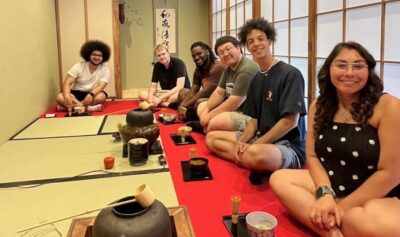
Browse the lists this tour appears in