
Reviewed · TEMPLES AND SHRINES
Fukuoka’s Sacred Path: Temples, History & Culture
Ancient faith meets modern Fukuoka here. This three-hour walk links Shōfukuji and Tōchōji with Kushida Shrine, Sumiyoshi Shrine, and Canal City, giving you a clear look at how Hakata’s Buddhist and Shinto traditions fit into daily life. I like the easy mix of serious cultural sites and lively city scenery. I also like the relaxed pace, which leaves room for questions and conversation.
The main drawback is simple: you will walk for most of the afternoon. One traveler specifically advised preparing for a long walk, and that is fair advice. The tour costs $77 per person, so it offers good value if you want interpretation and local context, but less so if you prefer to explore temples silently at your own speed.
In This Review
- Key points to know before you go
- Starting beside Hakata Station
- Shōfukuji and the beginning of Japanese Zen
- Tōchōji and the huge wooden Buddha
- Kushida Shrine and Hakata’s festival spirit
- Canal City changes the mood
- Sumiyoshi Shrine and a fitting finish
- What the guide adds to the experience
- Is $77 a fair price?
- Who should book this walk?
- Should you book Fukuoka’s Sacred Path?
- FAQ
- How long does the Fukuoka Sacred Path tour last?
- Where does the tour begin?
- Where does the tour finish?
- Which languages are available?
- Is the tour private?
- What temples and shrines are included?
- Does the tour include Canal City?
- Are food, drinks, and transportation included?
- What should I bring?
Key points to know before you go
- Japan’s first Zen temple: Shōfukuji was founded in 1195 by Eisai, the monk credited with introducing Zen Buddhism from China.
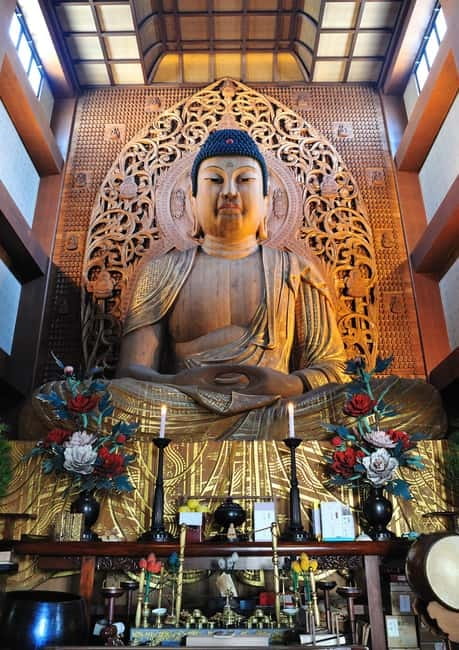
- A 10.8-meter wooden Buddha: Tōchōji’s Great Buddha is the visual high point, with an underground passage linked to Buddhist ideas about the afterlife.
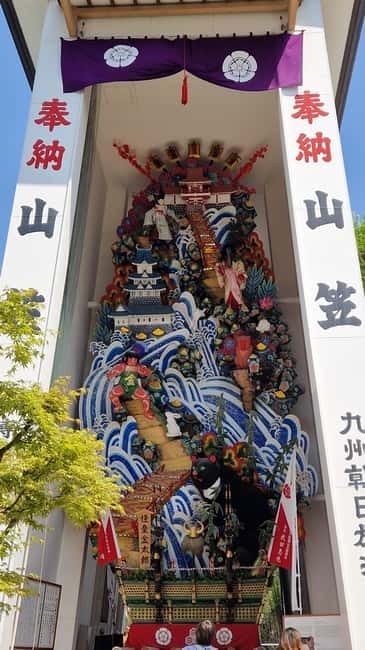
- Fukuoka’s festival heart: Kushida Shrine is tied closely to the Hakata Gion Yamakasa festival and has a large float on display.
- Old and new in one walk: Canal City’s water show provides a sharp change of mood after the temples and shrines.
- A private guided outing: The tour is offered in English and German, with conversational Japanese available, and guides such as Andy, Paula, and Arianna have led guests on past departures.
Starting beside Hakata Station
The meeting point is outside the Casetify shop at Amu Plaza Hakata, just outside Hakata Station’s West Exit. This is a practical place to begin because Hakata Station is one of Fukuoka’s main transport hubs, and you do not need to search for a small temple entrance or a distant hotel lobby.
From there, you walk for about 10 minutes to Shōfukuji. That opening stretch gives you time to meet your guide and settle into the pace. You should arrive in comfortable shoes, since the tour includes several walking sections and a total of roughly 90 minutes of movement between stops.
The group format is described as private, which can make a real difference on a cultural walk. You can ask why a shrine gate looks a certain way, how Buddhist and Shinto customs differ, or what a festival means locally without trying to catch a guide’s voice across a crowd.
More Temples and Shrines in Fukuoka:
- Kyushu One-Day Tour: Yufuin no Mori Train & Yufuin Town & Nyoirin-ji Temple & Dazaifu & Hell Hot Springs (Departing from Fukuoka)
★ 4.9 · 4,474 reviews - Day Tour to Miyazaki Takachiho Gorge & Shrine depart from Fukuoka
★ 4.5 · 61 reviews - From Fukuoka: Miyazaki, Takachiho Gorge And Shrine Day Tour
★ 4.5 · 44 reviews
Shōfukuji and the beginning of Japanese Zen
Shōfukuji is the right first stop because it places Fukuoka’s religious story in a quiet setting. Founded in 1195 by Eisai, it is recognized as Japan’s first Zen temple. Eisai introduced Zen Buddhism from China, and the temple grounds offer a chance to connect that major religious change with traditional wooden architecture and calm garden spaces.
The guided visit lasts about 20 minutes. That is enough time for an introduction to the temple, its place in Zen history, and basic ideas about meditation and practice. Do not expect a long formal meditation session. This is a sightseeing and interpretation stop, not a retreat.
I like the way Shōfukuji sets the tone without demanding too much from you at the start. Fukuoka is a busy city, but the temple offers a quiet pause almost immediately after leaving the station area. Your guide can also help explain temple etiquette, an especially useful service if you are unsure where to stand, how to behave, or what details deserve attention.
The short visit is also a limitation. If Shōfukuji is your main reason for booking, 20 minutes may feel brief. The value comes from seeing it as part of a larger story rather than treating it as a stand-alone temple tour.
Tōchōji and the huge wooden Buddha
A five-minute walk brings you to Tōchōji Temple, where the tour spends about 30 minutes. This is likely to be the most visually powerful stop because the temple houses a 10.8-meter wooden Buddha, described as Japan’s largest wooden Buddha statue.
The scale alone makes the visit worthwhile, but the guide’s explanation helps you understand why the statue matters beyond its size. Tōchōji is one of Fukuoka’s important Buddhist sites, and the Great Buddha gives the tour a strong focal point after the quieter opening at Shōfukuji.
Tōchōji also has an underground passage symbolizing a journey through the afterlife. This adds a different kind of interest. Instead of simply admiring architecture or a statue, you encounter a space connected with Buddhist thought and spiritual symbolism.
Allow yourself time to adjust to the change from open temple grounds to an enclosed passage. Some people will find the underground section memorable because it is unusual. Others may prefer the statue and temple buildings themselves. Your guide’s commentary is particularly useful here, since symbolism can be easy to miss when you are looking only at the physical space.
The scheduled 30 minutes is sensible, though anyone fascinated by Buddhist art may wish for longer. Since this is a walking tour with several more stops ahead, the group keeps moving rather than lingering at every detail.
Kushida Shrine and Hakata’s festival spirit
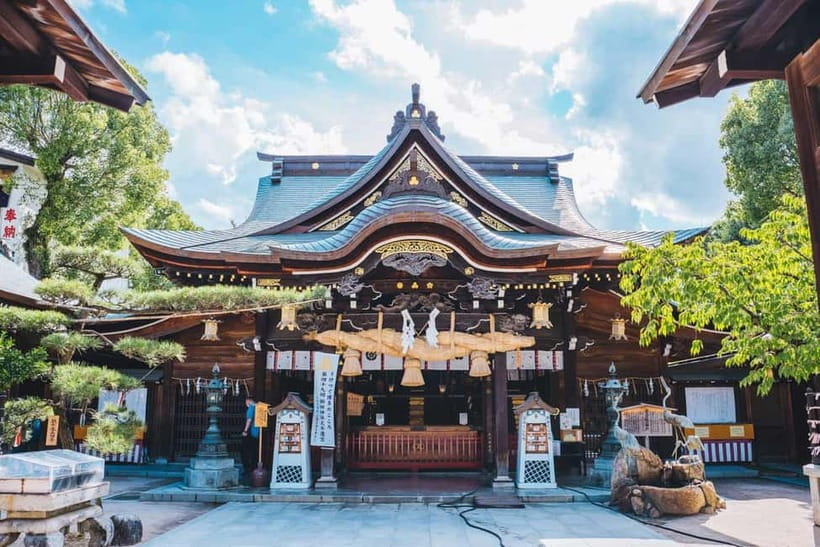
After about 15 minutes on foot, you reach Kushida Shrine. The guided visit and sightseeing time total around 30 minutes, making it one of the fuller stops on the route.
Kushida Shrine is closely tied to the Hakata Gion Yamakasa festival, one of Fukuoka’s best-known local traditions. A towering Yamakasa float is displayed at the shrine, giving you a chance to see the craftsmanship and scale of the festival outside its main season.
This is where the tour moves beyond broad religious labels. Shinto is not only about shrine gates and purification rituals. It is also connected with local identity, seasonal events, neighborhood traditions, and the way people mark the year. A guide can show you how the shrine functions as part of Fukuoka life rather than as an isolated monument.
The visit is also a good place to learn basic etiquette. You may receive explanations about how to approach a shrine, how to behave near the worship area, and how Shinto practice differs from Buddhist temple customs. One past participant valued learning how Buddhism and Shinto are practiced together in Japan, and that is one of the tour’s strongest educational themes.
Kushida Shrine can feel more active than Shōfukuji or Tōchōji, especially because it is tied to a major city festival. If you want a silent, empty shrine, this may not be the right expectation. If you want to understand why a place matters to local people, it is a useful stop.
A few more options to weigh up in Fukuoka
- Kyushu: Mount Aso, Kusasenri & Takachiho Gorge Day Tour (Optional Takachiho Boat Ride Experience)
★ 4.9 · 4,957 reviews - teamLab Forest Fukuoka Ticket
★ 4.7 · 1,925 reviews - Shiraito Falls & Forest Cafe & Handmade Flower Salt Pudding & Grilled Seafood & Totoro Forest & Sakurai Futamigaura & Angel’s Wings & Coconut Tree Swing Day Tour (Departing from Hakata Station, with Mandarin, English, and Cantonese speaking guide)
★ 4.9 · 1,840 reviews - Fukuoka Tower Admission Ticket
★ 4.8 · 1,804 reviews
Canal City changes the mood
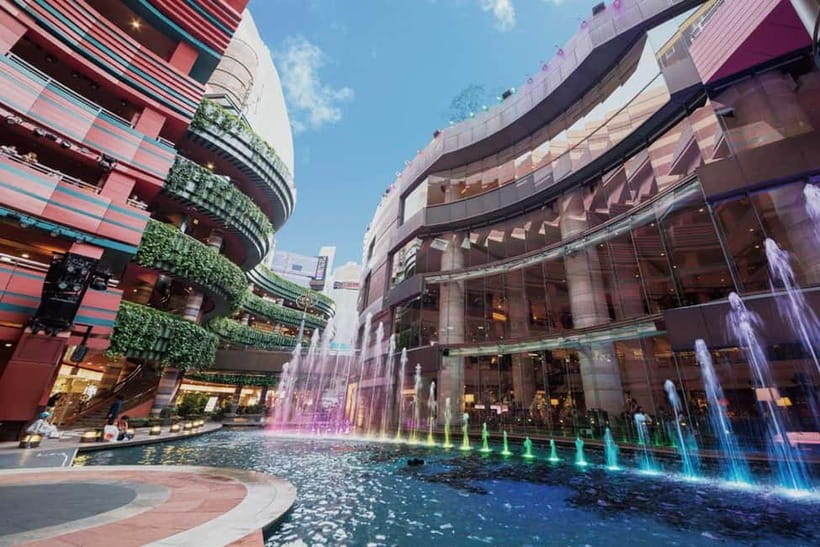
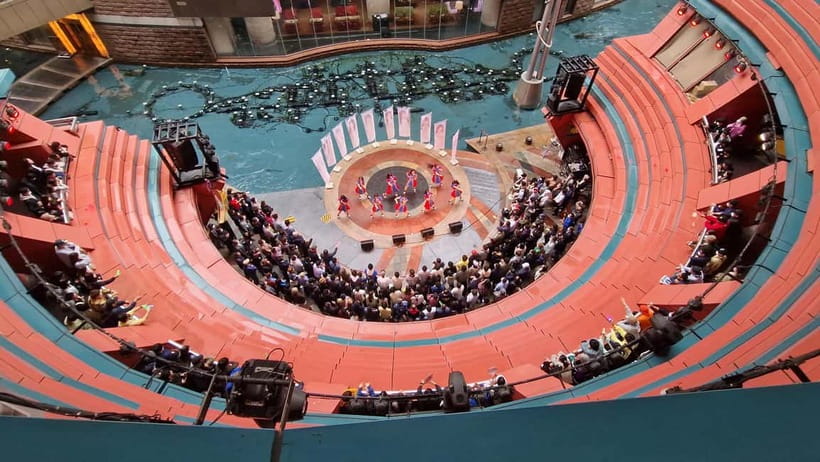
The route then shifts from sacred sites to Canal City Hakata. You spend about 15 minutes sightseeing and watching the fountain show before walking five minutes to the final shrine.
Canal City is a large shopping and entertainment complex, so it may seem like an odd partner for temples and shrines. That contrast is exactly why it works. Fukuoka is not a museum city frozen in the past. Its old religious sites sit within a modern urban center, and Canal City makes that point without a long lecture.
The fountain show combines water, lights, and music. Timing can affect what you see, so it is wise to check current conditions and show schedules when planning your day. The information provided for this tour does not promise a particular show time or length, so treat it as a planned sightseeing stop rather than the sole reason to book.
Fifteen minutes is enough to see the water display and get a sense of the complex. It is not enough for shopping, a meal, or a full look around Canal City. Food and drinks are not included, so you should plan those separately if you want to eat before or after the walk.
I like this section because it prevents the tour from becoming a chain of similar religious buildings. The sudden appearance of music, retail, and water gives you a better feel for present-day Fukuoka.
Sumiyoshi Shrine and a fitting finish
A five-minute walk from Canal City brings you to Sumiyoshi Shrine, the final major stop. The guided visit lasts about 25 minutes, followed by a 15-minute walk back to the starting point.
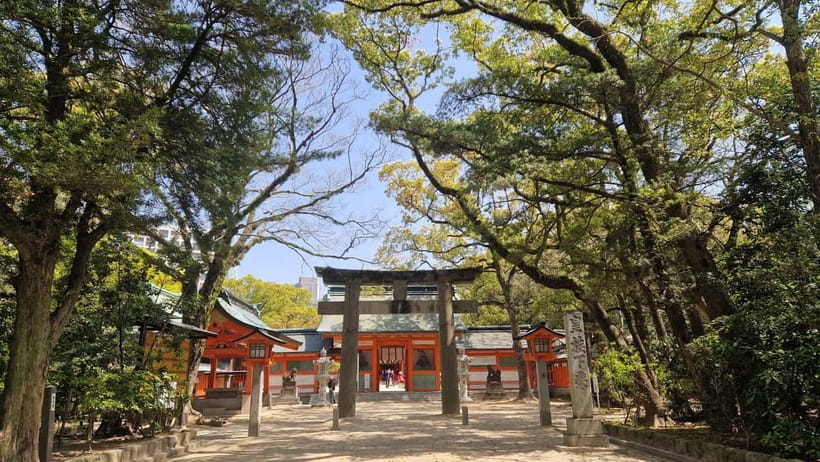
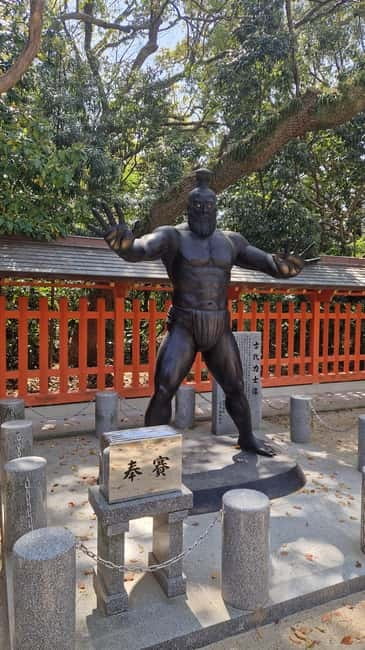
Sumiyoshi Shrine is dedicated to the gods associated with safe travel and protection. That makes it a fitting place to end a walking tour, especially for people arriving in Japan or continuing on to another part of Kyushu. Its vermilion torii gates and peaceful setting offer a gentler finish after the scale of Tōchōji and the activity around Canal City.
The guide can help you read the shrine as both a religious site and a place connected to everyday hopes. Safe journeys, protection, and good fortune are practical concerns, not just abstract ideas. This stop gives the tour a personal close rather than ending at a shopping complex.
The return walk to Hakata Station takes about 15 minutes. In total, the route includes visits of varying length, several short walks, and the longer 10-minute opening and 15-minute closing sections. It is not an exhausting full-day outing, but you should not think of it as a short hop between attractions.
What the guide adds to the experience
The strongest reason to choose this tour is the live explanation. The temples and shrines can be visited independently, but the connections between them are harder to grasp on your own.
Past guide feedback highlights Andy’s patience, cultural explanations, easy conversation, and useful suggestions for food and markets after the tour. Paula has also guided guests through the local temples and shrines, while Arianna has led a private Hakata experience. The guide assigned to your date may differ, but the service is designed around conversation rather than a fixed speech.
That matters because the tour covers several subjects in a short time:
- The origins and practice of Zen Buddhism
- The role of Buddhist temples in Fukuoka
- Shinto shrine etiquette
- The relationship between Buddhism and Shinto
- Seasonal festivals and local customs
- The way historic sites fit into modern Hakata
The language options are English and German, and conversational Japanese is available according to the tour description. German-speaking guests have found the format useful, while English-speaking guests have praised the guides for making room for questions and informal discussion.
A private group can also make the afternoon feel more personal. You can tell the guide if you want more detail at a temple, need a slower pace, or have particular interest in food, festivals, or religious practice. Still, the route has a set structure, so do not expect to spend an hour at one location.
Is $77 a fair price?
At $77 per person, this is not the cheapest way to see Fukuoka’s central temples and shrines. Several locations can be reached without paying for a guide, and the tour does not include transport, food, drinks, or souvenirs.
The price makes more sense if you value interpretation and a private setting. You are paying for three hours of local guiding, route planning, cultural explanations, festival stories, and the chance to ask questions in English or German. The guide’s recommendations for local food and markets can also help you use the rest of your day well.
I would compare the cost with your travel style. If you enjoy reading plaques, following maps, and making your own connections, independent sightseeing may be better value. If you want someone to explain why a place matters and how Buddhist and Shinto customs work together, $77 is reasonable for a private three-hour walk.
The tour also offers free cancellation up to 24 hours in advance and a reserve now, pay later option. Those terms make it easier to fit the walk around changing plans, but you should still check the available starting times before booking.
Who should book this walk?
I would recommend it to first-time visitors who want a strong introduction to Hakata. It covers major spiritual sites without requiring a full day, and the route begins and ends at Hakata Station, which is convenient for fitting into a wider Fukuoka plan.
It also suits history lovers, culture-focused visitors, couples, families with older children, and anyone curious about Japanese religious customs. The private format is useful if you want to ask basic questions without feeling rushed or self-conscious.
You should think twice if you dislike walking, want extensive shopping time at Canal City, or prefer to explore each temple at length. The pace is described as leisurely, but leisurely does not mean stationary. Wear proper walking shoes, check the weather, bring a camera, and carry money for souvenirs or anything you want to buy along the way.
Should you book Fukuoka’s Sacred Path?
Book this tour if you want the story behind Fukuoka’s sacred places, not just a checklist of buildings. Shōfukuji gives you Zen origins, Tōchōji supplies the big visual moment, Kushida Shrine explains Hakata’s festival identity, Canal City adds modern contrast, and Sumiyoshi Shrine closes the route with a message of protection.
The best fit is a visitor who values conversation, cultural context, and a manageable afternoon walk. At $77, it is worth considering when a private guide and clear explanations matter more to you than keeping sightseeing costs to a minimum.
FAQ
How long does the Fukuoka Sacred Path tour last?
The tour lasts three hours, including the guided visits, walking sections, Canal City sightseeing, and the return to Hakata Station.
Where does the tour begin?
It begins outside the Casetify shop at Amu Plaza Hakata, just outside Hakata Station’s West Exit.
Where does the tour finish?
The walk returns to the same Casetify shop outside Hakata Station.
Which languages are available?
The tour is offered in English and German. Conversational Japanese is also available according to the experience description.
Is the tour private?
Yes. The activity is listed as a private group experience.
What temples and shrines are included?
The route visits Shōfukuji Temple, Tōchōji Temple, Kushida Shrine, and Sumiyoshi Shrine.
Does the tour include Canal City?
Yes. The tour stops at Canal City Hakata for sightseeing and the fountain show.
Are food, drinks, and transportation included?
No. Food, drinks, and transportation costs are not included in the price.
What should I bring?
Bring comfortable walking shoes, a camera, and money for souvenirs. You should also check the weather before setting out.
Just added in Fukuoka
- Treasures of Kyushu by Europamundo – 7-Day Tour Review★ 5.0 · 1 review
- Kyushsu Half Island Express Tour by MW Tours – 8 Days from Fukuoka Review★ 5.0 · 1 review
- teamLab Forest Fukuoka Ticket★ 4.7 · 1,925 reviews
- Fukuoka Nakasu River Cruise Ticket★ 4.6 · 164 reviews
- Shiraito Falls & Forest Cafe & Handmade Flower Salt Pudding & Grilled Seafood & Totoro Forest & Sakurai Futamigaura & Angel’s Wings & Coconut Tree Swing Day Tour (Departing from Hakata Station, with Mandarin, English, and Cantonese speaking guide)★ 4.9 · 1,840 reviews
- Uminonakamichi Marine World Admission Ticket in Fukuoka★ 4.8 · 1,298 reviews
- Fukuoka Tower Admission Ticket★ 4.8 · 1,804 reviews
- Kyushu One-Day Tour: Yufuin no Mori Train & Yufuin Town & Nyoirin-ji Temple & Dazaifu & Hell Hot Springs (Departing from Fukuoka)★ 4.9 · 4,474 reviews
Temples and Shrines, compared.
![[Kyoto & Nara Day Tour] Sagano Scenic Railway & Nara Park & Fushimi Inari Taisha Thousand Torii Gates & Togetsukyo Bridge & Bamboo Grove & Kimono Forest (Departing from Osaka)](https://media.japanvisits.com/wp-content/uploads/kyoto-nara-day-tour-sagano-scenic-railway-nara-park-fushimi-inari-taisha-thousand-torii-gates-togetsukyo-bridge-bamboo-grove-kimono-forest-departing-from-osaka-k110001-400x257.jpg)
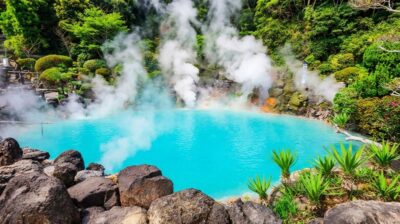
Kyushu One-Day Tour: Yufuin no Mori Train & Yufuin Town & Nyoirin-ji Temple & Dazaifu & Hell Hot Springs (Departing from Fukuoka)
Read our review →
Fushimi Inari, Kinkakuji, Bamboo Grove 1 Day Bus Tour
Read our review →
Tea Ceremony in a Traditional Tea House in Kiyomizu
Read our review →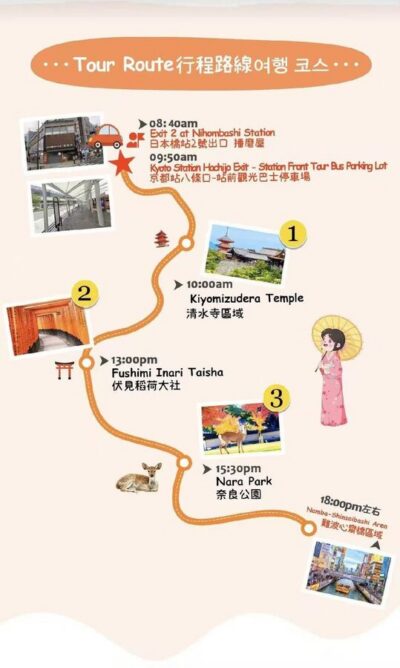
Kyoto Nara Day Trip │ Kiyomizu-dera Temple + Fushimi Inari-taisha Shrine + Nara Park (Departing from Osaka/Kyoto)
Read our review →
Browse the lists this tour appears in