Reviewed · GUIDED
Tokyo Guided Small-Group Biking Tour
Tokyo reveals itself best between the famous sights. This six-and-a-half-hour ride connects major landmarks with quiet neighborhood streets, giving you a useful sense of how the city fits together. You move from Shinjuku skyscrapers to small shrines, parks, shopping districts, temples, the waterfront, and the Imperial Palace.
I like the relaxed pace and the tiny group size, which is limited to five people. I also like the route’s variety, especially the bento lunch by Tokyo Bay and the final 360-degree view from the Tokyo Metropolitan Government Building. The main consideration is physical: this is a 20-mile, 32-kilometer ride on busy city roads, and the bike is a regular cross-city bike, not an electric bicycle.
In This Review
- Key points to know before booking
- Why this bike tour works so well in Tokyo
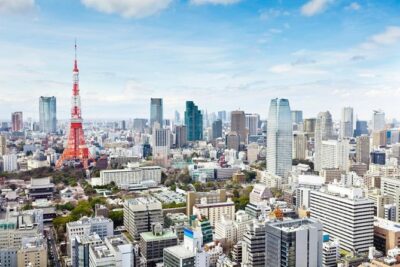
- Starting under the Shinjuku skyscrapers
- Meiji Jingu and Yoyogi Park
- Omotesando, Roppongi Hills, and Aoyama Cemetery
- Bento shopping and Tokyo Bay lunch
- Zōjō-ji Temple and the Tokyo Tower view
- Ginza’s main roads and backstreets
- The Imperial Palace and its outer moats
- The 48-story finale in Shinjuku
- Is $106.12 a fair price?
- Fitness, age, and what to wear
- Who should book this six-and-a-half-hour ride?
- Should you book the Tokyo bike tour?
- FAQ
- How long is the Tokyo biking tour?
- How far do you ride?
- Is an electric bike provided?
- What is included in the tour price?
- Where does the tour start and finish?
- What ages and heights are accepted?
- What happens if the weather is poor?
Key points to know before booking
- A 20-mile route covers a remarkable slice of Tokyo: You see Shinjuku, Meiji Jingu, Omotesando, Roppongi Hills, Ginza, Tokyo Bay, and the Imperial Palace in one day.
- The group never exceeds five people: That makes street riding easier and gives you more time to ask questions or request small changes to the route.
- The ride mixes famous sights with ordinary Tokyo: Small neighborhood shrines, residential lanes, a supermarket lunch stop, and Aoyama Cemetery add local texture.
- Lunch is a local-style bento stop: You buy your own boxed meal at a grocery store, carry it in your backpack, and eat beside the waterfront.
- The final viewpoint helps you understand the route: From the Tokyo Metropolitan Government Building, you can look across the city and spot places visited earlier.
- You need city-cycling confidence: You should be comfortable with a multi-speed bicycle, pedestrians, traffic, and a long day in the saddle.
Why this bike tour works so well in Tokyo
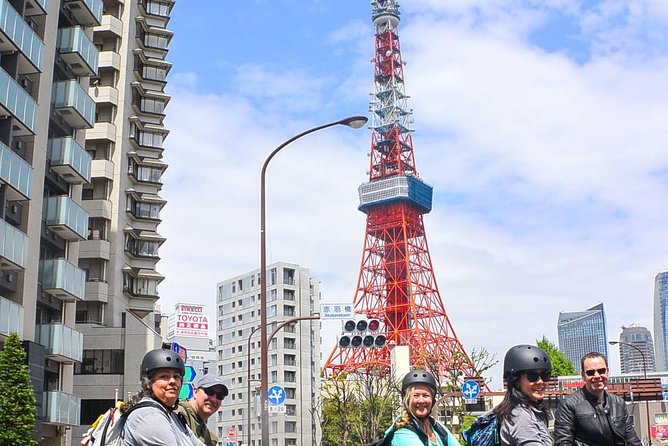
Tokyo is huge. Walking tours can show you one district well, but they cannot easily connect the city’s far-flung highlights in a single day. Public transportation is fast, yet it keeps you underground or inside stations for much of the journey.
This ride fills that gap. You travel at street level, pass through changing neighborhoods, and get a practical sense of distance. Shinjuku’s tall towers give way to quieter lanes. A polished shopping avenue leads to an old cemetery. A temple frames Tokyo Tower. The Imperial Palace opens into broad moats and stone walls. Then the city stretches out below you from a high observation floor.
The strongest part of the experience is the balance between structure and flexibility. The route is planned, but the guide can adjust some stops when timing allows or when you have already visited a particular sight. That personal attention matters in a group capped at five.
Gaku is the guide most often named in the feedback, and his role sounds central to the experience. He explains each section before setting off, shows the route on a map, gives an estimate of the next riding time, and handles busy sections at the front. His friendly manner and strong local knowledge help make a demanding day feel manageable.
The tour receives a five-star rating with 1,250 reviews and a 100 percent recommendation rate. That is a strong record, though the physical demands still deserve more attention than the glowing score might suggest.
A few more options to weigh up in Tokyo
- Tokyo Disney Resort – Tokyo Disneyland & Tokyo DisneySea Park Tickets
★ 4.8 · 99,488 reviews - SHIBUYA SKY Ticket
★ 4.7 · 46,509 reviews - JR Whole Japan Rail Pass
★ 4.8 · 29,150 reviews
Starting under the Shinjuku skyscrapers
The meeting point is at 3-chōme-20-2 Nishishinjuku, in central Tokyo. You meet in the early morning, receive your bicycle and helmet, and begin among the high-rise buildings of Shinjuku.
This start gives you an immediate lesson in Tokyo’s contrasts. The area is one of the capital’s main business centers, but the tour quickly leaves the tower blocks behind. You ride through backstreets and residential lanes toward a small local shrine.
That first shrine is not presented as one of Tokyo’s headline attractions. That is precisely its value. You see a quieter place used by the surrounding community, then continue through streets that most coach tours could never reach. The route begins to show Tokyo as a lived-in city, not just a collection of famous photo stops.
Expect some street riding here. The route uses busy roads as well as calmer lanes, so you must pay attention and follow the guide closely. The guide’s position at the front is especially useful when traffic or pedestrians make the route less obvious.
Meiji Jingu and Yoyogi Park
From the residential streets, you ride toward Yoyogi Park and Meiji Jingu, Tokyo’s best-known Shinto shrine. The park provides a welcome change from the hard surfaces of Shinjuku, while the shrine grounds offer space to slow down and walk.
You do not simply cycle past the entrance. The itinerary includes time to walk around the peaceful gardens with the guide. That pause matters because the shrine is more enjoyable when you can put the bicycle aside and notice the setting.
In spring, Yoyogi Park is known for cherry blossoms, but the timing of blossoms is not guaranteed. Even outside blossom season, the park helps explain the unusual rhythm of Tokyo, where dense urban development can sit close to broad green spaces and sacred sites.
This section is also a reminder that the tour is not six and a half hours of nonstop pedaling. Stops, explanations, walking, food shopping, and the observation deck break up the ride. Still, you should not mistake the relaxed pace for an easy half-day outing. The full route is long.
Omotesando, Roppongi Hills, and Aoyama Cemetery
After Meiji Jingu, the bicycles head along Omotesando. This is one of Tokyo’s most polished shopping streets, with major fashion names and carefully designed buildings. It is a useful contrast to the narrow residential lanes visited earlier.
The route then heads toward Roppongi Hills, a large entertainment and shopping complex. Here, the city feels more modern and commercial again. You get a quick sense of Tokyo’s sophisticated side without spending the day inside stores or malls.
The more surprising stop is Aoyama Cemetery. Reached by a backstreet, it has a quieter atmosphere and a visual character that can feel far removed from the city’s newer districts. The cemetery is described as looking much as Tokyo might have a century ago, making it a good example of the older layers that remain within a modern capital.
I particularly like this sequence because it avoids a common sightseeing problem. Instead of stacking one major attraction after another, the ride uses small transitions to show how one district changes into the next. You are not only checking sights off a list. You are learning the city’s scale and texture.
A completely different kind of day out:
- Mt Fuji and Hakone 1-Day Bus Tour Return by Bullet Train
★ 5.0 · 26,383 reviews - TOKYO SKYTREE® Ticket
★ 4.7 · 25,136 reviews - teamLab Borderless Tickets: MORI Building DIGITAL ART MUSEUM
★ 4.7 · 24,126 reviews - teamLab Planets TOKYO Ticket
★ 4.7 · 21,663 reviews
Bento shopping and Tokyo Bay lunch
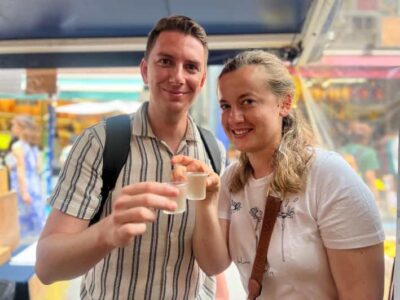
At a local supermarket, you stop to buy a bento box at your own expense. This is a small but useful part of the day. Rather than eating at a fixed restaurant, you choose a boxed meal in the same kind of setting locals use for an inexpensive lunch.
You need to carry the bento in your backpack or messenger bag. The waterfront is about 25 minutes away, so plan to keep the box level and pack carefully. Drinks and food are not included in the tour price.
Lunch takes place beside the water with views toward Rainbow Bridge, the Tokyo skyline, and the Aqua City Odaiba complex. After several hours of street riding, this is a welcome place to rest. The open view also changes your perspective on the city. Earlier, Tokyo has felt like a series of narrow corridors and districts. At the bay, it opens out.
The lunch arrangement keeps costs and choices flexible, but it is less convenient than having a meal served to you. If you prefer a sit-down lunch or need a specific diet, the supermarket stop gives you control, though you must make your own selection and carry it.
Zōjō-ji Temple and the Tokyo Tower view
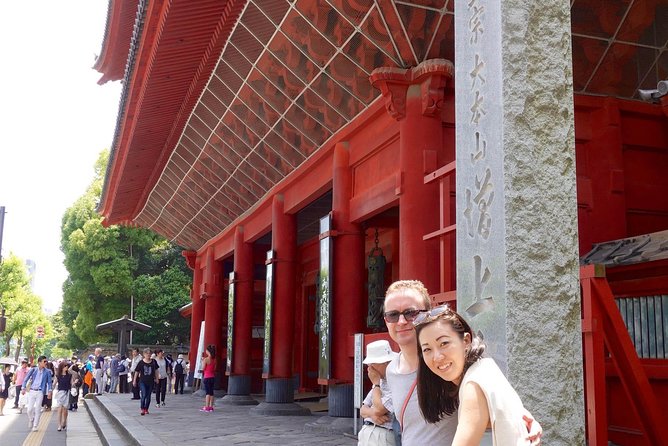
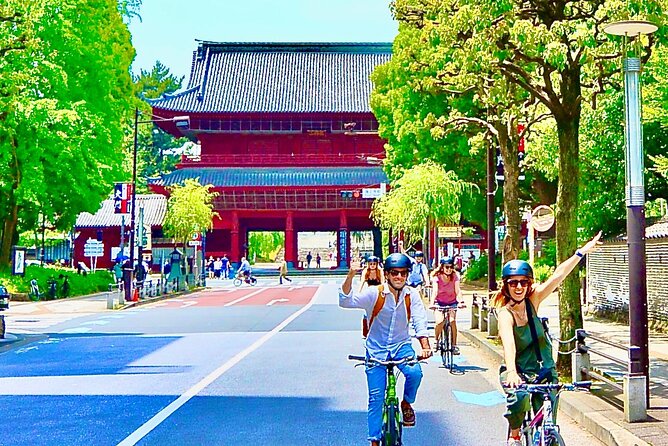
The route includes Zōjō-ji Temple, where Tokyo Tower rises behind the temple buildings. This is one of the clearest visual pairings in the itinerary: an important Buddhist temple in the foreground and a modern communications tower behind it.
It is an efficient stop because it gives you cultural and architectural contrast without requiring a long detour. You can see how older religious spaces continue to occupy valuable central land beside modern Tokyo landmarks.
The tour does not promise a lengthy temple visit, so I would treat this as a focused sightseeing stop rather than a full temple tour. The guide’s explanations are important here, especially if you want context about what you are seeing rather than a quick photograph.
Ginza’s main roads and backstreets
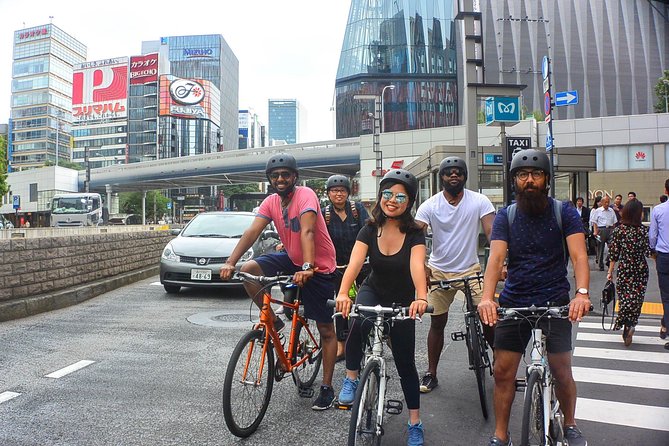
After lunch, you cycle through Ginza, Tokyo’s famous luxury shopping district. The route uses both the main streets and backstreets, giving you two views of the neighborhood.
The main avenues show Ginza’s polished commercial face. The smaller roads provide a more human scale and help you move beyond the storefronts. This is one of the tour’s better examples of why a bicycle can be more revealing than a coach. You can shift between major roads and side streets without losing the sense of the district.
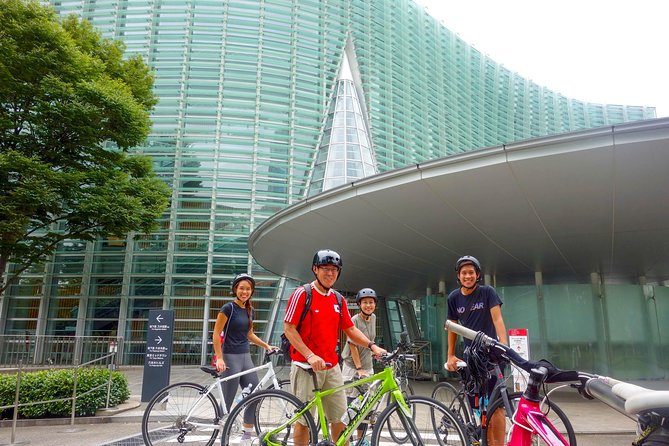
Ginza also adds to the physical challenge. City riding requires steady attention, even when the route is mostly flat. You need to watch for pedestrians, traffic, intersections, and changes in road space. The supplied bike is a flat-handlebar cross-city bicycle, not a cruiser with a high raised handlebar.
You should already know how to ride a multi-speed bike. Several riders describe the elevation gain as minimal, and regular exercisers generally find the ride manageable. The bigger challenge is duration and urban traffic, not steep hills.
The Imperial Palace and its outer moats
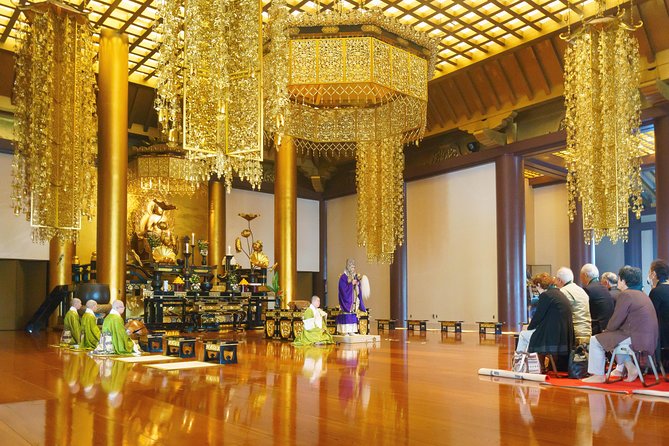
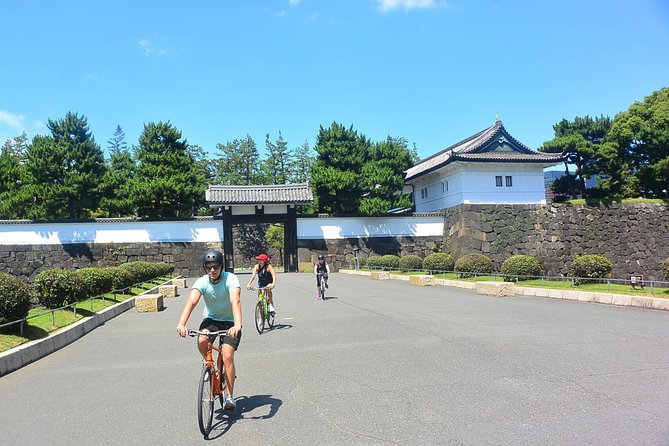
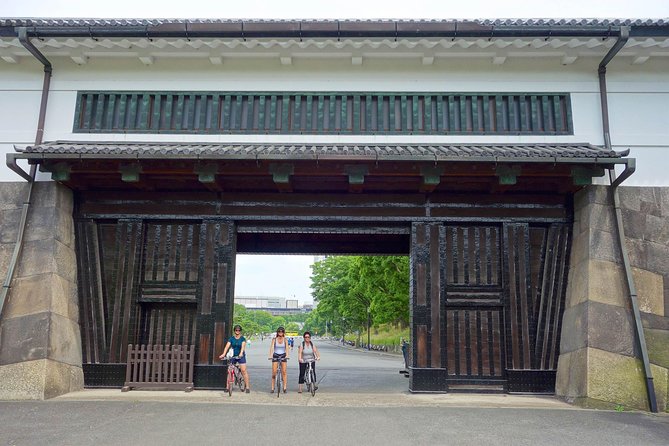
From Ginza, the route continues to the Imperial Palace. You ride through two outer gates and follow sections of the large moat. The palace grounds include a traditional Japanese garden, tea pavilion, stone walls, and water defenses.
This is one of the itinerary’s major landmarks, but the experience remains active. You are not entering every palace building or spending hours inside a museum. Instead, you see the outer setting, ride along the moat, and take in the scale of the palace area from the bicycle.
That approach suits this tour. The goal is to connect many parts of Tokyo, not provide a detailed specialist visit at every stop. If the Imperial Palace is your main priority, you may want to return separately for a slower visit. If you want a broad introduction, the ride gives you a solid first look.
The palace section also helps you understand Tokyo’s central geography. Wide open grounds and old defensive features sit surprisingly close to Ginza’s retail streets and the business districts beyond.
The 48-story finale in Shinjuku
The route heads back toward Shinjuku and ends with a high-speed elevator ride to the Tokyo Metropolitan Government Building. From the observation level, you get a 360-degree view across the capital.
This is more than a grand finale. It helps you connect the day’s separate pieces. You can look for Tokyo Skytree, trace the broad city spread, and, on a clear day, possibly see Mount Fuji. The route that seemed large at ground level becomes easier to understand from above.
The building is 48 stories high, and the elevator makes the ascent quick. After the viewpoint, it is only about a five-minute ride back to the original meeting point.
Ending at the observation deck is smart planning. You finish with a citywide view instead of simply returning to the starting point after a long ride. It also gives you one last chance to see how far you have traveled.
Is $106.12 a fair price?
At $106.12 per person, this is not a budget bicycle rental. The cost includes a professional guide, bicycle, and helmet, but not lunch, drinks, hotel pickup, or drop-off.
The value comes from the route and the time saved. In one organized day, you reach districts that are spread across Tokyo and receive guidance through traffic, backstreets, shrine grounds, shopping areas, waterfront roads, and palace surroundings. Recreating that route alone would require careful planning, several train journeys, and confidence navigating an unfamiliar city by bike.
The five-person maximum is also important. A large cycling group would be harder to manage on busy roads and less personal at the smaller sights. With only a few riders, the guide can answer questions, keep the pace together, and make modest route changes when possible.
I would call the price fair for an active introduction to Tokyo, especially if you have limited time. It is less attractive if you dislike cycling, already know the city well, or want long visits inside individual attractions.
Fitness, age, and what to wear
You must be at least 12 and no older than 69. The operator may ask for identification to verify age. Your height must be between 125 and 190 centimeters, or about 4 feet 1 inch to 6 feet 3 inches, so the bicycle can be fitted correctly.
Take the height requirement seriously. Incorrect height information can mean you cannot ride, with no refund provided for that problem. Enter every rider’s height carefully when booking.
Wear comfortable clothing and bring a backpack or messenger bag. You will need room for your bento and personal items. Since the route covers roughly 20 miles, comfortable footwear and clothing matter more than dressing for a stylish Tokyo lunch.
The ride requires moderate fitness and comfort on busy roads. The route is not an electric-bike tour. You should be able to steer around pedestrians, shift gears, brake smoothly, and remain attentive for most of the day.
Hot weather can make the ride harder. Rain or a heatwave can lead to cancellation, with a different date or full refund offered. If the operator cancels, the guide sends an email by 7 a.m. that morning.
Who should book this six-and-a-half-hour ride?
I would choose this tour for a first Tokyo visit when I wanted a broad overview in one day. It suits people who enjoy active sightseeing and prefer local streets to a coach window.
It is also a good choice for families with older children, couples, solo riders, and small groups who want direct contact with a guide. Several people have found the experience especially useful early in a Tokyo stay, since it helps them understand the districts before exploring them again by train or on foot.
You should skip it if you are not comfortable cycling in traffic, cannot manage a long ride, or need a slow schedule with frequent indoor breaks. The tour moves at a steady pace, even though hills are limited.
The route can also be changed or shortened for operational reasons, and some attractions may be substituted. That flexibility is normal for a city activity, but it means you should see the itinerary as a strong outline rather than a guarantee of every stop.
Should you book the Tokyo bike tour?
Book it if you want to see a lot of Tokyo in one active day, especially if quiet lanes and small local sights matter as much as famous landmarks. The combination of Meiji Jingu, Yoyogi Park, Aoyama Cemetery, Zōjō-ji, Ginza, the Imperial Palace, Tokyo Bay, and the Shinjuku viewpoint gives you far more variety than a single-district walking tour.
The best reason to book is the small group and the guide-led navigation. Gaku’s calm route briefings, local recommendations, safety focus, and friendly approach receive especially strong praise. You get exercise, orientation, history, and street-level Tokyo in one package.
Just be honest about your cycling ability. This is a long ride on a standard bicycle over busy roads. If that sounds enjoyable, $106.12 is a reasonable price for the amount of ground covered and the personal attention provided. If it sounds tiring, choose a shorter walking or transit-based experience instead.
FAQ
How long is the Tokyo biking tour?
The tour lasts approximately 6 hours and 30 minutes, including cycling, sightseeing stops, lunch shopping, the waterfront break, and the observation deck visit.
How far do you ride?
The total route is about 20 miles, or 32 kilometers. The ride includes busy city roads and some quieter backstreets.
Is an electric bike provided?
No. The bicycle is a cross-city bike with a flat handlebar. It is not a cruiser bike and is not described as an electric bicycle.
What is included in the tour price?
The price includes a professional guide, bicycle rental, and helmet rental. Food, drinks, hotel pickup, and hotel drop-off are not included.
Where does the tour start and finish?
The meeting point is 3-chōme-20-2 Nishishinjuku, Shinjuku City, Tokyo 163-1407, Japan. The tour ends back at the same meeting point after the final short ride from the Tokyo Metropolitan Government Building.
What ages and heights are accepted?
The minimum age is 12 and the maximum age is 69. Riders must be between 125 and 190 centimeters tall, or about 4 feet 1 inch to 6 feet 3 inches.
What happens if the weather is poor?
The tour requires good weather. If rain, extreme heat, or another weather problem causes cancellation, you will be offered another date or a full refund. If canceled, the guide sends an email by 7 a.m. on the tour day.
Just added in Tokyo
- A One-of-a-Kind Sushi Experience in a Special Place of Japan★ 5.0 · 15 reviews
- Tokyo Cute Bento Cooking Class – Make a Kawaii Character Lunchbox★ 5.0 · 126 reviews
- Japanese Home Cooking Class & Walk in Todoroki Temple Tokyo★ 5.0 · 88 reviews
- Japan Tokyo Tower Observatory Deck E-Ticket★ 4.0 · 34 reviews
- Catch a Baseball Game in Tokyo with a Local – Tickets Included★ 5.0 · 24 reviews
- JDM Experience with Fast&Furious RX-7 (English speaking Driver)★ 5.0 · 57 reviews
- Tokyo Private Day Tour by Car with English speaking Driver Guide★ 4.0 · 29 reviews
- Japan Classic 10 Day – One Life Adventures★ 5.0 · 129 reviews
Guided, compared.
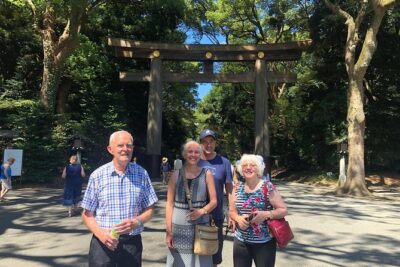
Tokyo 6hr Private Tour with Government-Licensed Guide
Read our review →
Shiraito Falls & Forest Cafe & Handmade Flower Salt Pudding & Grilled Seafood & Totoro Forest & Sakurai Futamigaura & Angel’s Wings & Coconut Tree Swing Day Tour (Departing from Hakata Station, with Mandarin, English, and Cantonese speaking guide)
Read our review →
Shinjuku Local Bar and Izakaya Guided Walking Tour
Read our review →
Private City Highlights Tour with Local Guide
Read our review →
Kyoto Early Morning Tour with English-Speaking Guide
Read our review →