
Reviewed · KIMONO AND CULTURAL DRESS
Kyoto 5-Star Geisha Night Walk: Small-Group Authentic Experience
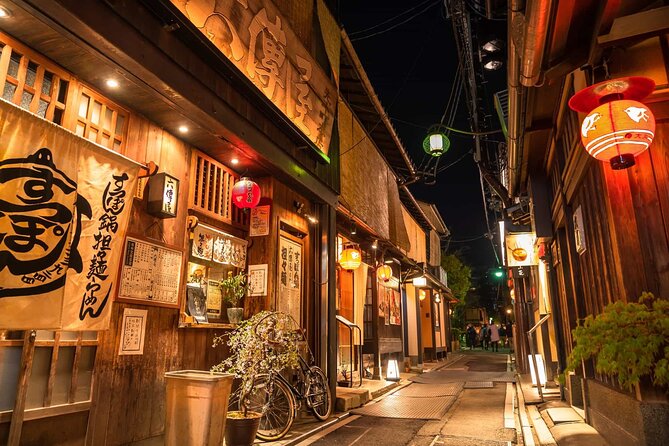
Kyoto after dark feels like another city. This 3.5-hour walk brings you into Gion’s lantern-lit lanes, traditional geisha streets, shrines, temples, and Pontocho with an English-speaking guide who explains what you are seeing instead of simply pointing at it. I especially like the maximum group size of eight, which should make questions and quiet street stops much easier. The included Kyoto snack is another welcome touch during a long evening on foot.
The strongest part of this experience is its cultural context. Richard receives repeated praise for explaining geisha life, kimono, Shinto beliefs, architecture, and Japanese history in a clear, story-based way. I also like the timing: Gion is often packed during the day, while an evening visit brings cooler air, softer light, and a more atmospheric walk. The catch is simple: you need good walking stamina, since the route lasts about three and a half hours and includes steps and rough, unpaved sections.
In This Review
- Key points before you book
- Why an evening walk works better in Gion
- Meeting Richard near Shijo-Kawaramachi
- Hanamikoji Street and the working geisha district
- Kabuki, temples, and two sides of Kyoto
- Yasui-Konpiragu and the meaning of a small shrine
- Yasaka Pagoda and Higashiyama at night
- Nene-no-Michi and the included Kyoto snack
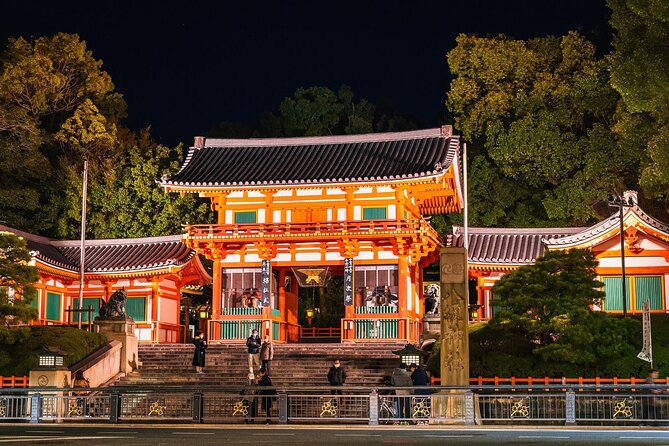
- Yasaka Shrine after sunset
- Pontocho, Kyoto’s narrow nightlife district
- What the $98 price gets you
- Who should book this walk?
- Cancellation and practical planning
- Should you book the Kyoto Geisha Night Walk?
- FAQ
- How long does the Kyoto Geisha Night Walk last?
- What time does the tour start?
- Where does the tour begin?
- Where does the tour end?
- How many people can join the tour?
- Is a snack included?
- Is the tour conducted in English?
- Is the walk suitable for people with walking difficulties?
- What happens if the weather is poor?
Key points before you book
- Gion after sunset: See Hanamikoji Street and nearby alleys when the district is less crowded and traditional buildings are softly lit.
- Richard’s cultural storytelling: His explanations cover geisha training, kimono, Shinto, temples, architecture, and Kyoto life.
- Eight people maximum: A small group gives the guide more room to answer questions and adjust the pace.
- A wide-ranging route: The walk links Gion, Higashiyama, Yasaka Shrine, and Pontocho rather than staying in one street.
- Snack break included: You receive a local Kyoto treat during a 30-minute pause on Nene-no-Michi.
- A walking-first evening: The tour begins at 5:20 pm near the Disney Store in Kyoto Shijo-Kawaramachi and ends at Sanjo Ohashi Bridge.
Why an evening walk works better in Gion
Gion is one of Kyoto’s most famous districts, and fame brings crowds. By day, Hanamikoji Street can feel like a photo queue, with people stopping in the middle of the lane and peering into private entrances. This tour shifts the visit into the evening, when the mood is quieter and the old wooden facades look especially atmospheric.
You should not expect Gion to become empty. It remains a working neighborhood with restaurants, bars, residents, and people heading to appointments. The value is that the night setting makes the district feel less like a sightseeing display and more like a living part of Kyoto.
The guide also helps you read the streets correctly. A simple doorway may lead to a geisha house, a training space, or a private residence. That distinction matters. Geisha districts are not open-air museums, and respectful behavior is part of the experience. You will pass working establishments and living quarters, but the tour is about understanding the culture from public streets, not entering private buildings.
More Kimono Experiences in Kyoto
- [Kyoto & Nara Day Tour] Sagano Scenic Railway & Nara Park & Fushimi Inari Taisha Thousand Torii Gates & Togetsukyo Bridge & Bamboo Grove & Kimono Forest (Departing from Osaka)
★ 4.9 · 10,942 reviews - Kyoto Geisha Walking Tour: Gion District & Hidden Gems
★ 4.7 · 3,273 reviews - Kyoto: Gion Magical Night Walking Tour with Geisha Trivia
★ 4.9 · 2,393 reviews
Meeting Richard near Shijo-Kawaramachi
The meeting point is outside the Disney Store at Kyoto Shijo-Kawaramachi, at the northeast corner of Shijo Street and Kawaramachi Street. The tour starts at 5:20 pm, so plan to arrive early enough to find the correct corner in the busy shopping district.
This location is convenient for public transportation, but it is also a busy urban intersection. Keep the meeting instructions and mobile ticket easy to access. Once the group sets off, the commercial streets give way to older lanes and the traditional districts that form the heart of the evening.
Richard is the guide most often praised for this experience. His background is described as American and Japanese, which helps him explain Japanese customs to an English-speaking audience without assuming too much prior knowledge. He is also praised for answering questions thoroughly, keeping families involved, and offering restaurant suggestions when asked.
That matters on a cultural tour. Geisha traditions can be misunderstood through films, photographs, or quick internet summaries. A guide who can explain both the visible details and the social background gives you a more useful picture.
Hanamikoji Street and the working geisha district
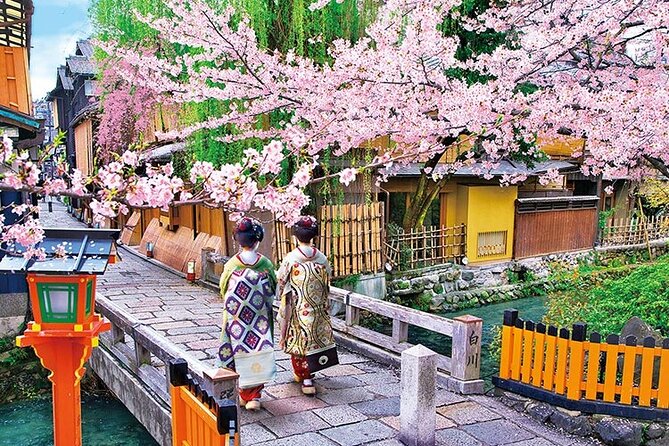
The first major portion of the walk takes about an hour around Hanamikoji Street and the surrounding alleys. This is the core geisha district experience, but the appeal is not simply the chance of seeing a maiko or geiko heading to an appointment.
The guide explains geisha arts, training, clothing, and daily life while taking you past geisha houses and living quarters. You may learn how the training process works and how the district functions today. The exact conversation will depend on your questions and the evening’s pace, but the focus is on cultural explanation rather than celebrity spotting.
Some participants have been lucky enough to see geisha and new trainees moving through the area. Treat that as a possibility, not a promise. The most reliable benefit is learning how to recognize the setting and understand why these streets matter.
You will also pass Gion Corner, associated with geisha study and training. This adds useful context to the walk because it connects the polished appearance of the district with the work, practice, and discipline behind traditional performance arts.
Photography needs common sense here. The supplied information does not promise private access or arranged photographs, and the route passes active businesses and homes. Listen to the guide and avoid blocking lanes or photographing people without permission.
Kabuki, temples, and two sides of Kyoto
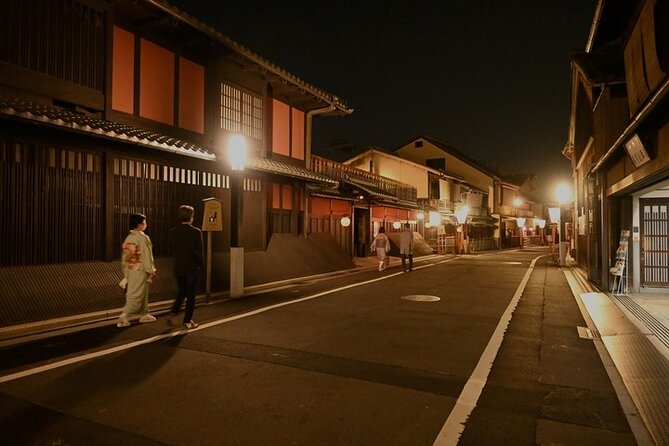
The walk includes a stop near the Kabuki theater, where Richard explains this traditional form of Japanese entertainment. Even a short explanation can help you see the connection between performance, costume, stagecraft, and the wider world of Kyoto’s traditional arts.
The route then moves toward one of Kyoto’s oldest temples, with an explanation of Japanese Zen. This part broadens the evening beyond geisha culture. Kyoto is not just wooden teahouses and elegant kimono. Its cultural life also includes religious practice, theater, architecture, food, and the routines of people who have lived in the city for generations.
You will not receive a full temple tour or a long meditation session. Instead, the stop gives you a framework for understanding what you pass. That is a good use of a walking guide, especially if you are seeing temples at night and want more than a quick photograph.
More Walking Tours in Kyoto
- Kyoto: Gion Geisha District Walking Tour – Stories of Geisha
★ 4.7 · 2,187 reviews - Night Walk in Gion: Kyoto’s Geisha District
★ 4.5 · 2,003 reviews - Kyoto Gion Geisha District Walking Tour – The Stories of Geisha
★ 5.0 · 1,441 reviews - Nishiki Market Brunch Walking Tour (7 Tastings + Brunch)
★ 5.0 · 1,355 reviews
Yasui-Konpiragu and the meaning of a small shrine
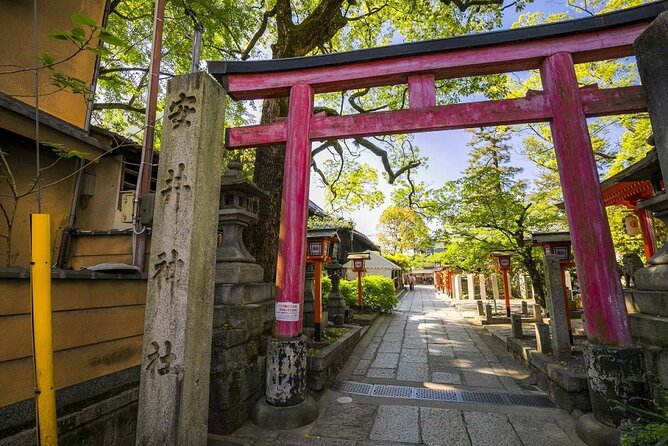
Yasui-Konpiragu receives about 30 minutes on the route. It is an intimate Shinto shrine, and the guide explains ancient traditions as you explore it.
A smaller shrine can be more rewarding than a huge landmark when you have someone to explain the symbols and customs. The setting lets you focus on details and beliefs without the same scale as Kyoto’s major temple compounds. The stop also gives the walk a change of pace after the narrow geisha lanes.
The title of the tour places geisha culture at the center, but the inclusion of Shinto and Zen is one reason the experience receives such strong praise. You are not just looking at an attractive district. You are learning how religion, art, social customs, and city life overlap in Kyoto.
Yasaka Pagoda and Higashiyama at night
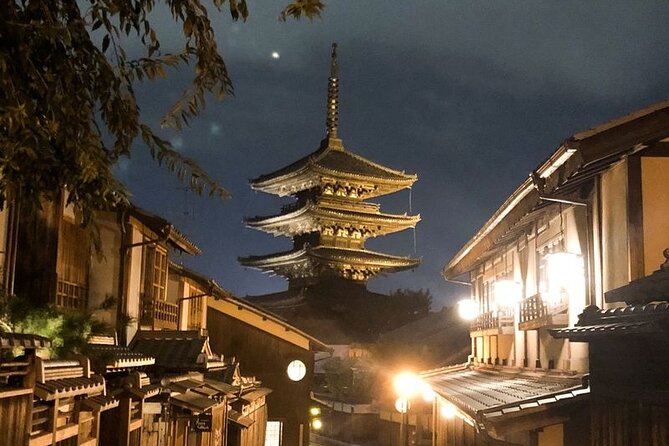
Hōkan-ji Temple, better known for its Yasaka Pagoda, is scheduled for about 15 minutes. This is one of the evening’s best photo locations, with a historic streetscape that looks particularly striking after sunset.
The short stop is enough for photographs and an explanation, but it is not a full temple visit. That is worth knowing if you want extensive time at every landmark. The tour covers several areas, so the tradeoff is variety rather than long stays.
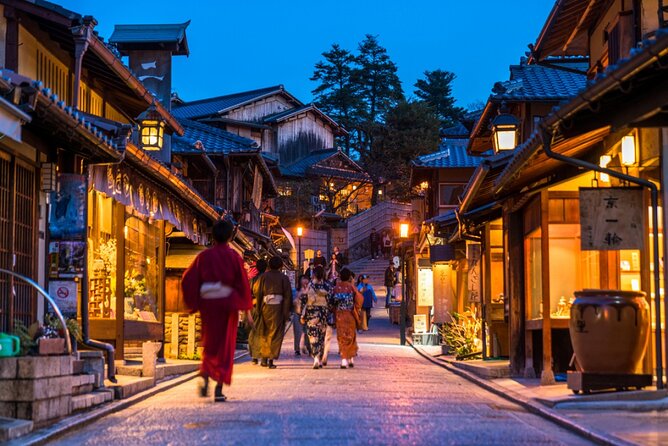
From there, the route continues through Ninenzaka, another 15-minute section. The alley is especially appealing at night, when the traditional buildings and sloping stone streets take on a quieter character. You will walk through an area that many people visit during the day, but the evening timing changes the feel.
Steps and uneven surfaces become more relevant here. The operator notes that strollers may need to manage steps and unpaved rocky paths. The walk is not suitable for anyone with walking issues, so consider your comfort before paying. Comfortable shoes are the practical choice, even though the tour itself does not state a dress requirement.
Nene-no-Michi and the included Kyoto snack
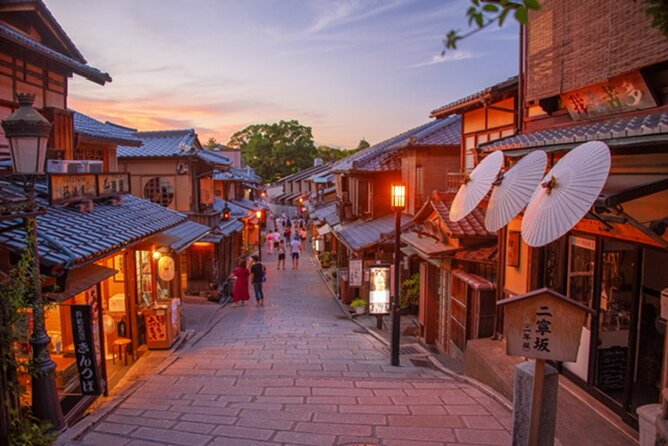
Nene-no-Michi is the planned break point, with around 30 minutes for a Kyoto snack and a rest. After several sections on foot, this pause has real value. It gives you time to sit or slow down, ask follow-up questions, and process what you have seen.
The exact snack is not specified in the tour details. Some feedback describes it as a traditional or Kyoto-style treat, with the guide explaining its different parts. You may enjoy it, or you may find the taste unfamiliar. That is part of the point: this is a small chance to try something local rather than a generic packaged refreshment.
The snack does not replace dinner. The tour lasts into the evening, and the food inclusion is described as a short break, not a meal. If you need a full dinner, plan to eat before the tour or after it. Richard has also provided restaurant suggestions when asked, which may help you decide where to go once the walk ends.
Yasaka Shrine after sunset
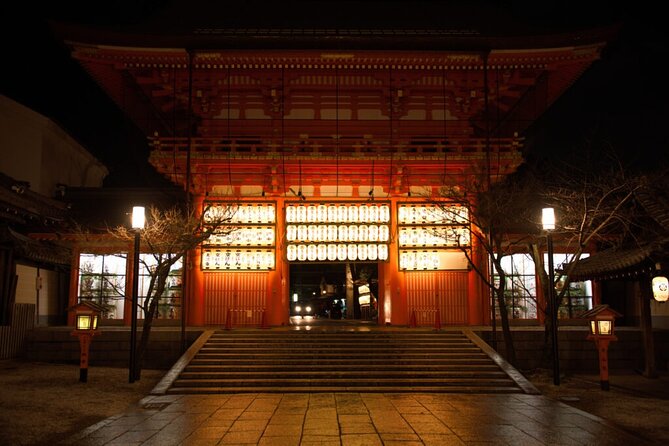
Yasaka Shrine receives about 30 minutes. It is one of Japan’s major shrines and an important stop for understanding Kyoto’s religious traditions.
At night, the shrine offers a different experience from a daytime visit. The atmosphere is calmer, and the guide can point out features that you might otherwise pass without noticing. The stop also provides a useful contrast with the private-looking lanes of Gion. Here, the setting is a major public religious site rather than a cluster of working entertainment houses.
The tour does not promise a special ceremony or exclusive access. Its strength is the guide’s explanation and the chance to see the shrine as part of a broader route through eastern Kyoto.
Pontocho, Kyoto’s narrow nightlife district
The final major stop is Pontocho, where the walk ends near Sanjo Ohashi Bridge. The group explores the narrow Pontocho District for about 30 minutes, seeing a mixture of geisha houses, bars, and nightlife.
Pontocho feels different from Gion. Gion has broad famous lanes and a strong connection to traditional architecture and geisha quarters. Pontocho is narrower and more nightlife-focused, with a compact corridor of restaurants and entertainment venues. Seeing both districts helps you understand that Kyoto’s geisha areas are not all alike.
The official end point is the northern end of Pontocho alley near Sanjo Ohashi Bridge. This is a useful finish because you are near transportation and evening dining options, though the tour does not include a ride back to your accommodation.
What the $98 price gets you
At $98 per person, this is not the cheapest way to walk through Gion. You can visit many of these streets, shrines, and viewpoints without paying an admission fee. The question is what you gain from having a guide for three and a half hours.
For me, the value rests in four things:
- Interpretation: You receive explanations of geisha training, kimono, Shinto, Zen, Kabuki, and Kyoto customs.
- Route planning: The guide connects Gion, Higashiyama, Yasaka Shrine, and Pontocho in one evening.
- Small-group access: With no more than eight people, the experience should feel less like a large street procession.
- Local orientation: You can ask questions about restaurants, districts, and cultural details as you go.
The price makes more sense if this is your first Kyoto visit, your first close look at geisha culture, or the first evening of your stay. Several comments indicate that taking it early helped provide context for the rest of a Kyoto trip. It can also save you from wandering through the districts without understanding what is public, private, historic, or still active today.
If you already know Gion well and prefer exploring alone, the cost may feel high. You are paying for the guide’s time and explanations, not entrance tickets to a series of attractions.
Who should book this walk?
I would recommend it to anyone who wants cultural context with their evening sightseeing. It suits couples, families, and small groups who enjoy asking questions and walking at a steady pace. The feedback especially praises Richard’s ability to keep different ages engaged, so families may find the storytelling easier to follow than a lecture-heavy tour.
It is also a good choice if you enjoy photography. Yasaka Pagoda, Ninenzaka, lantern-lit lanes, shrines, and old wooden buildings offer many atmospheric scenes. Just keep photography respectful around working geisha districts.
You should think twice if you dislike long walks, uneven paths, or a fixed route. The tour lasts approximately 3 hours and 30 minutes, includes steps and rocky sections, and is specifically not suitable for people with walking issues. Strollers may also be difficult in parts of the route.
The experience is conducted in clear, native English and includes a mobile ticket. Personal expenses are not included, and tips are appreciated. The tour requires good weather, so poor conditions can lead to a different date or a full refund.
Cancellation and practical planning
You can cancel at least 24 hours before the 5:20 pm start time for a full refund. Cancellations or changes made within 24 hours are not refunded or accepted.
Because this is an outdoor walking experience, check the forecast before leaving your hotel. Wear shoes suited to steps and rough paths, bring water, and avoid scheduling another demanding activity immediately afterward. The snack is included, but dinner is not.
Should you book the Kyoto Geisha Night Walk?
Book it if you want to understand Kyoto’s geisha districts rather than simply photograph them. The small group, evening timing, broad route, local snack, and Richard’s clear storytelling make this a strong choice for a first visit, especially if you take it near the beginning of your stay.
Skip it if you want private geisha contact, guaranteed sightings, indoor performances, or a short and easy stroll. That is not what this experience offers. It is a guided walk through public streets and religious sites, built around explanation, atmosphere, and respectful observation.
For most people who can handle the walking, $98 is a fair price for a focused evening that puts Gion and Pontocho into cultural context. You leave with more than night photographs. You gain a better sense of how Kyoto’s traditional arts, shrines, neighborhoods, and modern evening life fit together.
FAQ
How long does the Kyoto Geisha Night Walk last?
The tour lasts approximately 3 hours and 30 minutes.
What time does the tour start?
The tour starts at 5:20 pm.
Where does the tour begin?
It begins at the Disney Store at Kyoto Shijo-Kawaramachi, at the northeast corner of Shijo Street and Kawaramachi Street.
Where does the tour end?
The walk ends at Sanjo Ohashi Bridge, at the northern end of Pontocho alley.
How many people can join the tour?
The tour has a maximum of eight participants.
Is a snack included?
Yes. A local Kyoto snack is included during a break at Nene-no-Michi.
Is the tour conducted in English?
Yes. An expert guide speaking clear, native English leads the walking tour.
Is the walk suitable for people with walking difficulties?
No. The 3.5-hour route is not suitable for anyone having walking issues. It includes some steps and unpaved rocky paths, which can also be difficult for strollers.
What happens if the weather is poor?
The experience requires good weather. If it is canceled because of poor weather, you will be offered another date or a full refund.
Just added in Kyoto
- The “Golden Route” and Ancient Japan by DIAMIR Erlebnisreisen – 14-Day Tour★ 2.0 · 2 reviews
- Japan: Castles & Cuisine by G Adventures – 6-Day Kyoto to Osaka Tour★ 4.5 · 4 reviews
- Cycle Japan by Explore! – 13-Day Kyoto to Tokyo Tour★ 4.7 · 12 reviews
- Cycle Japan by Intrepid Travel – 11-Day Kyoto to Tokyo Tour★ 4.8 · 2 reviews
- Classic Japan by Intrepid Travel – 11-Day Kyoto to Tokyo Tour★ 4.4 · 14 reviews
- Ancient & Modern Japan 14-Day Tour by Exodus Adventure Travels★ 4.4 · 40 reviews
- 5 Day Cultural Adventure of Kyoto, Nara & Osaka by Tourist Journey★ 2.5 · 2 reviews
- 12 Days Kinosaki Onsen Escape: A Journey Through Japan’s Timeless Towns by UME Travel★ 4.8 · 5 reviews
Kimono and Cultural Dress, compared.
![[Kyoto & Nara Day Tour] Sagano Scenic Railway & Nara Park & Fushimi Inari Taisha Thousand Torii Gates & Togetsukyo Bridge & Bamboo Grove & Kimono Forest (Departing from Osaka)](https://media.japanvisits.com/wp-content/uploads/kyoto-nara-day-tour-sagano-scenic-railway-nara-park-fushimi-inari-taisha-thousand-torii-gates-togetsukyo-bridge-bamboo-grove-kimono-forest-departing-from-osaka-k110001-400x257.jpg)

Tokyo Asakusa Kimono&Yukata Rental at Kimono Miyabi Asakusa Station
Read our review →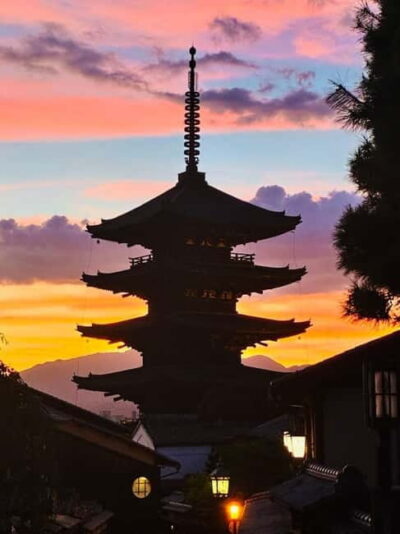
Kyoto Geisha Walking Tour: Gion District & Hidden Gems
Read our review →
Gion Magical Night Walking Tour with Geisha Trivia
Read our review →
Gion Geisha District Walking Tour – Stories of Geisha
Read our review →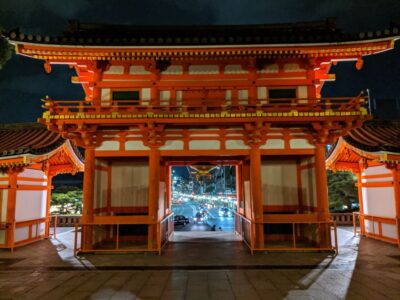
Best of Kyoto: Gion, Geisha, Pagodas & Cobblestones
Read our review →
Kyoto Kimono Rental Experience (Optional Exquisite Hair Styling/Japanese Makeup/Photography) (Ookini Kiyomizu-dera Main Store)
Read our review →Browse the lists this tour appears in