
Reviewed · FOOD TOURS
Kyoto Food Tour of 10 Tastings with Wagyu, Mochi & More Surprises
Kyoto tastes better one small bite at a time. This 3-hour-30-minute walk connects Karasuma, Nishiki Market, the Kamo River, and Gion through a lineup of ten Japanese tastings, with Wagyu sushi and yuba tofu among the highlights. I like the easy-to-find starting point and the small maximum group of ten, which keeps the outing more personal than a large food crawl. The main drawback is that several stops feature fried or casual street food, so anyone seeking a polished, restaurant-heavy meal may find the selection less satisfying.
I also like the way the food walk doubles as a first look at central Kyoto. You get a taste of katsudon, okonomiyaki, fish cakes, sake, beer, daifuku mochi, and matcha while moving toward Gion. The weak point, based on some lower scores, is guide delivery: guides such as Yuma and Tomoro earned warm praise for being friendly, while some people found the English too soft or the food explanations too brief.
In This Review
- Key things to know before booking
- Starting at Karasuma with a clear meeting point
- First stop: katsudon with a Kyoto twist
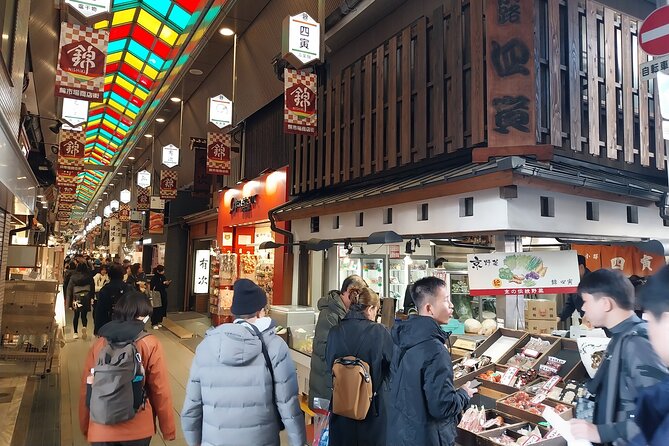
- Nishiki Market, Kyoto’s main food chapter
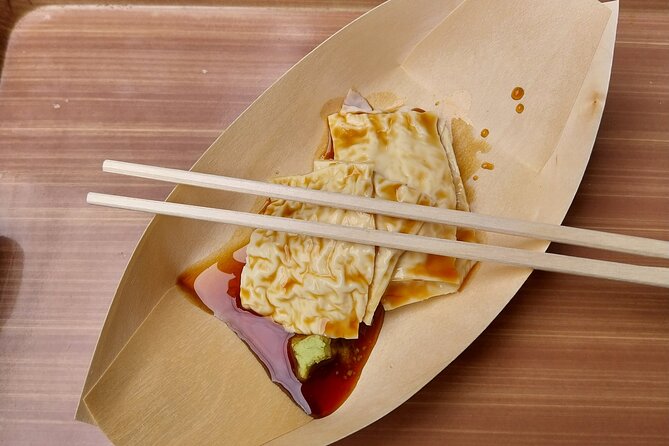
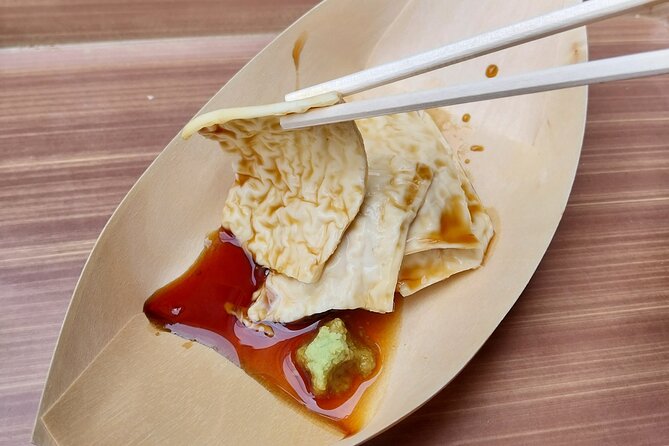
- Yuba tofu and the art of soy milk
- Sake, fish cakes, and market texture
- Wagyu sushi and a Kyoto-style savory pancake
- Daifuku mochi and the final matcha stop
- What the ten tastings really include
- Guide quality can shape the whole experience
- Walking, timing, and practical planning
- Who will get the most from this Kyoto food walk?
- Should you book the Karasuma to Gion food tour?
- FAQ
- Where does the Kyoto food tour start?
- How do I identify the guide?
- Where does the tour end?
- How long does the experience last?
- How many people can join the group?
- What foods are included?
- Are drinks included?
- Is hotel pickup included?
- Can dietary requirements be accommodated?
Key things to know before booking
- Ten tastings cover both food and drink: Expect katsudon, yuba tofu, Wagyu sushi, fish cakes, okonomiyaki, mochi, a secret dish, beer, sake, and Japanese tea.
- The route runs from Karasuma to Gion: You will walk through Nishiki Market and along views of Pontocho and the Kamo River.
- Nishiki Market gets the most time: About 90 minutes are set aside for food, crafts, local trades, and market browsing.
- The group is limited to ten people: That suits you if you prefer a quieter outing and a chance to ask questions.
- Wear proper walking shoes: This is a point-to-point walk, not a series of short rides between restaurants.
- The menu can change: Food availability, weather, and other conditions may alter the route or tastings.
Starting at Karasuma with a clear meeting point
The tour begins outside Starbucks Coffee in the Kyoto Sanjo Karasuma Building, across from Exit 5 of Karasuma Oike Subway Station. That is useful in a city where a station exit can make the difference between finding your guide quickly and wandering around a block of similar-looking streets.
Look for the guide holding an orange umbrella. After introductions, you receive an outline of the walk before setting off. The starting area makes sense for this route: Karasuma is central, well connected, and a practical place to begin a walk toward the market and Gion.
The small-group format is one of the strongest features. With no more than ten people, you are less likely to be split into separate clusters at food counters. It also gives you a better chance to hear the guide, though that depends on the individual guide’s voice and English ability.
The price is $142 per person. That is not cheap for three and a half hours of food, especially when some items are casual market snacks that you could buy yourself for less. You are paying for the route, several included tastings, drinks, local context, and the convenience of having the stops arranged. The value is best if you want an introduction to Kyoto food and do not want to research every stall and restaurant yourself.
More Food Tours in Kyoto
- Kyoto Night Foodie Tour in Gion (9+ dishes + 6 Sake tastings)
★ 5.0 · 1,762 reviews - Kyoto: Gion Food Tour 13 Dishes at 4 Eateries
★ 5.0 · 408 reviews - Kyoto Foodie Night Tour
★ 5.0 · 376 reviews
First stop: katsudon with a Kyoto twist
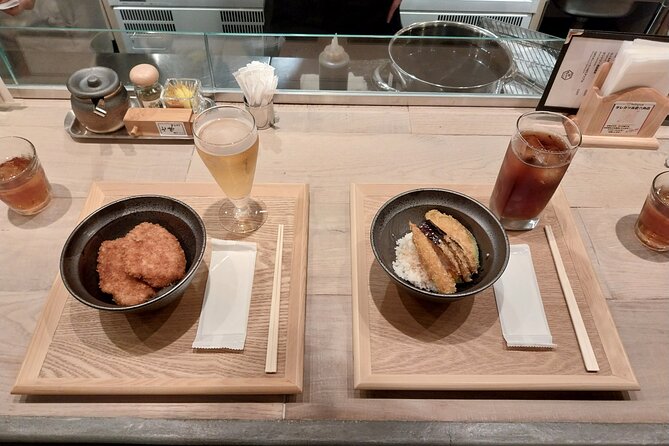
The first food stop is Kyoto Tonkatsu Katsuda near Shijo Kawaramachi. Here, the tour starts with katsudon, a familiar Japanese dish made with breaded pork served over rice, presented with a regional flavor variation.
This is a sensible opening bite. It gives you something filling before the lighter market samples arrive, and it introduces the idea that Japanese food changes from place to place. The point is not simply to eat a standard dish, but to notice how Kyoto’s local preferences affect a familiar meal.
The stop lasts about 30 minutes. That gives you time to eat rather than rush through a single mouthful. It also means the first course takes up a meaningful part of the tour, so the experience feels closer to a progressive meal than a quick snack circuit.
If you dislike fried food, note the pattern from the beginning. The tonkatsu course contributes to the tour’s heavier side, and some of the other tastings may also be fried. This is one reason I would not book the walk expecting ten delicate, highly refined courses.
Nishiki Market, Kyoto’s main food chapter
The tour spends roughly 90 minutes in Nishiki Market, the longest section of the outing. The market street stretches about 400 meters and is lined with food sellers and small businesses. The guide explains local artisans and their trades while leading you to several tastings.
Nishiki is valuable because food here is tied to daily commerce. You are not only sampling finished dishes. You are also seeing ingredients, handmade products, and small-scale food production in the setting where Kyoto residents shop and work.
Yuba tofu and the art of soy milk
Yuba tofu is one of Kyoto’s signature preparations. It forms from the thin skin that develops on heated soy milk, and it has a delicate texture that is quite different from firm tofu. A presentation helps make this tasting more than a quick sample, since you can see how the food is prepared and understand why it matters in Kyoto cooking.
This is one of the more distinctive items on the menu. Wagyu sushi may sound more immediately luxurious, but yuba offers a stronger connection to local tradition. If you want food with a clear Kyoto identity, pay close attention here.
A completely different kind of day out:
- PERFECT KYOTO 1-Day Bus Tour
★ 5.0 · 13,518 reviews - [Kyoto & Nara Day Tour] Sagano Scenic Railway & Nara Park & Fushimi Inari Taisha Thousand Torii Gates & Togetsukyo Bridge & Bamboo Grove & Kimono Forest (Departing from Osaka)
★ 4.9 · 10,942 reviews - Kyoto: Fushimi Inari, Kinkakuji, Bamboo Grove 1 Day Bus Tour
★ 4.8 · 4,316 reviews - Kyoto: Tea Ceremony in a Traditional Tea House in Kiyomizu
★ 4.9 · 3,519 reviews
Sake, fish cakes, and market texture
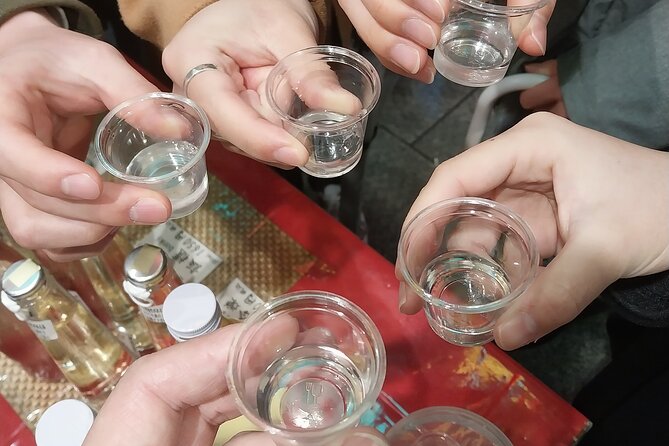
You also taste local sake and freshly made fish cakes in several flavors. The sake tasting adds a drink component without requiring you to visit a dedicated brewery or bar. The fish cakes provide a savory contrast to tofu and later sweets.
The market portion is likely to feel the most informal. You may eat standing or in compact spaces, and the order of tastings can change based on what is available. That is part of the charm, but it also means the tour will not have the controlled rhythm of a formal restaurant meal.
The market is also where guide quality matters most. A strong explanation can connect ingredients, local trades, and Kyoto customs. A quiet guide with limited English can make the same stop feel like a series of unconnected samples. If you have food questions, ask them directly and early.
Wagyu sushi and a Kyoto-style savory pancake
Wagyu sushi is included among the featured tastings. The beef is seared, then served in sushi form, giving you a richer bite than the market fish cakes or tofu. It is a crowd-pleasing course and one of the items that helps justify the tour price for people who want to sample premium Japanese beef without arranging a separate meal.
You should keep your expectations measured. One tasting is not a full Wagyu dinner, and the exact presentation can vary. Still, it gives you a compact introduction to the way Japanese ingredients are combined with sushi technique.
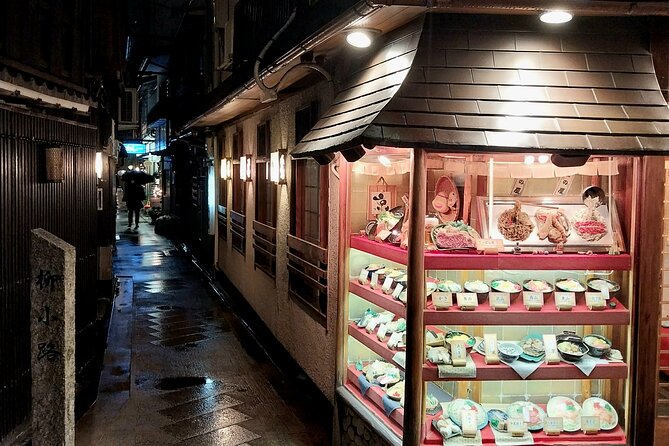
After walking through Pontocho and enjoying views along the Kamo River, the route reaches Gion. Pontocho’s narrow streets and the riverfront provide a pleasant change from the market’s tight food stalls. This stretch is important because it lets the tour function as a walking orientation to central Kyoto, not just a sequence of eating stops.
In Gion, you sit down for Kyoto-style okonomiyaki. This savory pancake is cooked with a mix of ingredients and finished with toppings, though the precise preparation can vary. The tour describes this as a hearty rest stop, and the timing makes sense: after market walking, a hot meal gives you a chance to slow down.
The restaurant is described as quaint, which suggests a more intimate setting than a large dining hall. You should not expect a long restaurant experience, since about 30 minutes are allotted. It is enough time for a hearty serving, but not for lingering over several courses.
Okonomiyaki also reinforces the tour’s casual side. This is approachable Japanese food, not ceremonial dining. I see that as a strength if you want ordinary food with a regional touch. It is less appealing if your goal is an elegant Kyoto kaiseki-style meal.
Daifuku mochi and the final matcha stop
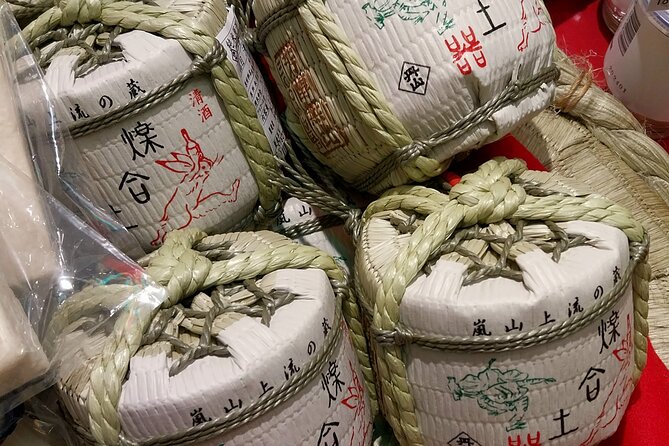
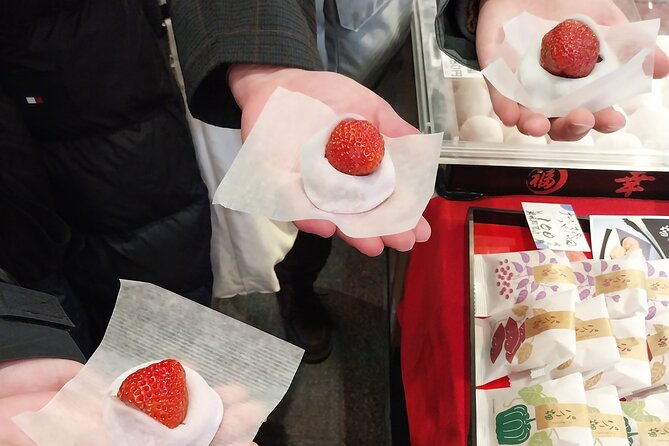
Daifuku mochi with a seasonal fruit filling provides the sweet course. Mochi has a soft, chewy rice-cake exterior, while the fruit adds freshness and a changing seasonal note. Since the tour menu can change, the exact fruit is not guaranteed.
This is a useful counterpoint to the fried and savory dishes. It gives the meal a lighter finish before tea, and it adds a texture many first-time visitors may not have tried in this form. Eat it slowly, since mochi is dense despite its small size.
The final stop is a matcha venue in Kyoto, a city closely associated with tea ceremony. You can receive hot or cold tea, depending on the season, within the available selection. The stop lasts about 20 minutes and brings the walk to a calm close.
Japanese tea is included as a tasting rather than a full tea ceremony. That distinction matters. You are sampling tea at the end of a food walk, not taking part in a formal ceremony with an extended demonstration. Still, matcha gives the tour a distinctly Kyoto finish and helps balance the meat, fried food, and sweets.
The route ends at the entrance to the Minami Gion district. Gion Shijo Station on the Keihan Line is only a couple of minutes away, and Yasaka Shrine is nearby. That makes the ending convenient if you want to continue sightseeing rather than return directly to your hotel.
What the ten tastings really include
The advertised food and drink lineup is broad:
- Yuba tofu
- Katsudon with a local twist
- Kyoto-style okonomiyaki
- Seared Wagyu sushi
- Fresh handmade fish cakes
- Daifuku mochi with seasonal fruit
- A secret dish
- A glass of draft beer
- A selection of Kyoto sake
- Japanese tea, hot or cold
That is a good spread of textures and categories. You get meat, soy, rice, seafood-based snacks, sweets, alcohol, and tea. The secret dish adds a little uncertainty, though it also means you cannot plan around a fixed ten-item menu.
The biggest concern is freshness and balance. Some people found the food too fried and wanted more fresh dishes. If you prefer vegetables, raw seafood, or subtle seasonal cooking, you may find the selection heavy. If you like savory comfort food, small market bites, and a few premium touches, the lineup should feel more rewarding.
The menu is subject to location availability, weather, and other conditions. You should treat the listed foods as the intended range, not an unchangeable promise.
Guide quality can shape the whole experience
The experience earns a very strong overall rating of 4.9 from 85 ratings, with 96 percent recommending it. The most warmly praised guides include Yuma, described as friendly and pleasant, and Tomoro, who received especially positive comments for the food and market walk.
At the same time, guide performance is not perfectly consistent. Some people found the guide too quiet, with only moderate English and limited detail about the dishes, ingredients, and history. That is the most important caution in deciding if this tour suits you.
I would book this if you value company, a planned route, and the chance to ask questions in a small group. I would hesitate if you want a specialist food historian or chef leading every stop. The guide may be passionate about Kyoto food without having a professional culinary background.
Walking, timing, and practical planning
The full route takes about three and a half hours, with a fair amount of walking. Comfortable shoes are essential. You move from Karasuma through Nishiki Market, across the Pontocho and Kamo River area, and into Gion, so this is not a stationary tasting.
The meeting point is close to public transportation, and the ending is also convenient. Hotel pickup and drop-off are not included, so you need to reach Starbucks near Karasuma Oike Station on your own.
Most people can participate, but the walking requirement matters more than any formal access statement. Plan to eat a light meal beforehand rather than arriving very hungry or overly full. The dishes are spread across the route, and the early katsudon and later okonomiyaki are more substantial than simple samples.
Tell the operator about dietary requirements in advance. The tour asks you to make contact ahead of time so the food can be adjusted as well as possible. Do not wait until the meeting point, since menu changes depend on the individual locations.
Free cancellation is available if you cancel at least 24 hours before the start time. Cancellations inside that window are not refunded. Poor weather or failure to reach the minimum group size can also lead to a date change, another experience, or a full refund.
Who will get the most from this Kyoto food walk?
I think this tour is a good fit for a first visit to Kyoto, especially if you want food and neighborhood orientation in the same afternoon. You will see several central areas while sampling dishes that are easy to miss when you eat only near major sights.
It also suits you if you like a social outing with a limited group and do not want to make a long list of restaurant reservations. The included beer, sake, and tea make the price easier to accept, particularly for anyone who values convenience and variety.
I would choose something else if you want a refined dining tour, a large number of fresh dishes, or detailed culinary lectures at every stop. The food leans casual, the menu may shift, and the guide’s communication style can make a real difference.
Should you book the Karasuma to Gion food tour?
Book it if you want an easy introduction to Kyoto food, a walk through Nishiki Market and Gion, and a broad set of tastings in one outing. The strongest reasons are the small group, the yuba presentation, Wagyu sushi, local sake, and the practical point-to-point route.
Skip it if $142 feels high for casual food, or if fried dishes are not your thing. For the best match, contact the operator about dietary needs before booking, wear good shoes, and approach the experience as a guided tasting walk rather than a formal food seminar.
FAQ
Where does the Kyoto food tour start?
It starts in front of Starbucks Coffee in the Kyoto Sanjo Karasuma Building, across from Exit 5 of Karasuma Oike Subway Station.
How do I identify the guide?
The guide will be holding an orange umbrella at the meeting point.
Where does the tour end?
The tour ends at the entrance to the Minami Gion district. Gion Shijo Station on the Keihan Line is a few minutes away, and Yasaka Shrine is nearby.
How long does the experience last?
The tour lasts approximately 3 hours and 30 minutes.
How many people can join the group?
The maximum group size is 10 people.
What foods are included?
Included tastings feature yuba tofu, katsudon, okonomiyaki, seared Wagyu sushi, fresh fish cakes, daifuku mochi with seasonal fruit, and a secret dish.
Are drinks included?
Yes. The experience includes a glass of draft beer, a tasting of various Kyoto sakes, and Japanese tea served hot or cold.
Is hotel pickup included?
No. Hotel pickup and drop-off are not included.
Can dietary requirements be accommodated?
You should contact the operator in advance with any dietary requirements so they can try to make suitable arrangements.
Just added in Kyoto
- The “Golden Route” and Ancient Japan by DIAMIR Erlebnisreisen – 14-Day Tour★ 2.0 · 2 reviews
- Japan: Castles & Cuisine by G Adventures – 6-Day Kyoto to Osaka Tour★ 4.5 · 4 reviews
- Cycle Japan by Explore! – 13-Day Kyoto to Tokyo Tour★ 4.7 · 12 reviews
- Cycle Japan by Intrepid Travel – 11-Day Kyoto to Tokyo Tour★ 4.8 · 2 reviews
- Classic Japan by Intrepid Travel – 11-Day Kyoto to Tokyo Tour★ 4.4 · 14 reviews
- Ancient & Modern Japan 14-Day Tour by Exodus Adventure Travels★ 4.4 · 40 reviews
- 5 Day Cultural Adventure of Kyoto, Nara & Osaka by Tourist Journey★ 2.5 · 2 reviews
- 12 Days Kinosaki Onsen Escape: A Journey Through Japan’s Timeless Towns by UME Travel★ 4.8 · 5 reviews
Food Tours, compared.
Shinjuku Food Tour (13 Dishes at 4 Local Eateries)
Read our review →
Shinsekai Food Tour with 13-15 Dishes at 5 Eateries
Read our review →
Osaka Food Tour: 13 Dishes at 5 Local Eateries
Read our review →
Shinjuku Food Tour (15 Dishes and 4 Eateries)
Read our review →
Best of Shinjuku: Izakaya Food Tour (4 Stops, 14+ Tastings)
Read our review →
Kyoto Night Foodie Tour in Gion (9+ dishes + 6 Sake tastings)
Read our review →
Hungry Osaka Street Food Tour:15 Tastings & 3 Drinks with a Local
Read our review →
Tokyo Night Foodie Tour in Shinjuku – Seasonal Sushi, Wagyu Beef
Read our review →Browse the lists this tour appears in