
Reviewed · KIMONO AND CULTURAL DRESS
Kyoto Gion Night Walk & Geisha District Guided Tour
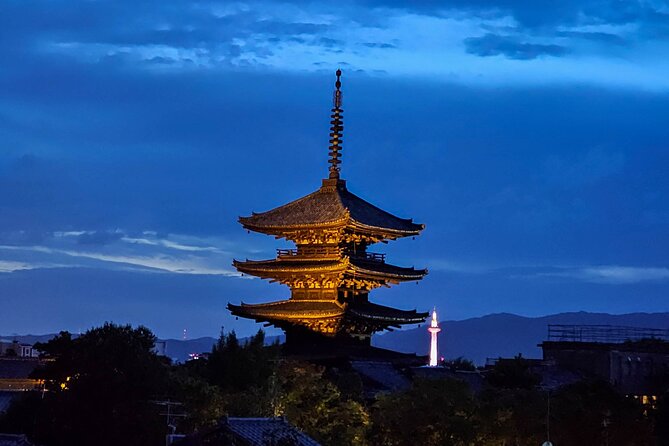
Kyoto glows after dark. This three-hour walk through Gion brings you past lantern-lit lanes, old teahouses, Hanamikoji Street, and Yasaka Shrine while a guide explains the customs behind the scenery. I like the small-group format, capped at nine people for the usual outing, and the chance to see quieter corners that are easy to miss alone. The $18 price is also unusually fair for a guided Kyoto evening.
I also like the range of guides, from Naoki and Shingo to Jasmine, Raphael, Vincent, and Miyake. Their strongest skill is turning streets and buildings into stories about geisha culture, shrines, food, and local customs. The main caution is timing: three hours of walking can run through dinner, and winter evenings may feel cold. A few visitors also found the meeting point confusing, so arrive early.
In This Review
- Key points to know before you book
- Why Gion works best after dark
- Starting near Kyoto Kawaramachi
- The long first section through Gion
- Hanamikoji Street and the chance of a sighting
- Yasaka Shrine and the final half hour
- What the guides add to the price
- Food, drinks, and the dinner-hour problem
- Who should choose this Kyoto walk?
- Is the small group really small?
- Final verdict: book it for the stories, not a guarantee
- FAQ
- How long does the Kyoto Gion night walk last?
- Where does the tour start?
- Where does the tour finish?
- Is a geisha or maiko sighting guaranteed?
- Is the tour suitable for children?
- Is food included?
- Can I cancel for a refund?
Key points to know before you book
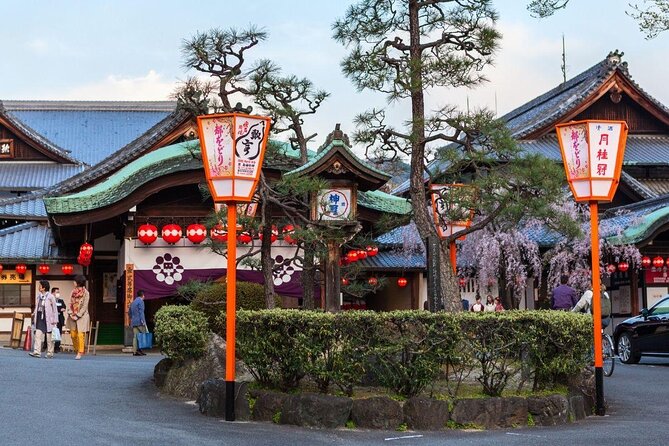
- Gion after sunset: Lanterns, narrow lanes, traditional restaurants, bars, and teahouses give the district a different mood from daytime Kyoto.
- A small walking party: The outing is advertised for no more than nine people, though the general activity information gives a maximum of 25, so confirm the group size for your date.
- Three classic stops: The route covers Gion, Hanamikoji Street, and Yasaka Shrine, with extra lanes and sites along the way.
- Guide quality matters: Strong guides such as Naoki, Jasmine, Shingo, Raphael, Vincent, and Miyake add much of the tour’s value through stories and practical advice.
- Good value at $18: The base price is modest for three hours of guiding, though snacks are listed only for premium group and private bookings.
- A night walk, not a geisha guarantee: You may see a maiko or geisha, but sightings depend on chance, local activity, and the evening’s conditions.
Why Gion works best after dark
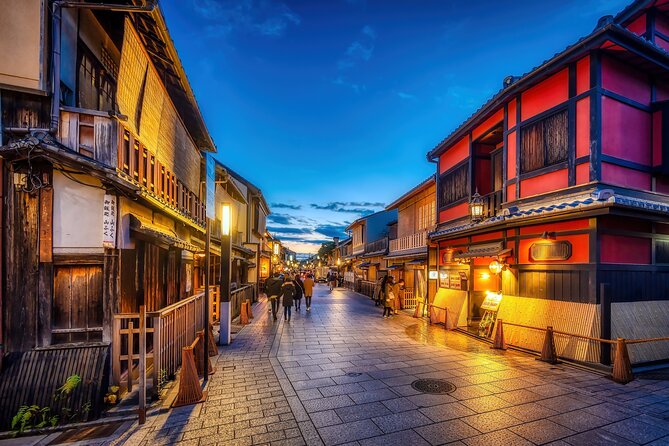
Gion is Kyoto’s historic entertainment district, known for traditional teahouses, restaurants, bars, and the women who work in its geisha culture. At night, the district takes on a quieter, more theatrical look. Paper lanterns glow above wooden facades, and narrow streets reveal details that daylight can flatten.
That atmosphere is the main reason I would choose this tour over a general city walk. You are not simply checking off famous buildings. You are moving through a part of Kyoto where appearance, manners, privacy, and old customs still matter.
The mood changes from night to night. A lively evening may bring more open restaurants and activity, while a holiday or quiet night can make the streets feel subdued. Do not book this expecting a guaranteed geisha sighting or a busy nightlife scene. Book it for the setting and the cultural explanation, with any sighting treated as a bonus.
This is also a useful first-evening activity. Several guides have been praised for restaurant suggestions and advice about other places to visit. You can use the walk to get your bearings, then return to Gion later with a better sense of where you are and what you are seeing.
More Kimono Experiences in Kyoto
- [Kyoto & Nara Day Tour] Sagano Scenic Railway & Nara Park & Fushimi Inari Taisha Thousand Torii Gates & Togetsukyo Bridge & Bamboo Grove & Kimono Forest (Departing from Osaka)
★ 4.9 · 10,942 reviews - Kyoto Geisha Walking Tour: Gion District & Hidden Gems
★ 4.7 · 3,273 reviews - Kyoto: Gion Magical Night Walking Tour with Geisha Trivia
★ 4.9 · 2,393 reviews
Starting near Kyoto Kawaramachi
The meeting point is Kyoto Kawaramachi Garden at 68 Shinchō in the Shimogyo Ward. The area is near public transportation, and buses make access fairly easy, but the meeting place can feel confusing on a busy street with several guides and groups.
I would arrive early and keep the meeting information open on your phone. The ticket is mobile, and confirmation is provided at booking. This is not a hotel pickup tour, so you need to make your own way to the start.
That small preparation matters. One guide, Miyake, was praised for patiently helping someone who had trouble finding the meeting point, but you should not rely on a last-minute rescue. Build in time to identify the correct guide and group before the walk begins.
The route ends at Sanjō Ōhashi Bridge in Nakagyo Ward. That is useful because you finish near another well-connected part of central Kyoto rather than returning to the starting point. One account described a different end point than expected, so check your confirmation carefully before setting out.
The long first section through Gion
The Gion portion lasts about two hours, making it the heart of the experience. Expect to walk through narrow back streets, see illuminated traditional buildings, and pause while the guide explains the district’s architecture, customs, and entertainment culture.
The best guides make these pauses worthwhile. Naoki has been praised for linking Gion to Japanese history and culture, while Shingo was singled out for taking a guest to places they would not have found alone. Jasmine has received strong praise for answering questions carefully and keeping the pace comfortable.
The route may include offbeat temples and shrines that are not always part of a standard sightseeing circuit. This is where a guide can add real value. Without context, a quiet lane may look like a pleasant photo spot. With a good explanation, you begin to understand why the buildings look as they do and how the district functions.
Still, the tour’s quality may depend heavily on the guide assigned to your date. Most feedback praises clear explanations, patience, humor, and good English. A smaller number of accounts describe communication problems or a series of facts that did not form a clear story. If you enjoy asking questions, do so early. A responsive guide can shape the walk into a much better experience.
There is also a matter of etiquette. Gion is not a stage set built for sightseeing. Some teahouses and private properties are not open to the public. One uncomfortable experience involved a guide pointing out a private teahouse, which left the group unsure how to behave. Respect signs, do not block doorways, and never follow or photograph performers in an intrusive way.
Hanamikoji Street and the chance of a sighting
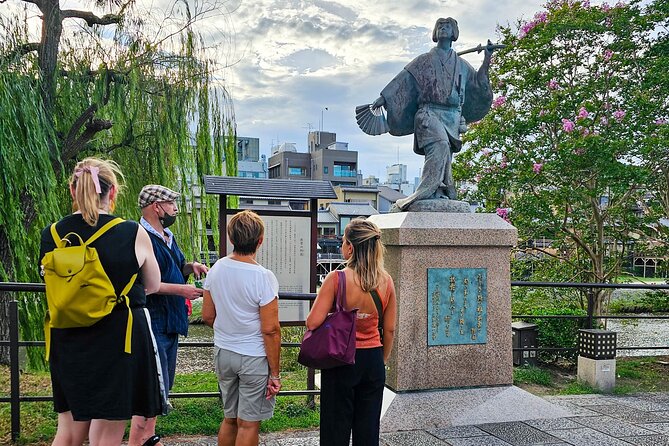
Hanamikoji Street gets about 30 minutes on the route. It is one of Gion’s best-preserved historic streets, with traditional facades and a strong connection to the district’s teahouse culture.
This is one of the clearest places to understand why Gion feels different from ordinary shopping streets. The architecture is restrained, the lanes are compact, and many businesses are private or reserved for established customers. Your guide can explain the difference between what you can admire from the street and what you should leave alone.
Hanamikoji is also one of the places where you might see a maiko or geisha. One account described spotting one geisha and two maiko near the street, but other evenings produced no sightings at all. The guide cannot control this, and the absence of a sighting does not mean the walk failed.
The sensible approach is to treat performers as working people, not attractions. Watch from a respectful distance and follow local instructions. You will get more from the area by noticing its buildings and customs than by turning the entire evening into a search for a photograph.
This section may feel short if you want a long explanation of geisha culture. It is better understood as part of a wider route, not a dedicated performance or museum visit. The tour gives you an introduction to the district and its traditions, rather than access to a teahouse or a formal geisha event.
More Walking Tours in Kyoto
- Kyoto: Gion Geisha District Walking Tour – Stories of Geisha
★ 4.7 · 2,187 reviews - Night Walk in Gion: Kyoto’s Geisha District
★ 4.5 · 2,003 reviews - Kyoto Gion Geisha District Walking Tour – The Stories of Geisha
★ 5.0 · 1,441 reviews - Nishiki Market Brunch Walking Tour (7 Tastings + Brunch)
★ 5.0 · 1,355 reviews
Yasaka Shrine and the final half hour
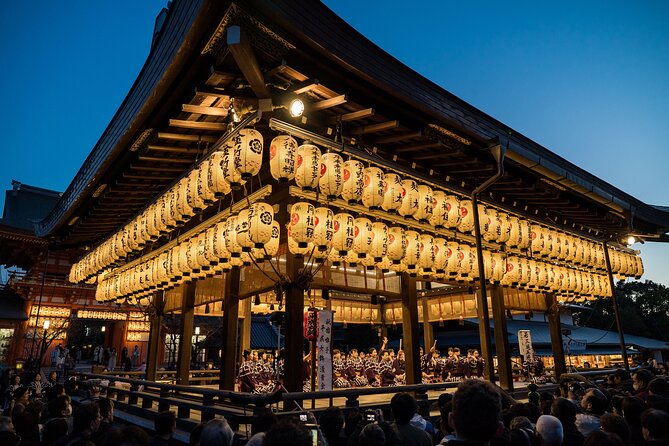
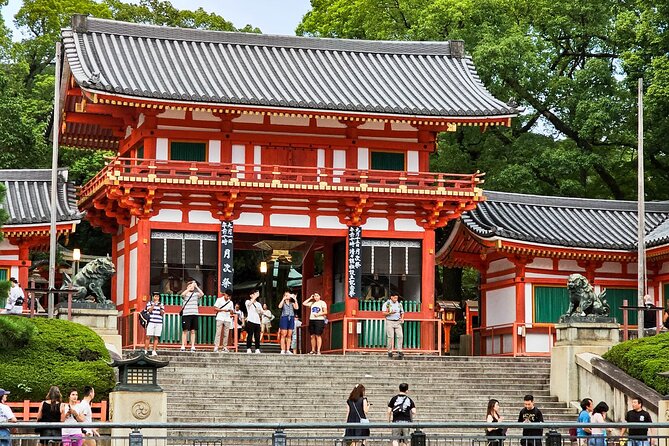
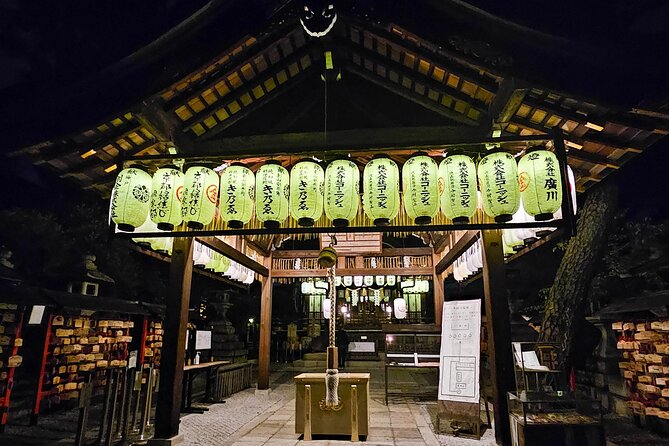
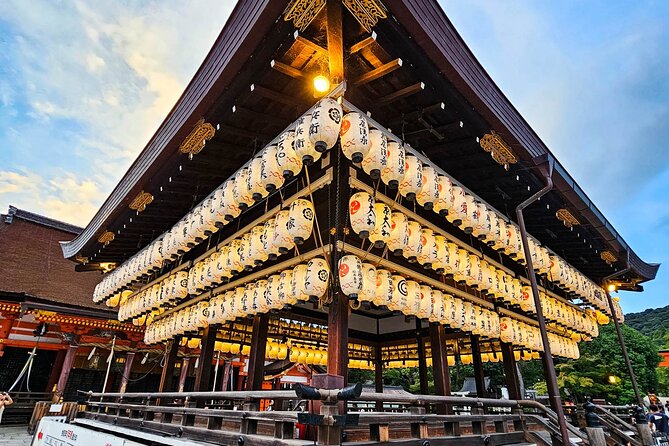
The final listed stop is Yasaka Shrine, also called Gion Shrine, with about 30 minutes set aside for the visit. The shrine adds a religious and architectural layer to the evening, balancing the entertainment district with a major place of worship.
A guide can help explain how the shrine fits into Kyoto’s traditions and the relationship between religious spaces and the surrounding neighborhood. This is especially useful if you are new to Japanese shrine customs. You get more from the visit when you understand what you are looking at, rather than simply walking through the gate, taking a picture, and moving on.
The stop also breaks up the street walking. Even so, the full outing is still a three-hour walk with limited pauses. One person described it as long but informative, while another warned that families with younger children may find the timing and distance demanding.
You should wear comfortable shoes. Families can manage the tour, and children between 12 and 16 have enjoyed it, but the evening is not designed as a short stroll. If your group includes older relatives, tell the guide at the start. A guide named Zied was praised for helping an elderly mother, suggesting that the staff can be considerate when they know what your group needs.
What the guides add to the price
At $18 per person, the tour offers strong value if your guide is engaging. A private guide, transport, or attraction admission would cost much more, while this outing gives you three hours of local explanation for less than the price of many Kyoto activities.
The real product is not entry to a monument. Gion’s streets and Yasaka Shrine do not require an expensive admission ticket. You are paying for interpretation, route planning, cultural context, and the chance to ask questions as you walk.
The guide list in the feedback is broad. Naoki is praised for history and culture, Shingo for finding unusual places, Jasmine for patience and detailed answers, Raphael for clear English and insight into the geisha district, Vincent for Japanese history, and Miyake for both depth and humor. Eloise was described as engaging and friendly, while Guillaume created the feeling of being shown around by a local friend.
That variety is encouraging, but it also explains why experiences can differ. Some guides build a clear story from the district’s past and present. Others may provide interesting facts without tying them together. If you want a tightly structured lecture, this may feel loose. If you prefer conversation, questions, and local recommendations, it can be a fine fit.
A private upgrade is available in several languages. That option makes sense if your group wants a slower pace, a particular language, or more control over the subjects covered. For most budget-minded visitors, the regular English-speaking group should be enough.
Food, drinks, and the dinner-hour problem
The tour information is slightly mixed about refreshments. The general description refers to a snack and water, while the included items specify a snack for premium group and private tours only. The standard package lists the walking tour and English-speaking guide, but not a meal or other drinks.
I would not treat the snack as guaranteed unless your booking clearly says premium group or private. Bring water and eat before the tour if your start time falls near dinner. One family finished hungry because the walk ran across the usual dinner period.
That is an easy problem to solve. Have an early meal, carry a small drink, and remember that the guide may offer restaurant suggestions at the end. Several guides have been praised for useful food recommendations, which can help you choose where to eat after the walk.
Winter requires another small adjustment. Gion’s lanterns look especially good in the dark, but the streets can feel cold during a three-hour outing. Dress warmly, especially if you plan to pause outdoors while the guide talks.
Who should choose this Kyoto walk?
I would recommend it to a first-time Kyoto visitor who wants cultural context without paying for a costly private experience. It works well for couples, friends, solo visitors, and families with older children who can handle several hours on foot.
It is also a good choice if you prefer stories over formal sightseeing. You will hear about Gion, geisha customs, temples, shrines, architecture, and local traditions while moving through the area. The guide’s restaurant tips can also help you plan the rest of your evening.
You may want another kind of activity if you need a guaranteed performance, a seated experience, or a short route. This is not a geisha show, dinner, or admission-based attraction. It is a walking introduction to a historic district.
I would also think twice if your group dislikes uncertainty. The exact atmosphere depends on the night, restaurants may be closed, and a maiko or geisha sighting is never promised. The route can feel long, and a weaker guide may leave the history feeling scattered.
The tour is described as suitable for most people, but it requires good weather. If poor weather cancels the experience, you are offered another date or a full refund. You can cancel for a full refund up to 24 hours before the start time. Changes or cancellations inside that window are not accepted.
Is the small group really small?
The main description promises no more than nine people per outing, which is a major advantage in narrow Gion lanes. A small party makes it easier to hear the guide, ask questions, and avoid forming an awkward wall outside restaurants or teahouses.
The additional activity information gives a maximum of 25 people. That may refer to the broader operating limit rather than the usual small-group promise, but the difference is worth checking before payment. If a compact group is important to you, confirm the expected size for your date.
A group of around ten has still worked well for some people, especially when the guide keeps everyone together. The smaller the party, though, the more personal the explanations are likely to feel.
Final verdict: book it for the stories, not a guarantee
I would book this Kyoto Gion night walk if I wanted an affordable introduction to the district, a lantern-lit evening route, and a guide who could explain what I was seeing. The price is hard to fault, and the best guides turn a simple walk into a memorable lesson in Kyoto culture.
Go in with realistic expectations. You may not see a geisha, some restaurants may be closed, the walk may overlap dinner, and the experience depends on the guide assigned to your group. Confirm the group size, check whether a snack is included in your package, arrive early at Kyoto Kawaramachi Garden, and wear warm, comfortable clothing.
For a first evening in Kyoto, this is a sensible choice. For a guaranteed geisha encounter or a polished performance, choose something more specialized.
FAQ
How long does the Kyoto Gion night walk last?
The tour lasts approximately three hours. About two hours are spent exploring Gion, followed by roughly 30 minutes on Hanamikoji Street and 30 minutes at Yasaka Shrine.
Where does the tour start?
The meeting point is Kyoto Kawaramachi Garden at 68 Shinchō, Shimogyo Ward, Kyoto, 600-8001, Japan.
Where does the tour finish?
The listed end point is Sanjō Ōhashi Bridge at Ohashicho, Nakagyo Ward, Kyoto, 604-8004, Japan.
Is a geisha or maiko sighting guaranteed?
No. You may see a maiko or geisha, particularly around Hanamikoji Street, but sightings depend on the evening and are not guaranteed.
Is the tour suitable for children?
Most people can participate, and children aged 12 to 16 have enjoyed the walk. It lasts about three hours and involves walking through Gion, so younger children or anyone who tires easily may find it demanding.
Is food included?
A snack is listed for premium group and private tours. The standard tour includes the guide and walking tour, while meals and other drinks are not included. Check your selected package for the exact details.
Can I cancel for a refund?
Yes. You can cancel at least 24 hours before the start time for a full refund. Cancellations or changes made less than 24 hours before the start time are not accepted. If poor weather causes the tour to be canceled, you can choose another date or receive a full refund.
Just added in Kyoto
- The “Golden Route” and Ancient Japan by DIAMIR Erlebnisreisen – 14-Day Tour★ 2.0 · 2 reviews
- Japan: Castles & Cuisine by G Adventures – 6-Day Kyoto to Osaka Tour★ 4.5 · 4 reviews
- Cycle Japan by Explore! – 13-Day Kyoto to Tokyo Tour★ 4.7 · 12 reviews
- Cycle Japan by Intrepid Travel – 11-Day Kyoto to Tokyo Tour★ 4.8 · 2 reviews
- Classic Japan by Intrepid Travel – 11-Day Kyoto to Tokyo Tour★ 4.4 · 14 reviews
- Ancient & Modern Japan 14-Day Tour by Exodus Adventure Travels★ 4.4 · 40 reviews
- 5 Day Cultural Adventure of Kyoto, Nara & Osaka by Tourist Journey★ 2.5 · 2 reviews
- 12 Days Kinosaki Onsen Escape: A Journey Through Japan’s Timeless Towns by UME Travel★ 4.8 · 5 reviews
Kimono and Cultural Dress, compared.
![[Kyoto & Nara Day Tour] Sagano Scenic Railway & Nara Park & Fushimi Inari Taisha Thousand Torii Gates & Togetsukyo Bridge & Bamboo Grove & Kimono Forest (Departing from Osaka)](https://media.japanvisits.com/wp-content/uploads/kyoto-nara-day-tour-sagano-scenic-railway-nara-park-fushimi-inari-taisha-thousand-torii-gates-togetsukyo-bridge-bamboo-grove-kimono-forest-departing-from-osaka-k110001-400x257.jpg)

Tokyo Asakusa Kimono&Yukata Rental at Kimono Miyabi Asakusa Station
Read our review →
Kyoto Geisha Walking Tour: Gion District & Hidden Gems
Read our review →
Gion Magical Night Walking Tour with Geisha Trivia
Read our review →
Gion Geisha District Walking Tour – Stories of Geisha
Read our review →
Best of Kyoto: Gion, Geisha, Pagodas & Cobblestones
Read our review →
Kyoto Kimono Rental Experience (Optional Exquisite Hair Styling/Japanese Makeup/Photography) (Ookini Kiyomizu-dera Main Store)
Read our review →Browse the lists this tour appears in