
Reviewed · KIMONO AND CULTURAL DRESS
Kyoto: Meet the Geisha Maiko with Gion Walking Tour
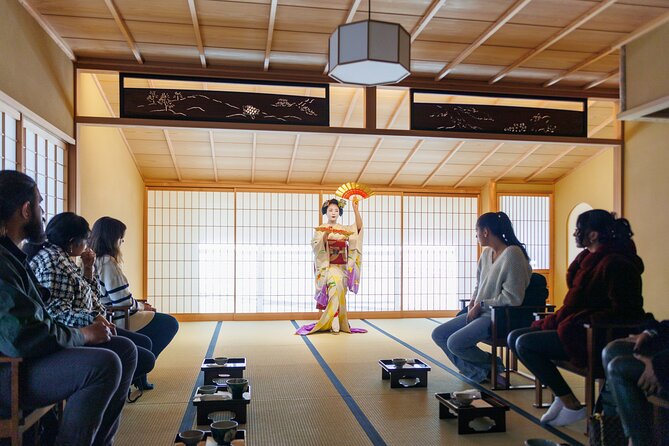
Step into Kyoto’s living traditions. This three-hour experience combines a guided walk through Gion with something far harder to arrange on your own: a private visit to an ochaya, where you meet a maiko and a retired geiko, watch a traditional performance, and ask questions through an interpreter. I especially like the chance to meet these artists directly instead of chasing them through Gion, and the small-scale conversation after the dance gives the evening real human warmth. The main drawback is the walking portion, which some people may find repetitive for the price.
I also like the cultural care built into the format. You learn why maiko and geiko dress, train, and work as they do, then see a performance in the type of private house traditionally associated with their profession. Still, at $109.43 per person, you should book this for access and context, not for food, drinks, transportation, or a long list of major sights.
In This Review
- Key points to know before booking
- What this Kyoto geisha tour is really offering
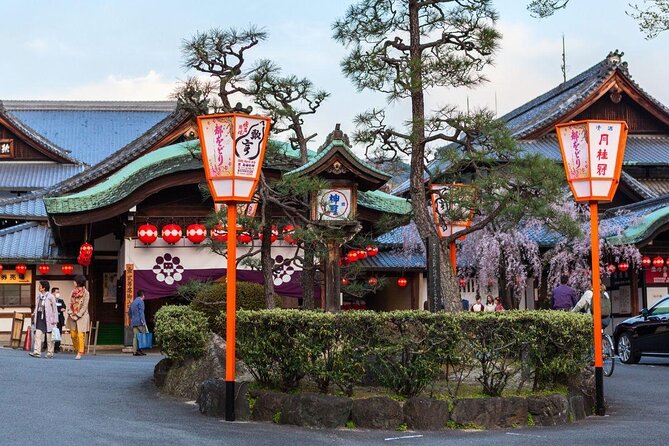
- Starting around Gion Shirakawa
- Tatsumi Daimyojin Shrine and Tatsumi Bridge
- Hanamikoji Street and the old Gion district
- The private ochaya visit in Miyagawasuji
- Why the Q&A matters more than the dance alone
- Group size, comfort, and the practical details
- Is $109.43 a fair price?
- Who should book this experience?
- Should you book the Gion maiko tour?
- FAQ
- How long does the Kyoto maiko and Gion tour last?
- Where does the tour start and end?
- Will I meet a real maiko and geiko?
- Is the performance held in a tea house?
- Are photographs allowed?
- Do I need to wear socks?
- Is the tour suitable for children?
Key points to know before booking
- Meet a maiko and retired geiko in a private ochaya: This is the heart of the experience and the part you cannot easily arrange alone.
- See a traditional dance with live shamisen music: The performance offers more than a photo opportunity and helps explain the artistic training behind the profession.
- Walk through Gion Shirakawa, Hanamikoji Street, and Miyagawasuji: You get an introduction to the streets where Kyoto’s geiko districts still function.
- Ask questions through a local guide: Guides such as Haruki, Takuma, Miko, Ayako, Naomi, Chiko, Yoko, and Ellie have received praise for their warmth, English, and cultural explanations.
- Plan for stairs and proper clothing: The performance is upstairs, socks are required, and comfortable shoes matter because the tour runs in all weather.
- Expect an intimate but variable experience: The performance group may be small, but the total tour can reach 30 people, and translation quality may vary by guide.
What this Kyoto geisha tour is really offering
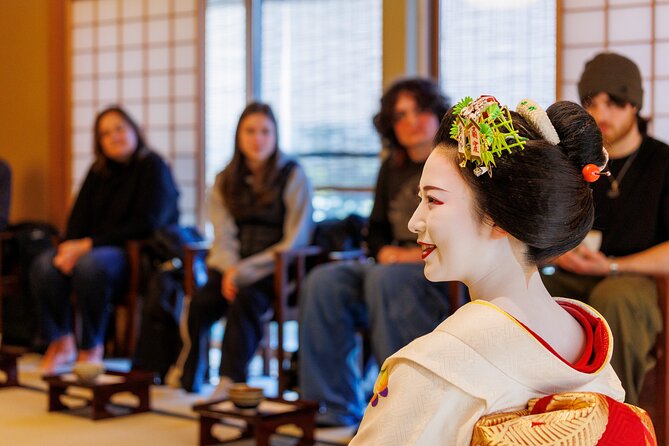
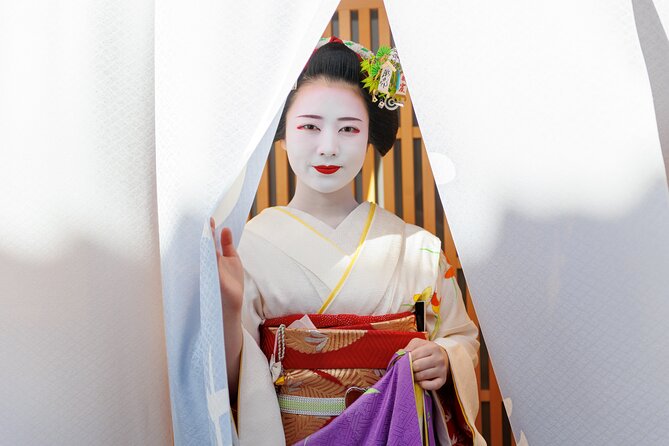
The word geisha can create a fog of movie images and tourist myths. This tour helps clear some of that away. In Kyoto, a maiko is an apprentice geiko, still training in dance, music, conversation, and formal service. A geiko is fully trained and continues working as a professional artist and entertainer.
That distinction matters because the experience is not simply a staged encounter with someone in costume. The point is to see a living tradition and hear how it functions today. The tour introduces the customs, training, clothing, and social setting before you meet the performers.
The visit to the ochaya is the strongest reason to consider booking. These private establishments are not ordinary cafés or public tea rooms. They are places where geiko and maiko traditionally entertain invited clients, and access is difficult even for many people who live in Kyoto.
The experience does not include a full meal or a large food-and-drink package. You are paying mainly for the setting, the performance, the interpretation, and access to people who can explain the work from personal experience.
More Kimono Experiences in Kyoto
- [Kyoto & Nara Day Tour] Sagano Scenic Railway & Nara Park & Fushimi Inari Taisha Thousand Torii Gates & Togetsukyo Bridge & Bamboo Grove & Kimono Forest (Departing from Osaka)
★ 4.9 · 10,942 reviews - Kyoto Geisha Walking Tour: Gion District & Hidden Gems
★ 4.7 · 3,273 reviews - Kyoto: Gion Magical Night Walking Tour with Geisha Trivia
★ 4.9 · 2,393 reviews
Starting around Gion Shirakawa
The walking portion begins in the Gion area, with Gion Shirakawa as the first major stop. This is one of the district’s most attractive stretches, with a traditional feel and the kind of scenery that helps you understand why Gion remains so closely linked with Kyoto’s performing arts.
Your guide explains the life and work of geiko and maiko while you walk. The emphasis is on their daily world, customs, and professional role, rather than on a broad survey of all Kyoto history.
That focus is useful if you are new to the subject. You learn what to look for later, from hairstyles and kimono to the difference between an apprentice and a fully trained artist. A guide can also explain why following or photographing geiko on public streets is poor behavior.
The walk lasts about 30 minutes at this stage. It is not a sightseeing route packed with temple admissions. You are looking at streets, buildings, and district patterns, so your enjoyment depends on how much you want to understand the setting behind the performance.
Tatsumi Daimyojin Shrine and Tatsumi Bridge
The route pauses at Tatsumi Daimyojin, a small Shinto shrine associated with protection, good fortune, and safety. It dates to the Heian period, from 794 to 1185, and adds a religious note to a walk otherwise centered on entertainment and traditional arts.
The stop itself is brief, about five minutes. Do not expect an extended shrine visit or a formal ceremony. Its value comes from the guide’s explanation and from seeing how a small place of worship fits into the old district.
Nearby Tatsumi Bridge offers one of Gion’s most photogenic scenes. Wooden machiya houses, narrow streets, and traditional façades make this corner feel removed from modern Kyoto, even though you are still in a working city.
This is also a place where manners matter. Gion is not a theme park. People live and work here, and the geiko community is not there for random photographs. Listen to your guide, keep your voice down, and avoid blocking entrances or pursuing anyone you happen to see.
Hanamikoji Street and the old Gion district
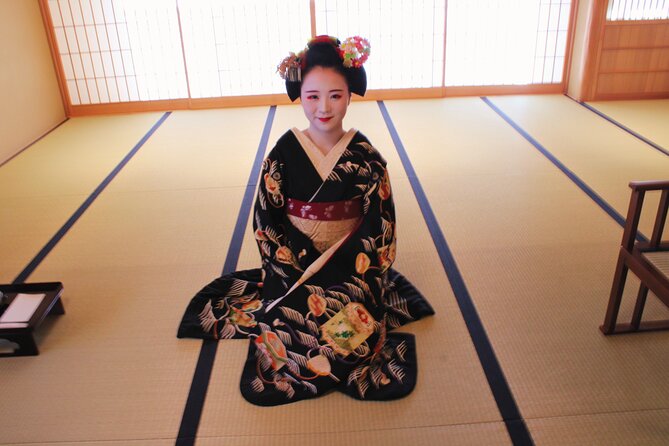
Hanamikoji Street is a main artery of Gion, lined with wooden machiya, restaurants, shops, and tea houses. It gives you a stronger sense of the district’s public face, while the smaller lanes reveal where the atmosphere becomes more private.
The route may also point out Gion Corner, a venue associated with introductions to several traditional Japanese arts. You do not appear to attend a full Gion Corner program on this tour, so think of it as a cultural reference point rather than another included show.
The walk also passes through the precinct of one of Kyoto’s oldest Zen Buddhist temples. The buildings are not entered, but you walk through the grounds as local pedestrians do and get a short change of mood from the geiko district.
This section is informative, but it is where the tour’s value can feel uneven. Several people have found the guide’s explanations helpful and the pace pleasant. Others felt that the group looped through the same area too long, with buildings pointed out from the street but little additional activity.
My advice is simple: book this portion for orientation, not for a major walking attraction. If you have already spent hours exploring Higashiyama and Gion, the route may feel familiar. If this is your first visit, the context can make the later encounter far more meaningful.
More Walking Tours in Kyoto
- Kyoto: Gion Geisha District Walking Tour – Stories of Geisha
★ 4.7 · 2,187 reviews - Night Walk in Gion: Kyoto’s Geisha District
★ 4.5 · 2,003 reviews - Kyoto Gion Geisha District Walking Tour – The Stories of Geisha
★ 5.0 · 1,441 reviews - Nishiki Market Brunch Walking Tour (7 Tastings + Brunch)
★ 5.0 · 1,355 reviews
The private ochaya visit in Miyagawasuji
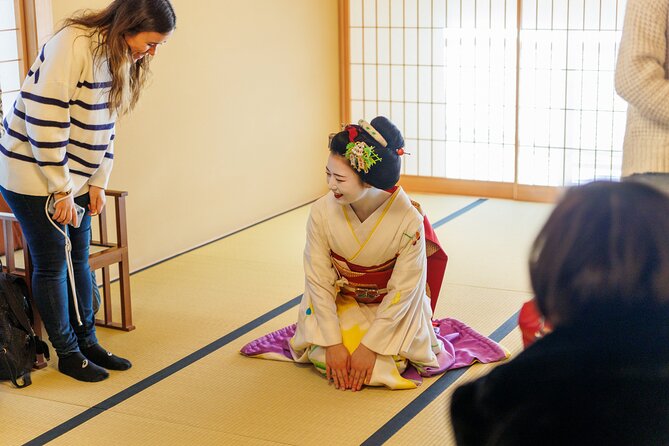
The tour’s final portion takes place in Miyagawasuji, another Kyoto geiko district. Here you enter a private ochaya for the main program, which lasts about 90 minutes.
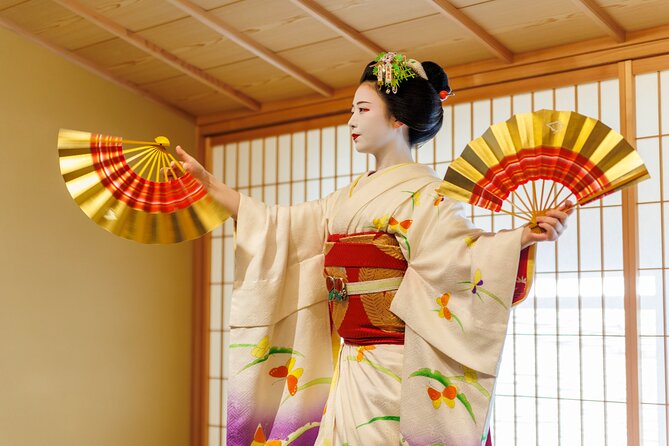
The exact order may vary, but you can expect an introduction to the house and the performers, a traditional dance by a maiko, and time to ask questions. A retired geiko may also be present, offering a useful contrast between apprenticeship and a completed professional career.
The performance is not just a quick appearance for photographs. It is the artistic center of the tour. The dance shows the controlled movements and formal style that take years to learn. One account also describes the house mother playing shamisen during the performance, adding live musical support to the dance.
Afterward, the maiko takes questions. Your guide translates, allowing you to ask about training, customs, lifestyle, and the profession today. This conversation is often the most memorable part because it turns an observation into a direct exchange.
You may also have a photo session, but photography and video are restricted. They are allowed during the performance and designated photo time. If you want to post images on social media, you must first ask the maiko directly for permission.
Why the Q&A matters more than the dance alone
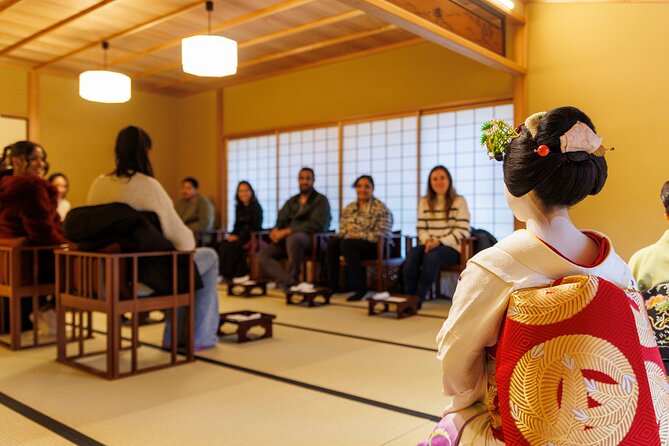
A short dance show can be beautiful, but it can also leave you with only a surface impression. The question period gives the performance a human frame.
You may hear about the discipline behind the art, the difference between maiko and geiko, and how the tradition continues in modern Kyoto. The retired geiko’s presence adds another layer, since you are not hearing only from someone still in training.
The guide’s interpreting skill is important here. Strong guides such as Miko, Naomi, Chiko, and Ellie have been praised for clear English and for making the exchange easy to follow. Ayako has also been singled out for going beyond the scheduled program by helping with a restaurant recommendation afterward.
There is a real caution, though. At least one person found the translation too quiet and difficult to hear, with parts of the conversation lost. Since the guide translates every answer, your enjoyment depends partly on speaking volume, group placement, and the guide assigned that day.
If hearing clearly is important to you, stand or sit close to the guide and performers when possible. Do not expect a microphone unless the operator specifically provides one.
Group size, comfort, and the practical details
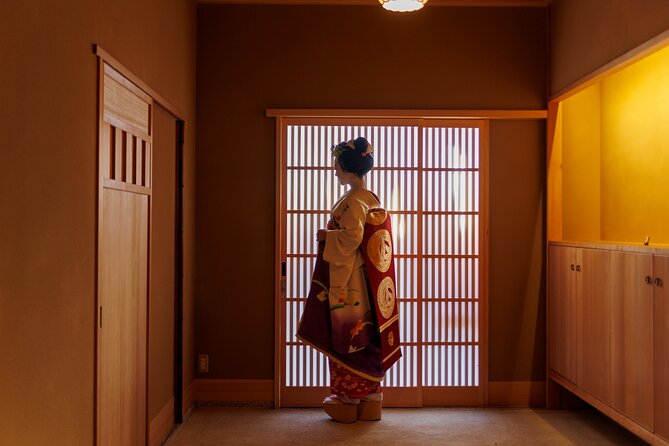
The tour can include up to 30 people, although the performance portion may feel much smaller on some dates. One account describes an intimate group of about 10 people at the ochaya, but that is not guaranteed.
A three-hour duration is reasonable for a walk plus a performance, yet the total can run longer depending on the day. The walking portion is on foot, so wear comfortable shoes. The tour operates rain or shine.
The private house is on the second floor and can only be reached by stairs. This is important if stairs are difficult for you. The venue also requires socks. Bring clean, dry socks and wear them throughout the visit.
On rainy days, do not arrive at the house with wet clothing or wet socks. Use an umbrella during the walk and take care not to track water inside. This may sound fussy, but it reflects the etiquette of entering a traditional house.
Children under 10 are not allowed. The tour requires moderate physical fitness, mainly because of the walking and stairs.
The starting and ending area is Miyagawasuji in Kyoto’s Higashiyama Ward, near public transportation. The exact meeting spot may not feel prominent, so allow extra time to find it. Hotel pickup, return transportation, food, drinks, and personal expenses are not included.
Is $109.43 a fair price?
At $109.43, this is not a bargain walking tour. You can explore Gion’s streets for free, and you can find other cultural programs that include food or drinks for less.
The price makes more sense when you separate the two parts. The walking route introduces you to Gion, but it is not the main purchase. The private ochaya visit, live performance, retired geiko, maiko conversation, and translation are what make the cost easier to justify.
I would compare it with booking a standard stage performance. A stage show may provide more polished production, but it will not normally give you a small-group question period with a maiko or entry into a private ochaya.
Value depends on your priorities. If you want dinner, drinks, and a full evening of entertainment, this may feel expensive and thin. If you want access, explanation, and a respectful meeting with performers, the price is more defensible.
The strongest praise centers on the guides and the personal encounter. The most repeated criticism concerns too much walking, repeated explanations, and unclear translation. That tells you exactly where the money is best spent: the private house, not the street loop.
Who should book this experience?
I would recommend it to a first-time Kyoto visitor who wants a clear introduction to geiko culture without trying to spot performers on the street. It also suits anyone interested in traditional Japanese dance, music, clothing, and the social customs around the ochaya world.
Families with children aged 10 and older may enjoy the question period and photo session, though the stairs and three-hour length still matter. Several accounts describe children remaining especially interested after the meeting.
You should think twice if you have already taken a detailed Gion tour or spent a full day walking Higashiyama. In that case, the street portion may add little, and you may prefer a shorter performance-only option if one is available.
This is also not the best fit if you expect a meal, alcoholic drinks, hotel pickup, or a large theatrical production. None of those are part of the stated package.
Should you book the Gion maiko tour?
Book it if the chance to enter a private ochaya and speak with a maiko matters more to you than having a packed sightseeing route. The performance, shamisen music, translation, and personal questions create a rare look at a Kyoto tradition that is otherwise difficult to approach.
Skip it if $109.43 feels high for a three-hour program without food, or if you dislike slow walking through streets you could visit independently. You should also be comfortable with stairs, socks, rain, and the possibility that translation may not be perfectly audible.
My practical verdict: this is a worthwhile special event, but not a perfect general Gion tour. Treat the walking section as preparation. The real experience begins when you sit inside the ochaya, watch the dance, and have a respectful conversation with the maiko and retired geiko.
Free cancellation is available up to 24 hours before the start time. If you cancel later, the payment is not refunded, and changes made within that period are not accepted.
FAQ
How long does the Kyoto maiko and Gion tour last?
The tour lasts about three hours, though it may run longer depending on the day.
Where does the tour start and end?
It starts in the Miyagawasuji area of Kyoto’s Higashiyama Ward and ends at the special private house used for the program.
Will I meet a real maiko and geiko?
The experience includes a meeting with a maiko and a retired geiko, along with a traditional performance and time for questions.
Is the performance held in a tea house?
The performance takes place inside a private ochaya. An ochaya is a traditional entertainment house associated with geiko and maiko performances, not an ordinary café or public tea room.
Are photographs allowed?
Photography and video are allowed during the performance and photo session only. Ask the maiko directly before posting any images on social media.
Do I need to wear socks?
Yes. Socks are required at the performance venue. On rainy days, your clothing and socks must be dry before entering.
Is the tour suitable for children?
Children under 10 are not permitted. All participants should have moderate physical fitness, and the performance room is upstairs and accessible only by stairs.
Just added in Kyoto
- The “Golden Route” and Ancient Japan by DIAMIR Erlebnisreisen – 14-Day Tour★ 2.0 · 2 reviews
- Japan: Castles & Cuisine by G Adventures – 6-Day Kyoto to Osaka Tour★ 4.5 · 4 reviews
- Cycle Japan by Explore! – 13-Day Kyoto to Tokyo Tour★ 4.7 · 12 reviews
- Cycle Japan by Intrepid Travel – 11-Day Kyoto to Tokyo Tour★ 4.8 · 2 reviews
- Classic Japan by Intrepid Travel – 11-Day Kyoto to Tokyo Tour★ 4.4 · 14 reviews
- Ancient & Modern Japan 14-Day Tour by Exodus Adventure Travels★ 4.4 · 40 reviews
- 5 Day Cultural Adventure of Kyoto, Nara & Osaka by Tourist Journey★ 2.5 · 2 reviews
- 12 Days Kinosaki Onsen Escape: A Journey Through Japan’s Timeless Towns by UME Travel★ 4.8 · 5 reviews
Kimono and Cultural Dress, compared.
![[Kyoto & Nara Day Tour] Sagano Scenic Railway & Nara Park & Fushimi Inari Taisha Thousand Torii Gates & Togetsukyo Bridge & Bamboo Grove & Kimono Forest (Departing from Osaka)](https://media.japanvisits.com/wp-content/uploads/kyoto-nara-day-tour-sagano-scenic-railway-nara-park-fushimi-inari-taisha-thousand-torii-gates-togetsukyo-bridge-bamboo-grove-kimono-forest-departing-from-osaka-k110001-400x257.jpg)

Tokyo Asakusa Kimono&Yukata Rental at Kimono Miyabi Asakusa Station
Read our review →
Kyoto Geisha Walking Tour: Gion District & Hidden Gems
Read our review →
Gion Magical Night Walking Tour with Geisha Trivia
Read our review →
Gion Geisha District Walking Tour – Stories of Geisha
Read our review →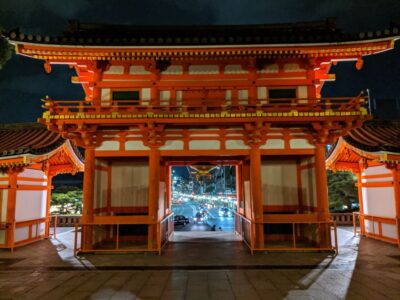
Best of Kyoto: Gion, Geisha, Pagodas & Cobblestones
Read our review →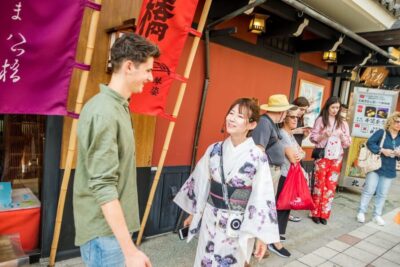
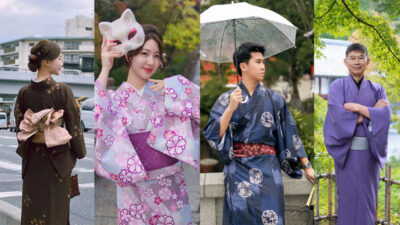
Kyoto Kimono Rental Experience (Optional Exquisite Hair Styling/Japanese Makeup/Photography) (Ookini Kiyomizu-dera Main Store)
Read our review →Browse the lists this tour appears in