
Reviewed · WALKING TOURS
Shimbashi Hidden Gem Walking Tour
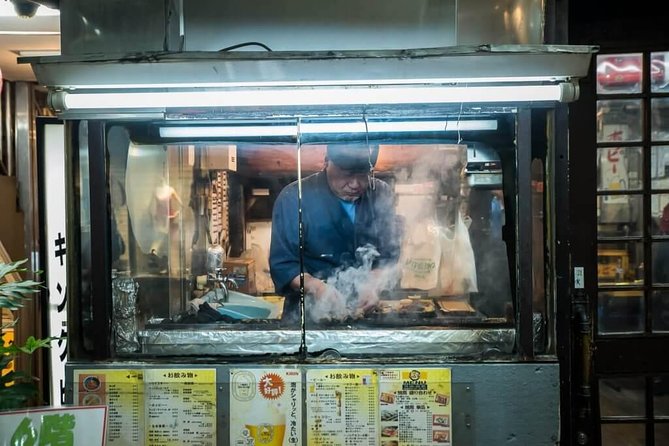
Tokyo eats best after work. This three-hour evening walk takes you into Shimbashi’s salaryman district, where yakitori, sashimi, dumplings, and drinks replace the usual sightseeing checklist. I like the five food stops and the chance to see a side of Tokyo built around everyday social life, not grand monuments. I also like the small maximum of 10 people, which should make moving through compact eateries easier.
The main caution is the price: $217 per person is a serious bill for three hours, especially since only two drinks are included and you pay for your own transport. Food quality may vary by stop, too. One past booking praised the guide and first stop but found later dishes disappointing, so this tour makes the most sense if the local setting and guidance matter as much as the amount of food.
In This Review
- Key points to know before booking
- Why Shimbashi makes a good food-tour setting
- Meeting at SL Square at 4:30 pm
- Karasumori Jinja and the first taste of Shimbashi
- New Shinbashi Building and the working-city feel
- Five food stops, with room for surprises
- The railway exhibition and Shiodome sights
- A small group helps in narrow izakayas
- Is $217 a fair price?
- Practical details for a smoother evening
- Who will enjoy this Shimbashi evening?
- Should you book it?
- FAQ
- How long does the Shimbashi food tour last?
- What time does the tour begin?
- Where does the tour start?
- Where does the tour end?
- How many food stops are included?
- Are drinks included?
- Can vegetarians or people with special diets join?
Key points to know before booking
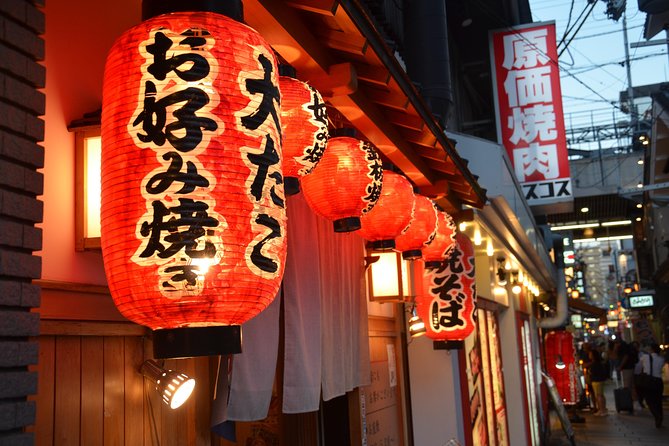
- The tour starts at 4:30 pm, just as Shimbashi shifts from office hours to evening eating and drinking.
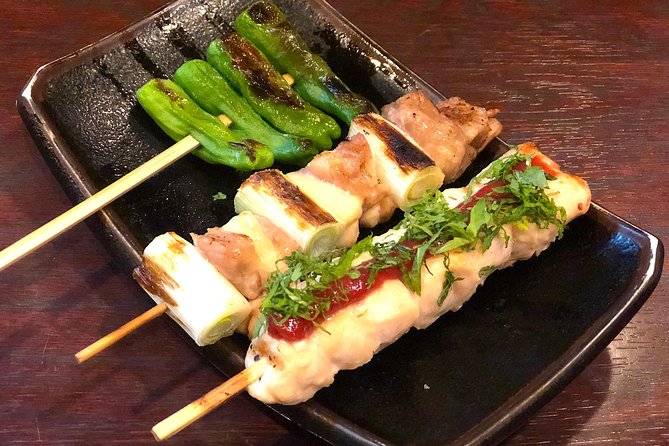
- Five food stops are included, with seasonal Japanese dishes such as yakitori, gyoza, sashimi, okonomiyaki, gyoza nabe, and taiyaki.
- Two drinks are included, but extra food and drinks cost more.
- The group is capped at 10 people, a useful limit in narrow izakayas and small drinking dens.
- The route connects food with local Tokyo sights, including Karasumori Jinja, the Old Shimbashi Station Railway History Exhibition Hall, and the Shiodome area.
- The tour suits pescatarians and vegetarians better than vegans or people avoiding gluten.
Why Shimbashi makes a good food-tour setting
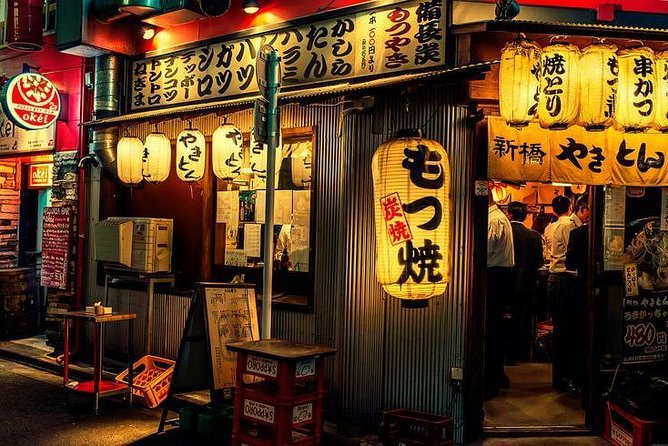
Shimbashi is not mainly about postcard views. It is a working district near major offices, railway lines, and government buildings, and it becomes especially social at the end of the day. The tour is timed for that changeover, when office workers gather for quick meals, beer, and conversation.
That timing gives the experience its point. You are not simply being taken from one restaurant to another at a quiet hour. You are seeing the district during its natural eating period, when izakayas and casual food shops serve people finishing work.
The local angle also helps if Tokyo feels too polished elsewhere. Shimbashi has famous transport connections and nearby attractions, but this walk focuses on ordinary dining customs. You learn how Japanese food pubs work, what dishes pair well with drinks, and how people socialize over small plates.
The setting is also practical for a short Tokyo stay. You finish at JR Shimbashi Station, so you can continue elsewhere in the city without arranging a separate ride back. You should still plan your route to the meeting point carefully, since hotel pickup is not included.
More Walking Tours in Tokyo
- Tokyo Tsukiji Fish Market Food and Culture Walking Tour
★ 5.0 · 3,184 reviews - Tokyo: Imperial Palace and Shogun Historical Walking Tour
★ 5.0 · 2,251 reviews - Tokyo: Shinjuku Local Bar and Izakaya Guided Walking Tour
★ 4.9 · 1,794 reviews
Meeting at SL Square at 4:30 pm
The meeting point is SL Square, formally Shimbashi Station West Entrance Square, at 2-chōme-7-1 Shinbashi. The steam locomotive displayed in the square gives you a clear landmark near the station, though you should check the exact directions on your mobile ticket before setting out.
Starting here is more than a convenient station meeting. Shimbashi has long been linked with rail travel and commuting, so the square fits the district’s working-city character. Your guide introduces the route and the food plan before the group heads into the surrounding streets.
The tour lasts about three hours. That is long enough for several tastings and some neighborhood context, but not so long that the evening becomes a full-day commitment. Wear comfortable shoes and expect steady walking between stops. A moderate level of physical fitness is recommended.
The adults-only rule is important. Everyone must be at least 20 years old, which matches Japan’s legal drinking age and the tour’s focus on izakaya dining. This is not a family food walk.
Karasumori Jinja and the first taste of Shimbashi
Karasumori Jinja provides an early change of pace. In the middle of a business district, a shrine gives you a glimpse of the older religious layer that remains part of Tokyo’s daily life. It also helps break up the food stops, giving the guide a place to explain local customs and manners.
That cultural explanation may be one of the tour’s strongest features. A past booking singled out guides Asami and assistant Lora for their lively style and their explanations of Japanese eating habits. You should value this kind of guidance because small details at an izakaya can be hard to read on your own.
The first food stop is meant to begin the meal in an accessible way, although the exact restaurant and dishes can change. The tour promises local and seasonal food, and the stated examples include yakitori, gyoza, and sashimi. Yakitori offers a familiar starting point for many people, while sashimi and other raw dishes require a more adventurous appetite.
Do not expect a fixed menu carved in stone. Restaurant schedules, holidays, weather, and other changes can alter the route. Substitutions are made when needed, so you should treat the listed dishes as a guide to the style of food, not a guarantee of every plate.
New Shinbashi Building and the working-city feel
The New Shinbashi Building is one of the route’s useful urban landmarks. It represents the less glamorous side of Tokyo that makes the district appealing: offices, stations, quick meals, and compact drinking places operating close together.
You might pass through or near this area between tastings, using the walk to understand how Shimbashi fits together. The experience is not just a restaurant crawl. It shows how food, commuting, and after-work social life occupy the same few blocks.
The food here is described as casual Japanese drinking food. That means small portions and dishes designed to share or pair with a drink rather than one large formal meal. Gyoza, grilled skewers, sashimi, and okonomiyaki fit that pattern well.
One menu may also include gyoza nabe, a dumpling hot pot, or taiyaki, the fish-shaped sweet filled with a dessert filling. The contrast is part of the fun: you can move from savory food and beer to a simple Japanese sweet before the evening ends.
The tour includes two drinks. That might mean beer, sake, or another suitable option, but the provided details do not promise a specific drink list. Extra beverages and extra food are not covered, so keep some yen or a payment method ready if you want more.
A completely different kind of day out:
- Tokyo Disney Resort – Tokyo Disneyland & Tokyo DisneySea Park Tickets
★ 4.8 · 99,488 reviews - SHIBUYA SKY Ticket
★ 4.7 · 46,509 reviews - JR Whole Japan Rail Pass
★ 4.8 · 29,150 reviews - Mt Fuji and Hakone 1-Day Bus Tour Return by Bullet Train
★ 5.0 · 26,383 reviews
Five food stops, with room for surprises
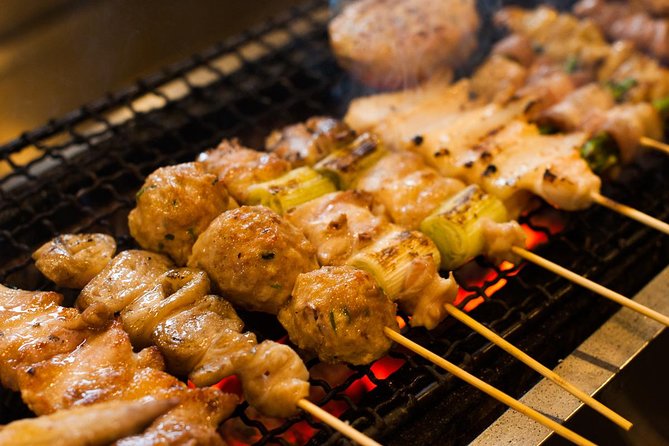
Five stops give the tour a useful rhythm. You taste a dish, walk through the neighborhood, hear some context, and then sit down again. For someone new to Japanese food, this is often easier than ordering a large meal from an unfamiliar menu.
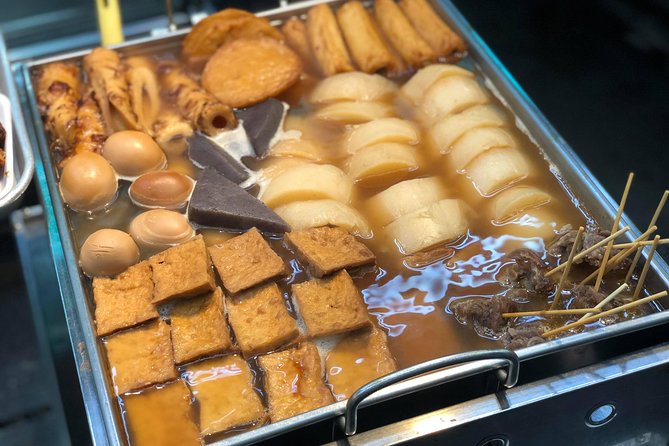
The strongest value comes from variety. You may try grilled meat, dumplings, raw fish, a savory pancake, hot pot, and dessert in one evening. That range lets you find dishes you would not have chosen from a menu on your own.
The limitation is consistency. A three-hour tour covering several venues cannot guarantee that every dish will suit your taste. One past booking described the first food stop as excellent but found the second and fourth disappointing, while another praised the food across the evening. That mixed experience is worth taking seriously.
You should also be ready for unusual choices. One person specifically recalled trying raw chicken, which is a reminder that the menu may go beyond standard tourist-friendly dishes. If you have strong food restrictions or dislike raw items, tell the guide before ordering and ask what alternatives are available.
Pescatarians and vegetarians are accommodated, according to the tour details. Vegans and people following a gluten-free diet are not recommended for this experience. If your diet is medically important, do not assume that substitutions will cover every need.
The railway exhibition and Shiodome sights
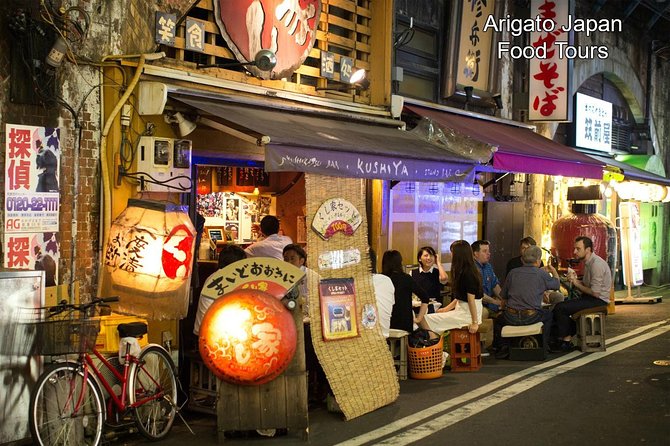
The Old Shimbashi Station Railway History Exhibition Hall adds useful context to the district. Shimbashi is closely associated with Tokyo’s railway story, and this stop connects the modern commuter culture around the station with the city’s earlier rail development.
The visit is part of the route rather than a separate museum tour with a long scheduled admission. The itinerary does not specify how much time you spend inside or whether admission is included separately, so keep your expectations modest. The main focus remains food and neighborhood life.
The Advertising Museum Tokyo and Panasonic Shiodome Museum are also listed along the route. These places give the walk a broader Shiodome frame and show that the area is not only restaurants and offices. Depending on opening hours and the day’s schedule, you might pass by rather than receive a full museum visit.
Hamarikyu Gardens is another listed sight. It is a valuable nearby reference point, but this three-hour evening experience is not presented as a garden tour. Do not book it expecting a detailed exploration of every attraction on the list. The food route is the central event, and the landmarks help explain where you are.
A small group helps in narrow izakayas
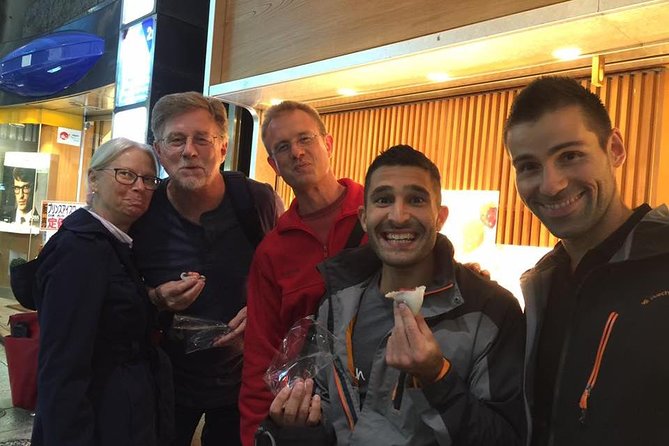
The maximum group size is 10 people. That is a practical advantage in Shimbashi, where some casual eateries and drinking dens can feel tight, and where a large group would be harder to seat together.
A smaller group also makes conversation with the English-speaking guide easier. You can ask about etiquette, ingredients, or the district without shouting across a crowd. If you are traveling alone, the operator asks you to email in advance, so do that before booking rather than assuming a solo place will be available.
The group size may vary, and some dates could be much smaller. One past couple found themselves as the only participants, with Asami and Lora leading the evening. A nearly private format can be wonderful for questions and flexibility, though you should not pay the price expecting a private tour on every date.
The social setting is part of the appeal. You are encouraged to experience the after-work culture associated with Japanese office workers, but you are not promised direct interaction with particular office workers. Think of it as sharing the same dining district and observing its rhythm, not joining a staged office party.
Is $217 a fair price?
At $217, this tour is expensive for three hours. The price includes a local English-speaking guide, five food stops, seasonal and local tastings, and two drinks. It does not include transport, hotel pickup, or anything you order beyond the included food and beverages.
I would judge the value by what you want from the evening. If you only want a cheap dinner, the price is hard to defend. You could spend much less in Tokyo by choosing one izakaya and ordering on your own.
If you want help navigating unfamiliar restaurants, a planned route, explanations of dining customs, and a small group that takes you beyond the most obvious tourist streets, the price becomes easier to understand. You are paying for access and interpretation as much as for the food.
The 4.8 rating from 106 ratings and 97 percent recommendation show strong overall approval, but the mixed comments about individual dishes point to a sensible expectation: the experience is not a guarantee of five perfect meals. The best return comes when you care about discovering Shimbashi and trying new dishes.
Practical details for a smoother evening
The tour starts at 4:30 pm and ends at JR Shimbashi Station, at 2 Chome-17 Shinbashi. Public transport is nearby at both ends, but you handle your own transportation costs.
Use the mobile ticket and arrive with enough time to identify the correct station exit and square. Shimbashi has several railway and subway connections, so rushing at the last moment can create needless confusion.
Wear shoes suitable for walking and bring an appetite, but do not eat an enormous lunch. Five small stops can add up, especially if the menu includes hot pot, grilled dishes, raw fish, and dessert.
The route can change for restaurant schedules, public holidays, weather, or other unforeseen issues. Poor weather can also lead to a new date or a full refund if the experience is canceled. For other cancellations, you receive a full refund when you cancel at least 24 hours before the start time. Changes made inside that window are not accepted.
Karaoke is available as an after-party option. The supplied details do not say that it is included in the $217 price, so ask the operator about cost and availability before counting on it.
Who will enjoy this Shimbashi evening?
I would recommend this tour to a first-time Tokyo visitor who wants structure and does not feel ready to order alone in a Japanese drinking district. It is also a good match for food lovers who want variety and for people who enjoy learning how locals eat rather than simply checking off famous sights.
It suits adults who are comfortable with two included drinks and may want to buy more. The 20-and-over rule, the evening schedule, and the izakaya setting make that clear.
You should think twice if you want a large, formal dinner, a quiet cultural tour, or a tightly fixed menu. The route can change, some food may be unfamiliar, and the high price will feel steep if your main goal is quantity.
Should you book it?
Book it if you want a guided introduction to Shimbashi’s after-work food culture, enjoy trying dishes such as sashimi and gyoza nabe, and value a small group with local explanation. The most praised parts are the friendly guides, the cultural insight, and the chance to reach casual places you might not choose on your own.
Skip it if you are vegan, gluten-free, under 20, or mainly seeking the cheapest way to eat dinner. At $217, the tour earns its price only when you treat the neighborhood access, food range, and guidance as the main product, with dinner included along the way.
FAQ
How long does the Shimbashi food tour last?
The tour lasts approximately three hours.
What time does the tour begin?
It begins at 4:30 pm.
Where does the tour start?
The meeting point is SL Square, at the Shimbashi Station West Entrance Square, 2-chōme-7-1 Shinbashi, Minato City, Tokyo 105-0004, Japan.
Where does the tour end?
The tour ends at JR Shimbashi Station, at 2 Chome-17 Shinbashi, Minato City, Tokyo 105-0004, Japan.
How many food stops are included?
Five food stops with local and seasonal Japanese food are included.
Are drinks included?
Two drinks are included. Additional drinks and food are not included.
Can vegetarians or people with special diets join?
The tour is suitable for pescatarians and vegetarians. It is not recommended for vegans or people following a gluten-free diet.
Just added in Tokyo
- Private homevisit for whole cultual experience, 20min from Tokyo★ 5.0 · 20 reviews
- Yanaka and Asakusa Walk around DOWNTOWN TOKYO like a local★ 5.0 · 36 reviews
- Yokohama/Kamakura Private Tour by Car- English speaking Driver★ 5.0 · 15 reviews
- Yanaka Historical Walking Tour in Tokyo’s Old Town★ 5.0 · 182 reviews
- 3-Hour Tokyo Pub Crawl Nightlife Welcome Guided Tour in Shibuya★ 5.0 · 209 reviews
- Official Japan Go-Kart Through Shibuya / Shinjuku (IDP Required)★ 5.0 · 92 reviews
- Tokyo private transfer from/to Tokyo Ports★ 4.5 · 26 reviews
- Exclusive Sumo Morning Practice in Tokyo with Photo Opportunity★ 5.0 · 68 reviews
Walking Tours, compared.
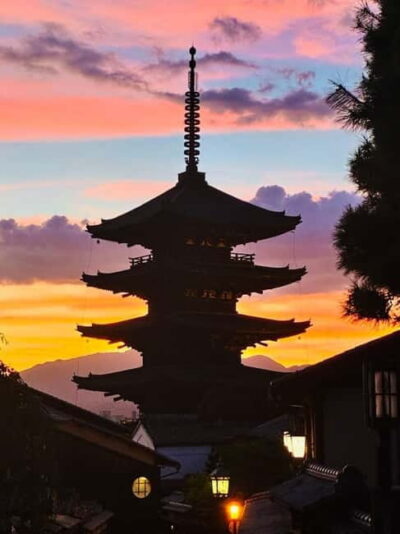
Kyoto Geisha Walking Tour: Gion District & Hidden Gems
Read our review →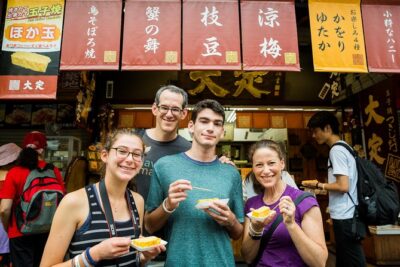
Tokyo Tsukiji Fish Market Food and Culture Walking Tour
Read our review →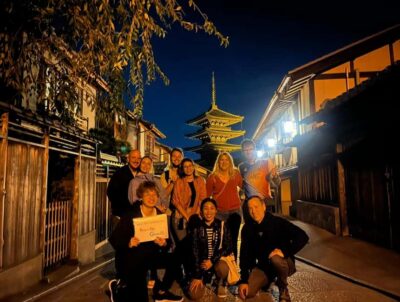
Gion Magical Night Walking Tour with Geisha Trivia
Read our review →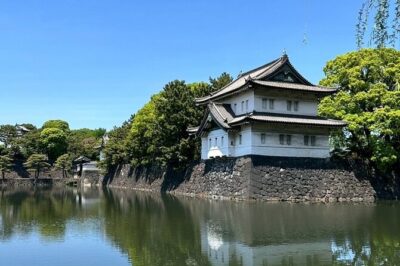
Imperial Palace and Shogun Historical Walking Tour
Read our review →
Gion Geisha District Walking Tour – Stories of Geisha
Read our review →
Shinjuku Local Bar and Izakaya Guided Walking Tour
Read our review →
Browse the lists this tour appears in