
Reviewed · SUMO EXPERIENCES
Tokyo: Visit Sumo Morning Practice with English Guide
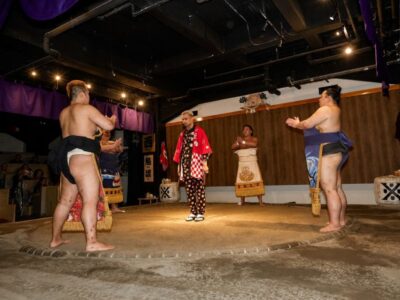
Sumo gets more powerful up close. This Tokyo morning visit takes you into Takasago Stable, a training room linked with championship wrestlers, where you watch athletes work through serious practice rather than a staged performance. I like the close view of the wrestlers and the chance to ask an English-speaking guide about rules, customs, and training. I also like the commemorative photo at the end, a simple souvenir from an unusual morning.
The main drawback is comfort and crowding. You sit on the floor or on small seats for roughly 90 minutes, and the viewing area can feel tight if another group or a Japanese fan club arrives. This is also observation, not a show, so you should book it for access to real training, not for a guided performance.
In This Review
- Key points to know before you book
- Why morning practice feels different from a tournament
- Meeting at Ryogoku Station at 7:45 or 8:00
- Entering Takasago Stable for close-up training
- What the English guide adds
- Floor seating, small stools, and a tight viewing area
- The photo with the wrestlers
- Pairing the stable with Asakusa
- What the $98.53 price buys you
- The timing and group size you should plan around
- Who will enjoy this morning most
- My verdict on this Takasago Stable visit
- FAQ
- Where does the sumo practice take place?
- Where is the meeting point?
- What time should I arrive?
- How long does the experience last?
- Is an English guide included?
- How many people can join the group?
- Is seating provided?
- Is a photo with the wrestlers included?
- Can I cancel for a full refund?
Key points to know before you book
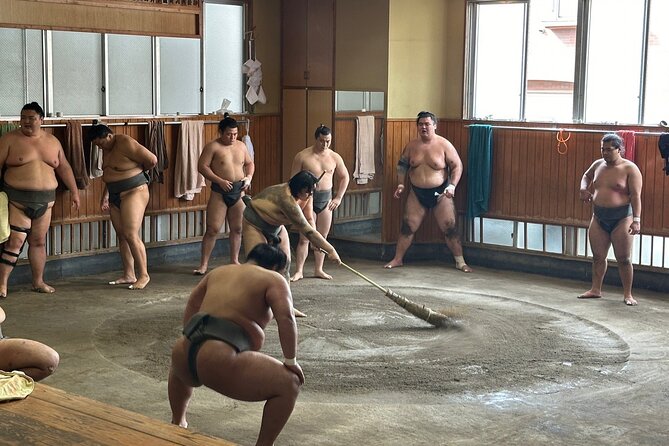
- Serious practice at Takasago Stable: Watch stretching, warmups, training exercises, and hard practice bouts at close range.
- Meet near Ryogoku Station: The guide leads you on foot from the meeting point to the stable, so arrive early and find the correct A3 exit.
- English support matters: Guides explain sumo terms, answer questions, and help you follow what is happening in the room.
- Traditional seating: Expect floor seating or small stools, which may be uncomfortable during a long session.
- A small-group setting: The maximum group size is 20, though the stable can feel crowded when other visitors arrive.
- Easy pairing with Asakusa: After the stable visit, you can continue sightseeing in nearby Asakusa.
Why morning practice feels different from a tournament
A formal sumo match gives you ceremony, bright lights, a large arena, and the drama of competition. This visit offers something quieter and more revealing: the daily work behind the spectacle.
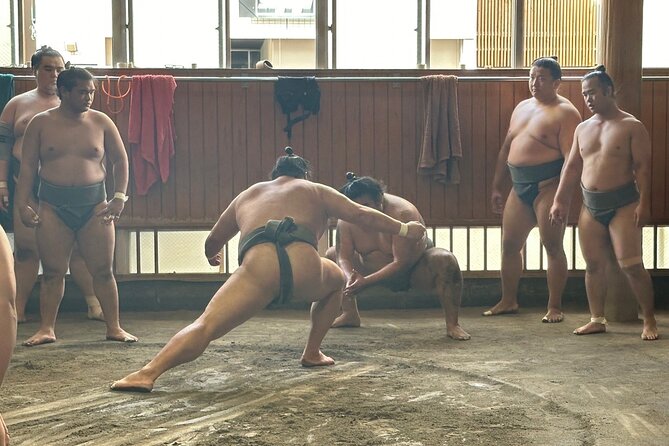
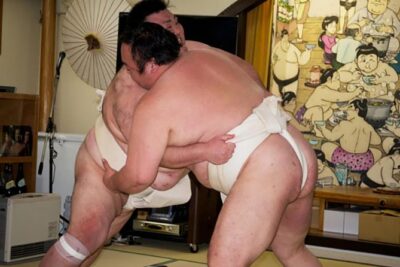
At Takasago Stable, you watch wrestlers prepare their bodies, repeat exercises, and challenge one another in practice bouts. The early part of the session may include around 30 minutes of stretching and conditioning before the stronger wrestlers begin more forceful contests. The pace builds gradually, so patience helps.
The sound is part of the experience. In a small room, the slap of bodies meeting the floor and the impact of wrestlers colliding can feel surprisingly close. You are not simply looking at a ring from a distant seat. You are watching athletes train within a traditional stable environment, where effort, repetition, and discipline matter more than showmanship.
I find this especially useful if you are new to sumo. Without context, morning practice can look like a series of ritual movements and sudden clashes. With a guide explaining the exercises and terms, you can begin to recognize how the session develops.
More Sumo Experiences in Tokyo
- Tokyo: Sumo Show Experience with Chicken Hot Pot and a Photo
★ 4.8 · 6,678 reviews - Tokyo: Sumo Live Show with Photo in Shinjuku
★ 5.0 · 3,438 reviews - Tokyo: Sumo Show and Dining Experience
★ 4.8 · 2,742 reviews
Meeting at Ryogoku Station at 7:45 or 8:00
The published start time is 8:00 a.m., but the practical instruction from the operator is to be at the meeting point 15 minutes earlier. One detailed account says the group leaves the A3 exit at exactly 7:45. Treat that earlier time as the one that matters.
The meeting point is near Ryogoku Station at 1-chōme-4-29 Yokoami, Sumida City. This sounds simple, but station exits in Tokyo can put you on the wrong side of the tracks or street. One person needed an extra 10 minutes to locate the correct A3 exit after arriving by train.
My advice is plain: arrive early, confirm you are at the A3 exit, and look for the guide holding a large sign. The company says two staff members may wait at the meeting point, and a confirmation message sent the day before should include a guide’s WhatsApp number. Still, do not rely on a last-minute scramble. Missing the short walk to the stable could mean missing the start of practice.
The guide then walks the group to Takasago Stable. The exact walk time is not specified, but the route is described as short and pleasant. A taxi directly to the stable has also been practical for people staying elsewhere, though you should still follow the meeting instructions unless the operator tells you to meet at the stable.
Entering Takasago Stable for close-up training
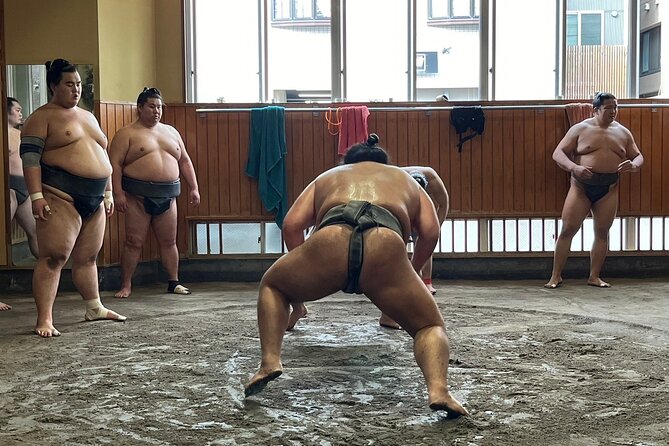
The stable itself is the heart of the morning. Takasago is described as a place that has produced many champions, which gives the visit a useful connection to sumo’s top level. You are not touring a museum or watching a film about the sport. You are sitting near an active training session.
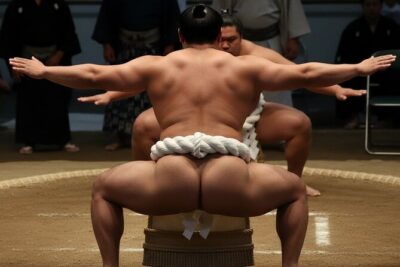
The best part is the distance. During an official match, spectators watch from fixed seats around the ring. Here, the wrestlers are much closer, and you can see the physical work in their faces, posture, and movement. The experience makes clear that sumo is not just about size. Balance, timing, leg strength, endurance, and technique are all visible in the practice room.
The session can last about one and a half to two hours, with the stated activity time around 90 minutes. The action may begin with body preparation, followed by younger or less senior wrestlers challenging one another. Later, more powerful wrestlers take their turns, and the practice bouts become more intense.
That progression gives the morning a natural rhythm. You may first wonder why the wrestlers are stretching for so long. Then the reason becomes obvious when the collisions begin. The warmup is not filler. It is part of seeing how a professional athlete prepares for demanding physical work.
What the English guide adds
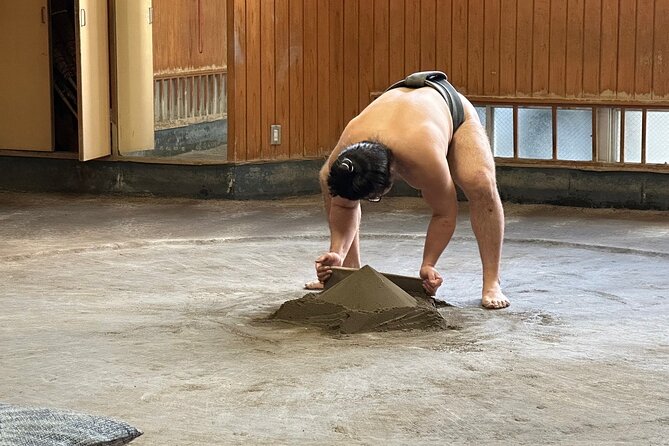
A good guide makes a major difference here. The session itself does not stop to explain every movement, and the wrestlers are focused on training. An English-speaking guide provides the bridge between what you see and why it matters.
The guides have been praised for being friendly, punctual, and willing to answer many questions. Naomi is one guide specifically praised for responding warmly to more than 20 questions before and after the practice. Another guide was heard speaking English, French, and Japanese.
You receive a fact sheet with information about sumo terms, training, and background. That is helpful because you can keep watching while checking a word or movement. You also have a chance to ask about the customs and history of sumo instead of trying to work everything out silently.
This is not a lecture-heavy outing. The strongest part of the guiding seems to be practical explanation at the right moment. You see an exercise, hear what it is for, and then watch the wrestlers apply their strength in practice. For a first introduction to sumo, that is enough structure to make the session easier to follow without taking attention away from the athletes.
A completely different kind of day out:
- Tokyo Disney Resort – Tokyo Disneyland & Tokyo DisneySea Park Tickets
★ 4.8 · 99,488 reviews - SHIBUYA SKY Ticket
★ 4.7 · 46,509 reviews - JR Whole Japan Rail Pass
★ 4.8 · 29,150 reviews - Mt Fuji and Hakone 1-Day Bus Tour Return by Bullet Train
★ 5.0 · 26,383 reviews
Floor seating, small stools, and a tight viewing area
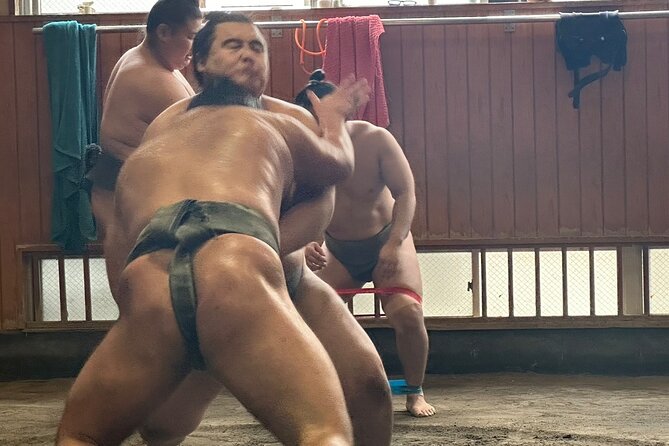
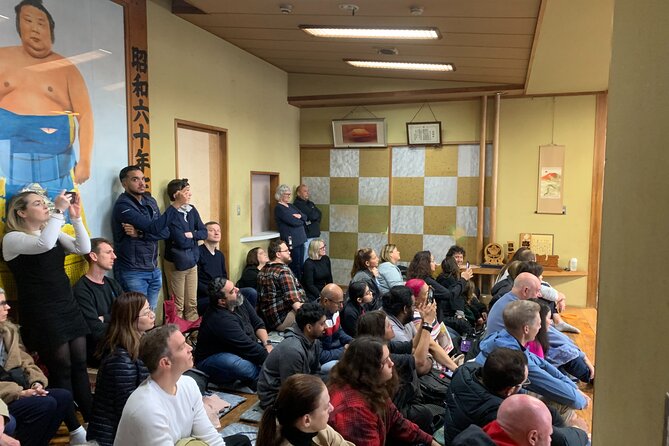
This is the point I would explain most clearly before booking. Traditional sumo stables are not designed like modern theaters. Seating may be on the floor or on small seats, and you could remain in that position for most of the session.
If your knees, hips, or back dislike floor seating, the 90-minute period may feel long. The operator acknowledges that this traditional arrangement can be uncomfortable for people accustomed to Western-style chairs. Check your own comfort level before paying for the experience.
The room can also become crowded. The maximum group size is 20, but another tour group or an unexpected Japanese fan club may arrive. One account describes squeezed seating and people joining after practice had begun. The guide worked to keep the booked group seated comfortably, but space is still limited.
This is a real limitation, not a minor footnote. Your view depends on where you are placed, how many people are present, and how the stable arranges the viewing area that morning. The upside is that a small room creates the close, powerful atmosphere people come for. The downside is that you do not get the roomy, polished setup of a sports venue.
The photo with the wrestlers
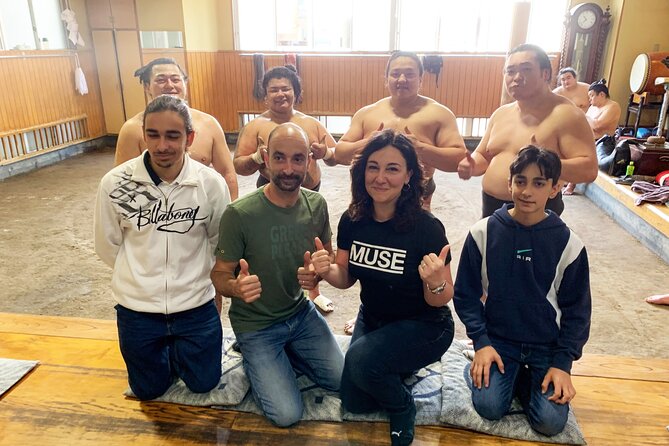
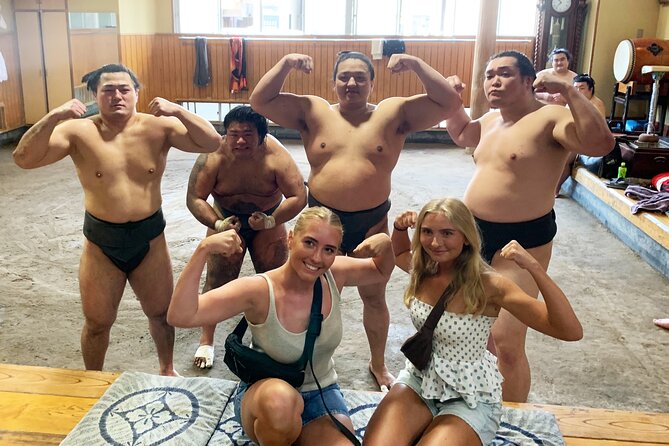
At the end, you can take a commemorative photo with the sumo wrestlers. This is one of the experience’s clearest extras, since it gives you something tangible to remember the morning.
The photo session is brief and organized, so it should not be confused with a long meet-and-greet. The main value is the unusual setting and the chance to record your visit after watching the practice from close range.
Be respectful during this part. The wrestlers have just completed serious training, and the stable remains a working place. Follow the guide’s directions about where to stand and when to take photos. The supplied details confirm the commemorative photo, but they do not promise individual conversations or unlimited personal photographs.
Pairing the stable with Asakusa
The stable visit ends at Takasago Stable at 2-chōme-30-1 Ishiwara, Sumida City. You are dismissed there rather than returned to the station. The guide shows you how to reach your next destination, which is useful if you plan to continue sightseeing.
Asakusa is nearby enough to make a sensible second stop, although no precise travel time is given. After a quiet morning watching sumo, you can spend the rest of the day exploring one of Tokyo’s best-known historic districts. Keep your plans flexible, since the practice length can vary between roughly 90 minutes and two hours.
The end location is worth noting when planning breakfast, shopping, or other reservations. This is not a round-trip activity. You should know where you want to go next before you enter the stable, especially if you are traveling with children or a group.
What the $98.53 price buys you
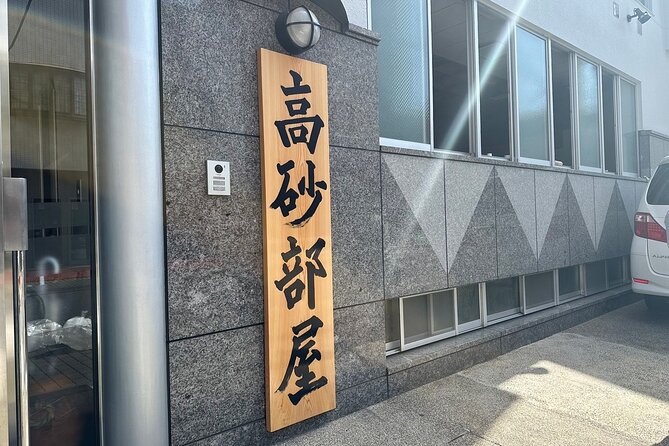
At $98.53 per person, this is not a cheap way to fill an hour in Tokyo. The value depends on how much you care about direct access to sumo and how useful you find the English guidance.
You are paying for more than a seat near a training room. The price includes admission, a guide who leads you from the station, language help, explanations during the session, answers to questions, and a commemorative photo. The stable is normally closed to spectators, so the access itself is the main product.
I would consider it good value for a sumo fan, a first-time visitor curious about Japanese sports, or a family with older children who can sit quietly and appreciate the setting. One family found the close action especially memorable for teenagers. You may prefer a formal tournament if your priority is a full competition with official bouts, ceremony, and the excitement of a public arena.
The price is harder to justify if you expect a performance, constant narration, comfortable seating, or a guaranteed quiet room. The operator itself describes this as real training, not a show. That distinction should guide your decision.
The timing and group size you should plan around
The experience lasts approximately one hour and 30 minutes to two hours. The listed activity at the stable is about 90 minutes, but actual practice and the photo session can affect the total time.
The maximum group size is 20. That is small enough for a guide to answer questions, but not necessarily small enough to guarantee an open view from every position. Since another group or fan club may appear unexpectedly, you should expect some variation from one morning to the next.
Most people can participate, and the activity is near public transportation. However, the floor seating is the practical accessibility concern. The information provided does not specify wheelchair access, seating alternatives, or facilities at the stable, so contact the provider before booking if you need an accommodation.
Mobile tickets make entry simple, and confirmation is received when you book. Free cancellation is available up to 24 hours before the local start time. Cancellations or changes made inside that window are not accepted for a refund.
Who will enjoy this morning most
I would choose this for you if you like sports, Japanese customs, or places normally closed to the public. You do not need a background in sumo. The guide and fact sheet provide enough basic information to help you understand the training.
It also suits families with teenagers who can handle an early start and quiet observation. The close action can hold their attention better than a distant arena match, especially once the harder practice bouts begin.
You may want to skip it if you dislike floor seating, have difficulty sitting still, or want a polished entertainment product. The guide cannot turn a working stable into a theater, and the wrestlers are not performing for the group.
The experience also works best when you leave room in your morning. Do not book a tight connection or an important appointment immediately afterward. The end time can vary, and you will probably want a little time to continue into Asakusa or another part of Tokyo.
My verdict on this Takasago Stable visit
I like the honesty of the basic idea: you watch athletes train, ask questions, and take a photo afterward. The strongest praise has focused on the guides, the serious nature of the practice, and the unusually close view. A rating of 4.6 from 22 posted evaluations supports the sense that this works well for most people, though the low-scoring experiences point to real risks around crowding, meeting arrangements, and expectations.
Book it if you want authentic access to sumo practice and can accept traditional seating. Arrive at least 15 minutes early, locate the A3 exit, and think of the morning as quiet observation rather than a performance.
I would recommend it to first-time sumo visitors, sports fans, and families with older children. I would not recommend it to anyone who needs cushioned seating or expects a full tournament. For the right person, the sound of wrestlers colliding a few feet away can be far more memorable than watching the sport from a large arena.
FAQ
Where does the sumo practice take place?
The practice takes place at Takasago Stable in Sumida City, Tokyo, at 2-chōme-30-1 Ishiwara.
Where is the meeting point?
The meeting point is near Ryogoku Station at 1-chōme-4-29 Yokoami, Sumida City, Tokyo 130-0015, Japan.
What time should I arrive?
The listed start time is 8:00 a.m., but the group is instructed to meet 15 minutes earlier. Arrive by 7:45 a.m., and allow extra time to find the A3 exit.
How long does the experience last?
It lasts approximately one hour and 30 minutes to two hours. The stated activity time at the stable is about 90 minutes.
Is an English guide included?
Yes. An English-speaking guide leads you from the meeting point, explains the practice, and answers questions about sumo.
How many people can join the group?
The maximum group size is 20 people.
Is seating provided?
You sit on the floor or use small seats at the stable. The traditional seating may be uncomfortable for some people during the session.
Is a photo with the wrestlers included?
Yes. The experience includes a commemorative photo with the sumo wrestlers after the practice.
Can I cancel for a full refund?
Yes, if you cancel at least 24 hours before the experience begins. Cancellations or changes made less than 24 hours before the local start time are not refunded or accepted.
Just added in Tokyo
- Tokyo Sunset Boat Party with Music Drinks and Vibes★ 5.0 · 15 reviews
- 【SUMO FESTIVAL】Tokyo Ginza: Sumo Show & Photo Experience★ 4.5 · 41 reviews
- Tokyo Sumo Experience with Live Show & Audience Challenge★ 5.0 · 38 reviews
- Premium 14-Piece Sushi & Cultural Discovery with Chef Interaction★ 5.0 · 57 reviews
- Tokyo Street Food Tour – 7 Japanese Foods★ 5.0 · 16 reviews
- Tokyo Sumo Morning Training/ Sumo Practice with Wrestlers★ 5.0 · 135 reviews
- Tokyo Morning Tour : Meiji Shrine, Asakusa and Fish Market★ 5.0 · 102 reviews
- Tokyo Sumo Morning Practice Tour w/ Ring-Side Seat + Photo Shoot★ 5.0 · 93 reviews
Sumo Experiences, compared.
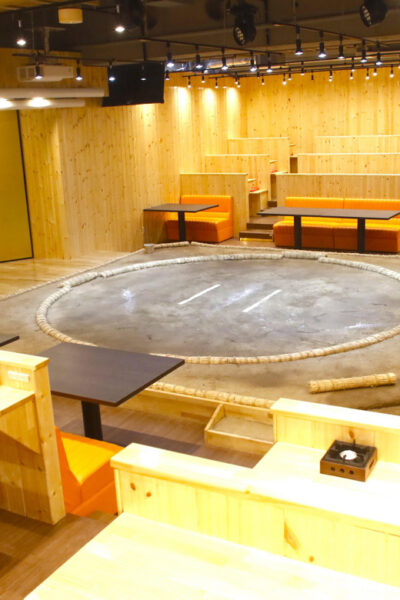
Sumo Show Experience with Chicken Hot Pot and a Photo
Read our review →
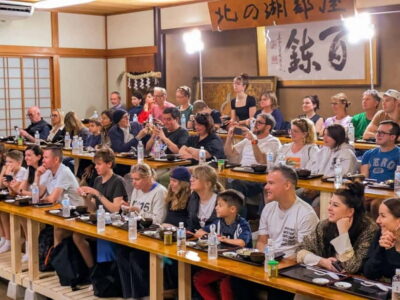
Tokyo Shinjuku Sumo Show & Experience with Photo
Read our review →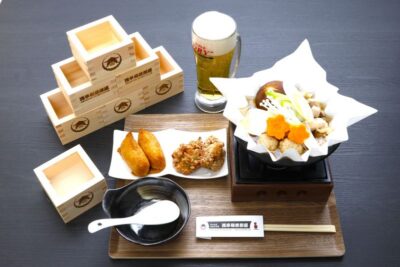
Asakusa Sumo Club Sumo Show Admission with Chankonabe in Tokyo
Read our review →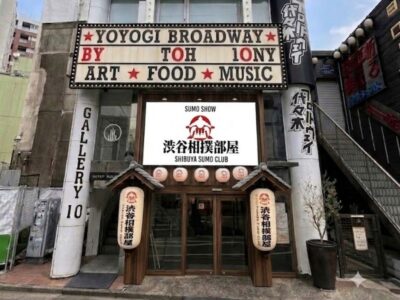
Tokyo Ginza Sumo Experience: Performance vs Pure Practice
Read our review →Browse the lists this tour appears in