
Reviewed · 3-HOUR EXPERIENCES
All must-sees in 3 hours – Nara Park Classic Tour! From JR Nara!
Deer are only the beginning. This three-hour walk links Nara’s main sights with local guides who explain the customs, beliefs, and stories that are easy to miss on your own. I especially like the included admission to Todai-ji’s Great Buddha Hall and the one-way bus ride from JR Nara Station, which saves time and energy. I also like that the tour usually ends around 1 pm, leaving you the afternoon for lunch and further exploring. The main drawback is the pace: you will walk several miles on gravel paths and through temple grounds, and one group found the tour too slow and tiring in intense heat.
The format is a small group of up to 15 people, not a private outing. Guides such as Mayumi, Nobuko, Reiko, Setsuko, Kazu, Makiko, and Shigeru have been praised for clear explanations, photo help, family-friendly care, and smart route choices. Just arrive on time at JR Nara Station, because the group leaves punctually and cannot wait for late arrivals.
In This Review
- Key points at a glance
- Starting at JR Nara Station at 10 am
- The bus ride into Nara Park
- Kasuga Grand Shrine and the meaning of Nara’s deer
- Todai-ji and the Great Buddha Hall
- Walking through Nara Park
- Kofuku-ji and the end near Nara’s center
- How good are the guides?
- Price, group size, and overall value
- Who should book this Nara walk?
- Should you book the Nara Park Classic Tour?
- FAQ
- Where does the Nara Park Classic Tour begin?
- What time does the tour start?
- Can I meet the group at Kintetsu Nara Station?
- Is the tour private?
- How long does the tour last?
- Is admission to Todai-ji’s Great Buddha Hall included?
- Is transportation included?
- Is the route suitable for strollers?
- What happens if the weather is poor?
Key points at a glance
- Meet at JR Nara Station at 10 am: Look for the guide holding a white NaraWalk flag outside the only ticket-gate area.
- One bus ride saves walking time: The group travels from JR Nara Station to the Nara Park area before beginning the main walk.
- See Nara’s essential trio: The route covers Kasuga Grand Shrine, Todai-ji Temple, and Kofuku-ji Temple.
- Great Buddha Hall admission is included: You do not need to arrange this major temple entry separately.
- Plan for real walking: Expect steps, gravel, heat, and potentially about five miles of walking with a family-paced route.
- Finish with useful local help: Guides can point you toward train stations, lunch, shops, and afternoon activities.
Starting at JR Nara Station at 10 am
The meeting point is simple if you use the right station. Come out through the ticket gates at JR Nara Station, where there is only one ticket-gate area, and find the white NaraWalk flag.
This detail matters because Kintetsu Nara Station is closer to the park, but it is not the meeting point. If you arrive there, you must make your own way to JR Nara Station. The group takes a bus from JR Nara Station and does not collect people at Kintetsu Nara Station.
You should build in spare time for the journey to Nara. One couple coming from Osaka needed several train changes and arrived close to the start time. That is an avoidable source of stress, especially since the tour does not wait for late arrivals.
The tour begins at 10 am sharp. That strict start is reasonable for a group outing, but it means you should not treat 10 am as a flexible target. Arrive early, locate the flag, and have your mobile ticket ready.
A few more options to weigh up in Nara
- World Heritage Kyoto & Nara Uji Authentic Matcha Experience
★ 5.0 · 1,573 reviews - Nara Half Day Trip Walking Tour (Private Option Available)
★ 5.0 · 937 reviews - Nara Early Morning Tour (Kyoto or Osaka Departure Available)
★ 5.0 · 676 reviews
The bus ride into Nara Park
The included bus ride is a small but useful feature. Instead of spending the first part of the morning walking from the station toward the park, you get to the main sightseeing area more directly.
The bus does not turn this into a vehicle tour. It simply puts you in a better position for the walking portion. Once you arrive near Nara Park, expect to spend most of the experience on foot, moving between shrine paths, open parkland, and temple grounds.
I see this as good value for anyone with only half a day in Nara. You pay $42.94 per person, and part of that price covers the bus and Todai-ji admission. The bigger value is the time saved in planning the route and understanding what you are looking at. You can certainly visit Nara Park without a guide, but it is easy to wander between deer, souvenir stalls, and temple buildings without grasping how Shinto and Buddhism shaped the city.
Kasuga Grand Shrine and the meaning of Nara’s deer
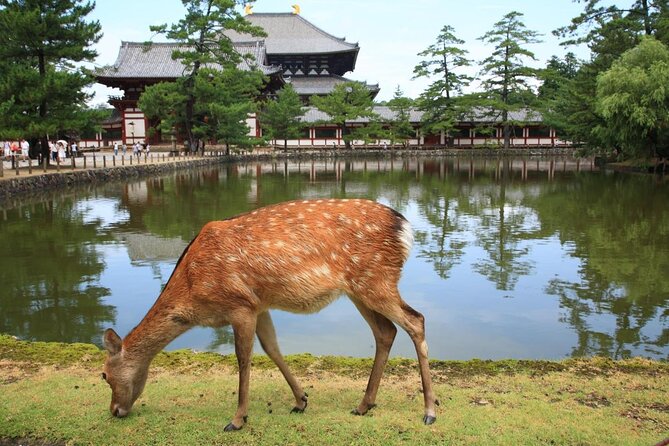
Kasuga Grand Shrine is usually the first major stop, with about 30 minutes in the precinct. The setting gives you a strong first taste of old Nara: wooded paths, religious buildings, and deer appearing along the way.
The guide explains why deer are allowed to roam freely in Nara. That context changes the experience. The deer are not simply a cute photo prop. They are tied to the religious traditions of the area, and their presence has a connection to Kasuga’s sacred setting.
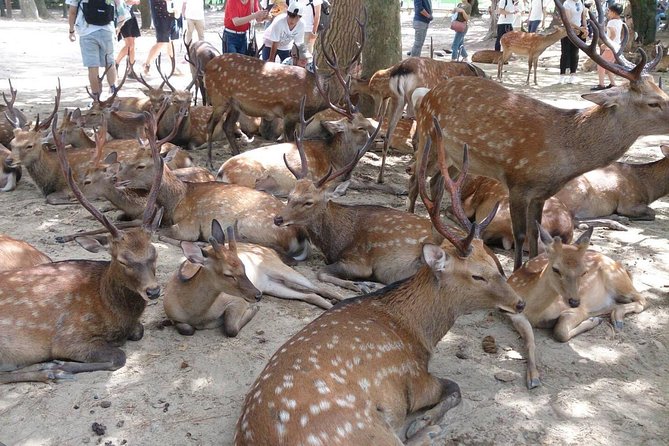
You will likely see deer here and elsewhere in the park. Feeding them can be fun, especially for children, but you need to pay attention. Several accounts point out that male deer can become pushy, particularly around food, and antlered animals deserve extra space. The deer may look calm, but they are still animals with their own ideas about who is holding the crackers.
Your guide can also explain the difference between Shinto and Buddhism. That is one of the strongest reasons to choose this walk instead of relying only on signs. The tour connects the buildings to Japanese religious practice, rather than treating each shrine and temple as a separate photo stop.
Todai-ji and the Great Buddha Hall
Todai-ji is the tour’s major architectural and spiritual highlight. About 40 minutes are set aside for the Great Buddha Hall, home to the enormous Great Buddha statue.
Admission to the hall is included, which helps the tour’s value. You enter with the group, hear the story behind the statue and temple, and have time for photographs. Guides have also explained the famous hole in one of the hall’s wooden pillars, a passage said to be the same size as the Great Buddha’s nostril. The reported measurements are about 37 by 30 by 110 centimeters.
If you want to try squeezing through, be realistic about your size and mobility. It is a fun detail, not a required part of the visit. The main reward is seeing the statue and understanding the scale of the hall around it.
This stop can become crowded, so a guide is useful for keeping the group together and finding sensible places to pause. Reiko has been praised for helping families move through busy temple areas, while other guides have taken groups toward quieter parts of the park when possible.
The 40-minute stop is enough for an introduction, but not for every corner of Todai-ji. If you want a slow study of the temple buildings, museum areas, or surrounding grounds, plan to return on your own after the tour.
A completely different kind of day out:
- Osaka: Nara and Uji Day Trip with Deer Park and Hot Spring
★ 4.4 · 302 reviews - Kyoto/Osaka: Kinkakuji, Bamboo Forest, and Nara Deer Park
★ 4.4 · 265 reviews - Nara 6hr Private Tour with Government-Licensed Guide
★ 5.0 · 219 reviews - E-Bike Nara Highlights – Todaiji, Knives, Deer, Shrine
★ 4.8 · 186 reviews
Walking through Nara Park
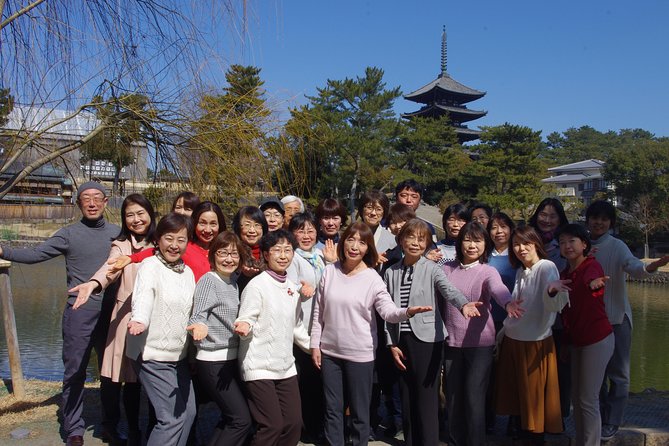
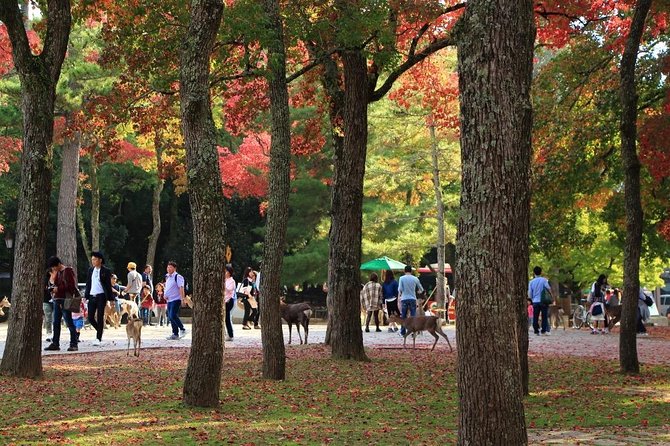
Nara Park is not just a single attraction. It is the broad setting that connects Todai-ji, Kasuga Grand Shrine, and Kofuku-ji. The route allows about 30 minutes here, though the exact path can change with the season and the group’s speed.
This flexible portion is valuable because your guide can react to conditions. A quieter path, a good deer-viewing area, or an extra park stop may be added when time allows. That gives the walk a more personal feel without turning it into a private tour.
You should not expect an effortless stroll. The route includes steps and gravel, and a stroller may need to be lifted or pushed firmly. One family with children aged four and seven covered roughly five miles overall. That is a useful warning for anyone planning to bring young children or older family members.
The pace is often described as comfortable, with time for pictures and deer feeding. Still, heat can change the experience. A few accounts describe very hot and humid conditions, and one person felt the guide continued too long after the group had tired. Wear proper walking shoes, carry water, and treat the three-hour schedule as an active morning rather than a gentle sightseeing loop.
Kofuku-ji and the end near Nara’s center
The tour usually ends at Kofuku-ji Temple after about 20 minutes. Its five-storied pagoda gives you one of the most recognizable photo opportunities on the route.
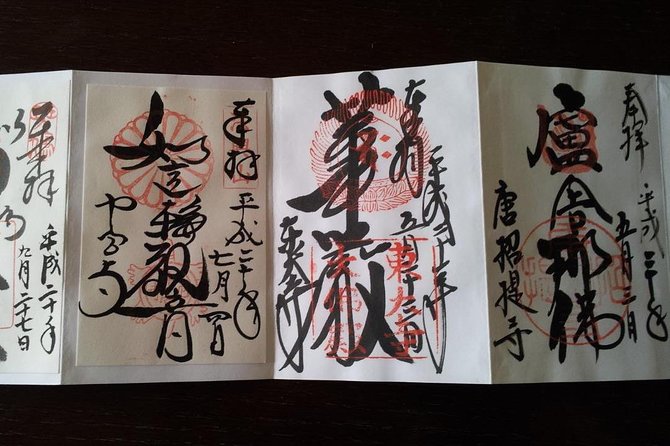
Your guide explains the temple’s history before helping you orient yourself for the rest of the day. This practical ending is one of the tour’s best features. Guides have offered directions to train stations, lunch areas, shops, and afternoon sights.
The activity ends in a different place from where it begins, so you should not expect to be escorted back to JR Nara Station. That is not a problem if you understand the layout, and the guide can point you in the right direction. It is also useful if you want to keep exploring rather than immediately return to the station.
You might continue with lunch, look for the famous mochi demonstrations mentioned by one participant, or spend more time around Nara’s central streets. The tour’s early finish gives you room to make that choice.
How good are the guides?
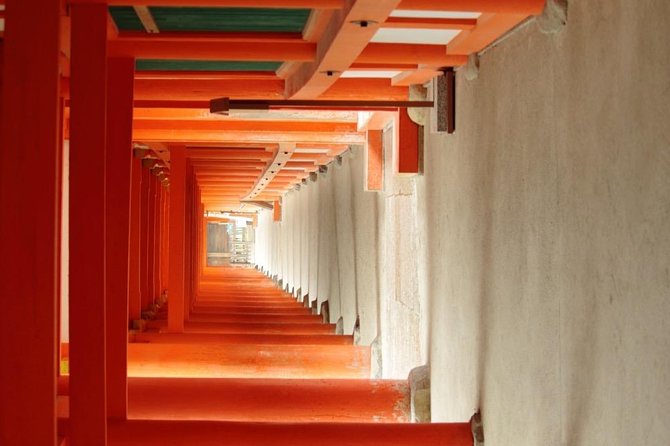
The guide is the central reason to book this experience. The strongest pattern across the comments is not one particular personality, but the care and local explanation offered by different guides.
Mayumi has been praised for her warm manner and broad understanding of Nara. Nobuko has received especially strong comments for patience, flexibility, and making the walk comfortable for people with different interests. Reiko has helped solo visitors with umbrellas and photos, and she has connected well with families and teenagers.
Setsuko has guided for about 10 years and has been credited with finding less crowded spots and helping families stay on schedule. Kazu has been appreciated for explaining religion, customs, and local history, then recommending lunch afterward. Makiko, Shigeru, Yoshi, Seiko, Satomi, Motoko, Lay, Mamiko, and other guides have also been praised for friendly explanations and personal attention.
You should keep your expectations measured. English ability can vary by guide. One participant found a guide’s English difficult to follow and felt the speaking voice was too soft. If you have hearing concerns, stay close to the guide and ask questions when needed.
The best guides do more than recite dates. They explain why the deer matter, how Shinto and Buddhism differ, where to take photos, and how to behave around the animals. That practical cultural guidance is hard to reproduce with a quick internet search.
Price, group size, and overall value
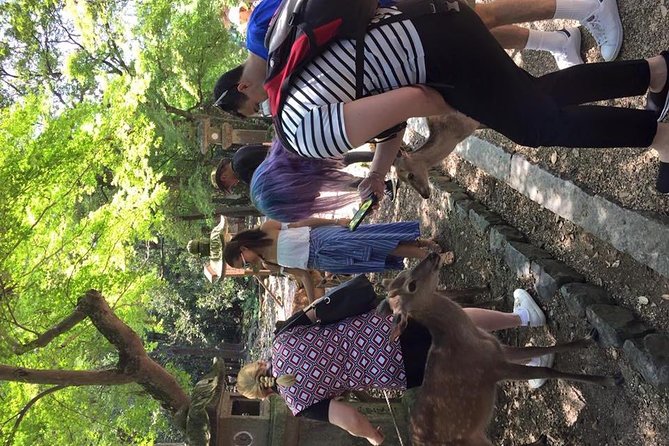
At $42.94 per person, this is not the cheapest way to walk through Nara Park. The park itself is open to the public, and you can visit the main areas without paying for a guide.
The price makes more sense when you value three things: a ready-made route, local explanations, and included entry to the Great Buddha Hall. The bus ride also trims some unnecessary walking at the start. For a first visit, especially one squeezed between time in Kyoto or Osaka, I think the cost is fair.
The group limit of 15 is important. This is not a private tour, but it is small enough to remain manageable. A full group will naturally feel less flexible than a one-family outing, and the guide cannot stop indefinitely for late arrivals or individual detours.
The rating is 4.9 from 108 ratings, with 98 percent recommending it. Those numbers point to a reliably strong experience, but they do not erase the practical limits. You need to handle a fair amount of walking, accept a fixed start, and be ready for outdoor conditions.
Who should book this Nara walk?
I would choose this tour if you have less than half a day in Nara and want the main sights explained in a sensible order. It suits first-time visitors, families who want help managing the route, solo visitors who appreciate photo assistance, and anyone curious about Japanese religion and deer customs.
It also works well for people staying in Osaka or Kyoto who want a clear morning plan. The tour usually finishes around 1 pm, so you can still have lunch and continue exploring.
I would think twice if you want a slow, private experience or dislike group schedules. It is also less suitable if gravel, steps, heat, or several miles of walking would be difficult. Parents with strollers should expect extra effort on the rougher sections.
The experience requires good weather. If poor weather causes cancellation, you will be offered another date or a full refund. You can cancel for a full refund up to 24 hours before the start time, but changes or cancellations inside that window are not accepted.
Should you book the Nara Park Classic Tour?
Book it if you want efficient sightseeing with meaning, not just a checklist of temples and deer. The tour gives you Nara’s essential sights, a Great Buddha visit, useful cultural background, and enough time afterward to make the day your own.
Skip it if you already know Nara well, prefer complete independence, or need a low-walking schedule. For most first-time visitors with a tight timetable, the combination of route planning, local help, and included admission makes $42.94 a sensible spend.
FAQ
Where does the Nara Park Classic Tour begin?
It begins at JR Nara Station, at 1 Sanjohonmachi, Nara. Meet in front of the ticket gates and look for the guide holding a white NaraWalk flag.
What time does the tour start?
The start time is 10 am. The group leaves punctually and cannot wait for people who arrive late.
Can I meet the group at Kintetsu Nara Station?
No. You must go to JR Nara Station. The group takes a bus from JR Nara Station and does not stop at Kintetsu Nara Station.
Is the tour private?
No. It is a group walking tour with a maximum of 15 participants.
How long does the tour last?
The tour lasts approximately three hours and usually ends around 1 pm.
Is admission to Todai-ji’s Great Buddha Hall included?
Yes. Admission to the Great Buddha Hall is included in the tour price.
Is transportation included?
One bus ride from JR Nara Station to the Nara Park area is included. The experience is primarily a walking tour after that.
Is the route suitable for strollers?
The route includes steps and gravel. You may need to carry a stroller or push it with extra force, so it is not an easy route for every stroller.
What happens if the weather is poor?
The tour requires good weather. If it is canceled because of poor weather, you will be offered a different date or a full refund.
Just added in Nara
- Hammer a Pattern on Your Ring Workshop★ 5.0 · 57 reviews
- Nara Private Tour: Flexible Pickup from Kyoto, Osaka, or Nara★ 5.0 · 17 reviews
- Private Nara Tour and Sake Tasting (Departing from Kyoto/Nara)★ 5.0 · 40 reviews
- Nara Highlight Walking Tour with Furoshiki Experience with Lunch★ 5.0 · 73 reviews
- Nara Sake Tasting Tour at Local Brewerie(tasting fee included)★ 5.0 · 12 reviews
- Nara World Heritage PRIVATE TOUR★ 4.5 · 15 reviews
- Nara – Highlights Bike Tour★ 4.5 · 89 reviews
- Sushi Making Experience Luxury Course in Nara★ 5.0 · 36 reviews
3-Hour Experiences, compared.
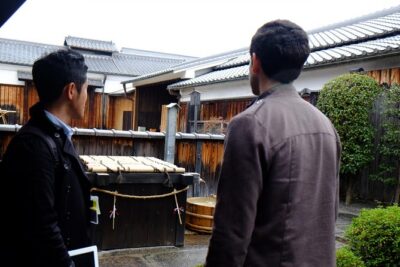
3-Hour Kyoto Insider Sake Brewery Tour with Tastings & Pairings
Read our review →

3h Tokyo E-Bike Tour: Hidden Gems, and Local Life with guide
Read our review →

3-hour Guided E-Bike Tour of the City’s Hidden Gems
Read our review →
3-Hour Bike/E-Bike Tour of the City’s Highlights
Read our review →
Browse the lists this tour appears in