
Reviewed · WALKING TOURS
Nara Highlight Walking Tour with Furoshiki Experience with Lunch
Nara rewards curious walkers. This 5.5-hour tour combines Todai-ji and Kasuga Taisha with free-roaming deer, a traditional lunch, and a hands-on furoshiki workshop. I like the mix of famous sights and simple local customs, and I like the small group size, capped at seven people.
The main drawback is that the walking and temple visits make for a full half-day. You also pay an extra ¥500 for the bus, and lunch is not included on Wednesdays or in every booking option, so check the exact package before you reserve.
In This Review
- Key points at a glance
- Why this Nara tour works well
- Meeting at the Gyoki Bosatsu statue
- Kasuga Taisha and the language of lanterns
- Tamukeyama Hachimangu and Nigatsu-do’s hillside view
- Todai-ji and the Great Buddha
- Nara’s deer and the need for simple manners
- Lunch and a furoshiki lesson at Shika no Fune Mayu
- Naramachi and the 1917 townhouse
- Group size, guide quality, and pace
- Is $37 a good value?
- Who should book this experience?
- FAQ
- How long is the Nara Highlight Walking Tour?
- Where does the tour start?
- Where does the tour end?
- Is the tour close to train stations?
- What is the group size?
- Is lunch included?
- What kind of lunch is served?
- Is the furoshiki workshop included?
- Is transportation included?
- Can I cancel for a full refund?
- Should you book it?
Key points at a glance
- Great Buddha and deer in one morning: You visit Todai-ji Temple and Nara Park, two of Nara’s essential stops.
- A useful craft to take home: The furoshiki workshop teaches traditional cloth wrapping, and you keep your own cloth.
- Small group, more personal pace: The tour accepts no more than seven people, which gives the guide room to answer questions.
- Lunch is part of the cultural experience: You eat a Japanese meal featuring freshly cooked rice and seasonal vegetables from Nara.
- Strong guide praise: Keiko received especially warm approval for keeping a very small group engaged with history and local insight.
- Easy finish near two stations: The tour ends near Nara’s shopping district, within easy reach of JR Nara Station and Kintetsu Nara Station.
Why this Nara tour works well
Nara is easy to visit on your own, but its major sights are spread across a large park area. A guide helps connect the temples, shrines, deer, and old neighborhoods into a clearer picture. You are not simply checking off Todai-ji and Kasuga Taisha. You are moving through the religious and cultural center of Japan’s first permanent capital.
At $37 per person, the price is appealing for a 5.5-hour experience. The cost includes temple and shrine entrance fees, an English-speaking local guide, lunch when your option includes it, and the furoshiki activity when selected. Add the ¥500 bus fare, and the total remains modest for a half-day outing with several included elements.
I especially like the balance between grand sights and ordinary traditions. Todai-ji supplies the dramatic scale. The furoshiki workshop gives you something practical and personal. Lunch slows the day down, while the walk through Nara’s old district adds a quieter finish.
The small group matters here. With a maximum of seven people, the guide can keep the group together without the rigid feel of a large coach tour. One especially well-rated guide, Keiko, was praised for maintaining engagement and offering strong insight even when only two people attended. That is a useful clue about the style of the experience: the best version may feel more like a guided walk with an attentive local than a fixed lecture.
More Walking Tours in Nara:
- Nara Half Day Trip Walking Tour (Private Option Available)
★ 5.0 · 937 reviews - Nara: Private Walking Tour with a Local
★ 4.3 · 36 reviews - Kyoto Geisha Walking Tour: Gion District & Hidden Gems
★ 4.7 · 3,273 reviews
Meeting at the Gyoki Bosatsu statue
The tour begins at the Gyoki Bosatsu statue at 27 Higashimuki Nakamachi. This meeting point is in central Nara, close to public transportation and the shopping streets around Kintetsu Nara Station.
Give yourself time to find the statue before the start. The tour information identifies the location clearly, but a central street meeting point can still take a moment to recognize, especially if you are arriving from JR Nara Station. Your mobile ticket should be available at booking, making it easy to keep the confirmation on your phone.
The day combines walking with a bus ride. The bus fare is not included and costs ¥500 per person. Bring some Japanese yen for that extra charge, and wear shoes you can walk in comfortably. The supplied timing adds up to several temple stops, lunch, and the old town, so this is not a quick orientation stroll.
Kasuga Taisha and the language of lanterns
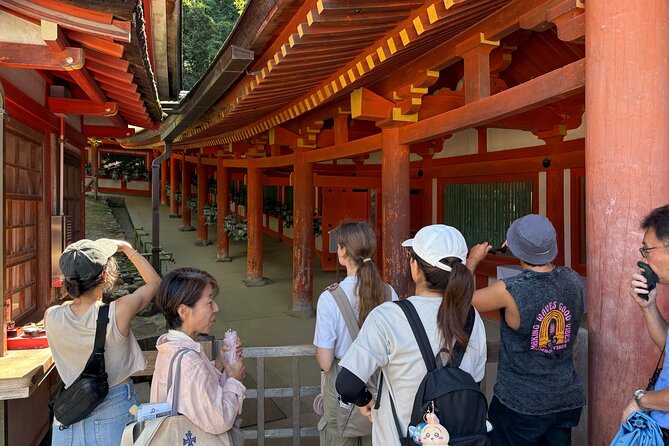
Kasuga Taisha, also called Kasuga Grand Shrine, was founded in 768. It is one of Nara’s best-known Shinto sites and is famous for the bronze and stone lanterns that line its grounds. The lanterns are lit during special festivals, making them one of the shrine’s most memorable features.
The scheduled visit lasts about 20 minutes, with admission included. That is enough for an introduction and a look at the shrine’s central features, but not a long, unhurried exploration. I would treat this stop as a focused visit rather than a chance to see every corner.
This shrine also helps you understand that Nara’s appeal is not only Buddhist temple architecture. Shinto shrines have their own visual language, rituals, and atmosphere. A local guide can point out those differences as you move through the site, which is useful if this is your first visit to Japan.
The short timing can be a benefit if you want to see several parts of Nara in one day. It can feel brisk if you prefer to linger, take many photographs, or read every sign. Keep your expectations realistic: this is a highlights tour, not a slow shrine study.
Tamukeyama Hachimangu and Nigatsu-do’s hillside view
The route also includes Tamukeyama Hachimangu, a small Shinto shrine built in 749 to protect the nearby Great Buddha Hall. It is dedicated to Hachiman, a deity linked with war and protection.
This stop is a nice counterpoint to the major monuments. Tamukeyama Hachimangu is smaller and more closely tied to the protection of Todai-ji. You get a glimpse of how religious sites in Nara were connected, rather than seeing each temple or shrine as an isolated attraction.
The itinerary then brings you to Nigatsu-do Temple, a historic hall within the Todai-ji complex. The visit lasts about 20 minutes and has no separate admission fee. Nigatsu-do is known for Omizutori, the Water-Drawing ceremony held each March for more than 1,250 years.
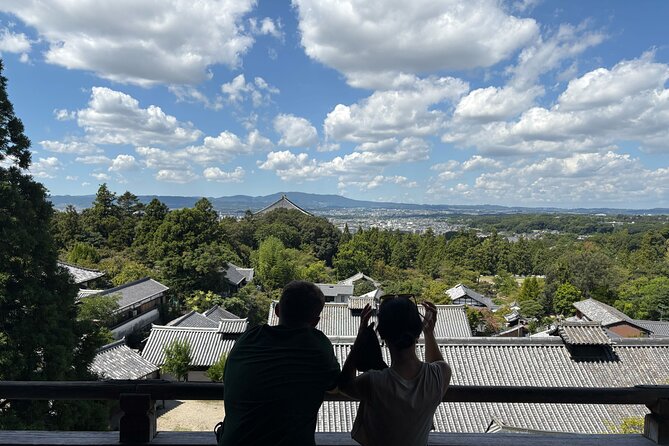
Nigatsu-do is also valued for its view over Nara. The elevated setting gives you a different angle on the city and the temple grounds. The stop is brief, so the guide-led visit is helpful for understanding why this hall matters. If you have limited time in Nara, it adds variety without requiring a separate detour.
The stairs and walking surfaces around historic religious sites can require care, though the supplied details do not give a specific accessibility assessment. Most people can participate, but anyone who finds extended walking difficult should ask the provider for current advice before booking.
A few more options to weigh up in Nara
- Shirakawa-go & Takayama Old Town Day Tour (Optional Hida Beef Lunch)
★ 4.6 · 3,936 reviews - Bike Tour Exploring North Kyoto plus Lunch
★ 5.0 · 1,087 reviews - Tokyo: Mt.Fuji & Lake Kawaguchiko 1-Day Bus Tour w/Optional Lunch
★ 4.5 · 839 reviews - Osaka/Kyoto: Arashiyama, Nara & Fushimi Inari Shrine w/Lunch
★ 4.4 · 754 reviews
Todai-ji and the Great Buddha
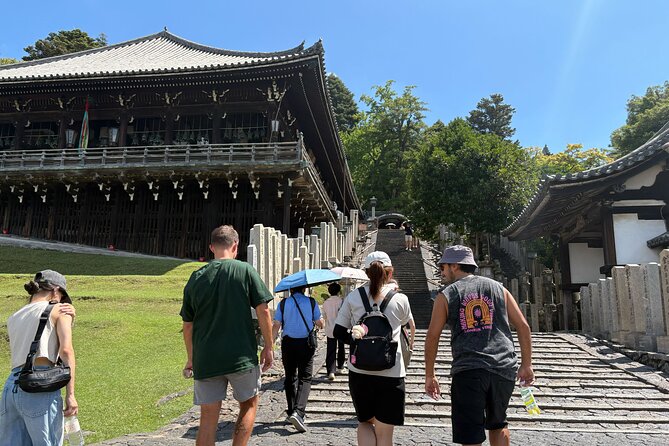
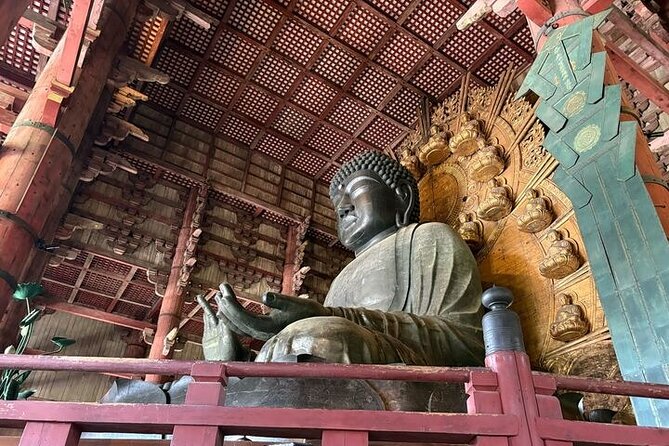
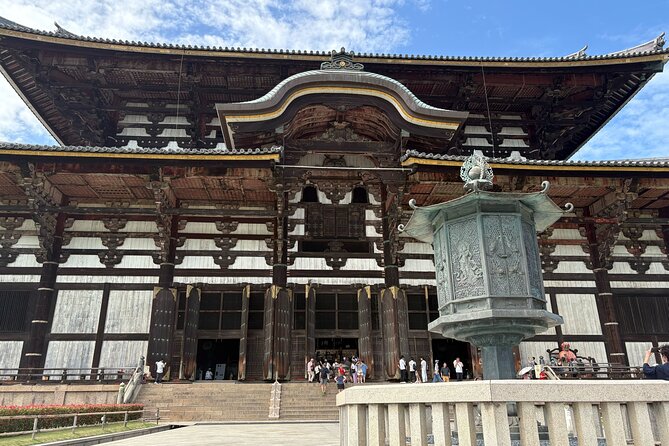
Todai-ji is the tour’s major architectural moment. The temple was built in the eighth century and houses the Great Buddha, one of the world’s largest bronze statues. It is also part of Nara’s UNESCO World Heritage sites.
The scheduled visit lasts about 40 minutes, and the entrance fee is included. That is a sensible amount of time for the main hall and Great Buddha, especially when the rest of the route still lies ahead. You should have enough time to take in the scale of the building and statue, hear the essential background, and look around without turning the entire day into one temple visit.
Todai-ji can be overwhelming in the best way. Its importance is not only its age or size. The Great Buddha gives the visit a strong visual center, while the hall shows how religious buildings were designed to create awe. A guide adds context that helps the monument feel like more than a very large wooden structure.
The stop is also where the tour’s pace becomes clear. You will see the main highlights, but you will not have unlimited free time. If Todai-ji is your highest priority, you might want to return independently later for a slower visit. For a first look at Nara, the included entrance and guided explanation offer good value.
Nara’s deer and the need for simple manners
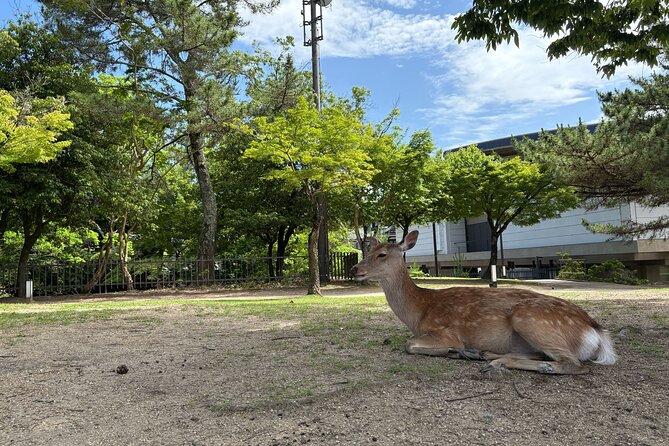
Nara’s free-roaming deer are one of the day’s most appealing features. They live around Nara Park and near the major temple and shrine sites, so you encounter them as part of the setting rather than at a separate animal attraction.
The tour description specifically allows time to meet and interact with the deer. That interaction is memorable, but you should remember that these are free-roaming animals. Follow the guide’s instructions and treat them with care. Keep your movements calm, and do not assume every deer wants attention.
The deer also make the walking route more playful. A large temple can feel formal, while a deer wandering nearby breaks that seriousness. Families and first-time visitors often value this contrast, but anyone hoping for a quiet, uninterrupted temple visit should expect a livelier outdoor setting.
Lunch and a furoshiki lesson at Shika no Fune Mayu
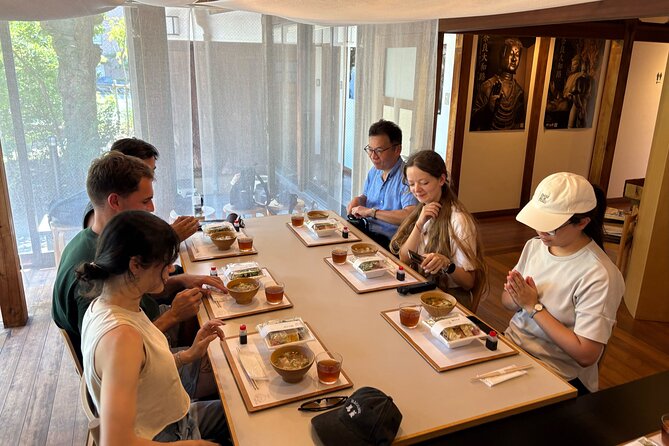
At Shika no Fune Mayu, the tour pauses for a one-hour lunch and furoshiki experience. This is the part of the day that gives the tour its strongest hands-on character.
The lunch is described as a traditional Japanese meal with freshly cooked rice and seasonal vegetables from Nara. Exact dishes can vary, so you should not book expecting a particular menu. The value is in having a meal connected to the region rather than grabbing a quick bite between temples.
The furoshiki workshop teaches you how to wrap items with a square Japanese cloth. Furoshiki can be used for carrying, covering, and presenting objects, so it is a useful tradition rather than a craft made only for display. You take home your own furoshiki, giving you a small souvenir with a practical purpose.
Check your booking option carefully. Lunch depends on the option you select, and it is not included on Wednesdays. The furoshiki activity also depends on the option. This is the most important detail to confirm before paying because the title of the experience may suggest that every package includes every element.
I like this stop because it changes the rhythm of the day. After several historic sites, you sit down, eat, and work with your hands. It also gives you an easy way to remember Nara beyond photographs. Years later, a cloth you use at home can bring back the day more effectively than another souvenir on a shelf.
Naramachi and the 1917 townhouse
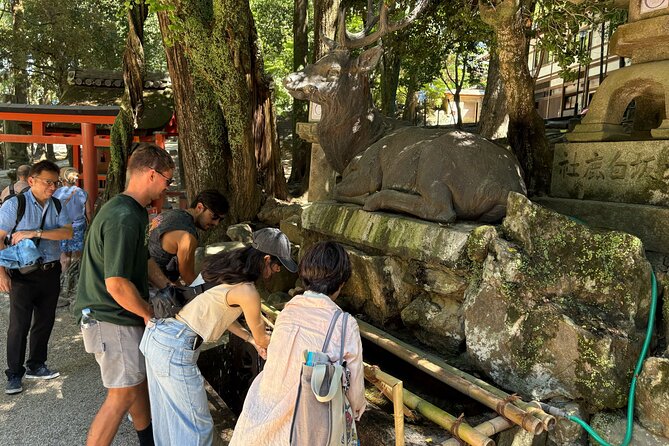
The final listed stop is Naramachi Nigiwai-no-Ie, a historic townhouse in Nara’s old Naramachi district. Built in 1917 by an antique dealer, the building is now a Registered Tangible Cultural Property.
The visit lasts about 15 minutes and has no separate admission fee. That short stop works as a closing glimpse of traditional urban Nara. After the major religious sites, you see the character of an older neighborhood and a building connected to local commerce.
Do not expect a long museum visit here. The value is the contrast. Nara is not only temples, shrines, and deer. Its old town also preserves the feel of domestic and commercial buildings from another period. Even a brief visit can help you notice the quieter details of the city.
The tour ends near Nakatanidou at 29 Hashimotocho, around Nara’s shopping district. From there, you have easy access to both JR Nara Station and Kintetsu Nara Station. That is convenient if you are continuing your sightseeing, catching a train, or looking for a snack after the tour.
Group size, guide quality, and pace
A maximum of seven people is one of the tour’s strongest practical features. A small group makes it easier to hear the guide, ask questions, and move through temple grounds without long pauses. It also gives the day a more relaxed feel than a large organized group.
The experience includes an English-speaking local guide. That matters most at places such as Tamukeyama Hachimangu and Nigatsu-do, where a short explanation can make the stop more meaningful. The tour has received a 4.9 rating from 73 reviews, with 100 percent recommending it, which supports the idea that guide quality is central to its appeal.
Keiko is the only guide named in the supplied feedback, and the praise is specific. She was valued for keeping the group engaged and sharing insight throughout the day. The fact that this was true even with only two participants suggests a guide who adjusts to the group instead of simply reciting a fixed script.
Still, a small-group format does not guarantee a private tour. The maximum is seven, and the actual number can vary. If you want a fully private itinerary or long periods at each site, this is not designed for that. You are choosing a compact, guided overview with personal attention.
Is $37 a good value?
At $37, the tour is priced well for the amount of time and the number of included components. You get about 5.5 hours, a local English-speaking guide, entrance fees for the listed temples and shrines, a traditional lunch in the appropriate option, and a furoshiki workshop in the appropriate option.
The ¥500 bus fee is modest, but it changes the real cost slightly. The larger issue is package selection. Wednesday departures do not include lunch, and the workshop also depends on the option you choose. Read the inclusions before booking rather than assuming the headline price covers everything described.
For me, the strongest value comes from the combination of guidance and variety. You could visit Todai-ji and Kasuga Taisha independently, but you would need to arrange your own route, pay entrance fees, learn the connections between the sites, find lunch, and seek out a furoshiki activity separately. This tour puts those pieces into one manageable day.
It is less compelling if you already know Nara well or want hours of free exploration. The schedule is designed around highlights, with timed stops of 15 to 40 minutes. That structure is useful for a first visit and less suitable for a slow, specialist visit.
Who should book this experience?
I would recommend this tour to a first-time Nara visitor who wants the major sights without spending a full day planning the route. It suits solo visitors, couples, families, and small groups who like a guide but do not want a large tour bus atmosphere.
It is also a good choice if you want cultural variety. The day gives you Buddhist and Shinto sites, deer, food, a traditional craft, and an old townhouse. Few half-day tours offer such a broad introduction for this price.
You should think twice if you dislike scheduled stops, have difficulty with extended walking, or want to spend most of your time at Todai-ji alone. You should also confirm the lunch and furoshiki inclusions if those are the reasons you are booking.
Cancellation is free if you cancel at least 24 hours before the local start time. Changes or cancellations inside that window are not accepted for a refund. The experience requires good weather, and poor conditions may lead to a new date or a full refund.
FAQ
How long is the Nara Highlight Walking Tour?
The tour lasts approximately 5 hours and 30 minutes.
Where does the tour start?
It starts at the Gyoki Bosatsu statue, 27 Higashimuki Nakamachi, Nara, 630-8215, Japan.
Where does the tour end?
It ends near Nakatanidou at 29 Hashimotocho, Nara, 630-8217, Japan, near Nara’s shopping district.
Is the tour close to train stations?
Yes. The ending area is easy to access from both JR Nara Station and Kintetsu Nara Station.
What is the group size?
The tour has a maximum of seven participants.
Is lunch included?
Lunch is included only with the applicable option. It is not included on Wednesdays.
What kind of lunch is served?
The included meal is a traditional Japanese lunch featuring freshly cooked rice and seasonal vegetables from Nara.
Is the furoshiki workshop included?
The furoshiki experience depends on the option selected at booking.
Is transportation included?
The bus fare is not included. It costs ¥500 per person.
Can I cancel for a full refund?
Yes, if you cancel at least 24 hours before the experience start time. Poor weather cancellations may result in a different date or a full refund.
Should you book it?
Book this tour if you want a well-paced first look at Nara with the big sights, a local guide, a meal, and a craft activity all in one morning and afternoon. The small group, strong guide feedback, included temple admissions, and easy finish near both train stations make it a practical choice.
Before booking, check two details: your option’s lunch and furoshiki inclusions, and the extra ¥500 bus fare. If you are comfortable with a full walking schedule and prefer guided context to wandering alone, this is a very good-value introduction to Nara.
Just added in Nara
- Hammer a Pattern on Your Ring Workshop★ 5.0 · 57 reviews
- All must-sees in 3 hours – Nara Park Classic Tour! From JR Nara!★ 5.0 · 108 reviews
- Nara Private Tour: Flexible Pickup from Kyoto, Osaka, or Nara★ 5.0 · 17 reviews
- Private Nara Tour and Sake Tasting (Departing from Kyoto/Nara)★ 5.0 · 40 reviews
- Nara Sake Tasting Tour at Local Brewerie(tasting fee included)★ 5.0 · 12 reviews
- Nara World Heritage PRIVATE TOUR★ 4.5 · 15 reviews
- Nara – Highlights Bike Tour★ 4.5 · 89 reviews
- Sushi Making Experience Luxury Course in Nara★ 5.0 · 36 reviews
Walking Tours, compared.
Kyoto Geisha Walking Tour: Gion District & Hidden Gems
Read our review →
Tokyo Tsukiji Fish Market Food and Culture Walking Tour
Read our review →
Gion Magical Night Walking Tour with Geisha Trivia
Read our review →
Imperial Palace and Shogun Historical Walking Tour
Read our review →
Gion Geisha District Walking Tour – Stories of Geisha
Read our review →
Shinjuku Local Bar and Izakaya Guided Walking Tour
Read our review →
Browse the lists this tour appears in