Reviewed · KYOTO TOURS
Authentic knife making experience at a blacksmith in Kyoto
Heat, steel, and a useful souvenir. This Kyoto blacksmithing workshop gives you rare hands-on time with a Japanese smith, from heating raw metal to sharpening a finished kitchen knife. I especially like the practical handmade blade you take home and the patient instruction from professionals such as Mao and Taka. The main drawback is that hammering near a hot furnace is real physical work, and the studio location must be confirmed before you go.
I also like the small-group feel and the fact that this is not just a demonstration. You put on traditional smith’s clothing, handle the tools, strike the glowing steel, and help shape the final edge. It is a memorable choice for families with older children, couples, solo visitors, and anyone who prefers making something to simply looking at another temple.
In This Review
- The essential details at a glance
- Why this Kyoto workshop is worth your time
- Arriving at Studio NIN in Sakyo-ku
- Putting on the smith’s uniform
- Learning the tools and the safety rules
- Heating the steel and striking the blade
- Cooling, shaping, and sharpening the edge
- Polishing the handmade finish
- What the instructors add to the experience
- Who will enjoy this most
- Is $154 a fair price?
- Booking and practical advice
- Should you book the Kyoto knife-making experience?
- FAQ
- Where does the knife-making experience take place?
- How long does the workshop last?
- How much does the experience cost?
- What size knife will I make?
- Is the workshop available in English?
- What should I bring?
- Can children attend?
The essential details at a glance
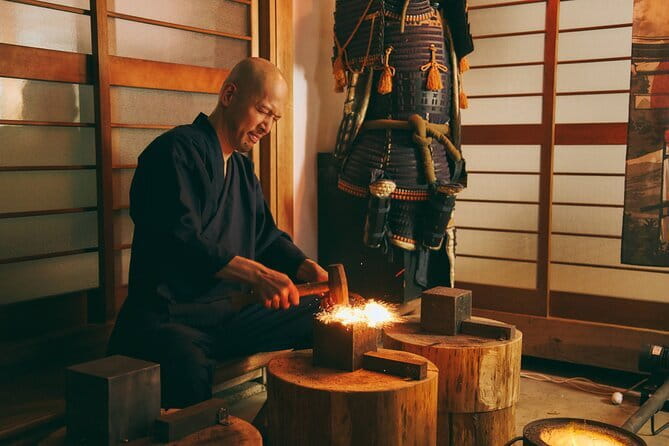
- You forge a real 13 to 15 cm knife: The finished blade is practical enough for everyday use and personal enough to make a fine gift.
- You work with red-hot steel: The furnace heats the metal to roughly 800 to 900°C, so clear safety instructions and careful guidance matter.
- The workshop takes about three hours: The knife-making format is shortened from longer, more involved knife sessions, so the pace is active.
- You wear traditional blacksmith attire: The costume is more than a photo prop. It helps turn a modern class into a hands-on craft lesson.
- The studios are in Sakyo-ku: The listed meeting point is close to the Yase-Hieizan Exit of the Eizan Electric Railway, but you must confirm whether you are going to Studio NIN Yase or Studio NIN Kendo.
- The class suits small groups: English and Japanese instruction is available, and the staff can give extra help when your blade needs correction.
Why this Kyoto workshop is worth your time
Kyoto has no shortage of temples, gardens, tea ceremonies, and polished cultural activities. Knife making gives you something different: a craft that asks you to use your hands, pay attention, and accept that the finished object will show signs of the process.
That last point matters. This is not a factory tour where every result looks identical. You help forge, shape, sharpen, and polish your own blade. The instructors may correct mistakes, but the knife still feels connected to your work.
At $154 per person, this is not a cheap souvenir activity. The price makes more sense when you count the instructor-led instruction, tools, materials, protective clothing, water, towel, box, bag, and the finished knife. You are paying for access to a hot forge and a skilled team, not simply buying a kitchen tool.
The final blade has a rustic kurouchi finish. This dark, raw-forged surface is part of the look and helps with rust resistance, according to the workshop guidance shared during the experience. Do not arrive expecting a factory-perfect silver blade. The charm is in the handmade surface and small signs of human work.
A few more options to weigh up in Kyoto
- PERFECT KYOTO 1-Day Bus Tour
★ 5.0 · 13,518 reviews - [Kyoto & Nara Day Tour] Sagano Scenic Railway & Nara Park & Fushimi Inari Taisha Thousand Torii Gates & Togetsukyo Bridge & Bamboo Grove & Kimono Forest (Departing from Osaka)
★ 4.9 · 10,942 reviews - Kyoto: Fushimi Inari, Kinkakuji, Bamboo Grove 1 Day Bus Tour
★ 4.8 · 4,316 reviews
Arriving at Studio NIN in Sakyo-ku
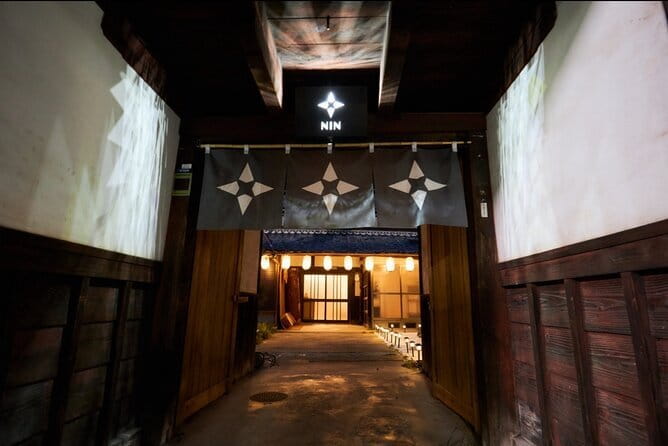
The main meeting point is given as Studio Shinobi YASE, at 168-1 Yase-no-secho, Sakyo-ku, Kyoto City. It is also described as Studio NIN Yase. The location is near the Yase-Hieizan Exit of the Eizan Electric Railway, and the directions say it is a one-minute walk from the station.
Give yourself extra time anyway. One attendee found the location confusing because the operation uses two studios, while another described the walk from the station as closer to 15 minutes. The safest plan is simple: wait for the staff message confirming the exact studio, then follow that address rather than relying only on the original meeting-point wording.
The second location is Studio NIN Kendo. Both studios are in Sakyo-ku, but they are not interchangeable for your arrival. Check the message carefully on the day before the class.
The train is the recommended way to arrive. Taxis are also available. If you are visiting Kyoto without a car, this is a useful activity because you do not need to arrange a long trip to a remote forge. Still, do not cut the timing close. Missing the start of a safety briefing would be a poor way to begin a hot-metal workshop.
Putting on the smith’s uniform
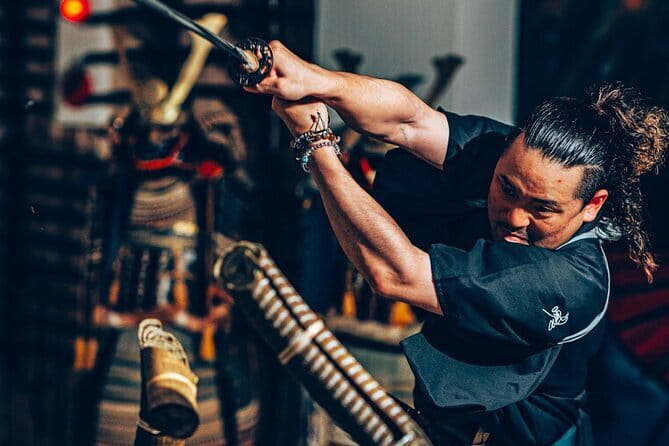
The class begins with a welcome from the instructor. Mao is identified as a knife professional with more than ten years of experience, and the wider team includes instructors such as Taka, Mits, Atsushi, and Daiki at different sessions.
You change into the traditional uniform worn by Japanese smiths. It is a small but effective start. Instead of walking into the class in ordinary sightseeing clothes and treating the forge as another photo stop, you have a clear role to play.
The studio provides the costume, towel, water, tools, materials, box, and bag. Bring socks, which are specifically required. Wear clothes you can work comfortably in underneath the provided attire, though the supplied information does not set out a full clothing rule.
The atmosphere appears friendly and informal. Several instructors are described as upbeat, patient, and willing to use humor while still keeping the work organized. That combination is useful because beginners need both firm instruction and enough encouragement to keep swinging when the work gets tiring.
Learning the tools and the safety rules
Before the furnace gets your attention, the team explains the main tools. You learn how to handle hammers, tongs, grinders, and sharpening equipment.
This part deserves your full attention. The metal reaches roughly 800 to 900°C, and the work involves force, heat, and sharp edges. The staff explain how to hold tools and where to position yourself. You should follow their instructions exactly rather than trying to copy a technique from a video or rushing to make the biggest strike.
The activity carries a clear risk warning. If an accident or injury occurs, responsibility rests with the customer under the stated conditions. That should not put you off, but it should help you understand the nature of the class. This is a supervised craft session, not a soft cultural demonstration.
Alcohol and drugs are not allowed. Children under 15 cannot attend, and anyone under 15 who might otherwise be considered must not be brought along. The activity is also listed as unsuitable for people over 95. Teenagers aged 15 and older have taken part, with one family especially enjoying the class with sons aged 15, 19, and 23.
A completely different kind of day out:
- Kyoto: Tea Ceremony in a Traditional Tea House in Kiyomizu
★ 4.9 · 3,519 reviews - Kyoto: Gion Make Your Own Chopsticks with Engraving Option
★ 5.0 · 3,465 reviews - Kyoto Nara Day Trip │ Kiyomizu-dera Temple + Fushimi Inari-taisha Shrine + Nara Park (Departing from Osaka/Kyoto)
★ 4.7 · 3,408 reviews - Kyoto Geisha Walking Tour: Gion District & Hidden Gems
★ 4.7 · 3,273 reviews
Heating the steel and striking the blade
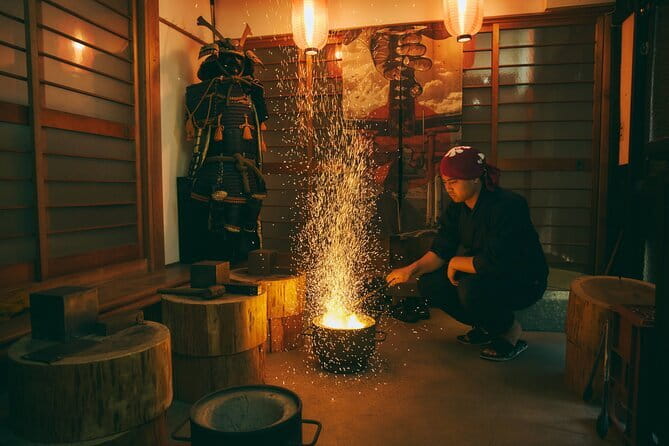
The most dramatic moment comes when the raw iron enters the furnace. It begins to glow red, and the room changes from classroom to working forge.
Under close direction, you strike the heated metal with a hammer. Mao or another instructor shows you the angle, rhythm, and force. You are not left to guess, but you do have to contribute. The hammering is physical, and several people found it more tiring than expected.
Stretch before you arrive. That advice is worth taking seriously, especially if you have spent several days walking around Kyoto. You will use your arms and shoulders, and you may spend time close to the furnace. In hot weather, the studio has provided frozen neck coolers and cooling wraps, and air conditioning has also been noted. Even so, expect warmth and effort, not a relaxed indoor craft class.
The best part of the hammering is its directness. You can see the steel change under each series of strikes. The instructors keep the work safe and help repair mistakes, which lets a beginner take part without turning the final knife into a failed experiment.
That help does not remove the satisfaction. You still feel the difference between being handed a completed object and helping make one.
Cooling, shaping, and sharpening the edge
Once the rough blade has been forged, it is cooled and checked. You work on the uneven edges and prepare the shape for sharpening.
This is where the workshop shifts from strength to care. The furnace and hammer provide the memorable action, but the knife becomes useful through the quieter finishing stages. You learn that a blade is not finished when it first resembles a knife.
Sharpening uses stones and grinders under instruction. Beginners can produce a functional edge because the staff guide the angle and step in when needed. You should expect assistance here. The goal is not to test whether you already know professional sharpening. The goal is to learn the basics and leave with a usable result.
There is a limit to what fits into this shorter format. The activity is presented as a refined 2.5-hour knife-making process within a three-hour booking window, while larger knives require more than five hours and cost over $400. You will not be completing a large chef’s knife or an advanced sword-making project in this session.
That is a fair trade for many people. The shorter knife is easier to complete during a Kyoto visit, and the 13 to 15 cm size is practical. If your main interest is advanced metallurgy or a large Japanese kitchen knife, this class may feel introductory.
Polishing the handmade finish
The final stages include polishing the blade and preparing it for collection. The raw steel becomes cleaner and more elegant, but the workshop does not aim to erase every sign of forging.
The kurouchi finish is important to understand before you book. It is rustic rather than mirror-bright. One useful piece of advice is to resist trying to make the blade completely silver and shiny. The dark forged finish is part of the knife’s character.
The finished knife comes in a box and bag. You can take photographs and videos during the process, and the staff may also help capture moments for you. That is particularly helpful during the hammering, when you will be too busy holding the tools to take your own pictures.
Some sessions have included extra waiting-time activities such as shuriken throwing, but this should not be treated as a guaranteed part of the knife class. The core experience is the forge, shaping, sharpening, and finishing.
What the instructors add to the experience
Instruction is the strongest part of this activity. The staff explain the process clearly, repeat directions when needed, and keep an eye on beginners working with hot steel.
Mao brings professional knife experience, while Taka has been praised for explaining Japanese blacksmithing methods and the background of the craft in an energetic way. Other named instructors include Mits, Atsushi, and Daiki. The exact team may vary, but the consistent point is that the staff are actively involved rather than standing back and watching.
English and Japanese are offered. You do not need previous metalworking experience. The team can adjust the amount of help, and several sessions have ended with good-looking knives even when participants started with no experience at all.
The historical explanation appears brief. You will learn something about Japanese blacksmithing and craftsmanship, but this is primarily a working class. If you want a long lecture on sword traditions, regional steel, or the full cultural background of Japanese blades, you may want to pair this with a museum or another craft visit.
For most people, that balance is right. Three hours pass quickly when you are alternating between explanation and physical work.
Who will enjoy this most
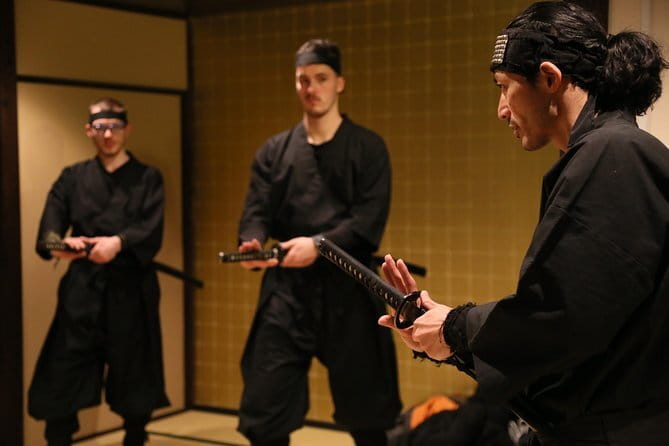
I would choose this for someone who values a souvenir with a story. A bought knife can be attractive, but a knife you helped forge has a stronger connection to your time in Kyoto.
It suits:
- Couples looking for a shared activity
- Families with children aged 15 or older
- Solo visitors who enjoy practical classes
- Anyone interested in Japanese craft
- People who prefer hands-on activities to museums
- Gift shoppers who want something useful rather than decorative
It may not suit you if you dislike heat, repetitive hammering, or close supervision around tools. The finished knife will be handmade, not flawless. That is part of the appeal, but it is worth knowing before you spend $154.
The class can also work well as a special occasion activity. It has been used as a birthday outing, and the finished knife makes a meaningful gift for a parent, partner, or friend. If you are making one for someone else, remember that the object is only half the present. The other half is the story of how you made it.
Is $154 a fair price?
The price is high compared with a short sightseeing stop, but it is reasonable for a three-hour craft session with specialist equipment and a finished object.
You receive the materials, tools, costume, water, towel, packaging, and instruction. You also get access to a forge that would be difficult and unsafe to use independently in Japan. The small-group option improves the value because instructors can spend more time correcting your hammering and sharpening.
Some sessions have been especially small, including one with only three participants and another that operated as a private class because no one else booked. You should not assume a private session, but a smaller group can make the work easier to follow.
There is also an optional extra cost for a handled knife. One participant reported paying an additional 5,000 yen for the handled version, with payment accepted by cash or card, including Apple Pay. Confirm the current upgrade price and payment method before relying on this detail.
For a basic, rustic blade that you helped make, the price is not bargain-level. For a rare Kyoto craft experience and a practical souvenir, I think the value is solid, especially if you would otherwise spend money on several small gifts with less personal meaning.
Booking and practical advice
The activity allows free cancellation up to 24 hours before the start for a full refund. You can also reserve now and pay later, which helps if your Kyoto schedule is still moving around.
Starting times vary, so check availability when choosing your date. The listed duration is three hours, though the knife-making work itself is described as a shorter 2.5-hour format. Do not plan a tightly timed attraction immediately afterward. Heat, hammering, location confusion, or a slower group can all make the finish feel less predictable.
Before leaving your hotel, confirm the studio address in the staff message. Bring socks, avoid alcohol and drugs, and arrive ready to work. Stretching beforehand is sensible, and in summer you should expect the furnace to make the room hot even with cooling measures.
Keep your expectations in the right place. You will learn the basic process and take home a functional handmade knife. You will not become a master smith in one afternoon.
Should you book the Kyoto knife-making experience?
Yes, if you want a genuine hands-on activity and a souvenir you can use. The strongest reasons to book are the patient instructors, the direct work with hot steel, the small-group potential, and the finished 13 to 15 cm blade.
I would skip it if you want a quiet cultural lesson, dislike physical work, or expect a perfectly polished professional knife. For everyone else, this is one of Kyoto’s more unusual ways to spend three hours. Confirm the studio first, allow time for the train journey, and arrive ready to swing a hammer.
FAQ
Where does the knife-making experience take place?
The listed meeting point is Studio Shinobi YASE at 168-1 Yase-no-secho, Sakyo-ku, Kyoto City. The operation also uses Studio NIN Yase and Studio NIN Kendo, so staff will message you before the visit to confirm the correct location.
How long does the workshop last?
The booking duration is three hours. The knife-making format itself is described as a refined 2.5-hour process.
How much does the experience cost?
The listed price is $154 per person. A handled knife may cost an additional 5,000 yen, according to the supplied activity information.
What size knife will I make?
The finished handmade knife is about 13 to 15 cm long. Larger knives require more than five hours and cost over $400.
Is the workshop available in English?
Yes. Instruction is available in English and Japanese.
What should I bring?
Bring socks. The workshop provides the costume, towel, water, tools, materials, box, and bag.
Can children attend?
Children under 15 are not suitable for the activity. Anyone under 15 must not attend unless the stated age requirements are met, and participants should be prepared for hot metal and physical work.
Just added in Kyoto
- The “Golden Route” and Ancient Japan by DIAMIR Erlebnisreisen – 14-Day Tour★ 2.0 · 2 reviews
- Japan: Castles & Cuisine by G Adventures – 6-Day Kyoto to Osaka Tour★ 4.5 · 4 reviews
- Cycle Japan by Explore! – 13-Day Kyoto to Tokyo Tour★ 4.7 · 12 reviews
- Cycle Japan by Intrepid Travel – 11-Day Kyoto to Tokyo Tour★ 4.8 · 2 reviews
- Classic Japan by Intrepid Travel – 11-Day Kyoto to Tokyo Tour★ 4.4 · 14 reviews
- Ancient & Modern Japan 14-Day Tour by Exodus Adventure Travels★ 4.4 · 40 reviews
- 5 Day Cultural Adventure of Kyoto, Nara & Osaka by Tourist Journey★ 2.5 · 2 reviews
- 12 Days Kinosaki Onsen Escape: A Journey Through Japan’s Timeless Towns by UME Travel★ 4.8 · 5 reviews
Kyoto Tours, compared.

![[Kyoto & Nara Day Tour] Sagano Scenic Railway & Nara Park & Fushimi Inari Taisha Thousand Torii Gates & Togetsukyo Bridge & Bamboo Grove & Kimono Forest (Departing from Osaka)](https://media.japanvisits.com/wp-content/uploads/kyoto-nara-day-tour-sagano-scenic-railway-nara-park-fushimi-inari-taisha-thousand-torii-gates-togetsukyo-bridge-bamboo-grove-kimono-forest-departing-from-osaka-k110001-400x257.jpg)

Fushimi Inari, Kinkakuji, Bamboo Grove 1 Day Bus Tour
Read our review →
Tea Ceremony in a Traditional Tea House in Kiyomizu
Read our review →
Gion Make Your Own Chopsticks with Engraving Option
Read our review →
Kyoto Nara Day Trip │ Kiyomizu-dera Temple + Fushimi Inari-taisha Shrine + Nara Park (Departing from Osaka/Kyoto)
Read our review →
Kyoto Geisha Walking Tour: Gion District & Hidden Gems
Read our review →