Reviewed · KYOTO TOURS
Discover Kyoto at Night by Bike
Kyoto glows after sunset. This 3-hour-45-minute bicycle tour gives you a lively way to see lantern-lit streets, riverside paths, shrines, and old wooden neighborhoods without the daytime crowds. I especially like the stops at Fushimi Inari and Yasaka Pagoda, plus the chance to ride beside the Kamogawa River as Kyoto settles into evening. The main consideration is the balance between riding and listening: one rider felt there was too much guide talk and only about 1 hour 45 minutes of actual cycling.
The small maximum of nine people is another real strength. Guides such as Juan have earned praise for helping riders feel safe, and the bilingual format makes the cultural explanations easier to follow. Still, you should be a reasonably confident cyclist. This is not presented as a lesson for first-time riders, and cooler evening weather can make the experience less comfortable.
In This Review
- The key points at a glance
- Why Kyoto works so well after sunset
- Fushimi Inari, Kyoto’s red-gate icon
- Miyagawa-cho and the first lantern-lit streets
- Gion after dark, with time for a short look
- Yasui-Konpiragu and its unusual purpose
- Hōkan-ji and the Yasaka Pagoda view
- Ninenzaka, the strongest photo stop
- The final Higashiyama park stop
- How much riding will you actually do?
- Bikes, fitness, weather, and group size
- Is $80 a fair price?
- Who should book this Kyoto night ride?
- Final call: a thoughtful ride, not a cycling sprint
- FAQ
- How long does Discover Kyoto at Night by Bike last?
- What time does the tour start?
- Where does the tour meet?
- Where does the tour end?
- What is included in the price?
- Is hotel transportation included?
- Is a guide included?
- How many people can join the tour?
- Do I need to be an experienced cyclist?
- What happens if the weather is poor?
- Can I cancel for a full refund?
The key points at a glance
- Fushimi Inari after dark: Spend about 40 minutes at Kyoto’s famous torii gate shrine, with admission included.
- A small group of no more than nine: The limited size should make it easier to hear the guide and keep the group together.
- A classic Higashiyama route: Gion, Miyagawa-cho, Yasui-Konpiragu, Hōkan-ji, and Ninenzaka bring you through Kyoto’s most traditional streets.
- More than a bike rental: The guide explains Kyoto’s customs, places, and stories, so expect regular stops and conversation.
- Good value at $80: The price includes the bicycle, bottled water, and entrance fees, with no extra admission charges listed.
- Weather matters: The tour requires good weather, and a cancellation for poor conditions brings a different date or full refund.
Why Kyoto works so well after sunset
Kyoto can feel crowded and busy around its best-known sights during the day. At night, the pace changes. Lanterns pick out wooden facades, temple grounds feel quieter, and narrow streets take on a more intimate mood.
That makes a bicycle useful. You can cover more ground than on foot, yet you remain close enough to notice old townhouses, stone lanes, and small pockets of neighborhood life. The bicycle also gives the evening a sense of movement that a standard walking tour cannot match.
This is not simply a ride past famous landmarks. It is a guided introduction to Kyoto’s traditional districts, with time to stop, listen, and look around. That distinction matters. If you want a fast-moving cycling workout, the frequent explanations may feel slow. If you want context for what you are seeing, the stops add value.
The tour starts at 5:00 pm from the 7-Eleven at 44-1 Higashikujō Kamitonodachō in Minami Ward. The activity returns to this same meeting point. Since the departure is near public transportation, you do not need to arrange hotel transportation, though getting to and from the starting point is your responsibility.
A few more options to weigh up in Kyoto
- PERFECT KYOTO 1-Day Bus Tour
★ 5.0 · 13,518 reviews - [Kyoto & Nara Day Tour] Sagano Scenic Railway & Nara Park & Fushimi Inari Taisha Thousand Torii Gates & Togetsukyo Bridge & Bamboo Grove & Kimono Forest (Departing from Osaka)
★ 4.9 · 10,942 reviews - Kyoto: Fushimi Inari, Kinkakuji, Bamboo Grove 1 Day Bus Tour
★ 4.8 · 4,316 reviews
Fushimi Inari, Kyoto’s red-gate icon
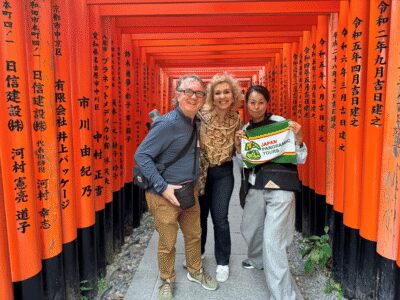
The first major stop is Fushimi Inari-taisha, one of Kyoto’s best-known Shinto shrines. It is famous for its thousands of torii gates, the bright red-orange passages that rise through the wooded grounds.
You get about 40 minutes here, the longest stop on the route. That is sensible. Fushimi Inari is not a sight to rush through, and even a short visit gives you time to see how the gates frame the paths and change the feel of the shrine after sunset.
Admission is free, and the tour covers entrance fees elsewhere as well. At Fushimi Inari, the evening setting is the main draw. The shrine has a different mood under dimmer light than it does in the middle of the day, when large crowds often fill the approach.
Do not expect to cycle through every part of the shrine grounds. The bicycle portion and walking portions are separate, and the 40-minute stop is best understood as a chance to explore a section of this large site. Comfortable shoes still matter because you will spend time off the bicycle.
Miyagawa-cho and the first lantern-lit streets
From Fushimi Inari, the route moves toward Miyakawa-cho Dori, also known as Miyagawa-cho. This traditional district lies south of Gion and runs parallel to the Kamogawa River.
The stop lasts about 15 minutes. That is not long, but the appeal here is visual rather than extensive sightseeing. At night, lantern light and old facades create one of Kyoto’s most atmospheric settings. You might find this part especially appealing if you enjoy quiet streets and traditional architecture more than major monuments.
The route’s bilingual guide adds useful context about Kyoto’s geisha and maiko traditions. You should keep expectations realistic, though. A ride through a historic entertainment district does not promise a performance or a close encounter with geisha. The value is in seeing the setting and learning how the district fits into Kyoto’s cultural life.
This is also one of the sections where the pace may feel stop-and-start. The guide may pause to explain details, and one past rider found that the talking took up more time than expected. Before booking, decide if you want a guided cultural tour on bicycles or a mostly uninterrupted evening ride.
Gion after dark, with time for a short look
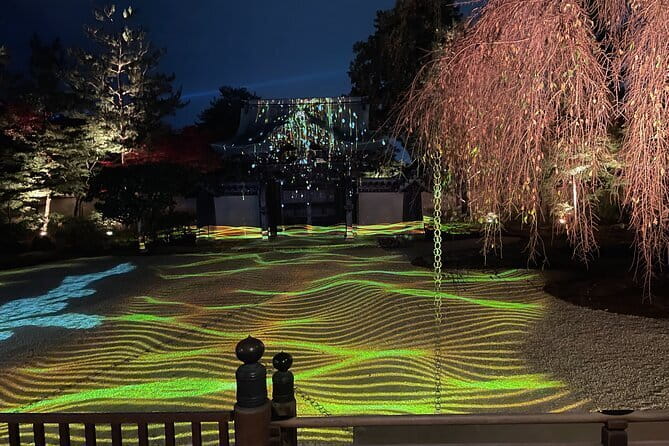
Gion is one of Kyoto’s most recognizable districts, and at night its traditional character becomes more pronounced. The tour includes the Hanamikoji area, lined with old tea houses and carefully preserved buildings.
The scheduled stop is about 10 minutes, so treat it as an orientation rather than a long wander. You will likely see the street, hear about its role in Kyoto’s traditional culture, and move on rather than spend a full evening exploring every lane.
That short visit can be a benefit. Gion is best approached with care, since it is a living neighborhood rather than an open-air stage set. A brief guided pass helps you see the architecture without turning the stop into a noisy group visit.
Your guide’s reminders about local customs can be useful here. The tour description emphasizes respect for Kyoto’s traditions, and that is important in districts where residents, businesses, and cultural workers share narrow streets. Listen closely, stay with the group, and follow any instructions about where you may stop or take photos.
A completely different kind of day out:
- Kyoto: Tea Ceremony in a Traditional Tea House in Kiyomizu
★ 4.9 · 3,519 reviews - Kyoto: Gion Make Your Own Chopsticks with Engraving Option
★ 5.0 · 3,465 reviews - Kyoto Nara Day Trip │ Kiyomizu-dera Temple + Fushimi Inari-taisha Shrine + Nara Park (Departing from Osaka/Kyoto)
★ 4.7 · 3,408 reviews - Kyoto Geisha Walking Tour: Gion District & Hidden Gems
★ 4.7 · 3,273 reviews
Yasui-Konpiragu and its unusual purpose

Yasui-Konpiragu is one of the more distinctive stops because of the purpose associated with the shrine. People visit to cut ties with bad relationships or habits and to form better connections.
The visit lasts around 10 minutes. That gives you enough time to understand the shrine’s unusual role and see the famous stone associated with its rituals, though the exact amount of time for personal participation is not specified.
I like this stop because it broadens the evening beyond the standard Kyoto checklist. Fushimi Inari, Gion, and Yasaka Pagoda are famous sights. Yasui-Konpiragu offers a look at a less familiar kind of religious practice, one tied to personal change and everyday hopes.
The narrow lanes around the shrine are part of the charm. The route passes through maiko and geisha alleyways, giving you a closer look at the small-scale streets that connect the larger landmarks. Keep your bicycle under control here, since traditional lanes can be tight and busy with foot traffic.
Hōkan-ji and the Yasaka Pagoda view
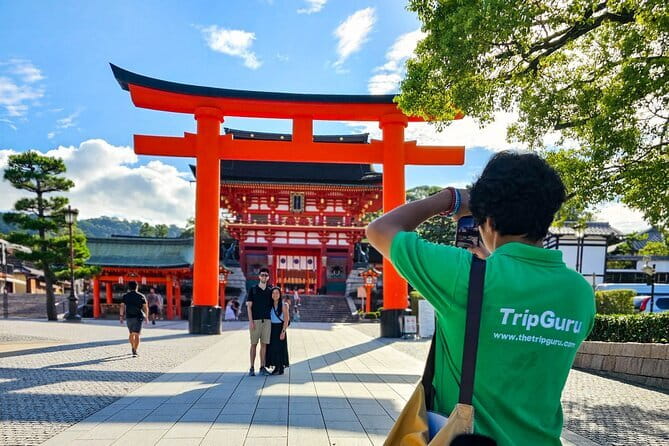
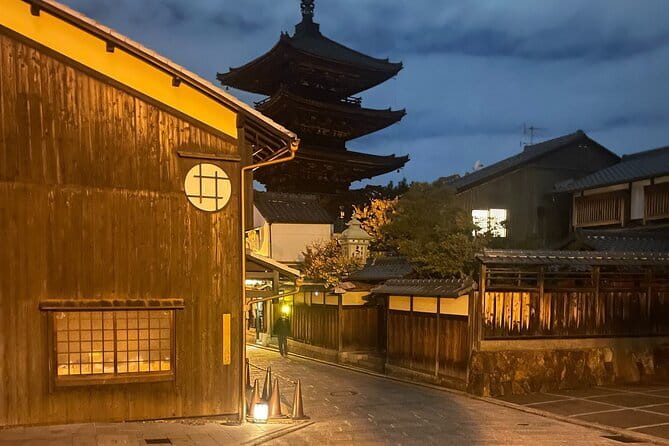
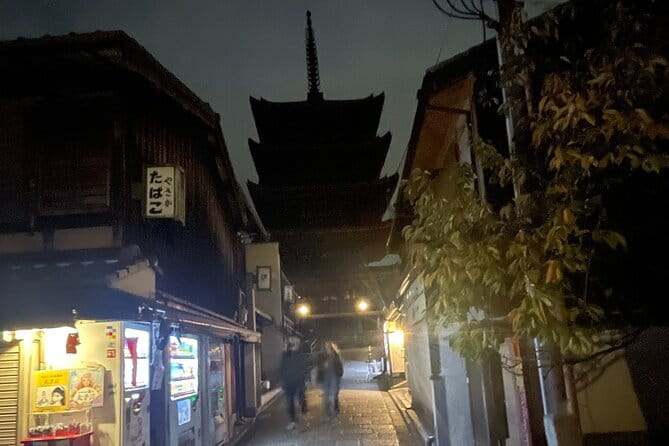
Hōkan-ji Temple, better known as Yasaka Pagoda, is among Kyoto’s most photographed locations. Its pagoda rises above old streets lined with machiya townhouses, creating the classic Higashiyama image many people hope to see.
The stop takes roughly 15 minutes. That may be enough for photos and a short explanation, but not for a full temple visit. Admission is listed as included for the stop, so there should be no separate entrance charge to add to your budget.
This part of the ride is especially good for anyone who wants traditional Kyoto scenery without spending the entire evening inside a single temple complex. The pagoda, cobblestoned streets, and wooden houses work together as a scene, and the soft evening light can make the area feel more composed than it does during the day.
There is a practical catch: this is one of the route’s more crowded pedestrian areas, and the streets are not designed for fast cycling. You may walk your bicycle at points or wait while the guide gathers the group. That is normal for a route through old Higashiyama and another reason this experience is not a cycling workout.
Ninenzaka, the strongest photo stop
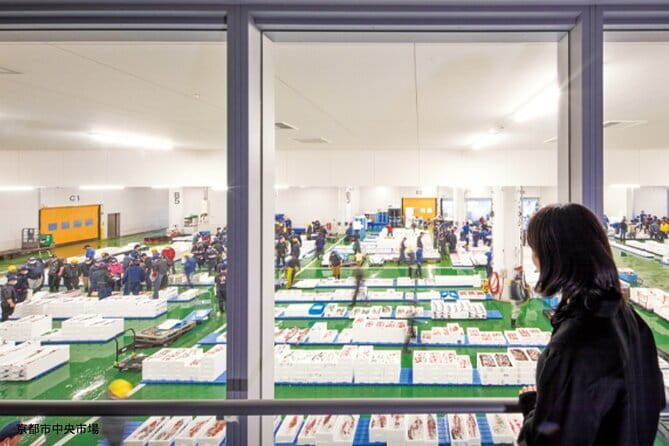
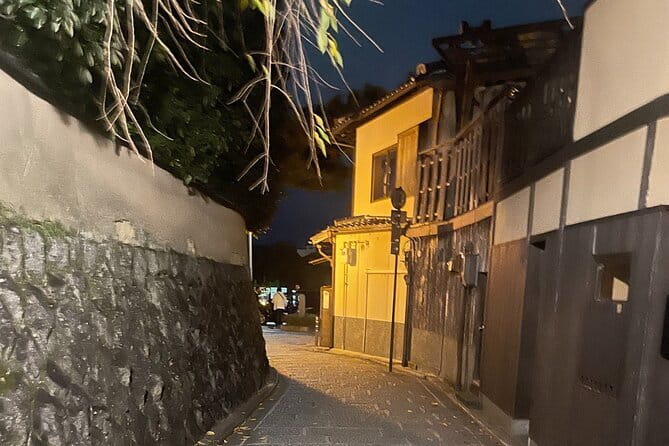
Ninenzaka is described as the tour’s best night scenery and photo area. It is one of the two historic slopes in Higashiyama, with traditional buildings and a strong sense of old Kyoto.
You get about 15 minutes here. I would use that time for photos and for looking closely at the street details rather than trying to shop or explore every side lane. The stop is short, and the group needs to remain on schedule.
Ninenzaka can be slippery or awkward for cycling because of its slope and stone paving. The tour information does not specify the exact cycling arrangements, so you should be ready for the possibility of walking with your bicycle. That is not a flaw in the route. It is the sensible way to handle a historic pedestrian area.
For photographers, this may be the evening’s high point. The combination of the slope, traditional facades, and Yasaka Pagoda nearby gives you the sort of Kyoto view that feels tied to place rather than staged for a tour.
The final Higashiyama park stop
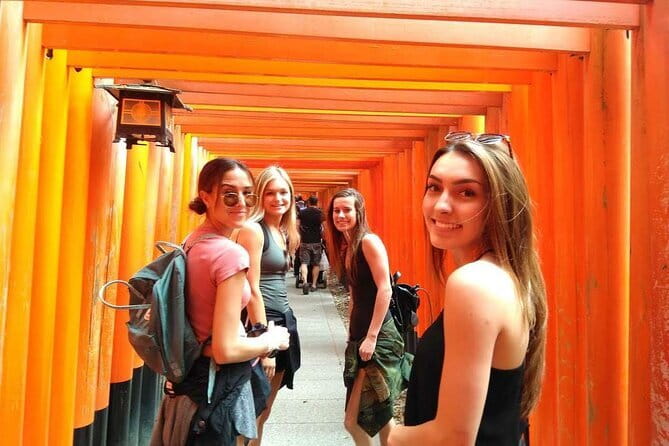
The route also includes a park described as the most famous park in Higashiyama, with cherry trees, ponds, and wooden bridges. The supplied details do not name the park, so you should confirm the exact stop with the operator if that matters to your planning.
This final setting adds a softer close to the route. After shrine gates, narrow lanes, and old entertainment districts, a park with water and trees gives the evening a little breathing room. Seasonal conditions will shape what you see, especially during cherry blossom periods, but the park’s ponds and bridges provide interest beyond blossom season.
The information does not give a separate duration for this stop. Since the full activity lasts about 3 hours 45 minutes, the park visit is part of the overall schedule rather than a long independent excursion.
How much riding will you actually do?
This question deserves a clear answer. The experience is marketed as a nighttime bicycle tour, but the route includes many stops and guided explanations. One rider estimated about 1 hour 45 minutes of riding, with the rest spent standing and listening, and felt the guide talked too much.
That does not make the tour poor. It does tell you what kind of activity this is. You are booking a guided sightseeing tour by bicycle, not a long-distance ride through Kyoto.
The guide’s style will shape your experience. The operator has acknowledged the need to find the right balance between riding and talking, and the strongest feedback praises guides who are friendly, safety-minded, and good at explaining Kyoto. Juan, in particular, received praise for making a solo rider feel safe and for continuing the tour even when that person was the only participant.
If you prefer steady movement, ask at the start how much riding is planned. If you enjoy questions, local stories, and cultural background, the slower sections may be exactly what you want.
Bikes, fitness, weather, and group size
The tour includes use of a bicycle and bottled water. The type of bicycle, helmet arrangements, bicycle sizing, and route surface are not specified, so ask the operator if you have equipment concerns.
A moderate level of physical fitness is required. You should be comfortable riding for part of an evening, starting and stopping often, and handling urban streets. The tour is not recommended as a first bike ride. One rider specifically advised choosing it only if you are a fairly proficient cyclist.
The maximum group size is nine people. That is small enough to keep the ride more personal than a large bus or mass walking tour. It also helps the guide manage safety at intersections and regrouping points, though you still need to pay attention and stay with the group.
The start time is 5:00 pm, but sunset changes during the year. In some seasons, part of the early route may take place before full darkness. The tour requires good weather, so rain or poor conditions can lead to a different date or a full refund.
One practical tip is to dress for the evening, not just the afternoon. A rider specifically advised choosing a warmer night. Bring a light layer, and remember that cycling can make a cool evening feel colder than walking.
Is $80 a fair price?
At $80 per person, this is not the cheapest way to see Kyoto. You are paying for more than a bicycle, though. The price includes the bike, bottled water, all listed entrance fees, a bilingual guide, and nearly four hours of organized sightseeing.
The value is strongest if you want a compact introduction to several Kyoto districts in one evening. You avoid arranging a bicycle rental, planning a route, finding each shrine, and working out how to connect Fushimi Inari with Gion and Higashiyama.
The value is weaker if your main goal is uninterrupted cycling. Since some of the time is spent listening at stops, you may feel you could rent a bicycle for less and explore at your own pace. You also pay for guided interpretation, so that part needs to matter to you.
The tour is often booked about 25 days ahead. That suggests you should reserve early if your schedule is tight, especially since the group is limited to nine people. Confirmation arrives at booking, mobile tickets are available, and free cancellation applies up to 24 hours before the 5:00 pm start. Cancellations within 24 hours are not refunded.
Who should book this Kyoto night ride?
I would recommend it to a confident cyclist who wants a guided evening introduction to Kyoto’s traditional districts. It suits solo visitors particularly well because the small group can still operate even when only one person books, as happened on one praised outing.
It also fits couples and small groups who want to combine light exercise with shrines, old streets, and cultural explanations. The route gives you a useful first look at Fushimi Inari, Gion, and Higashiyama, and you can return later to the places that deserve more time.
I would be cautious about booking it if you are a first-time cyclist, dislike frequent stops, or want a fast ride. I would also think twice if your evening schedule is tight. One tour ran 45 minutes over its expected finish time because the guide spent longer talking than planned.
Final call: a thoughtful ride, not a cycling sprint
Book this tour if you want to see Kyoto’s famous evening districts with a bicycle under you and a guide beside you. Fushimi Inari, Miyagawa-cho, Gion, Yasui-Konpiragu, Yasaka Pagoda, Ninenzaka, and the final Higashiyama park create a varied route, and the small group keeps the experience manageable.
Skip it if you want maximum riding time or need a firm finish time. The best match is a moderately fit cyclist who values stories, safety, and atmosphere as much as speed. For that person, $80 is a reasonable price for an organized Kyoto evening that reaches several memorable sights in one outing.
FAQ
How long does Discover Kyoto at Night by Bike last?
The experience lasts approximately 3 hours and 45 minutes.
What time does the tour start?
The tour starts at 5:00 pm.
Where does the tour meet?
The meeting point is the 7-Eleven at 44-1 Higashikujō Kamitonodachō, Minami Ward, Kyoto, 601-8002, Japan.
Where does the tour end?
The activity ends back at the original meeting point.
What is included in the price?
The price includes all entrance fees, use of a bicycle, and bottled water.
Is hotel transportation included?
No. Transportation to and from your hotel is not included.
Is a guide included?
Yes. The tour uses bilingual guides who explain Kyoto’s history, culture, and traditions.
How many people can join the tour?
The maximum group size is nine people.
Do I need to be an experienced cyclist?
You need a moderate level of physical fitness and should be a fairly proficient bicycle rider. The tour is not described as suitable for first-time riders.
What happens if the weather is poor?
If poor weather causes the tour to be canceled, you will be offered a different date or a full refund.
Can I cancel for a full refund?
Yes. You can cancel at least 24 hours before the experience start time for a full refund. Cancellations made within 24 hours are not refunded.
Just added in Kyoto
- The “Golden Route” and Ancient Japan by DIAMIR Erlebnisreisen – 14-Day Tour★ 2.0 · 2 reviews
- Japan: Castles & Cuisine by G Adventures – 6-Day Kyoto to Osaka Tour★ 4.5 · 4 reviews
- Cycle Japan by Explore! – 13-Day Kyoto to Tokyo Tour★ 4.7 · 12 reviews
- Cycle Japan by Intrepid Travel – 11-Day Kyoto to Tokyo Tour★ 4.8 · 2 reviews
- Classic Japan by Intrepid Travel – 11-Day Kyoto to Tokyo Tour★ 4.4 · 14 reviews
- Ancient & Modern Japan 14-Day Tour by Exodus Adventure Travels★ 4.4 · 40 reviews
- 5 Day Cultural Adventure of Kyoto, Nara & Osaka by Tourist Journey★ 2.5 · 2 reviews
- 12 Days Kinosaki Onsen Escape: A Journey Through Japan’s Timeless Towns by UME Travel★ 4.8 · 5 reviews
Kyoto Tours, compared.
![[Kyoto & Nara Day Tour] Sagano Scenic Railway & Nara Park & Fushimi Inari Taisha Thousand Torii Gates & Togetsukyo Bridge & Bamboo Grove & Kimono Forest (Departing from Osaka)](https://media.japanvisits.com/wp-content/uploads/kyoto-nara-day-tour-sagano-scenic-railway-nara-park-fushimi-inari-taisha-thousand-torii-gates-togetsukyo-bridge-bamboo-grove-kimono-forest-departing-from-osaka-k110001-400x257.jpg)
Fushimi Inari, Kinkakuji, Bamboo Grove 1 Day Bus Tour
Read our review →
Tea Ceremony in a Traditional Tea House in Kiyomizu
Read our review →
Gion Make Your Own Chopsticks with Engraving Option
Read our review →
Kyoto Nara Day Trip │ Kiyomizu-dera Temple + Fushimi Inari-taisha Shrine + Nara Park (Departing from Osaka/Kyoto)
Read our review →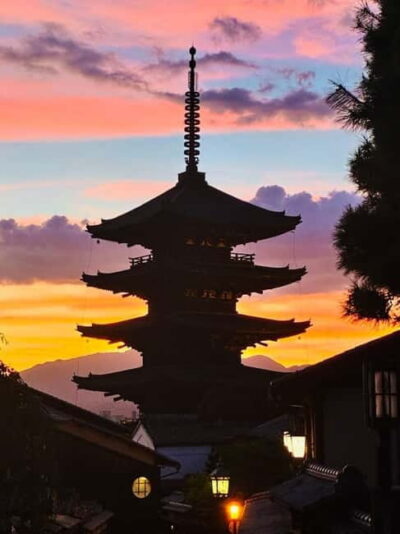
Kyoto Geisha Walking Tour: Gion District & Hidden Gems
Read our review →