
Reviewed · COOKING CLASSES
Experience Big soba knife Soba Making Class in Tokyo Kappabashi
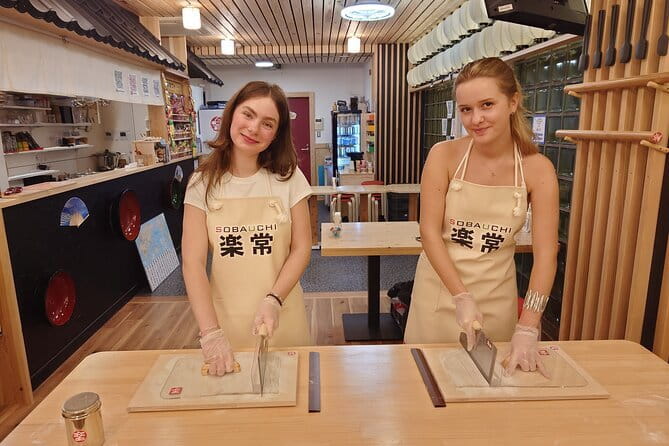
Soba starts with flour, water, and a very big knife. I like the hands-on four-step method, which lets you add water, knead, stretch, and cut your own buckwheat noodles instead of simply watching a demonstration. I also like the setting: Kappabashi is Tokyo’s kitchen town, so this short class fits neatly into a food-focused visit to Asakusa.
The main drawback is the pace. The noodle-making portion takes about 30 minutes, with the full experience lasting roughly 50 minutes, so you get a useful introduction rather than a long cooking lesson. Also, the class is not suitable if you have a buckwheat allergy, and the instructor may not speak English, although clear demonstrations, humor, photos, and video help bridge the gap.
In This Review
- Key points before you book
- Making soba in Tokyo’s kitchen town
- The four steps: water, kneading, stretching, cutting
- Why eating your own noodles matters
- The language question: clear demonstrations help
- A short route through Asakusa and Kappabashi
- Is $51.33 a fair price?
- Optional matcha soba and sake tasting
- Who will enjoy this class most?
- Practical planning for your Asakusa day
- Final verdict: book it for the food connection
- FAQ
- How long does the soba-making class last?
- Where does the class meet?
- Is the class near Sensoji Temple?
- Are food and protective clothing included?
- Can someone with a buckwheat allergy join?
- Can I cancel for a full refund?
Key points before you book
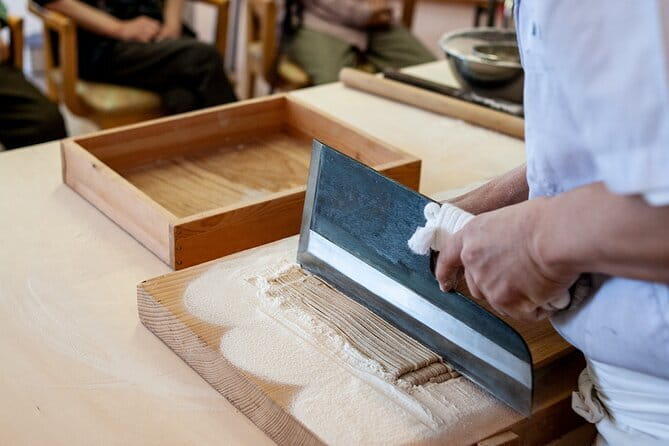
- Use a large soba knife: You cut the dough into thin noodles with a traditional-looking tool specially designed for soba.
- Make and eat your own noodles: The chef cooks what you cut, so the class ends with a snack or light meal rather than a plate of practice dough.
- Learn four practical steps: Adding water, kneading, stretching, and cutting are taught in a compact format.
- Meet in Kappabashi: The class sits about 25 minutes from Sensoji Temple on the famous kitchen-equipment street.
- Good for families and groups: Aprons and gloves come in different sizes, and the venue can hold up to 30 people, though this booking is limited to 15.
- Optional extras are available: You can add matcha soba for 700 yen or a three-sake comparison for 1,500 yen.
Making soba in Tokyo’s kitchen town
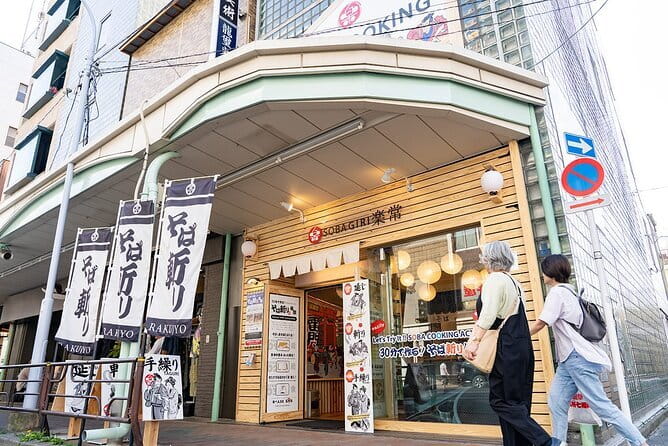
Kappabashi is one of the best places in Tokyo for a food-related activity. The street is lined with shops selling professional knives, pans, restaurant supplies, plastic food displays, and cooking tools. It has a working purpose, not just a tourist one. Chefs come here to buy equipment, and you get to make noodles in the middle of that food-supply world.
The class takes place at Open Kitchen Studio, operated by Sobagiri Rakujyo. The address is in Matsugaya, Taito City, on Kappabashi Tool Specialty Store Street. From Sensoji Temple in Asakusa, allow about 25 minutes to reach the studio. That makes the class easy to pair with temple sightseeing, though you should allow extra time if you plan to browse the shops along the way.
The space is a broad ground-floor restaurant that can seat up to 30 people. This particular activity accepts no more than 15 participants, which gives the lesson a more manageable feel than a large demonstration. The setting also works well for families, couples, and groups of four or more.
More Cooking Classes in Tokyo
- Sushi Making Tokyo Roll and Authentic Japanese Sushi Class
★ 5.0 · 3,971 reviews - Tokyo: Roll and Authentic Sushi Making Class in Asakusa
★ 4.9 · 1,957 reviews - Tokyo Shinjuku Chopsticks Making Class
★ 5.0 · 1,763 reviews
The four steps: water, kneading, stretching, cutting
The class uses buckwheat flour produced in Nagano Prefecture. The focus is on soba without wheat flour, making the main ingredient easy to understand: buckwheat flour and water, handled with care.
The process is taught in four steps.
First comes adding water. This may sound simple, but the amount and distribution of water affect the dough. The instructor shows you how to bring the flour together rather than leaving dry patches behind. Since the class relies heavily on demonstration, watch the hands closely if you do not speak Japanese.
Next, you knead the dough. This is the physical part of the class. You work the mixture until it becomes more unified and workable. You are not just pressing dough for fun. You are learning how a few basic ingredients become something that can be stretched and cut.
The third step is stretching. The dough must become thin and even before it can turn into noodles. This is where the instructor’s technique matters most. The class uses its own method to keep the process practical within a short session, so you get a real sense of the craft without spending half a day at the counter.
Finally comes cutting. This is the memorable part. You use a large knife made for soba, guiding it through the stretched dough to produce long, thin strands. The tool gives the activity its character, but it also means you should pay close attention to the demonstration and follow the instructor’s handling instructions.
The entire making process is described as taking about 30 minutes. That is fast, but it is also the point. You leave with a clear picture of how soba is made and a chance to practice the main movements yourself.
Why eating your own noodles matters
Many cooking activities end with a plate prepared by somebody else. Here, you get to taste the soba you cut yourself. The chef cooks the noodles, then serves them as a snack or meal with a choice of flavors.
That final step gives the class a useful finish. You can compare the noodles you produced with the smooth, cooked result, and you do not have to worry about finding food immediately afterward. It is not meant to replace a full restaurant meal, but it can cover a light lunch or snack, depending on your appetite.
I particularly like this part for families. Children can see the full chain from flour to finished food. The activity is not only about making something with your hands, then leaving it behind. You eat the result.
You can also take out the noodles you made. That gives you a small edible souvenir, though you should treat them as fresh food and follow the studio’s instructions for taking them away.
The language question: clear demonstrations help
One useful detail from the class experience is that the instructor may not speak English fluently. That could concern you if you expect a detailed spoken lesson. Still, the class is built around physical demonstrations, and the process has only four main steps.
The instructor has been described as funny and effective at getting the message across without much fuss. Photos and video may also be taken and sent to you, adding a record of the activity beyond the noodles themselves. The combination of gestures, demonstration, and humor seems to make the class accessible even when conversation is limited.
I would still recommend watching carefully and asking for help if you are unsure about the knife or dough. Do not treat the language gap as a reason to ignore instructions. The class is short, so you have little time to recover from a missed step.
A completely different kind of day out:
- Tokyo Disney Resort – Tokyo Disneyland & Tokyo DisneySea Park Tickets
★ 4.8 · 99,488 reviews - SHIBUYA SKY Ticket
★ 4.7 · 46,509 reviews - JR Whole Japan Rail Pass
★ 4.8 · 29,150 reviews - Mt Fuji and Hakone 1-Day Bus Tour Return by Bullet Train
★ 5.0 · 26,383 reviews
A short route through Asakusa and Kappabashi
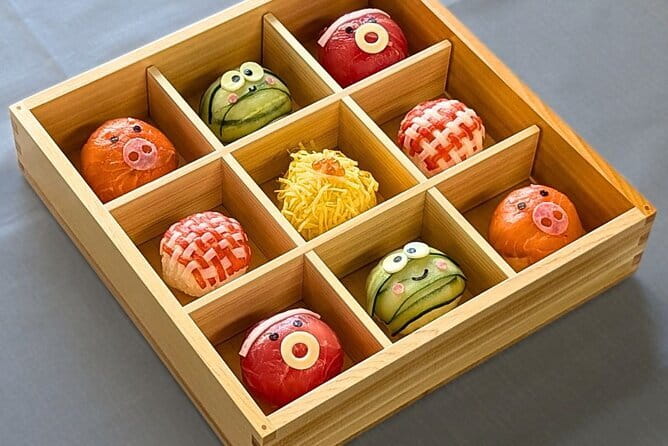
The experience is organized around three points: Asakusa, Kappabashi Street, and Asakusa again.
Asakusa is the natural starting area. Sensoji Temple is about 25 minutes from the studio, so you can plan the class before or after visiting the temple. If you are already spending time around Sensoji, this is a practical way to add a food activity without crossing the whole city.
Kappabashi Street, also called Kappabashi Dogugai, is the main attraction between the two Asakusa points. The street is known as Tokyo’s kitchen town, and its specialty shops give the outing a strong local-food setting. Even if you are not buying a chef’s knife or restaurant pan, browsing the equipment shops adds context to the class.
The activity ends back at the meeting point. There is no separate return transfer, and the class does not take you on to another neighborhood. That simplicity is useful if you have afternoon plans, though you will need to arrange your own transport to the next stop.
The meeting address is Japan, 111-0036 Tokyo, Taito City, Matsugaya, 3-chome 112, Matsugaya Center Building. Check the exact map pin before setting out, especially if you are walking from Sensoji or arriving by public transport.
Is $51.33 a fair price?
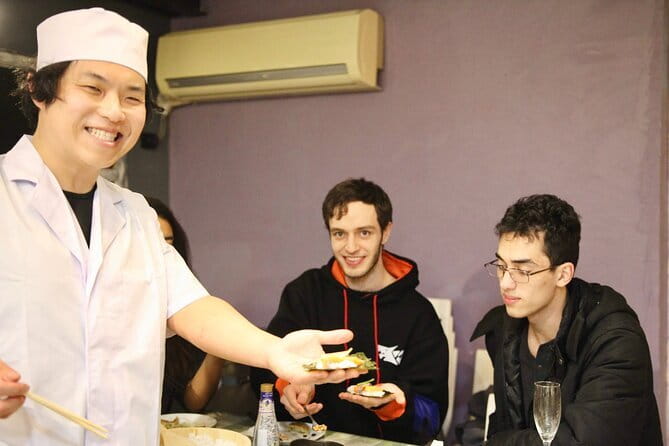
At about $51.33 per person, this is not the cheapest snack activity in Tokyo. The value comes from the combination of instruction, equipment, ingredients, protective clothing, and the meal at the end.
You are paying for more than a bowl of soba. You get to handle the ingredients, use a specialist knife, receive guidance through the full process, and taste the result. Aprons and gloves are provided in several sizes, so you do not need to pack cooking clothes or worry about bringing equipment.
The short duration makes the price easier to judge. A 50-minute class fits into a busy Tokyo day, but it also limits how much technique you can master. I would see this as a compact cultural activity, not professional training. If you want a relaxed, detailed lesson with time to repeat every movement, this may feel brief.
For a couple, family, or small group, the price can make sense because the activity creates a shared memory and a meal. The class also avoids the uncertainty of choosing a restaurant after a cooking session. You know the food component is built in.
The free cancellation policy adds some flexibility. You can cancel at least 24 hours before the local start time for a full refund. Changes or cancellations inside that 24-hour window are not accepted for a refund, so do not wait until the morning of the class if your plans are changing.
Optional matcha soba and sake tasting
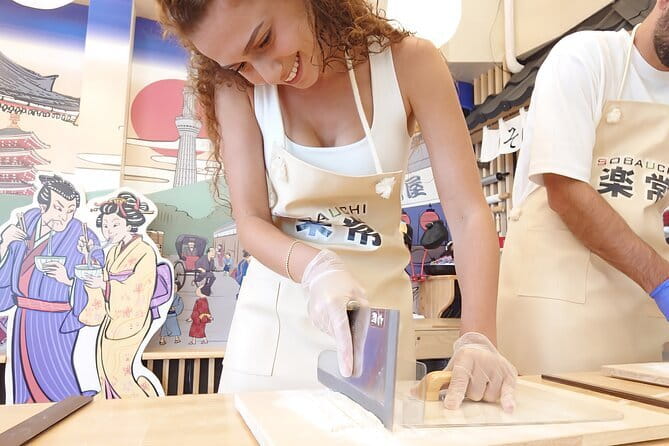
The standard activity uses buckwheat flour from Nagano Prefecture. If you want a variation, matcha soba is available for an extra 700 yen. Matcha is mixed into the soba flour, giving you a different color and flavor while keeping the same basic noodle-making process.
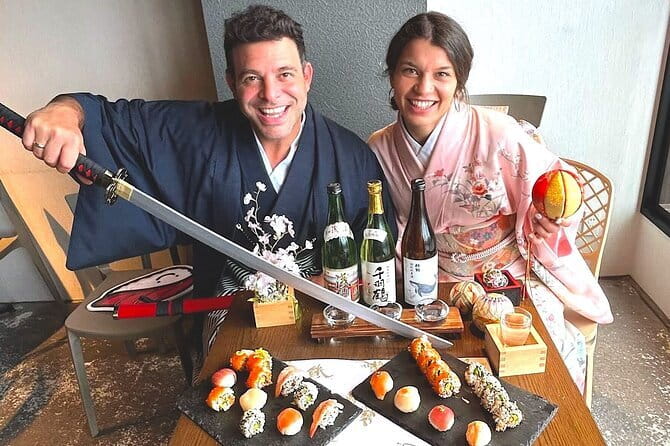
There is also an optional three-sake comparison for 1,500 yen. The owner selects the sake and presents it for comparison. This option is better suited to adults who want to connect the noodles with another part of Japanese food culture.
These extras are not needed to enjoy the class. I would add matcha soba if you want a more unusual food activity or a colorful result. The sake option makes more sense if you are not driving and want to linger over the finished noodles.
The food choices may involve an extra charge as well. A vegan or no-pork flavor option costs 500 yen more. Check this before booking if your diet requires one of those choices. The standard information does not describe every flavor, so do not assume that a special diet is included in the base price.
Who will enjoy this class most?
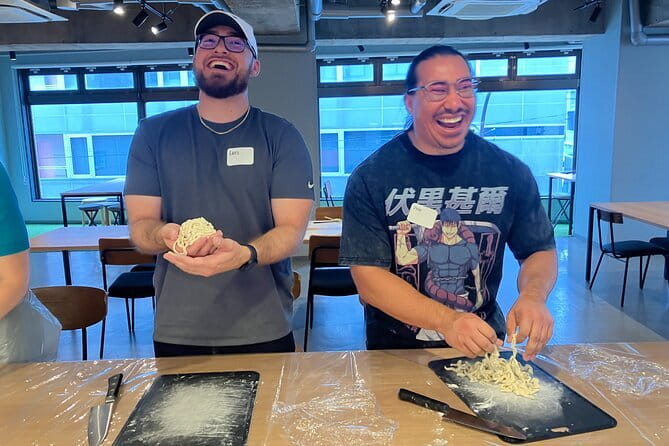
This is a good choice if you want an activity that is short, social, and genuinely hands-on. It suits people who would rather make one Japanese food carefully than spend hours in a broad cooking course.
Families are a strong match. The aprons and gloves come in different sizes, and the flour-to-noodle process gives children a clear task at each stage. Adults should still stay alert during the cutting portion, since the large soba knife is part of the real technique.
Couples may like the activity because it gives you something to do together rather than simply sitting across a restaurant table. Groups of four or more also fit the venue’s usual use, and the class limit of 15 keeps it from becoming an enormous workshop.
It is less suitable for anyone with a buckwheat allergy. The studio does not permit people with buckwheat allergies to enter the restaurant, so this is a firm safety restriction, not a minor menu issue.
It may also be a poor match if you want a long lesson taught entirely in English. The demonstrations appear to carry much of the instruction, but the information provided does not promise an English-speaking instructor. If spoken English teaching is essential, confirm that before booking.
Practical planning for your Asakusa day
I would schedule this class alongside Sensoji and Kappabashi rather than making a separate trip across Tokyo. Visit the temple first if you want a quieter start, then walk toward Kappabashi and allow time to browse the kitchen shops before your class.
Because the class lasts about 50 minutes, it can fit between larger sightseeing blocks. Keep your schedule a little open around the start time. The activity includes several physical steps, and arriving rushed would make the knife work less enjoyable.
The mobile ticket is useful for a simple Tokyo day plan. You do not need to carry a printed voucher, but you should have the booking details available on your phone when you reach the Matsugaya meeting point.
The venue is near public transportation, though the exact station route is not specified. Use the listed address and map location rather than relying only on the neighborhood name. Kappabashi’s shop streets can make a short walk feel longer when you stop to look at knives, ceramics, or plastic food models.
Service animals are allowed. Apart from the buckwheat restriction and the need to follow knife instructions, the activity information does not list other special access conditions.
Final verdict: book it for the food connection
I would recommend this soba class if you want a compact introduction to Japanese food craft in a useful Tokyo setting. The best parts are clear: you make the noodles yourself, use an unusual large knife, eat the finished result, and spend time in Kappabashi rather than in a generic cooking room.
Book it if you are visiting Asakusa, enjoy practical activities, or want something that works for a family or small group. The 100 percent recommendation rate and 5-star rating from 71 reviews support the idea that the class delivers a friendly and enjoyable experience.
Think twice if you have a buckwheat allergy, need a fully English-led lesson, or want advanced noodle-making instruction. At 50 minutes, this is a lively taste of soba making, not a master class. For most food-minded visitors, that compact format is its strength.
FAQ
How long does the soba-making class last?
The full experience lasts approximately 50 minutes. The noodle-making process itself takes about 30 minutes and covers adding water, kneading, stretching, and cutting.
Where does the class meet?
The meeting point is at Matsugaya Center Building, 3-chome 112 Matsugaya, Taito City, Tokyo 111-0036, Japan. The activity ends at the same meeting point.
Is the class near Sensoji Temple?
Yes. The studio is about 25 minutes from Sensoji Temple in Asakusa, on Kappabashi Tool Specialty Store Street.
Are food and protective clothing included?
All fees and taxes, a taste of the soba you cut, and aprons and gloves in various sizes are included. A vegan or no-pork flavor option costs an additional 500 yen.
Can someone with a buckwheat allergy join?
No. People with buckwheat allergies are not permitted to enter the restaurant.
Can I cancel for a full refund?
Yes. You can cancel at least 24 hours before the experience start time for a full refund. Cancellations or changes made less than 24 hours before the start time are not accepted for a refund.
Just added in Tokyo
- Tokyo Like a Local: Private & Personalised Experience (2-3 hours)★ 4.5 · 81 reviews
- Samurai Experience – Learn Bushido through Kendo, in Tokyo★ 5.0 · 88 reviews
- Tokyo Layover 5 Hours Private Tour★ 5.0 · 40 reviews
- Tokyo: SEGA Joypolis E-Tickets with Optional Tokyo Metro Pass★ 4.0 · 14 reviews
- Traditional Japanese Comedy, Juggling & Magic Live Show in Tokyo★ 5.0 · 37 reviews
- Imperial Palace Tour: Discover Samurai History with a Local Guide★ 5.0 · 20 reviews
- Tokyo Imperial Palace with Kagurazaka Alley Tour★ 5.0 · 54 reviews
- Tokyo Ikebukuro Evening Tour Dive into Japanese culture★ 5.0 · 15 reviews
Cooking Classes, compared.
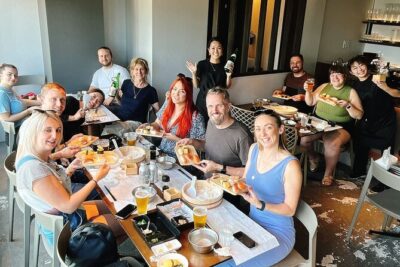
Sushi Making Tokyo Roll and Authentic Japanese Sushi Class
Read our review →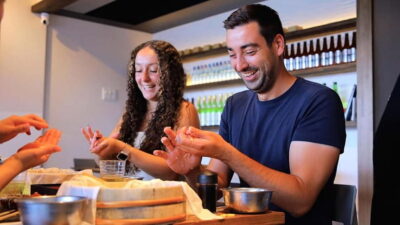
Roll and Authentic Sushi Making Class in Asakusa
Read our review →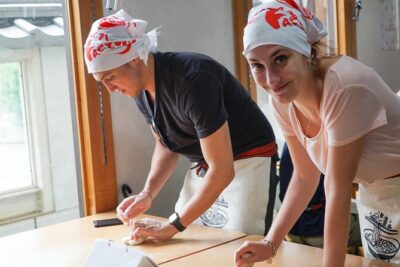
Ramen Cooking Class at Ramen Factory in Kyoto
Read our review →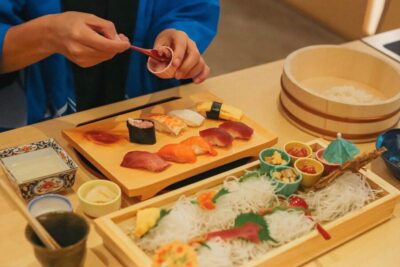
Sushi Making Class in a Happi Coat near a Famous Spot
Read our review →
Sushi Making Osaka Roll and Authentic Japanese Sushi Class
Read our review →
Tokyo Sushi Making Class in Tsukiji with Professional Chef
Read our review →
Ramen & Gyoza Cooking Class in Tokyo with Local Supermarket Visit
Read our review →Browse the lists this tour appears in