
Reviewed · WALKING TOURS
Half Day Private Guided Walking Tour in Hiroshima City
History feels different when it has a family voice. This four-hour private walking tour of Hiroshima combines major memorials with the personal perspective of Pancho, also known as Tetsuo Hamano, whose family was affected by the atomic bombing. I especially like the visit to Shirakami Shrine, with its unusual connection to Hiroshima’s wartime fate, and the chance to pause for Hiroshima-style okonomiyaki, ramen, or sushi.
The tour also earns praise for thoughtful extras, including origami cranes and small museums that are easy to miss. The main consideration is price: at $200 per person, lunch, transportation, and the Peace Memorial Museum entrance cost extra, so the value is strongest for visitors who want a private guide rather than a basic sightseeing walk.
In This Review
- Key things to know before you book
- Hiroshima’s painful story, told by Pancho
- Meeting Pancho at Hiroshima Station
- Shirakami Shrine and the story behind Hiroshima’s target
- The hypocenter and Saiko-ji Temple
- Atomic Bomb Dome and the Peace Flame
- Lunch near Peace Memorial Park
- The Rest House and a smaller museum experience
- Children’s Peace Monument and the cenotaph
- What the $200 price really buys
- Who will get the most from this tour?
- Practical planning advice for your four hours
- Should you book the Hiroshima private walking tour?
- FAQ
- How long does the Hiroshima private walking tour last?
- Where can I meet the guide?
- Who is the guide?
- Is this a private tour?
- Is transportation included?
- Is lunch included?
- Can the tour accommodate dietary restrictions?
- Is the Hiroshima Peace Memorial Museum entrance included?
Key things to know before you book
- Pancho’s family connection: The guide is the son of A-bomb survivors, bringing a personal voice to Hiroshima’s memorial sites.
- A focused four-hour route: You visit the hypocenter, Atomic Bomb Dome, Peace Flame, Children’s Peace Monument, and the cenotaph.
- A less obvious starting point: Shirakami Shrine and surviving trees add context beyond the best-known Peace Park sights.
- Flexible food stop: You can request Hiroshima-style okonomiyaki, ramen, sushi, or options for vegetarian, vegan, and gluten-free diets.
- Private, not shared: Only your own group takes part, allowing room for questions and changes in emphasis.
- Extra costs matter: Expect to pay separately for lunch, public transportation, taxis, and the ¥200 Hiroshima Peace Memorial Museum entrance.
Hiroshima’s painful story, told by Pancho
Hiroshima is not a place to rush. The city’s central memorial area is calm and orderly, but the subject is heavy. A guide can help you connect the monuments, photographs, buildings, and personal stories without reducing the experience to a list of dates.
Pancho’s connection to the bombing is the defining feature of this tour. He shares his family experience while also making room for the wider story of Hiroshima, including the city’s recovery and the human effort behind its peace message. That balance matters. You are not left with only destruction and grief. You also hear about resilience, remembrance, and the hope that such a catastrophe will not happen again.
This is a private tour, so you can ask questions as they come to you. That is a real advantage at places such as the hypocenter, where many people need more than a short caption on a sign. Pancho’s approach also appears warm and conversational. Guests have enjoyed exchanging family and national histories with him, not just listening to a formal lecture.
You should still know what this format is not. It is not a full-day historical seminar, and it does not include every museum or memorial in Hiroshima. Four hours gives you a guided introduction with several powerful stops. If you want extensive time inside the Peace Memorial Museum, you will need to visit separately or allow for less time elsewhere.
More Walking Tours in Hiroshima
- Hiroshima Historical Walking Tour – Why A-Bomb was Dropped
★ 4.8 · 893 reviews - Hiroshima Peace (Heiwa) Walking Tour at World Heritage Sites
★ 5.0 · 872 reviews - Hiroshima City 4hr Private Walking Tour with Licensed Guide
★ 5.0 · 437 reviews
Meeting Pancho at Hiroshima Station
The tour offers three meeting arrangements. You can meet Pancho on the bullet train platform at Hiroshima Station if you are arriving from Osaka, Kyoto, Tokyo, or another city. You can also arrange reception at your hotel, or meet at Hiroshima Station more generally.
That flexibility is useful for a day trip or a short stay. You do not need to make your own way across town before the tour begins if you are arriving by shinkansen. A 20-minute station meeting period is included, which gives you time to locate one another and get organized.
Pancho has used text messages and exchanged photos with people before meeting, which can make the first contact easier. If you have dietary restrictions or a particular interest, it is sensible to share that before the start. The tour works best when Pancho knows what you want from the four hours.
Transportation is not included. The route is based on public transportation or a taxi from your hotel or Hiroshima Station. Public transportation is listed at about $4 per person, while a private vehicle can be arranged for an additional charge. At the quoted price, this is a guided walking and local transit experience, not a chauffeured tour.
Shirakami Shrine and the story behind Hiroshima’s target
The first major stop is Shirakami Shrine, a Japanese Shinto shrine that may initially look familiar if you have visited other parts of Japan. Its importance here comes from its particular connection to Hiroshima and the circumstances that led to the city becoming an A-bomb target.
Pancho uses the shrine to explain part of the background before taking you into the central memorial area. That is a smart choice. Hiroshima’s story can feel abstract if you begin only with the famous dome and cenotaph. A local place of worship gives the account a human scale.
You also see trees that survived the bombing. These living survivors are among the most affecting details in Hiroshima. They show the force of the blast while also showing that life continued. The stop takes about an hour, making it one of the more substantial parts of the tour.
Admission is not included, though no separate entrance fee is listed for this stop. Because the shrine has a specific historical connection, this is more than a quick photo pause. It is one of the places where a guide’s explanation adds much more than a sign alone.
The hypocenter and Saiko-ji Temple
At the hypocenter monument, you stop at ground level to see where the atomic bomb exploded. The scheduled visit is short, about 10 minutes, but the location carries enormous weight. Pancho explains the monument and uses historical photographs to help you understand what happened at that point.
The brevity may be helpful. Some people prefer a quiet pause rather than a long presentation at the exact center of the destruction. Others may want more time for questions, so use the private format to ask.
The next stop, Saiko-ji Temple, lasts about 10 minutes. Here the focus shifts to the heat and blast and the physical evidence left behind. A temple is not simply another religious site in this setting. It helps you see how far the explosion reached and how ordinary buildings became evidence of the event.
These two stops work well together. The hypocenter gives you the geographic point. Saiko-ji gives you a clearer sense of the blast’s force. Neither requires an admission charge, keeping the route moving while adding context before the longer visit to the Peace Park.
A completely different kind of day out:
- Peaceful Hiroshima & Miyajima UNESCO 1 Day Bus Tour
★ 5.0 · 5,309 reviews - Hiroshima Peace Memorial Museum Ticket
★ 4.8 · 2,727 reviews - Hiroshima: Hiroshima and Miyajima UNESCO Sites 1-Day Tour
★ 4.9 · 2,330 reviews - Hiroshima Peace Memorial Museum Admission
★ 4.6 · 1,308 reviews
Atomic Bomb Dome and the Peace Flame
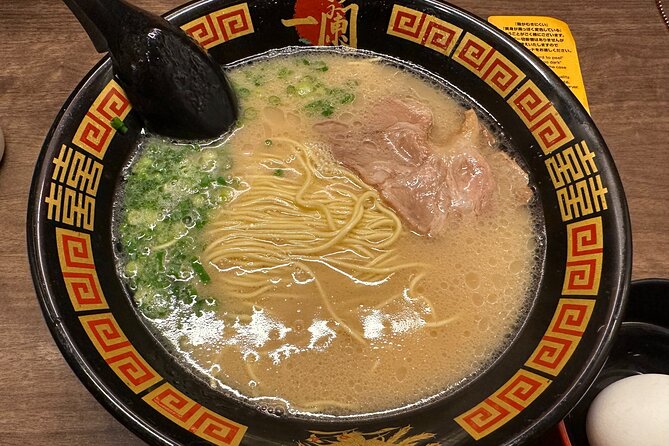
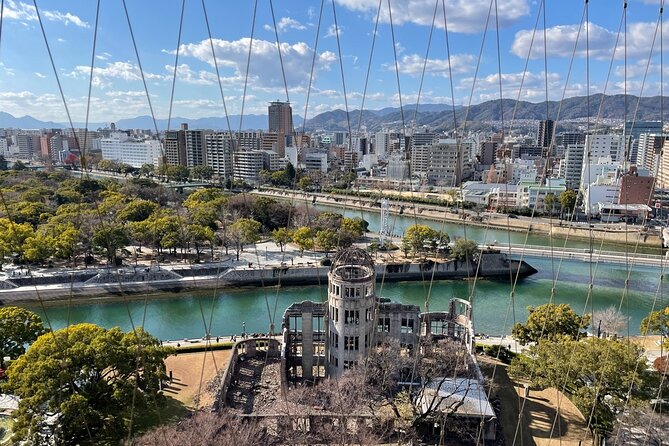
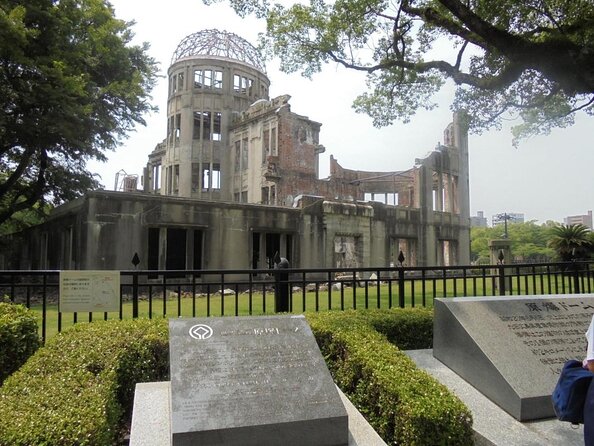
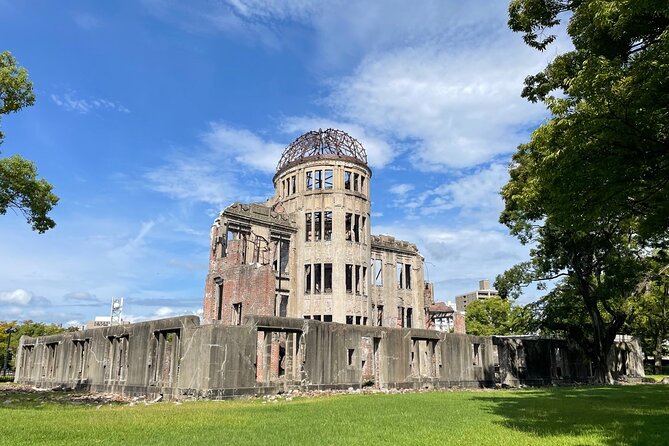
The Atomic Bomb Dome is Hiroshima’s most recognizable structure. You stop for about 20 minutes to look at the building that survived the bombing in damaged form. It was used before the attack and now serves as a reminder of the first use of an atomic bomb in warfare.
The dome is powerful, but it can also be easy to treat as a landmark for a photograph. Pancho’s explanation helps you consider why the remains were preserved and what the structure means within Hiroshima’s peace message. The site is free to view, and the exterior provides a strong visual anchor for the rest of the tour.
The Peace Flame is a much shorter stop, about five minutes. Its continued burning has a specific meaning, and Pancho explains why it remains lit. This is a small pause, but it adds another layer to the park’s message. Hiroshima’s memorials do not all speak in the same way. Some show physical damage, while others express remembrance and a wish for lasting peace.
The route does not treat the famous dome as the entire story. That is one of its strengths. You begin with a well-known image, then move through less familiar sites and personal accounts.
Lunch near Peace Memorial Park
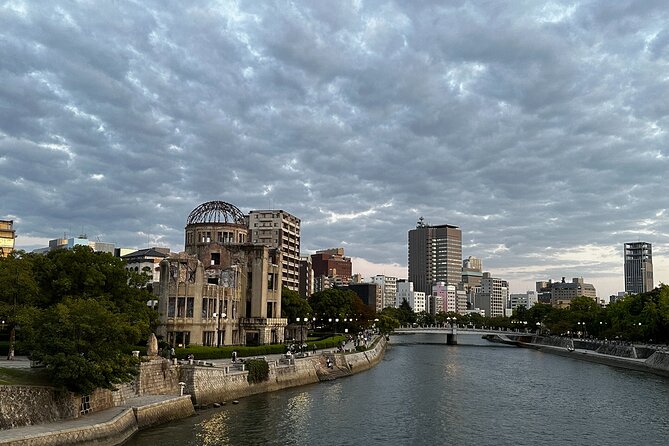
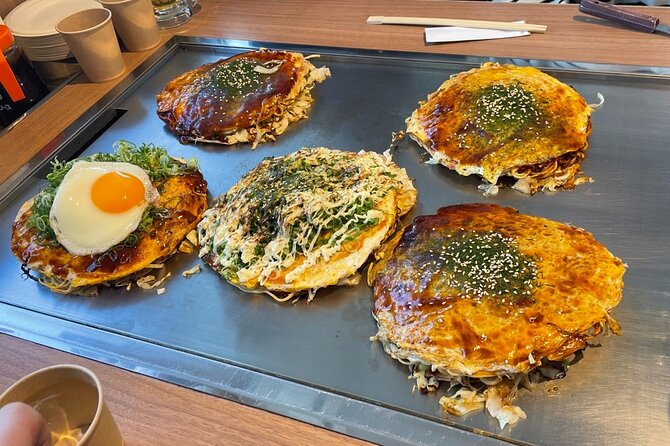
Lunch takes about 50 minutes near the Peace Memorial Park. Food is not included, but Pancho introduces local restaurants and helps you choose among Hiroshima-style okonomiyaki, ramen, and sushi.
Hiroshima-style okonomiyaki is the natural local specialty to consider. It is different from the Osaka style many visitors already know, so this is a chance to connect the meal with the region rather than simply stopping for a quick bite. If you prefer something else, ramen and sushi are also options.
Dietary needs can be discussed in advance. Vegetarian, vegan, and gluten-free options may be available, but you should not assume every restaurant can meet every restriction without notice. Tell Pancho before the tour so he can plan the stop more effectively.
The lunch break changes the rhythm of the day. After the emotional weight of the hypocenter and dome, sitting down for food gives you a natural pause. It also turns the tour into more than a memorial circuit. You get a small taste of present-day Hiroshima, a city that is lived in, eaten in, and enjoyed, not only remembered.
The Rest House and a smaller museum experience
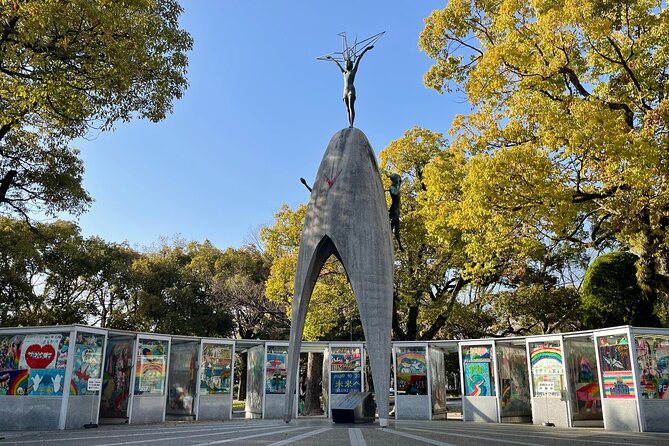
The Rest House of Hiroshima Peace Park is a surviving building from the bombing. Today it functions as a tourist information point and includes a small museum area. You spend roughly 15 minutes here.
This stop can suit people who want another piece of physical evidence but do not have time for a large museum visit. You might also take part in an origami experience. Pancho has taught people to fold paper cranes during the tour, and that hands-on moment can help younger visitors or families connect with the story of Sadako and the cranes.
The origami activity should not be confused with a full museum program. It is a short, personal addition, and its value comes from the conversation around it. If your group enjoys making things or wants a gentler activity after the more difficult stops, this is a useful part of the route.
The building’s survival gives the stop a clear purpose. You are not just resting because the schedule says so. You are sitting inside a piece of Hiroshima’s pre-bomb past that still has a public role today.
Children’s Peace Monument and the cenotaph
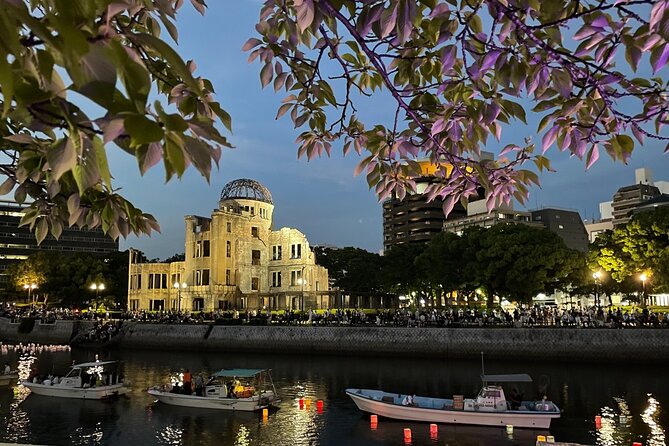
The Children’s Peace Monument takes about 10 minutes. Pancho explains the story of a girl who folded paper cranes while hoping to recover from leukemia, guided by a Japanese belief connected with crane folding.
This is one of the tour’s most emotionally direct stops. The monument links the atomic bombing to the lives of children and to the families who continued to suffer long after the blast. The cranes also offer a simple way to understand how remembrance became an act performed by ordinary people.
The final listed stop is the Hiroshima Peace City Monument Cenotaph for the Atomic Bomb Victims. You spend about 10 minutes here. Pancho explains the cenotaph’s history, its shape, and the ideas behind its design.
The cenotaph is a place for quiet reflection, but the design is not random. Understanding its form gives you a better sense of how Hiroshima’s memorial spaces were planned. The Children’s Peace Monument and cenotaph make a fitting pair: one centers on a child’s story and the other serves as a memorial to the many victims.
The tour schedule allows only a short period at each of these final monuments. If you want extended quiet time, tell Pancho. Because the tour is private, the pace can be more responsive than on a large group excursion, though four hours still imposes limits.
What the $200 price really buys
At $200 per person, this is expensive if you view it as a simple walking route. Many of the sites are free, public transportation costs about $4 per person, lunch is separate, and the Hiroshima Peace Memorial Museum entrance costs ¥200 per person.
The value is in the guide rather than in admission tickets. You are paying for Pancho’s time, planning, language support, local restaurant help, family perspective, and the ability to ask questions throughout a private experience. For a couple, family, or small group that wants focused attention, that can be worthwhile.
For a solo visitor, the cost is harder to justify unless a personal guide is a high priority. A larger private group may find the price more reasonable, but the supplied price is stated per person, so check the final total carefully before booking.
The tour is also useful when your time in Hiroshima is short. It gives you a structured route through important places without requiring you to research how they connect. If you have only one day in the city, the four-hour format leaves some room for your own plans, though you will need to budget for transport and food.
Who will get the most from this tour?
I would recommend this experience most strongly to:
- Families who want a guide able to explain difficult subjects with care.
- First-time Hiroshima visitors who want more context than a self-guided walk provides.
- People interested in personal stories and local perspectives.
- Visitors with limited time who want the major memorials connected in one route.
- Anyone who wants help choosing a local meal, including some dietary requirements.
- Repeat visitors who have already seen the main sites and want smaller places such as Shirakami Shrine or the Rest House museum.
It may be less suitable if you want to spend several hours inside the Peace Memorial Museum, move at a very slow pace, or avoid emotionally difficult material. It is also not the right choice if you expect private transportation to be included in the base price.
The tour is listed as suitable for most people and service animals are allowed. It is near public transportation, but you should ask about the walking demands if anyone in your group has mobility concerns. The description does not provide a detailed accessibility plan.
Practical planning advice for your four hours
Book ahead if your schedule is fixed. The experience is often reserved well in advance, with an average booking time of 108 days, and confirmation is sent within 48 hours subject to availability.
Bring a phone that can receive messages, since meeting details may be coordinated by text. If you are arriving by bullet train, the platform meeting option can save time, but make sure you and Pancho agree on the exact location before the day.
Plan a little money beyond the tour fee. You need to cover lunch, transportation, and the museum entrance if you add it. Private transportation is optional and costs extra.
Most important, tell Pancho what you want from the tour. The private setup is most useful when you ask questions, mention dietary needs early, and say if you want more time at a particular memorial. People have appreciated his communication before arrival, including photo exchanges that make meeting easier.
Cancellations are free up to 24 hours before the start time. A cancellation or change made less than 24 hours ahead is not refundable.
Should you book the Hiroshima private walking tour?
Book it if you want Hiroshima explained by a guide with a direct family connection to the bombing, and if personal conversation matters as much as seeing the landmarks. Pancho’s family story, the origami activity, the shrine visit, and the help with local food give this route more character than a basic monument checklist.
Think twice if $200 per person feels high for a tour where most admissions are free. You can explore the Peace Park independently and visit the museum for ¥200, but you will give up the connected storytelling, private questions, and local guidance.
For a family or small group making a first visit to Hiroshima, I think the personal format can justify the price. It is especially useful when you want to leave with more than photographs of the Atomic Bomb Dome. You leave with a clearer sense of the city’s suffering, its recovery, and the people who continue to carry its story.
FAQ
How long does the Hiroshima private walking tour last?
The tour lasts approximately four hours.
Where can I meet the guide?
You can meet at the bullet train platform in Hiroshima Station, arrange a hotel reception, or meet at Hiroshima Station if arriving by another route. Confirm the exact meeting point with the guide.
Who is the guide?
The guide is Tetsuo Hamano, who is also known as Pancho. He is the son of A-bomb survivors and shares personal family insight during the tour.
Is this a private tour?
Yes. Only your own group participates in the activity.
Is transportation included?
No. The tour uses public transportation or a taxi from your hotel or Hiroshima Station. Public transportation is approximately $4 per person, and private transportation costs extra.
Is lunch included?
No. Food and drinks are not included. The guide can introduce local restaurants serving Hiroshima-style okonomiyaki, ramen, and sushi.
Can the tour accommodate dietary restrictions?
Some vegetarian, vegan, and gluten-free restaurant options are available. Share your dietary needs before the tour so the meal stop can be planned.
Is the Hiroshima Peace Memorial Museum entrance included?
No. The entrance fee is ¥200 per person and must be paid separately.
Just added in Hiroshima
- Hiroshima Peace Memorial Museum Ticket★ 4.8 · 2,727 reviews
- Hiroshima Peace Memorial Museum Admission★ 4.6 · 1,308 reviews
- Private Full Day Hiroshima Tour★ 4.5 · 29 reviews
- The Peace Memorial to Miyajima : Icons of Peace and Beauty★ 4.5 · 31 reviews
- Shore Excursion from Hiroshima Port : Private Tour in Hiroshima★ 5.0 · 17 reviews
- Hiroshima & Miyajima All-Inclusive Tour w/Licensed guide Pancho★ 5.0 · 54 reviews
- Hiroshima Country Cycling: Explore Rural Life 1 HR from City★ 5.0 · 22 reviews
- Hiroshima Saijo Sake Tasting Tour with visit to 7 Breweries★ 5.0 · 104 reviews
Walking Tours, compared.
Kyoto Geisha Walking Tour: Gion District & Hidden Gems
Read our review →
Tokyo Tsukiji Fish Market Food and Culture Walking Tour
Read our review →
Gion Magical Night Walking Tour with Geisha Trivia
Read our review →
Imperial Palace and Shogun Historical Walking Tour
Read our review →
Gion Geisha District Walking Tour – Stories of Geisha
Read our review →
Shinjuku Local Bar and Izakaya Guided Walking Tour
Read our review →
Browse the lists this tour appears in