Reviewed · KYOTO TOURS
Ikebana Traditional Japanese Art of Flower Arranging
Flowers can teach you to slow down. This intimate Kyoto class turns fresh seasonal stems into a practical lesson in Japanese aesthetics, mindfulness, and balance. You work with the flowers yourself rather than simply watching a demonstration, and the small group size, capped at six people, keeps the session personal.
I like the clear, hands-on format, especially the chance to learn both Nageire and Moribana, two classic ikebana styles. I also like the useful flower-care advice, which can help your arrangement stay fresh for up to two weeks. The main consideration is that the 90-minute class gives you only a short introduction to ikebana’s schools, history, and wider rules.
In This Review
- Key points to know before booking
- What the Kyoto ikebana class is really about
- Beginning with a demonstration by Mana
- Learning Nageire and Moribana
- Making your own arrangement
- Why the small group size matters
- Flower care you can use after class
- The setting in Kamigyo Ward
- Is $72.26 a fair price?
- Who will enjoy this class most
- Timing, tickets, and cancellation
- My verdict on the Kaeribana experience
- FAQ
- Where does the ikebana class take place?
- How long does the experience last?
- How many people can join the class?
- Is the class taught in English?
- Which ikebana styles are included?
- Can I cancel for a full refund?
Key points to know before booking
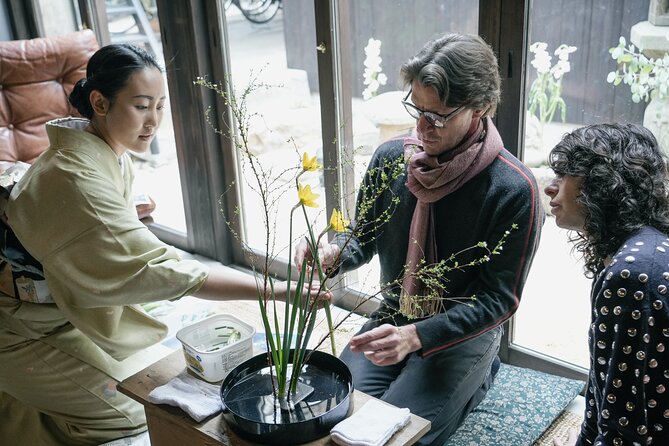
- Two traditional styles: Mana demonstrates and teaches Nageire and Moribana, giving you more than one way to arrange flowers.
- Small class size: The experience allows a maximum of six participants, so you should have room for personal guidance.
- Seasonal flowers: The materials change with the season, making each class slightly different.
- Mindfulness through arranging: The focus is not just on making a pretty display, but on noticing each stem’s natural shape and character.
- English-speaking instruction: An English-speaking ikebana expert explains the methods and guides your work.
- A central Kyoto meeting point: The class begins and ends at 3481 Symphony Kitano Higashi, Tanbayacho, Kamigyo Ward, Kyoto 602-8287.
What the Kyoto ikebana class is really about
Ikebana means living flowers. That idea shapes the entire activity. Instead of treating flowers as a bunch to pack into a vase, you consider the natural line, angle, height, and movement of each stem.
The goal is harmony, not abundance. A single branch may be more important than a large cluster of blooms. An open space can matter as much as a flower. This is where the Japanese idea of wabi-sabi enters the lesson: beauty can be found in restraint, asymmetry, natural changes, and small imperfections.
I like this approach because it gives you something to think about long after the class ends. You are not simply copying a fixed design. You are learning to look at what is already present in the material and make choices that support it.
The class uses seasonal flowers, so the exact materials will depend on the time of year. That is part of the appeal. You are working with what is available now, not with an identical souvenir activity that looks the same every month.
A few more options to weigh up in Kyoto
- PERFECT KYOTO 1-Day Bus Tour
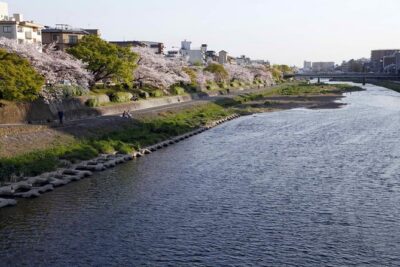
★ 5.0 · 13,518 reviews - [Kyoto & Nara Day Tour] Sagano Scenic Railway & Nara Park & Fushimi Inari Taisha Thousand Torii Gates & Togetsukyo Bridge & Bamboo Grove & Kimono Forest (Departing from Osaka)
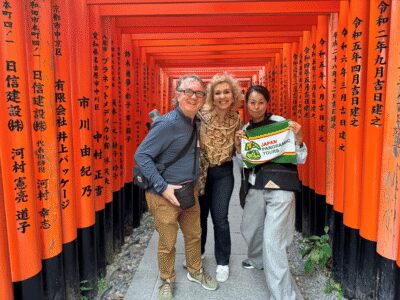
★ 4.9 · 10,942 reviews - Kyoto: Fushimi Inari, Kinkakuji, Bamboo Grove 1 Day Bus Tour
★ 4.8 · 4,316 reviews
Beginning with a demonstration by Mana
The session starts with an introduction to ikebana and its purpose. Mana, the English-speaking instructor, explains the ideas behind the art before showing you how the arrangements are built.
Several class comments praise her clear demonstrations and careful instruction. One especially useful feature is that she demonstrates two arrangements before asking you to make your own. That gives you a visual guide first, then lets you try the techniques with some freedom.
This order matters. Ikebana can look simple from across the room, but the placement of one stem affects the balance of the entire design. A short explanation followed by a demonstration makes the process easier to follow than a long lecture filled with unfamiliar terms.
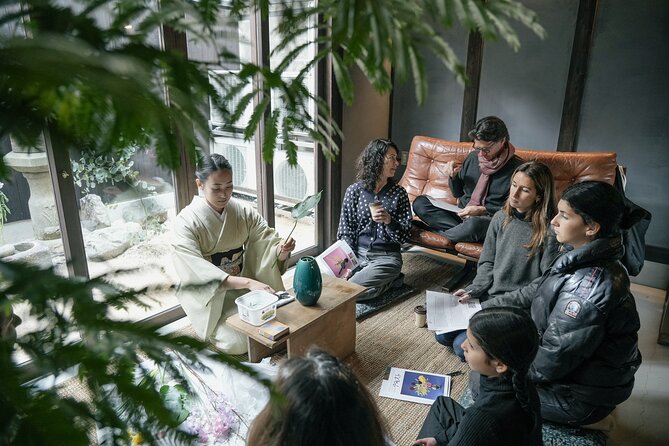
The class is also described as taking place in a typical Japanese home. That setting may appeal to you if you prefer a personal cultural activity over a large commercial studio. At the same time, a home setting can feel less formal than a traditional school lesson. If you expect a full academic discussion of ikebana, this is better understood as a friendly introduction.
Learning Nageire and Moribana
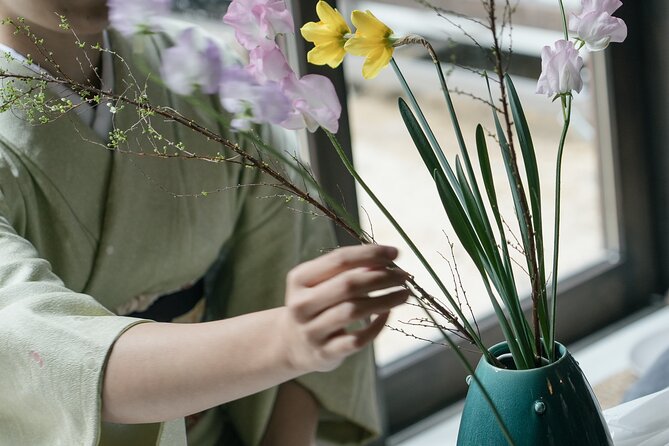
The most valuable part of the class is the chance to work with two different ikebana forms: Nageire and Moribana. These are beginner-friendly styles, but they represent distinct ways of thinking about the arrangement.
Nageire is associated with a more upright, natural presentation. Moribana generally uses a low, shallow arrangement style. You will not simply make one display and leave. The two methods show how different containers and forms can change the relationship between branches, flowers, and empty space.
The distinction is useful because it turns ikebana from a vague idea into something you can practice. You begin to see that the art has structure. The arrangements are not random, yet they are not rigid copies either.
Mana’s demonstrations are reported to be easy to follow, and the class allows flexibility once you begin arranging. That balance is important. Beginners need rules, but they also need room to make choices. You can receive guidance without feeling that every stem must match the instructor’s example.
A class participant who wanted more background on ikebana’s history and different schools felt that the short format did not cover enough theory. That is a fair limitation. The instructor focuses on two practical styles, so you should not expect a survey of every major ikebana tradition.
Making your own arrangement

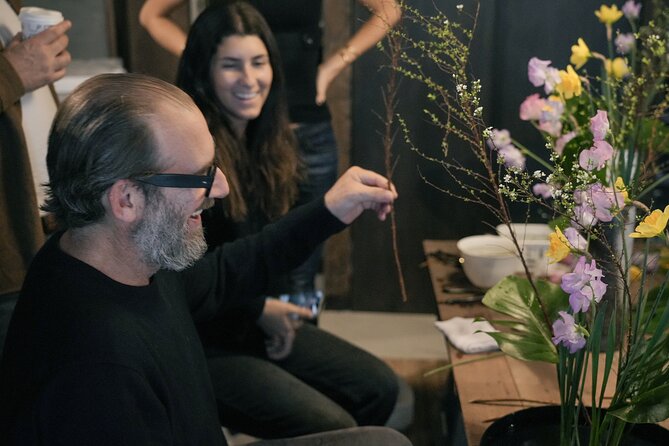
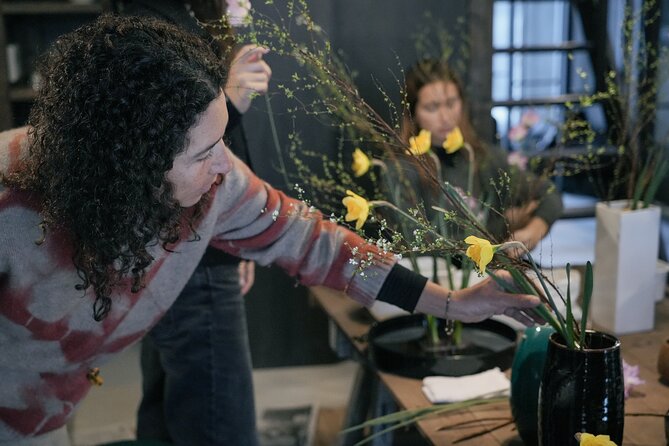
After watching the demonstrations, you get to arrange the flowers yourself. This is the point where the class becomes more than a cultural talk.
You may find that the flowers do not behave exactly as expected. A branch can lean in an attractive direction, a blossom may face away from the room, or a stem may create an unwanted visual weight. Rather than forcing every piece into a symmetrical shape, the method asks you to work with those natural qualities.
That is the mindfulness element. You slow down, observe the material, and decide what each piece contributes. The task is quiet and focused, with no need to rush toward a perfect result.
The instructor provides help while allowing personal choices. This was one of the most praised parts of the session. Couples in particular appreciated being able to create arrangements with flexibility instead of producing identical copies.
I would recommend treating your first attempt as practice, not a test. The point is not to produce a professional display in 20 minutes. It is to learn how line, mass, space, and balance work together.
A completely different kind of day out:
- Kyoto: Tea Ceremony in a Traditional Tea House in Kiyomizu
★ 4.9 · 3,519 reviews - Kyoto: Gion Make Your Own Chopsticks with Engraving Option
★ 5.0 · 3,465 reviews - Kyoto Nara Day Trip │ Kiyomizu-dera Temple + Fushimi Inari-taisha Shrine + Nara Park (Departing from Osaka/Kyoto)
★ 4.7 · 3,408 reviews - Kyoto Geisha Walking Tour: Gion District & Hidden Gems
★ 4.7 · 3,273 reviews
Why the small group size matters
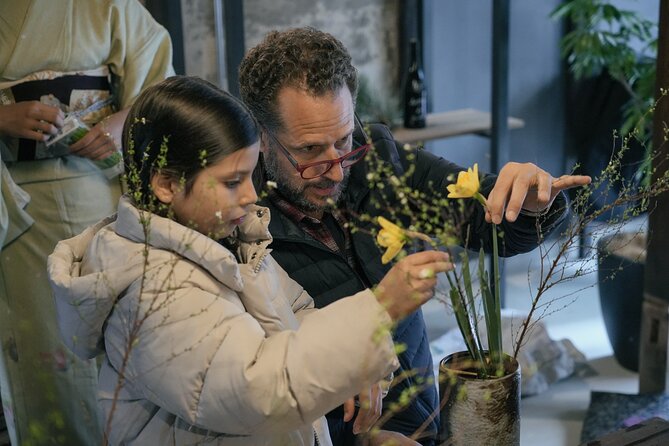
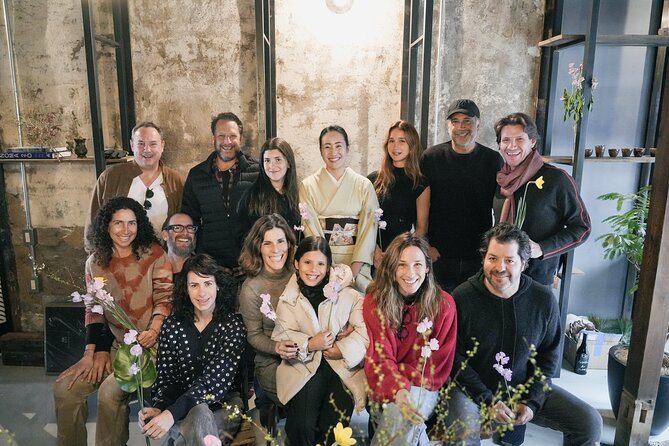
The maximum group size is six. That is a strong feature for this kind of activity.
With flowers, containers, and tools in front of you, a crowded class would make personal instruction difficult. A group of six gives the instructor a reasonable chance to look at your work, explain a correction, and answer questions.
The small format also suits people who want a calm break from Kyoto’s busier sights. You can focus on the arrangement rather than competing for a place in a large demonstration circle.
There is one practical point to keep in mind. The experience is small and personal, which means a missed meeting point can be especially disruptive. Confirmation is provided at booking, and the class begins and ends at the stated Kyoto address. Check the location carefully before setting out and keep your mobile ticket available.
One poor experience involved people not finding the provider at the meeting point or reaching the phone contact. That appears to be an isolated complaint beside the overall rating of 4.7 from 19 ratings, but it is still sensible to arrive with the address and booking details easy to access.
Flower care you can use after class
The lesson does not end when the arrangement is finished. You also learn tips for keeping fresh flowers in good condition, with the aim of helping them last up to two weeks.
That advice adds real value to the price. You are not making a display that immediately becomes a disposable holiday memory. You can continue observing it at home or in your accommodation, noticing how the flowers change over time.
The care guidance also fits the philosophy of ikebana. Giving flowers a new life means paying attention to them after the first arrangement. Trimming, refreshing, and placing them well become part of the practice.
The exact care techniques are not specified in the booking information, so I would not promise a particular method or guarantee a full two-week lifespan. The flowers’ condition, the room, and your care will all affect how long they remain fresh. Still, the inclusion of practical maintenance advice makes the session more useful than a one-time craft class.
The setting in Kamigyo Ward
The meeting point is in Kyoto’s Kamigyo Ward at 3481 Symphony Kitano Higashi, Tanbayacho. The activity ends back at this same point.
The location is near public transportation, which helps if you are fitting the class between other Kyoto plans. You should allow enough time to find the exact building rather than assuming that being in the right ward is enough. The address includes a Japanese building name and number, so keeping the full location on your phone is wise.
The home-style setting adds a sense of place without requiring a long excursion outside Kyoto. You get a cultural activity in the city rather than spending much of the day traveling to a remote workshop.
Because the total duration is about one hour and 30 minutes, it can fit neatly into a morning or afternoon. It is long enough to include explanation, demonstrations, and your own arrangements, but short enough to combine with sightseeing.
Is $72.26 a fair price?

At $72.26 per person, this is not the cheapest flower-arranging lesson you could find. The value depends on what you want from the activity.
If you only want to make a small floral display, the price may feel high. You are paying for more than flowers, though. The session includes an English-speaking expert, seasonal materials, demonstrations of two ikebana styles, individual practice, and advice on maintaining the flowers afterward.
The group limit also matters. A six-person maximum usually offers a more attentive experience than a large workshop. For a couple or a small family group, the class can function as both a creative activity and a gentle introduction to an important Japanese art form.
I would consider the cost reasonable for people who value instruction and cultural context. It is less compelling if you are seeking a long, formal course on ikebana schools, theory, or professional technique.
The class is booked an average of 30 days in advance, so planning ahead is sensible. That timing is especially important if your Kyoto schedule is fixed or if you want a particular day.
Who will enjoy this class most
This experience is a good match for you if you want:
- A quiet, creative activity between temple visits
- A short introduction to a traditional Japanese art
- English-language instruction
- A small group rather than a large workshop
- A hands-on class that suits couples or friends
- Practical flower-care advice to use after the session
- A cultural experience that does not require a full day
It may be less suitable if you want a detailed academic study of ikebana. One hour and 30 minutes is enough to learn two basic forms, but not enough to cover every school, historical period, or formal rule.
It is also not the best choice if you dislike guided activities. The instructor demonstrates the methods and gives feedback, so the class has a clear teaching structure. You do get creative freedom, but this is not simply an open studio where you arrange flowers without instruction.
The activity states that most people can participate. No special ability requirement is listed, but the class is centered on arranging fresh flowers by hand. If you have a specific physical concern, confirm directly before booking.
Timing, tickets, and cancellation
You receive confirmation at the time of booking, and the experience uses a mobile ticket. Keep it available on your phone when you go to the meeting point.
Free cancellation is available up to 24 hours before the local start time for a full refund. Cancellations or changes made less than 24 hours before the start are not accepted for a refund. That rule is fairly strict, so do not wait until the last day if your Kyoto plans are uncertain.
The activity starts and finishes at the same address. Since the class lasts about 90 minutes, you can plan another nearby activity afterward, but give yourself a little breathing room rather than scheduling a major appointment immediately after it.
My verdict on the Kaeribana experience
I would book this class if I wanted a compact, thoughtful Kyoto activity with real participation. The strongest features are the small group, Mana’s clear teaching, the two styles, and the chance to take home an arrangement that can remain part of your trip for days.
I would skip it only if my main goal were a long lesson on ikebana theory or the history of its many schools. For that purpose, the short format will feel limited.
For most people, the appeal is simpler: you spend 90 minutes paying attention to flowers, shape, space, and balance. That is a welcome change from rushing between famous sights. At $72.26, it earns its price best when you value personal instruction and a genuine cultural activity, not just a finished floral display.
FAQ
Where does the ikebana class take place?
The meeting point is Japan, 602-8287 Kyoto, Kamigyo Ward, Tanbayacho, 3481 Symphony Kitano Higashi. The activity ends back at the same meeting point.
How long does the experience last?
The class lasts approximately one hour and 30 minutes.
How many people can join the class?
The activity has a maximum of six participants.
Is the class taught in English?
Yes. An English-speaking ikebana expert leads the class.
Which ikebana styles are included?
The class teaches and demonstrates the Nageire and Moribana styles.
Can I cancel for a full refund?
Yes, if you cancel at least 24 hours before the experience start time. Cancellations or changes made less than 24 hours in advance are not accepted for a refund.
Just added in Kyoto
- The “Golden Route” and Ancient Japan by DIAMIR Erlebnisreisen – 14-Day Tour★ 2.0 · 2 reviews
- Japan: Castles & Cuisine by G Adventures – 6-Day Kyoto to Osaka Tour★ 4.5 · 4 reviews
- Cycle Japan by Explore! – 13-Day Kyoto to Tokyo Tour★ 4.7 · 12 reviews
- Cycle Japan by Intrepid Travel – 11-Day Kyoto to Tokyo Tour★ 4.8 · 2 reviews
- Classic Japan by Intrepid Travel – 11-Day Kyoto to Tokyo Tour★ 4.4 · 14 reviews
- Ancient & Modern Japan 14-Day Tour by Exodus Adventure Travels★ 4.4 · 40 reviews
- 5 Day Cultural Adventure of Kyoto, Nara & Osaka by Tourist Journey★ 2.5 · 2 reviews
- 12 Days Kinosaki Onsen Escape: A Journey Through Japan’s Timeless Towns by UME Travel★ 4.8 · 5 reviews
Kyoto Tours, compared.
![[Kyoto & Nara Day Tour] Sagano Scenic Railway & Nara Park & Fushimi Inari Taisha Thousand Torii Gates & Togetsukyo Bridge & Bamboo Grove & Kimono Forest (Departing from Osaka)](https://media.japanvisits.com/wp-content/uploads/kyoto-nara-day-tour-sagano-scenic-railway-nara-park-fushimi-inari-taisha-thousand-torii-gates-togetsukyo-bridge-bamboo-grove-kimono-forest-departing-from-osaka-k110001-400x257.jpg)
Fushimi Inari, Kinkakuji, Bamboo Grove 1 Day Bus Tour
Read our review →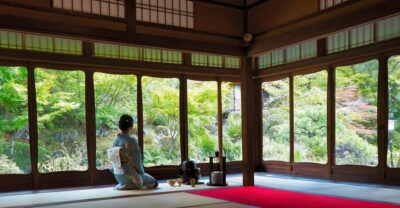
Tea Ceremony in a Traditional Tea House in Kiyomizu
Read our review →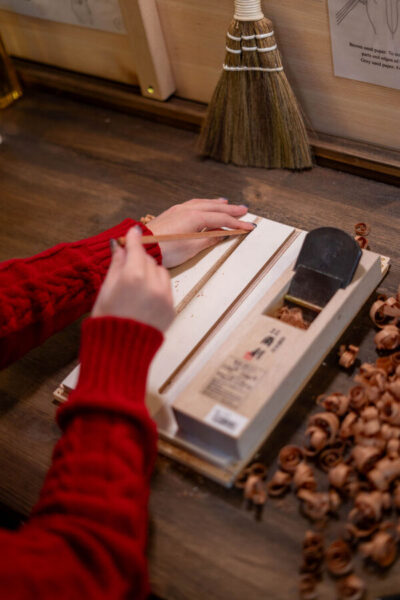
Gion Make Your Own Chopsticks with Engraving Option
Read our review →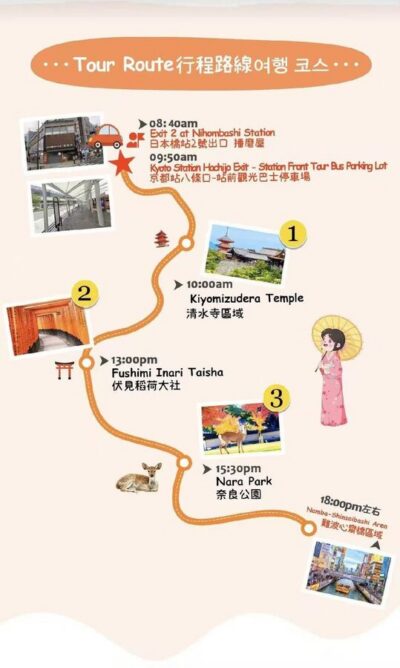
Kyoto Nara Day Trip │ Kiyomizu-dera Temple + Fushimi Inari-taisha Shrine + Nara Park (Departing from Osaka/Kyoto)
Read our review →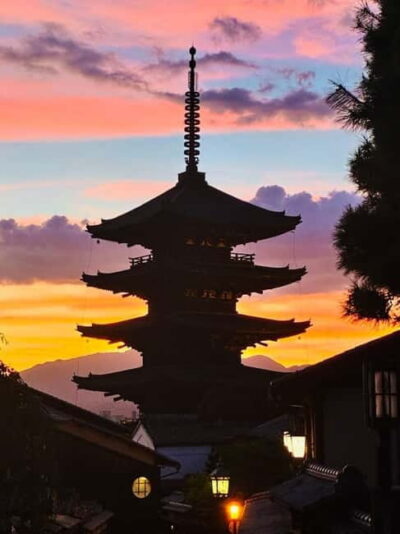
Kyoto Geisha Walking Tour: Gion District & Hidden Gems
Read our review →