

Reviewed · TEMPLES AND SHRINES
Kyoto Early Bird English Tour: Fushimi Inari & Gion(Private opt)
Kyoto rewards early risers. This four to five-hour morning tour links Fushimi Inari, Kiyomizu-dera, the old streets of Higashiyama, and Gion with an English-speaking local guide. I like the early start, which gives you a better chance of seeing Fushimi Inari before the torii gates become packed, and I like the personal photography included along the way. The main consideration is the walking: this is a real on-foot outing, with public transportation between areas and a moderate level of fitness needed.
I also like the private format. Your group gets the guide’s attention, so you can ask about religion, Kyoto customs, food, or anything else that catches your interest. The one point to clarify before booking is the schedule. It is advertised at four to five hours, but one guest described finishing in about two and a half hours, so the exact pace may depend on the guide, transportation, and how much time your group spends at each site.
In This Review
- Key things to know before you book
- Why the early start matters at Fushimi Inari
- Kiyomizu-dera brings the big city view
- The old streets of Sannenzaka and Ninenzaka
- Yasaka Pagoda and a memorable Kyoto photo stop
- Yasaka Koshindo adds color and local character
- Gion offers a quick look at old Kyoto
- Yasaka Shrine is a practical ending point
- What the guide adds to the experience
- Price, private format, and overall value
- Walking, timing, and what to bring
- Who should book this Kyoto morning tour?
- Should you book the Fushimi Inari and Gion tour?
- FAQ
- Where does the tour begin?
- Where does the tour end?
- How long does the tour last?
- Is Kiyomizu-dera admission included?
- Are transportation costs included?
- Is this a private tour?
Key things to know before you book
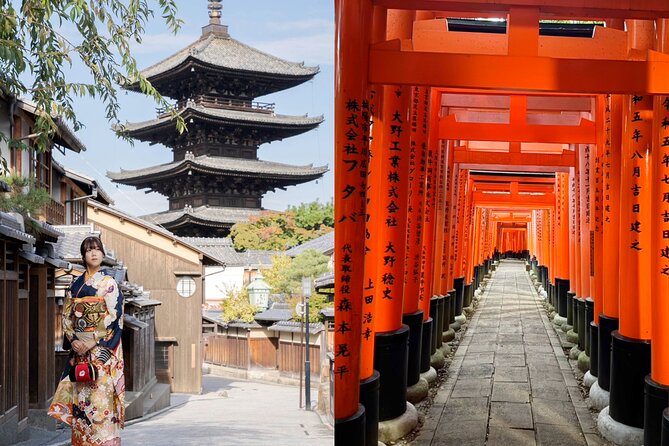
- Fushimi Inari comes first: The early timing is designed to reduce the worst crowds at Kyoto’s famous red torii gates.
- A local guide makes the difference: Ikki, who was born and raised in Kyoto, is praised for clear English, cultural explanations, patience, and helpful local suggestions.
- Seven Kyoto stops in one morning: The route includes Fushimi Inari, Kiyomizu-dera, Sannenzaka and Ninenzaka, Yasaka Pagoda, Yasaka Koshindo, Gion, and Yasaka Shrine.
- Photos are included: Your guide takes professional photos during the walk and sends them to you afterward.
- Budget for extra costs: The tour price is $99.10 per person, with ¥390 for public transportation and ¥500 for Kiyomizu-dera admission listed separately.
- You finish in Gion: The tour ends at Yasaka Shrine, a useful place to continue sightseeing, eat, or catch transportation.
Why the early start matters at Fushimi Inari
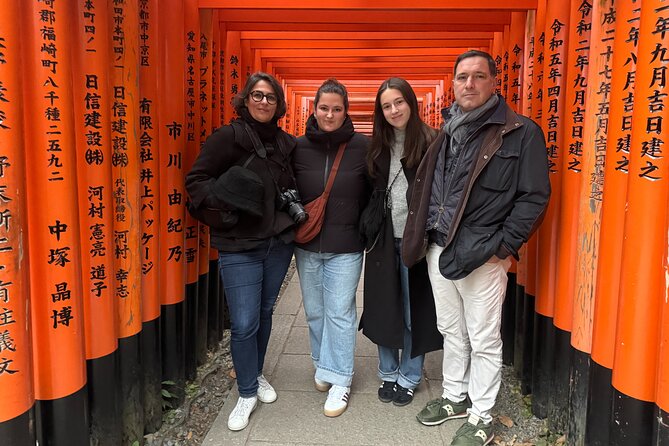
Fushimi Inari-taisha is the natural opening act. Its thousands of orange-red torii gates climb the wooded slopes of Mount Inari, creating one of Kyoto’s most recognizable scenes. The shrine is dedicated to Inari, associated with rice and prosperity, and the fox imagery connected with Inari worship gives the grounds an extra layer of character.
The timing is the real prize. Later in the day, the narrow gate paths can become crowded, making it harder to appreciate their rhythm and color. Start early, and you have a better chance to walk at a steady pace, hear your guide, and pause for photographs without blocking the flow of people.
You should not assume that one hour means a full climb to the top of Mount Inari. The listed time is enough for a focused introduction, photo stops, and an explanation of the shrine’s meaning, but a complete hike takes much longer. Ask your guide how far the group will go and how much time is planned for the gates.
The free admission helps keep the first stop simple. Still, wear shoes with good grip. Even if you do not complete the mountain route, this is not a flat, indoor sightseeing stop.
More Temples and Shrines in Kyoto
- [Kyoto & Nara Day Tour] Sagano Scenic Railway & Nara Park & Fushimi Inari Taisha Thousand Torii Gates & Togetsukyo Bridge & Bamboo Grove & Kimono Forest (Departing from Osaka)
★ 4.9 · 10,942 reviews - Kyoto: Fushimi Inari, Kinkakuji, Bamboo Grove 1 Day Bus Tour
★ 4.8 · 4,316 reviews - Kyoto: Tea Ceremony in a Traditional Tea House in Kiyomizu
★ 4.9 · 3,519 reviews
Kiyomizu-dera brings the big city view
From Fushimi Inari, the tour uses public transportation and continues to Kiyomizu-dera Temple. The transport fare is listed as ¥390 per person, separate from the tour price. Your guide handles the route between the major areas, which saves you from working out Kyoto’s transit system while trying to stay on schedule.
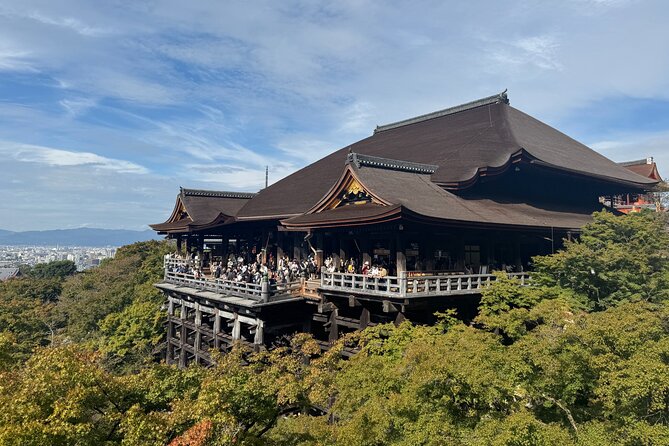
Kiyomizu-dera is one of Kyoto’s major temple destinations, perched above the city with broad views across Kyoto. Its setting is a large part of the appeal. You get architecture, religious history, and a view that helps you understand how the old temple districts relate to the modern city.
Admission is not included, so plan on ¥500 per person. That is a small extra cost, but it is worth knowing in advance because this is the only paid sight listed in the schedule.
The planned visit is about one hour. That gives you time to see the main areas and listen to explanations, but not unlimited time for every corner, shop, and photo angle. If Kiyomizu-dera is your top priority, tell the guide early. In a private setting, your group may have more flexibility than a large scheduled group, though the full route still needs to fit into the morning.
The old streets of Sannenzaka and Ninenzaka
After the temple, the route moves through Sannenzaka and Ninenzaka. These stone-paved streets run between traditional wooden buildings, small shops, and restaurants. They are among the most atmospheric parts of eastern Kyoto, but their charm comes with a practical warning: the streets are popular, and their slopes and stone paving can be tiring after the morning’s earlier walking.
The official stop is listed at only 15 minutes. Think of this as a guided orientation rather than a shopping session. Your guide can point out the old townscape and explain how the area connects Kiyomizu-dera with Gion, while you get a quick sense of where to return later.
I would not plan to buy gifts or sit down for a full meal here during the tour. Save those activities for after the tour, when you can explore at your own speed.
Yasaka Pagoda and a memorable Kyoto photo stop
Yasaka Pagoda, part of Hokanji Temple, is one of the most recognizable structures in this district. Its height and wooden construction give the surrounding streets a strong sense of place. The pagoda is especially useful as a visual landmark, since it helps tie the narrow lanes and old buildings together.
The stop lasts about 15 minutes and admission is listed as free. That is enough for an explanation and photographs, but not a leisurely visit inside the temple. The pagoda is best treated as a short, well-placed stop along the walking route.
Photography is one of this tour’s most praised extras. Ikki is repeatedly singled out for taking many photos, including shots that couples and families could not easily manage on their own. If you want particular group combinations or a photo at a certain viewpoint, speak up. A private guide can usually respond more easily to those requests than a guide managing a large crowd.
A completely different kind of day out:
- PERFECT KYOTO 1-Day Bus Tour
★ 5.0 · 13,518 reviews - Kyoto: Gion Make Your Own Chopsticks with Engraving Option
★ 5.0 · 3,465 reviews - Kyoto Nara Day Trip │ Kiyomizu-dera Temple + Fushimi Inari-taisha Shrine + Nara Park (Departing from Osaka/Kyoto)
★ 4.7 · 3,408 reviews - Kyoto Geisha Walking Tour: Gion District & Hidden Gems
★ 4.7 · 3,273 reviews
Yasaka Koshindo adds color and local character
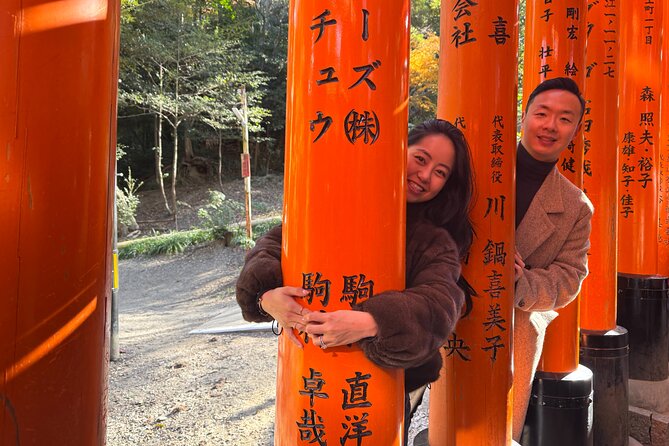
Yasaka Koshindo is a smaller and more unusual stop. Its colorful decorations contrast with the quieter tones found at many Japanese temples, and that makes it a strong photo location. The temple’s construction date is unclear, which gives your guide a chance to explain the site without pretending every detail is neatly documented.
The visit is scheduled for 15 minutes and admission is free. That sounds brief, but it fits the scale of the place. This is not a major complex where you need an hour. It is a compact cultural pause that breaks up the larger temple visits.
For me, stops like this are part of the route’s value. Fushimi Inari and Kiyomizu-dera are headline sights. Yasaka Koshindo gives you something smaller and less predictable, while your guide supplies the context you would probably miss if you simply walked past.
Gion offers a quick look at old Kyoto
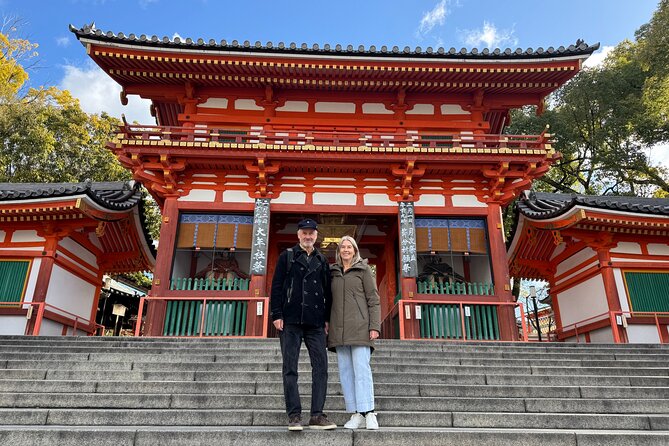
The route then reaches Gion, Kyoto’s best-known geisha district. Traditional machiya houses, teahouses, and preserved streets give the area its old Kyoto appearance. The setting is appealing, but it is important to keep expectations realistic. A 15-minute stop provides an introduction, not a full exploration of Gion.
Your guide can explain the district’s role in Kyoto culture and help you understand what you are seeing beyond the attractive façades. You should also be respectful while walking here. Do not photograph people without permission, and follow any posted requests around private buildings and traditional establishments.
The quick visit works well if you are new to Kyoto and want a first orientation. It is less suitable if your main goal is a slow afternoon wandering through Gion’s lanes, shopping, dining, or seeking evening entertainment. You can easily return after the tour because the final stop is nearby.
Yasaka Shrine is a practical ending point
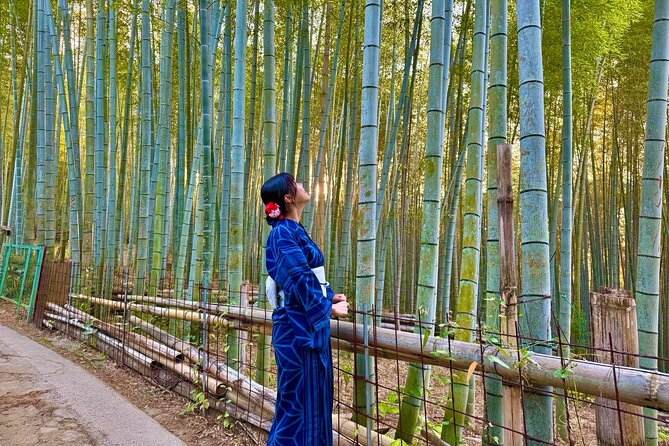
The morning finishes at Yasaka Shrine, the headquarters of about 2,300 related shrines across Japan. The shrine is associated with prosperity and protection and has played an important role in Kyoto’s religious life.
The planned visit lasts 30 minutes, longer than the brief stops at the pagoda and Koshindo. That gives you time to look around, ask final questions, and get advice for the rest of your day.
The ending point is useful. Yasaka Shrine sits in the Gion area, so you are not dropped somewhere remote or sent back to Kyoto Station. You can continue exploring on foot, find lunch, or take a bus toward another attraction or your hotel. Tell your guide your next plan, and the tour information says they can direct you toward a suitable route.
What the guide adds to the experience
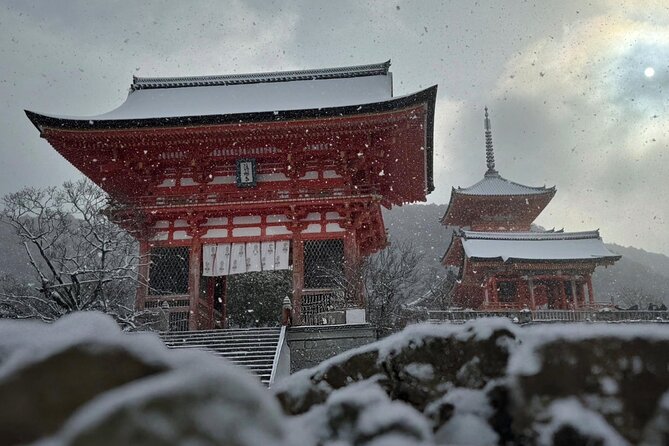
The guide is the strongest reason to choose this tour instead of visiting the sights independently. Ikki receives repeated praise for his fluent English, clear explanations, friendly manner, and strong preparation. He is described as being born and raised in Kyoto, which gives his explanations a local point of view rather than a simple recitation of dates.
His approach also seems to suit different ages. Families describe him as patient and kind with children, while teenagers and older relatives reportedly enjoyed talking with him. That matters on a private tour because the morning can be shaped around your group’s questions and energy.
Another useful touch is supplementary material. Ikki has used a booklet with photographs and explanations about Japanese language, temple and shrine history, and prayer customs. This can help you understand how to behave at religious sites, rather than simply taking pictures and moving on.
The guide also offers practical recommendations. These have included food suggestions and help finding a conveyor-belt sushi restaurant after the walk. Such advice is valuable at the end of a busy morning, especially if you are still learning how Kyoto’s neighborhoods fit together.
Price, private format, and overall value
At $99.10 per person, this is not the cheapest way to visit the temples. You also need to allow for ¥390 in public transportation and ¥500 admission to Kiyomizu-dera, plus any food or drinks. Group discounts may improve the price for larger parties, but the available details do not state the discount amount.
The value comes from the private guiding, the English explanations, the early timing, and the photos. If you are a couple, family, or small group that wants help with Kyoto’s religious sites and old neighborhoods, the cost can make sense. You are paying for organization and personal attention, not just entry to attractions.
The value is weaker if you are happy navigating public transportation alone, reading up on the shrines beforehand, and taking your own photos. You will also want to confirm the expected duration if every minute matters. The advertised four to five hours allows for a substantial morning, but one experience ended much sooner.
The private format is important here. Only your group participates, so you can ask more questions and request help with photos or onward plans. It does not guarantee a completely flexible schedule, but it should feel more personal than a large group outing.
Walking, timing, and what to bring
This is a walking tour that also uses public transportation. You move through shrine grounds, temple approaches, stone-paved lanes, and historic neighborhoods. Moderate physical fitness is required, and comfortable shoes are more important than stylish ones.
Arrive early at Kyoto Station. The late policy is strict: if you miss the meeting time, you cannot join the tour or receive a refund. The experience begins at Kyoto Station and ends at Yasaka Shrine, so plan your morning around that one-way route.
Bring water and keep breakfast simple if you prefer to eat before starting. Food and drinks are not included, and the schedule may leave little time for a proper meal until the end. You can use your final location in Gion to continue with lunch or more sightseeing.
The mobile ticket is convenient, and booking confirmation is provided at the time of booking. Free cancellation is available up to 24 hours before the start time. Changes or cancellations inside that 24-hour window are not accepted for a refund.
Who should book this Kyoto morning tour?
I would recommend it most strongly for first-time visitors who want a well-organized introduction to Kyoto’s major sights. It is also a good match for families, couples, and small groups who want a guide to take photos and explain religious customs in clear English.
You will get the most from it if you enjoy moving at a steady pace and seeing several districts in one morning. The route gives you a useful overview, then leaves you at Yasaka Shrine, where you can spend more time in Gion afterward.
I would be more cautious if you dislike early starts, have difficulty walking on slopes or stone streets, or want long, unhurried visits at each temple. I would also ask about the expected finish time if you have a train, reservation, or another fixed appointment afterward.
Should you book the Fushimi Inari and Gion tour?
Book it if you want Kyoto’s essential eastern sights explained by a local guide, especially if the chance to avoid the worst crowds and receive a set of personal photos appeals to you. Ikki’s English, local background, patience, cultural explanations, and food advice are the clearest strengths.
Before paying, confirm the start time, expected length, and exact transportation plan. If you accept the early morning, the walking, and the extra ¥890 in listed transit and temple costs, this private tour offers a smart first look at Kyoto without leaving you to decode every shrine and street on your own.
FAQ
Where does the tour begin?
The tour begins at Kyoto Station, at Higashishiokoji Kamadonocho in Shimogyo Ward, Kyoto.
Where does the tour end?
It ends at Yasaka Shrine in the Gion area. From there, you can continue sightseeing or use public transportation to reach another attraction or your hotel.
How long does the tour last?
The advertised duration is approximately four to five hours. One experience was reported as lasting about two and a half hours, so you should confirm the expected timing before booking.
Is Kiyomizu-dera admission included?
No. Kiyomizu-dera admission is listed separately at ¥500 per person.
Are transportation costs included?
No. Public transportation costs are listed separately at ¥390 per person.
Is this a private tour?
Yes. Only your group participates in the activity.
Just added in Kyoto
- The “Golden Route” and Ancient Japan by DIAMIR Erlebnisreisen – 14-Day Tour★ 2.0 · 2 reviews
- Japan: Castles & Cuisine by G Adventures – 6-Day Kyoto to Osaka Tour★ 4.5 · 4 reviews
- Cycle Japan by Explore! – 13-Day Kyoto to Tokyo Tour★ 4.7 · 12 reviews
- Cycle Japan by Intrepid Travel – 11-Day Kyoto to Tokyo Tour★ 4.8 · 2 reviews
- Classic Japan by Intrepid Travel – 11-Day Kyoto to Tokyo Tour★ 4.4 · 14 reviews
- Ancient & Modern Japan 14-Day Tour by Exodus Adventure Travels★ 4.4 · 40 reviews
- 5 Day Cultural Adventure of Kyoto, Nara & Osaka by Tourist Journey★ 2.5 · 2 reviews
- 12 Days Kinosaki Onsen Escape: A Journey Through Japan’s Timeless Towns by UME Travel★ 4.8 · 5 reviews
Temples and Shrines, compared.
![[Kyoto & Nara Day Tour] Sagano Scenic Railway & Nara Park & Fushimi Inari Taisha Thousand Torii Gates & Togetsukyo Bridge & Bamboo Grove & Kimono Forest (Departing from Osaka)](https://media.japanvisits.com/wp-content/uploads/kyoto-nara-day-tour-sagano-scenic-railway-nara-park-fushimi-inari-taisha-thousand-torii-gates-togetsukyo-bridge-bamboo-grove-kimono-forest-departing-from-osaka-k110001-400x257.jpg)
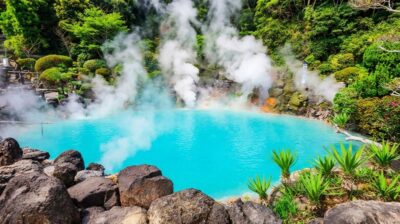
Kyushu One-Day Tour: Yufuin no Mori Train & Yufuin Town & Nyoirin-ji Temple & Dazaifu & Hell Hot Springs (Departing from Fukuoka)
Read our review →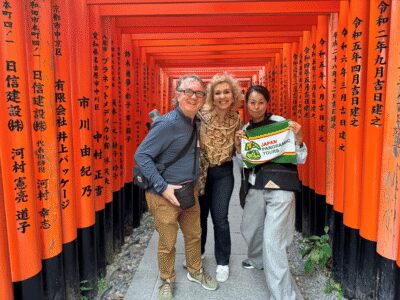
Fushimi Inari, Kinkakuji, Bamboo Grove 1 Day Bus Tour
Read our review →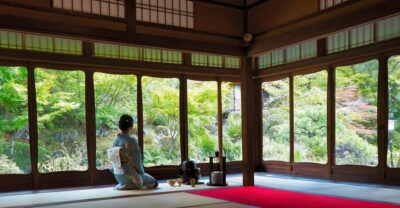
Tea Ceremony in a Traditional Tea House in Kiyomizu
Read our review →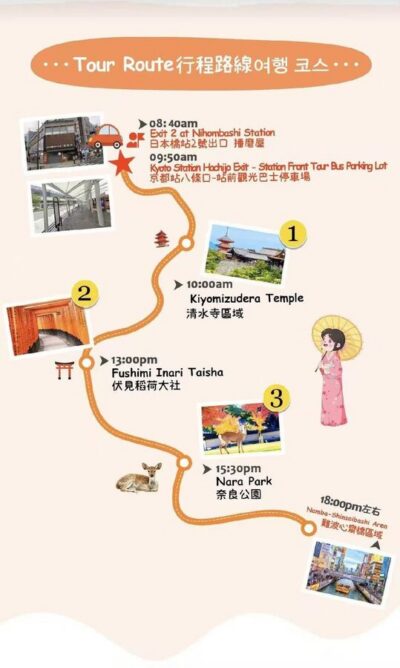
Kyoto Nara Day Trip │ Kiyomizu-dera Temple + Fushimi Inari-taisha Shrine + Nara Park (Departing from Osaka/Kyoto)
Read our review →
Browse the lists this tour appears in