
Reviewed · MORNING
Kyoto Early Morning Private Tour with Government-Licensed Guide
Kyoto rewards early risers. This four-hour private tour gives you a licensed English-speaking guide, a choice of two or three Kyoto sights, and a calmer start before the city fills up. I like the personal format, and I like that guides such as Rie, Yasu, Tomy, Kay, and Mayumi have adapted routes around guest interests, mobility, and weather.
The main tradeoff is simple: you cover only two or three places, not the long list of attractions shown in the tour description. You also pay your own transport and entrance fees, and one serious complaint involved a guide who became ill and did not arrive. That appears to be an exception, but it is worth knowing before you book.
In This Review
- Key points to know before booking
- Why an early start changes Kyoto
- What the private format actually gives you
- Fushimi Inari and the red torii gates
- Kiyomizu-dera and historic Higashiyama
- Gion, Pontocho, and Nishiki Market
- Nijo Castle and the Kyoto Imperial Palace
- Ginkakuji, Nanzenji, and Tofukuji
- Kinkakuji, Ryoanji, and Ninnaji
- Arashiyama’s bamboo and quieter temple paths
- Northern mountains and Imperial villas
- The price and what you receive
- Who should book this Kyoto morning?
- Final verdict: book it for focus, not maximum coverage
- FAQ
- How long is the Kyoto Early Morning Private Tour?
- What time does the tour start?
- How many attractions can I choose?
- Is the tour private?
- Is hotel pickup included?
- Is transportation included?
- Are entrance fees included?
- Can I cancel for a full refund?
Key points to know before booking
- Start as early as 6:30 or 7:00 a.m. to see Fushimi Inari or Kiyomizu-dera before the heaviest crowds.
- Choose two or three sites, making this a focused introduction rather than a full-day sightseeing marathon.
- Meet on foot in a designated Kyoto area, with no private car included.
- Use the guide for cultural context and practical help, including restaurant suggestions and advice for getting around after the tour.
- Expect a private experience for only your own group, with route changes possible within the available attractions.
- Budget separately for rail, bus, taxi, and admission charges, since these are not generally included.
Why an early start changes Kyoto
Kyoto’s famous sights can feel very different at daybreak. Fushimi Inari-taisha and Kiyomizu-dera are both popular, and the narrow paths around them become harder to enjoy later in the day. Starting at 6:30 or 7:00 gives you a better chance to walk at a steady pace and pause for photos.
One guide, Tomy, specifically began at 6:30 and took the group to Kiyomizu-dera and Fushimi Inari while they were still nearly empty. Another guide, Rie, began at 7:00 on January 2, an especially busy date in Japan, and still managed to visit four locations before finishing at 11:00.
That early hour is also useful in warmer months. Yasu’s advice was direct: start early because Kyoto can get busy and hot. I think that is one of the strongest reasons to choose this tour, even if you normally avoid guided sightseeing.
The early start does require discipline. You must be ready at an hour when breakfast options may be limited, and the tour’s four hours pass quickly. If your group needs a slow pace, has young children, or wants long temple visits, choose two stops rather than trying to squeeze in three.
More Private Tours in Kyoto
- Kyoto 6hr Private Tour with Government-Licensed Guide
★ 5.0 · 1,369 reviews - 10 Must-see Spots in Kyoto One Day Private Tour (up to 7 people)
★ 5.0 · 1,108 reviews - Kyoto 4hr Private Tour with Government-Licensed Guide
★ 5.0 · 629 reviews
What the private format actually gives you
This is not a private vehicle tour. You meet your government-licensed local guide on foot, and you travel by walking and public transportation, with any rail, bus, or taxi costs paid separately. One group of four used public transportation to get around Kyoto, while another met Yasu at its hotel and visited three selected places.
The private format matters most when you have a clear goal. You can focus on temples, gardens, food, traditional neighborhoods, photography, or a gentle introduction to Kyoto culture. A guide can also adjust the pace when someone has a problem with mobility. Mayumi added another half hour for a guest with an ankle issue, although you should not assume extra time is guaranteed.
You also avoid the stop-and-go rhythm of a large group. Ask a question, change the order of stops, or spend longer at a place that interests you. A private guide can explain customs and daily life in a way that a fixed audio guide cannot.
The guide can also help after the formal tour ends. Rie finished by taking her group to a favorite sushi restaurant, and another guide helped explain how to reach later sights independently. That practical orientation can be worth as much as the temple commentary, especially during a first visit.
Fushimi Inari and the red torii gates
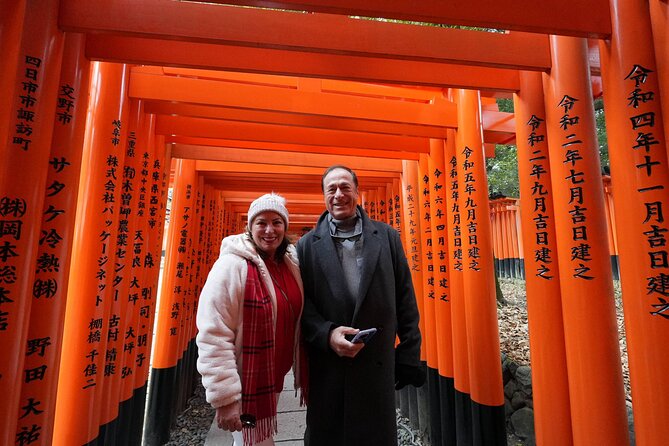
Fushimi Inari-taisha is the clearest choice for an early morning route. Its long corridors of vermillion torii gates are instantly recognizable, but the shrine is more than a photo stop. Your guide can explain the shrine’s stories, customs, and the meaning behind what you are seeing.
You do not need to walk every gate for the visit to work. With only four hours, the guide will need to balance the torii paths with your other selected stops. If photography is your priority, tell the guide in advance so the schedule does not become too rushed.
The shrine pairs well with Kiyomizu-dera because both are popular and both benefit from an early arrival. The drawback is transport time between distant parts of Kyoto, so do not add several western Kyoto sites to the same morning.
Kiyomizu-dera and historic Higashiyama
Kiyomizu-dera is one of Kyoto’s essential temple visits, with broad views and impressive temple buildings on the eastern hills. The surrounding Higashiyama Ward adds atmosphere through preserved streets and traditional-looking lanes.
A guide is especially useful here because the approach can be confusing for a first-time visitor. Bell’s group reached Kiyomizu-dera by taxi around 8:00 during cherry blossom season and found the visit went smoothly despite the crowds elsewhere.
Keep in mind that the area involves walking and slopes. If you have limited energy, make Kiyomizu-dera your main stop and treat the nearby streets as an optional extension. The private format lets you make that call without holding up a busload of people.
A completely different kind of day out:
- PERFECT KYOTO 1-Day Bus Tour
★ 5.0 · 13,518 reviews - [Kyoto & Nara Day Tour] Sagano Scenic Railway & Nara Park & Fushimi Inari Taisha Thousand Torii Gates & Togetsukyo Bridge & Bamboo Grove & Kimono Forest (Departing from Osaka)
★ 4.9 · 10,942 reviews - Kyoto: Fushimi Inari, Kinkakuji, Bamboo Grove 1 Day Bus Tour
★ 4.8 · 4,316 reviews - Kyoto: Tea Ceremony in a Traditional Tea House in Kiyomizu
★ 4.9 · 3,519 reviews
Gion, Pontocho, and Nishiki Market
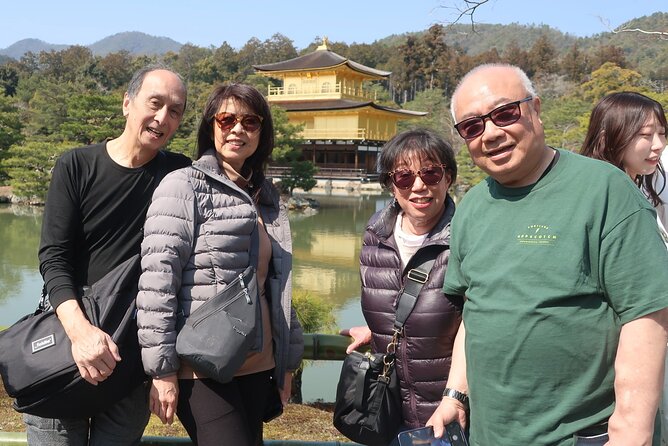
Gion is Kyoto’s famous geisha district, known for narrow lanes and traditional buildings. A guide can help you understand the area without wandering aimlessly, while also reminding you to behave respectfully in a residential setting.
Pontocho is another atmospheric old district, a narrow dining lane running between Shijo-dori and Sanjo-dori near the Kamogawa River. It is more useful as a cultural walk than as a morning meal stop, since many restaurants operate later in the day.
Nishiki Market is Kyoto’s Kitchen, a five-block shopping street with more than one hundred shops and restaurants. It is best for food, local products, and a look at everyday shopping, but it may not be the strongest choice for a very early start. If you choose Nishiki, ask the guide what will be open at your tour time.
These three stops create a city-center route with less temple repetition. I would choose them if you want food and neighborhoods more than gardens and religious sites. For a first Kyoto visit focused on iconic sights, choose Fushimi Inari or Kiyomizu-dera instead.
Nijo Castle and the Kyoto Imperial Palace
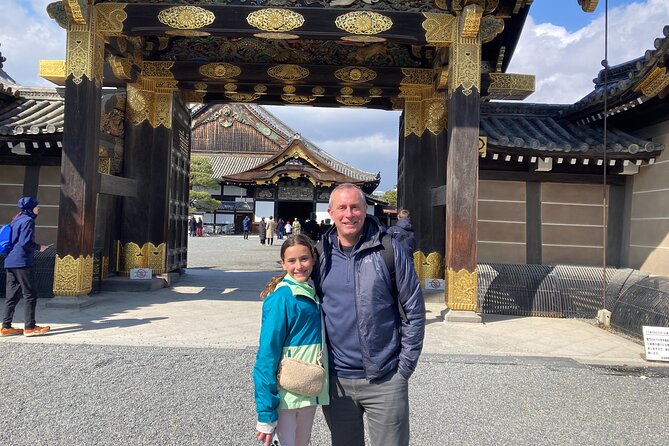
Nijo Castle was built in 1603 as the Kyoto residence of Tokugawa Ieyasu, the first shogun of the Edo period. It offers a different view of power and politics from Kyoto’s temples, making it a good choice if your interests extend beyond Buddhism and Shinto.
The Kyoto Imperial Palace served as the Imperial Family’s residence until 1868, when the emperor and capital moved to Tokyo. Its spacious grounds provide a change from Kyoto’s tight lanes and crowded temple approaches.
Both sites can require admission, and entrance fees are not included. They also need enough time to feel worthwhile, so I would not pair both with Fushimi Inari and Kiyomizu-dera in a four-hour outing.
Ginkakuji, Nanzenji, and Tofukuji
Ginkakuji, the Silver Pavilion, began as the retirement villa of shogun Ashikaga Yoshimasa in 1482. Despite its name, it is not covered in silver. Its Zen setting and garden design are the real attraction.
Nanzenji has spacious grounds at the foot of the eastern mountains and is one of Japan’s important Zen temples. The nearby Suirokaku aqueduct adds an unusual architectural detail to a temple visit.
Tofukuji is a large Zen temple in southeastern Kyoto, particularly famous for autumn color. It is a sensible seasonal choice, but the best route depends on opening times, transport, and the other sites you select.
These temples reward a guide who can explain the difference between a Zen temple, a Shinto shrine, and an Imperial site. Without that context, several temple visits can blur together. I would choose one or two, not all three.
Kinkakuji, Ryoanji, and Ninnaji
Kinkakuji, formally Rokuonji, is the Golden Pavilion, with its upper two floors covered in gold leaf. It is one of Kyoto’s most recognizable sights and deserves a place on your shortlist if you have never seen it.
Ryoanji contains Japan’s best-known rock garden. The garden is deliberately spare, and a guide can help you appreciate its design without telling you there is one single correct interpretation.
Ninnaji is a World Heritage temple and the head temple of the Omuro School of the Shingon sect. It provides a less hurried alternative to simply collecting famous photo stops.
These northern Kyoto attractions are not a sensible add-on to Fushimi Inari and Kiyomizu-dera in one short morning. Pick a northern route instead. Kinkakuji and Ryoanji can work as a pair, while Ninnaji adds more temple detail if your group wants it.
Arashiyama’s bamboo and quieter temple paths
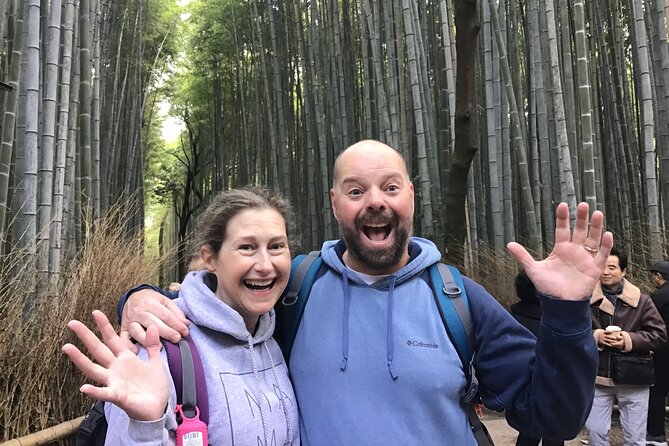
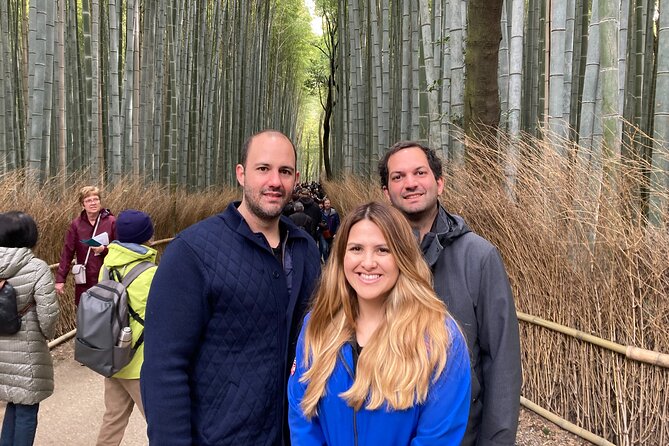
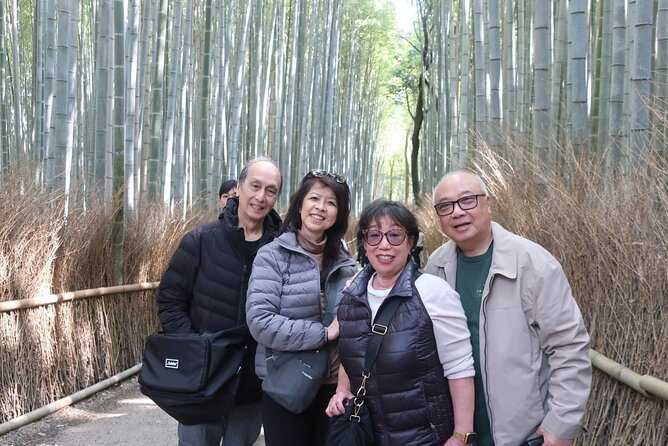
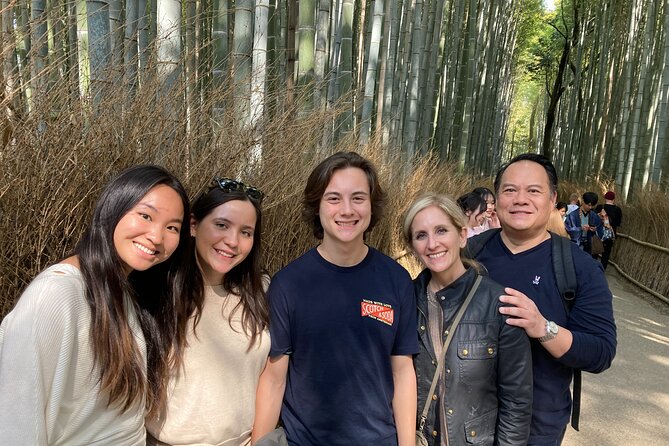
Arashiyama is one of the tour’s strongest choices for photography. The Bamboo Forest Street is attractive in the early morning, when the paths can feel calmer and the light is softer. Kay’s group particularly enjoyed the bamboo forest and the river views around Arashiyama.
Togetsukyo Bridge is the district’s best-known landmark, crossing the river with mountain views around it. Tenryuji is Arashiyama’s major Zen temple and a World Heritage site, while Okochi Sanso Garden offers a former villa with several gardens and buildings.
If you want a quieter walk, the guide can point you toward Jojakkoji, Nisonin, Gioji, Adashino Nenbutsuji, or Otagi Nenbutsuji. Gioji is known for its moss garden and thatched buildings, while Otagi Nenbutsuji is noted for its 1,200 stone rakan figures, each with a different expression.
The catch is distance. Arashiyama has enough sights for a full day, and the four-hour tour will only give you a sample. Choose Bamboo Forest, Togetsukyo Bridge, and one temple rather than attempting the whole district.
Northern mountains and Imperial villas
The tour’s suggested choices reach well beyond central Kyoto. Shugakuin Imperial Villa, Katsura Imperial Villa, Kurama-dera, Kibune River, and Yoshimine-dera all require more planning than a simple central-city walk.
Shugakuin Imperial Villa was built in the seventeenth century for Emperor Gomizuno and is managed by the Imperial Household Agency. Katsura Imperial Villa is known for its architecture and garden design. Both are attractive choices for visitors who care about formal gardens and Imperial history, but they may not fit easily into a spontaneous four-hour route.
Kibune is a small mountain town built around Kifune Shrine, while Kurama is a rural northern settlement known for Kurama-dera and its hot spring. Yoshimine-dera sits in Kyoto’s western mountains and is built along a hillside.
These options make the tour customizable, but they also show why you should discuss your route before the morning begins. A remote temple and a central market are not interchangeable stops. Your guide can help you choose a realistic pair.
The price and what you receive
At $101.82 per person, the tour is not the cheapest way to see Kyoto. For a solo visitor or couple, you are paying for a licensed private guide, not a vehicle or a ticket bundle. The value improves for families or small groups, particularly when a group discount applies.
The best return comes from using the guide well. Ask for cultural explanations, route advice, food suggestions, and help understanding what you are seeing. If you only want someone to lead you from one famous gate to another, the price may feel high.
You must also add transportation and admission costs. Nijo Castle, Kiyomizu-dera, Kyoto Imperial Palace, Kinkakuji, Ryoanji, and many other listed sights show admission as not included. Confirm the exact ticket arrangements for your chosen stops before you set out.
The tour has a 96 percent recommendation rate and a 4.8 rating from 23 reviews, which is encouraging but not a guarantee. Most praise centers on guide flexibility, cultural explanations, clear English, and early access to crowded sights. One booking failed when the assigned guide fell ill, and the customer reported a delayed refund process. Free cancellation is available up to 24 hours before the start time, but late cancellations and changes are not refunded or accepted.
Who should book this Kyoto morning?
I would recommend it for first-time visitors who want fast orientation without joining a large group. It is also a good fit for families, small friend groups, photographers, and anyone who wants to choose between temples, food streets, gardens, and traditional districts.
It suits you especially well if you can wake early and name two or three priorities. Guides such as Yasu, Tomy, Rie, Kay, and Mayumi have received strong praise for clear explanations, responsiveness, and personal attention.
I would be cautious if you want a leisurely full-day visit, a private car, or admission included in the price. I would also avoid packing distant sites into one route. Kyoto looks compact on a map, but moving between Fushimi, Arashiyama, northern temples, and the mountain towns takes time.
Final verdict: book it for focus, not maximum coverage
Book this tour if your ideal Kyoto morning includes a licensed local guide, an early start, and the freedom to choose a small number of meaningful stops. The early timing is the real advantage, and the private format makes it easier to ask questions, adjust the pace, and leave with a practical sense of how Kyoto works.
Before booking, decide on one main area. Choose Fushimi Inari and Kiyomizu-dera for classic Kyoto, Arashiyama for bamboo and river scenery, or Gion and Nishiki for streets and food. Keep your route realistic, budget for tickets and transport, and contact the provider if you need a specific pace or meeting arrangement.
FAQ
How long is the Kyoto Early Morning Private Tour?
The tour lasts approximately four hours.
What time does the tour start?
Start times can be early, with examples of 6:30 and 7:00 a.m. The exact start time is arranged for your booking.
How many attractions can I choose?
The included experience allows you to customize a tour of two or three sites from the listed attractions.
Is the tour private?
Yes. Only your own group participates in the activity.
Is hotel pickup included?
The guide meets you on foot within a designated area of Kyoto. There is no private vehicle included.
Is transportation included?
No. Transportation fees are not included. The tour is conducted by walking and public transportation, with taxi use possible at your own expense.
Are entrance fees included?
Entrance fees, lunch, and other personal expenses are not generally included. Confirm the admission arrangements for the specific sights you select.
Can I cancel for a full refund?
You can cancel up to 24 hours before the local start time for a full refund. Cancellations or changes made less than 24 hours before the start are not accepted or refunded.
Just added in Kyoto
- The “Golden Route” and Ancient Japan by DIAMIR Erlebnisreisen – 14-Day Tour★ 2.0 · 2 reviews
- Japan: Castles & Cuisine by G Adventures – 6-Day Kyoto to Osaka Tour★ 4.5 · 4 reviews
- Cycle Japan by Explore! – 13-Day Kyoto to Tokyo Tour★ 4.7 · 12 reviews
- Cycle Japan by Intrepid Travel – 11-Day Kyoto to Tokyo Tour★ 4.8 · 2 reviews
- Classic Japan by Intrepid Travel – 11-Day Kyoto to Tokyo Tour★ 4.4 · 14 reviews
- Ancient & Modern Japan 14-Day Tour by Exodus Adventure Travels★ 4.4 · 40 reviews
- 5 Day Cultural Adventure of Kyoto, Nara & Osaka by Tourist Journey★ 2.5 · 2 reviews
- 12 Days Kinosaki Onsen Escape: A Journey Through Japan’s Timeless Towns by UME Travel★ 4.8 · 5 reviews
Morning, compared.
Kyoto Early Morning Tour with English-Speaking Guide
Read our review →Early Morning Tour with English-Speaking Guide
Read our review →
World Heritage Shirakawa-go Morning Guided Tour
Read our review →
Nara Early Morning Tour (Kyoto or Osaka Departure Available)
Read our review →
Hiroshima in a Nutshell: Morning Bike Adventure
Read our review →
Browse the lists this tour appears in