
Reviewed · KIMONO AND CULTURAL DRESS
Kyoto: Samurai Sword & Kimono Action Filming Experience
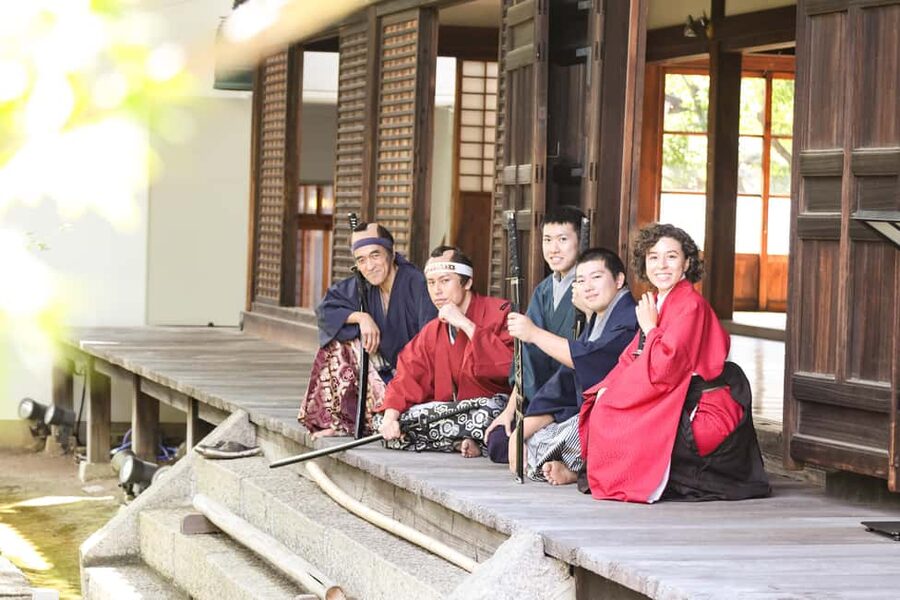
Grab a sword and make a movie. At Myokaku-ji Temple in Kyoto, you learn basic chambara sword movements, put on a traditional kimono, watch trained period-drama actors, and then film your own short action scene. The setting gives the activity more character than a standard costume photo session, especially since the temple is linked with Sengoku-era warlords such as Nobunaga Oda.
I like the small group size, limited to six people, and the way the instructors combine real acting skill with patient teaching. I also like that the kimono rental, photography, and video recording with your own camera are included. The main consideration is time: 70 minutes passes quickly, and the activity is physical, staged, and playful rather than a full lesson in historical swordsmanship.
In This Review
- Key points to know before you book
- Entering Myokaku-ji Temple for a 70-minute samurai lesson
- Learning the sword movements before the cameras roll
- Wearing a kimono inside a working temple
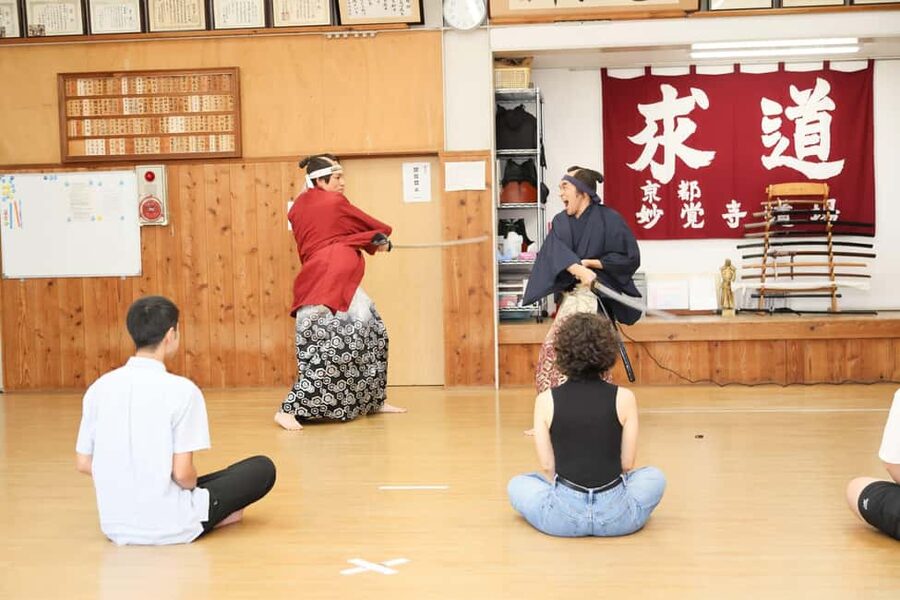
- Watching trained actors perform chambara
- Filming your own short samurai scene
- What $127 gets you in Kyoto
- Who will enjoy this most?
- Booking, cancellation, and useful preparation
- Should you book the Kyoto samurai filming experience?
- FAQ
- Where does the samurai sword and kimono experience take place?
- How long does the experience last?
- Is the kimono rental included?
- Can I take photos or videos?
- Is transportation included?
- Who cannot take part?
Key points to know before you book
- Myokaku-ji Temple setting: You practice inside a working temple location with links to powerful Sengoku-era figures.
- Kimono included: Dressing up is part of the experience, not an extra-cost photo package.
- Professional samurai actors: Instructors Keisuke Irie and Kazuya Naito have appeared in Japanese films and television programs.
- Small-group coaching: With no more than six participants, you get room to practice and perform.
- Your own action footage: Bring a camera or phone so the instructors can record your choreographed sword scene.
- Limited suitability: The activity is not suitable for children under five, pregnant women, people with back problems or pre-existing medical conditions, or anyone over 95.
Entering Myokaku-ji Temple for a 70-minute samurai lesson
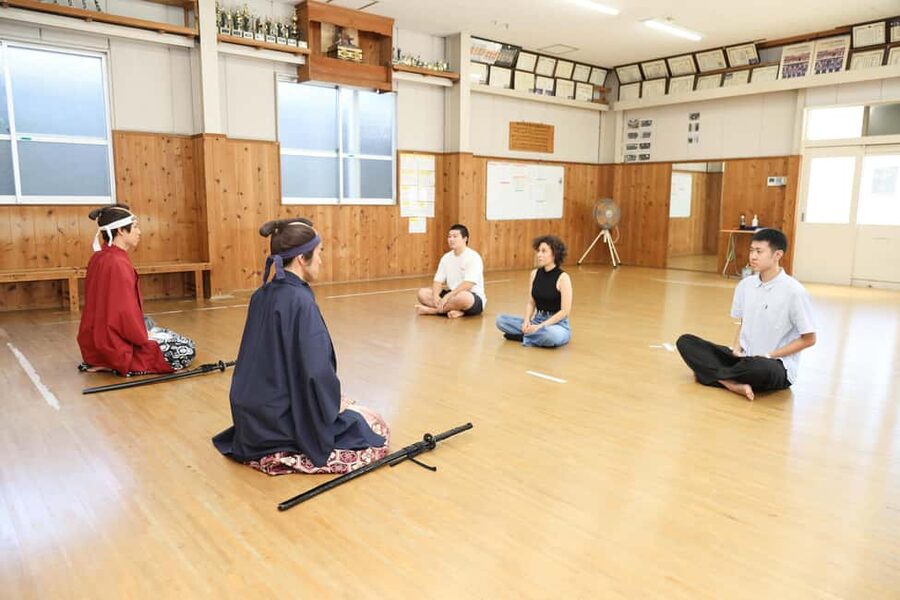
You meet at the Myokaku-ji Dojo, just to the left after entering the temple’s main gate. Transportation to the temple is not included, so you need to arrange your own way there. The separate entrance helps you get to the activity without waiting in a general line.
The location matters. This is not simply a rented studio with painted walls. Myokaku-ji is a historical temple, and the activity connects the sword session with Kyoto’s samurai past. Sengoku warlords, including Nobunaga Oda, stayed here around 400 years ago. That does not turn the session into a formal history lecture, but it gives the setting a sense of place that a hotel function room cannot match.
The dojo is also described as a real kendo training space. That detail helps explain why the activity feels more grounded than a quick dress-up stop. You are still there for entertainment, but the movements are taught in a space designed for martial practice.
You should arrive in comfortable clothes suitable for physical activity. The kimono is provided, but loose, practical clothing underneath will make changing and moving easier. Smoking, alcohol, and drugs are not allowed.
More Castles and Historic Sites in Kyoto
- Kyoto Samurai Experience
★ 5.0 · 1,294 reviews - Kyoto: Nijo-jo Castle and Ninomaru Palace Guided Tour
★ 4.7 · 1,020 reviews - Kyoto: Kendo and Samurai Experience with Uniform and Gear
★ 4.9 · 815 reviews
Learning the sword movements before the cameras roll
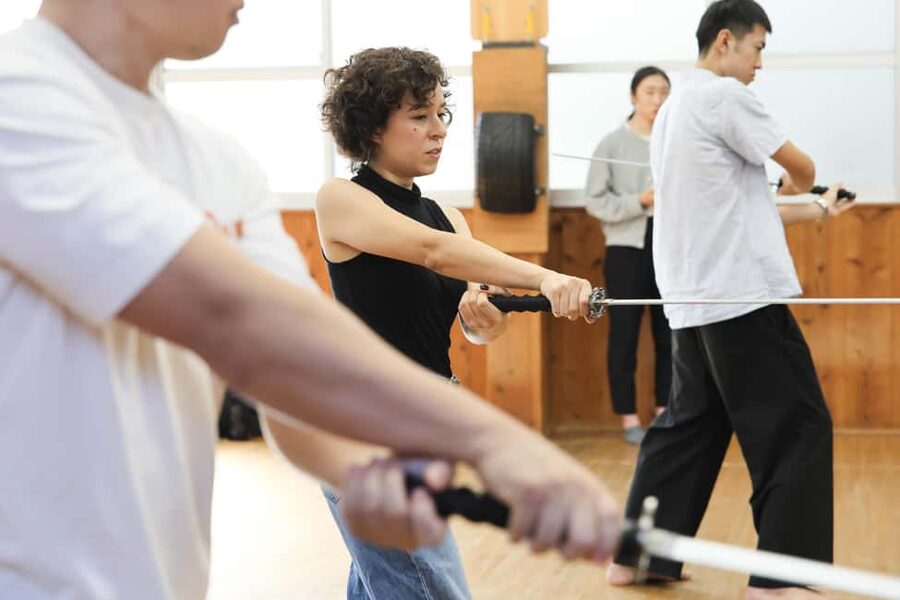
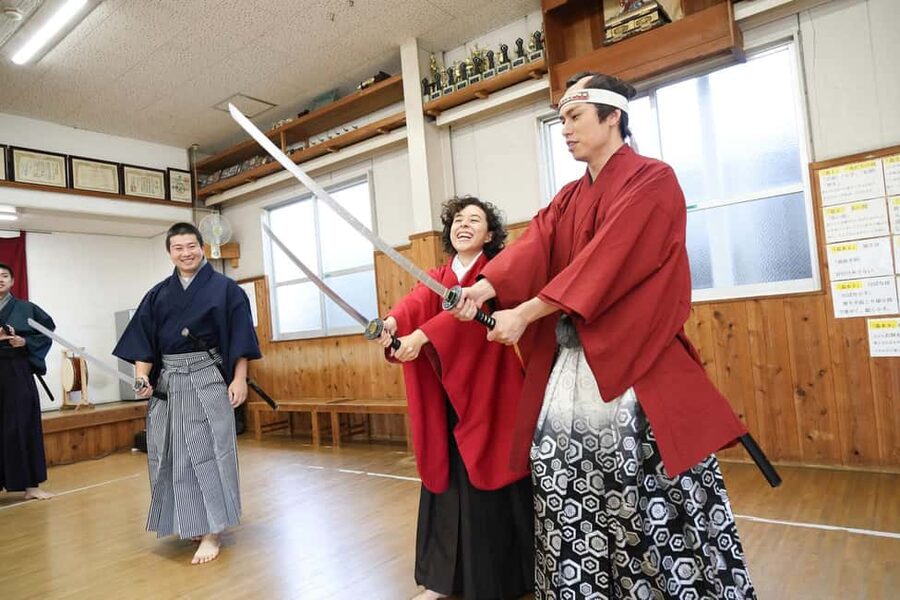
The first active part is the chambara lesson. Chambara refers to Japanese sword-action performance, the kind of dramatic swordplay you see in period films. You learn how to hold and wield the sword, then practice named movements including makkogiri and kesagiri.
The instructors focus on safe, choreographed action rather than unscripted combat. That distinction is important. You are not learning to fight with a sharp sword, and the sword used for the activity is described by participants as fake. The goal is to look convincing, follow the sequence, and work with your scene partners.
I would expect the teaching to suit complete beginners. The instructors demonstrate the movements, guide you through the sequence, and make room for mistakes. Keisuke Irie and Kazuya Naito are professional actors who have worked in Japanese movies and television, so they bring performance experience as well as sword training.
That combination is one of the activity’s strongest features. A martial arts teacher might correct your stance, while an actor can also show you how to turn a simple movement into a readable action scene. You learn where to look, how to pause, and how to make a choreographed strike appear dramatic without making it dangerous.
Do not worry if your first attempt looks awkward. In fact, the comedy is part of the charm. You need to accept that you will probably not look like a seasoned samurai after a few minutes. The instructors keep the mood light, and the activity works best when you treat it as playful role-play rather than a test of physical ability.
Wearing a kimono inside a working temple
The kimono portion adds a visual change and gives you a chance to feel the costume rather than simply pose beside it. The rental fee is included in the $127 price, so you do not need to budget separately for the outfit.
You learn about the traditional art of kimono dressing and then wear the clothing during the experience. The costume helps the filming session feel more complete, especially when paired with the temple surroundings and sword movements.
There is a practical tradeoff. A kimono is not athletic clothing, so your movement may feel less natural once you are dressed. That is part of the fun, but it also makes comfortable clothes underneath a useful choice. You should not book this expecting a long fashion presentation or a detailed cultural workshop. The kimono supports the samurai performance and gives you a memorable look for the photographs and video.
For families with older children, teenagers, and adults, this section can be a good shared activity. One parent described sending two boys while doing something else, and the children returned excited to watch their videos. The minimum age is five, but the activity is not suitable for every child. Anyone joining should be able to listen carefully, move safely, and follow stage directions.
Watching trained actors perform chambara
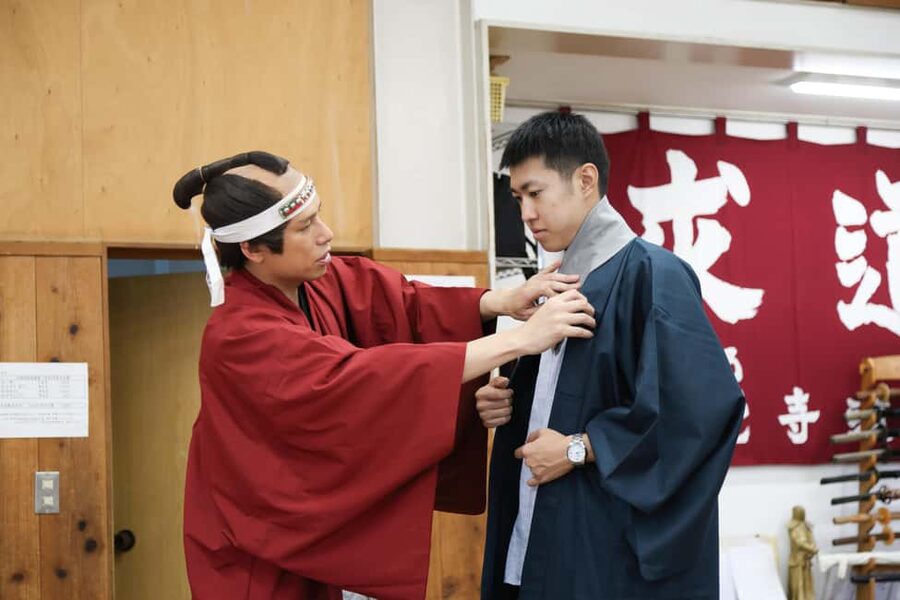
Before your own filmed sequence, you watch the instructors perform. This is where the difference between ordinary dress-up and stage combat becomes clear.
The professional actors demonstrate polished swordplay based on years of training in bushido and period drama. Their performance gives you a useful model for the timing and body language you will later try yourself. It also gives the session a genuine entertainment element, so you are not spending the entire 70 minutes repeating drills.
I especially like this part for anyone who has little background in Japanese martial arts. You can see how a simple sword movement becomes dramatic through rhythm, posture, facial expression, and controlled distance. The actors make the action look effortless, but that contrast also reminds you not to copy advanced movements without instruction.
The performance is not presented as a museum demonstration or a formal lesson in samurai history. It is a live show designed to prepare you for the action filming. If you want quiet temple contemplation, this is not the right use of your time. If you want a lively activity with skilled performers, it fits well.
More Kimono Experiences in Kyoto
- [Kyoto & Nara Day Tour] Sagano Scenic Railway & Nara Park & Fushimi Inari Taisha Thousand Torii Gates & Togetsukyo Bridge & Bamboo Grove & Kimono Forest (Departing from Osaka)
★ 4.9 · 10,942 reviews - Kyoto Geisha Walking Tour: Gion District & Hidden Gems
★ 4.7 · 3,273 reviews - Kyoto: Gion Magical Night Walking Tour with Geisha Trivia
★ 4.9 · 2,393 reviews - Kyoto: Gion Geisha District Walking Tour – Stories of Geisha
★ 4.7 · 2,187 reviews
Filming your own short samurai scene
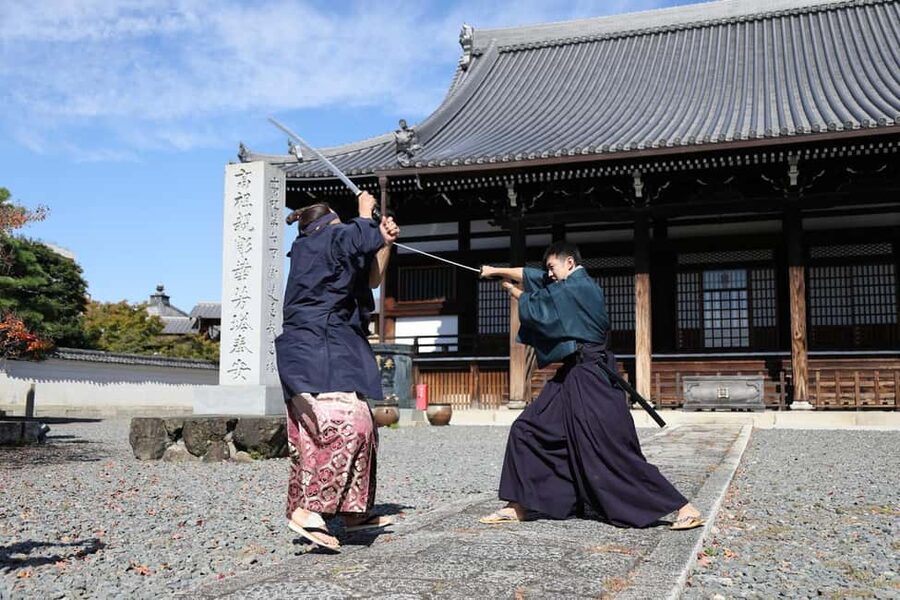
The final stage is the part most people remember. You perform the sword techniques you have learned while the instructors help create an action sequence. You are welcome to record the scene with your own camera, and photography and video recording with your camera are included.
Bring a phone or camera with enough battery and storage. The experience provider also includes a photo download service, giving you a lasting record after the session. Since the supplied information does not specify the exact delivery method or the number of edited clips, you should ask the staff on arrival how the download works.
The filming is choreographed, so you do not need to invent a fight from scratch. The instructors guide your positions and movements. That structure matters because it lets you concentrate on expression and timing instead of wondering what to do next.
You will get more from the filming if you commit to the role. One useful tip is to play it straight, even if you feel silly. Look where you are told, use the pauses, and make your movements clear. The scene may be intentionally theatrical, but that is what makes the final footage fun to show at home.
The action sequence may take place outside, according to one participant’s description. That can make the finished footage more varied, though the exact filming location and conditions may depend on the session. You are allowed to take photos and videos during the experience, so friends or family members can also capture moments if the staff permits it at that point.
What $127 gets you in Kyoto
At $127 per person, this is not a low-cost sightseeing stop. The value depends on what you want from your Kyoto day.
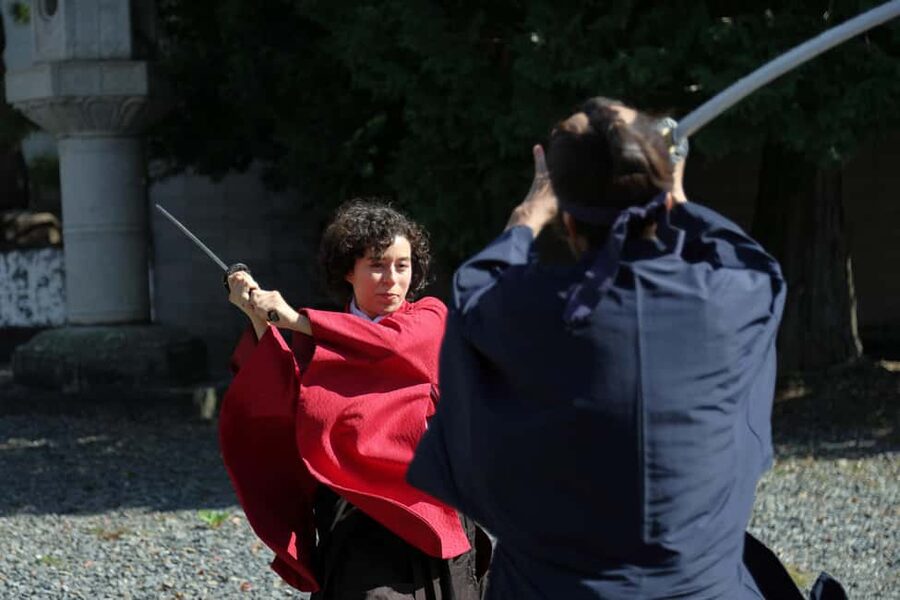
You are paying for a guided activity with professional performers, a small group capped at six, kimono rental, the sword lesson, the live demonstration, camera recording, and a photo download service. The small group is particularly important. With only a few participants, the instructors can correct movements and give each person a more active role in the final scene.
The price makes more sense if you value participation and a take-home video. A simple temple visit costs less, and a basic kimono rental may cost less, but neither gives you the same combination of sword coaching and filmed performance. The experience also suits people who want a shared memory rather than another passive photo stop.
The time is the main limitation. Seventy minutes is enough for an introduction, costume change, demonstration, practice, and filming, but not enough for a detailed study of kendo, bushido, Japanese dress, or temple history. I would treat it as a compact entertainment experience with cultural context, not as formal martial arts training.
Meals are not included, though the short duration means food is not a major concern. Transportation is also separate, so factor in the time and cost of reaching Myokaku-ji Temple.
Who will enjoy this most?
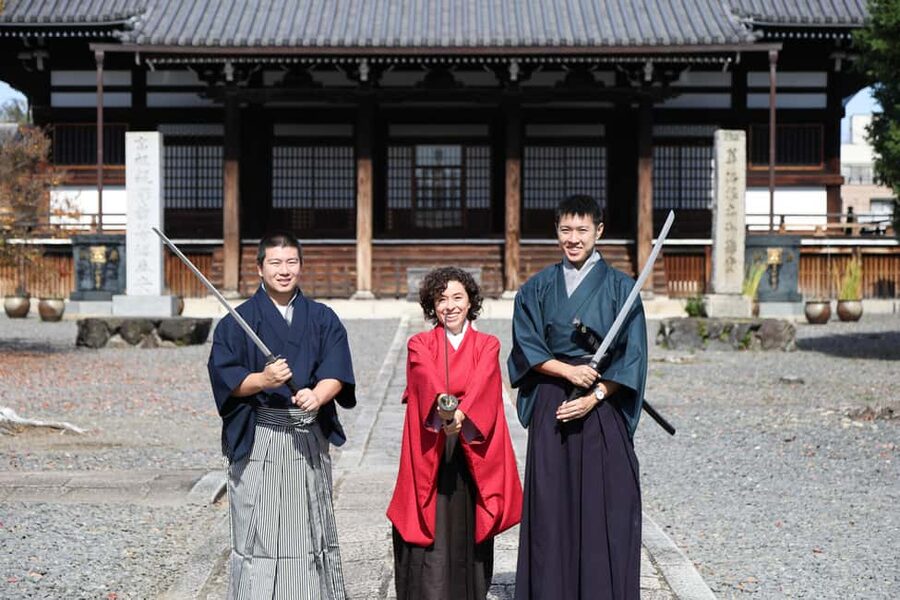
I would recommend the experience to you if you meet one or more of these descriptions:
- You want an active Kyoto activity instead of another sightseeing walk.
- You enjoy film, theater, cosplay, or playful role-play.
- You are visiting with teenagers or older children who like samurai stories.
- You want photos and video that feel more personal than standard vacation snapshots.
- You prefer a small group where instructors can give direct help.
- You are curious about Japanese sword performance but do not have martial arts experience.
It is also a good choice for a parent and child, couples, or friends who are willing to laugh at themselves. The instructors are described as kind, funny, patient, and encouraging, which is useful when the choreography feels unfamiliar.
I would skip it if you want a quiet temple visit, a serious combat course, or a long historical talk. You should also skip it if physical activity is difficult for you, or if you fall into one of the listed groups for whom the session is not suitable: children under five, pregnant women, people with back problems, people with pre-existing medical conditions, and people over 95.
Booking, cancellation, and useful preparation
You can reserve the experience and pay later, which helps if your Kyoto schedule is still changing. Free cancellation is available up to 24 hours in advance for a full refund.
The instructors speak Japanese and English. That is enough to make the activity accessible to international participants, especially because the movements are shown as well as explained.
Wear comfortable clothing and bring a camera. Check your battery before arriving, since the recording is one of the best reasons to book. Keep your belongings manageable because you will be changing into a kimono and moving through a physical session.
The experience is limited to six people, but the exact starting time depends on availability. The separate entrance at the temple helps with arrival, though you still need to find Myokaku-ji on your own.
Should you book the Kyoto samurai filming experience?
Book it if you want a short, funny, highly visual activity with real performers and a strong sense of place. The temple setting, included kimono, small group, and take-home footage give the $127 price a clear purpose.
I would not call it a replacement for a museum, martial arts class, or temple tour. It is better understood as a carefully guided samurai movie scene in Kyoto, with enough cultural background to make the role-play feel connected to Japan.
For the best result, bring a camera, wear easy clothing, listen closely, and commit to the performance. If you do that, you will leave with more than a costume photo. You will have played a small part in your own chambara scene.
FAQ
Where does the samurai sword and kimono experience take place?
It takes place at Myokaku-ji Temple in Kyoto, at the Myokaku-ji Dojo. After entering through the main gate, gather at the dojo to the left.
How long does the experience last?
The activity lasts 70 minutes. Starting times depend on availability.
Is the kimono rental included?
Yes. The rental kimono is included in the price, along with the kimono dressing experience.
Can I take photos or videos?
Yes. You are welcome to take photos and videos during the experience. Photography and video recording with your own camera are included, and a photo download service is provided.
Is transportation included?
No. Transportation to and from Myokaku-ji Temple is not included. Meals are also not included.
Who cannot take part?
The experience is not suitable for children under five, pregnant women, people with back problems, people with pre-existing medical conditions, or people over 95. You should also wear comfortable clothes suitable for physical activity.
Just added in Kyoto
- The “Golden Route” and Ancient Japan by DIAMIR Erlebnisreisen – 14-Day Tour★ 2.0 · 2 reviews
- Japan: Castles & Cuisine by G Adventures – 6-Day Kyoto to Osaka Tour★ 4.5 · 4 reviews
- Cycle Japan by Explore! – 13-Day Kyoto to Tokyo Tour★ 4.7 · 12 reviews
- Cycle Japan by Intrepid Travel – 11-Day Kyoto to Tokyo Tour★ 4.8 · 2 reviews
- Classic Japan by Intrepid Travel – 11-Day Kyoto to Tokyo Tour★ 4.4 · 14 reviews
- Ancient & Modern Japan 14-Day Tour by Exodus Adventure Travels★ 4.4 · 40 reviews
- 5 Day Cultural Adventure of Kyoto, Nara & Osaka by Tourist Journey★ 2.5 · 2 reviews
- 12 Days Kinosaki Onsen Escape: A Journey Through Japan’s Timeless Towns by UME Travel★ 4.8 · 5 reviews
Kimono and Cultural Dress, compared.
![[Kyoto & Nara Day Tour] Sagano Scenic Railway & Nara Park & Fushimi Inari Taisha Thousand Torii Gates & Togetsukyo Bridge & Bamboo Grove & Kimono Forest (Departing from Osaka)](https://media.japanvisits.com/wp-content/uploads/kyoto-nara-day-tour-sagano-scenic-railway-nara-park-fushimi-inari-taisha-thousand-torii-gates-togetsukyo-bridge-bamboo-grove-kimono-forest-departing-from-osaka-k110001-400x257.jpg)

Tokyo Asakusa Kimono&Yukata Rental at Kimono Miyabi Asakusa Station
Read our review →
Kyoto Geisha Walking Tour: Gion District & Hidden Gems
Read our review →
Gion Magical Night Walking Tour with Geisha Trivia
Read our review →
Gion Geisha District Walking Tour – Stories of Geisha
Read our review →
Best of Kyoto: Gion, Geisha, Pagodas & Cobblestones
Read our review →
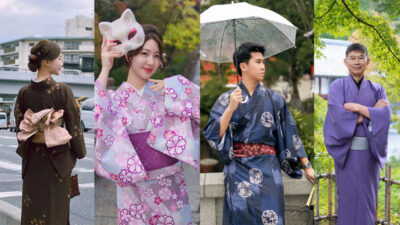
Kyoto Kimono Rental Experience (Optional Exquisite Hair Styling/Japanese Makeup/Photography) (Ookini Kiyomizu-dera Main Store)
Read our review →Browse the lists this tour appears in