
Reviewed · MARKETS AND FOOD HALLS
Osaka Food Walking Tour with Market Visit
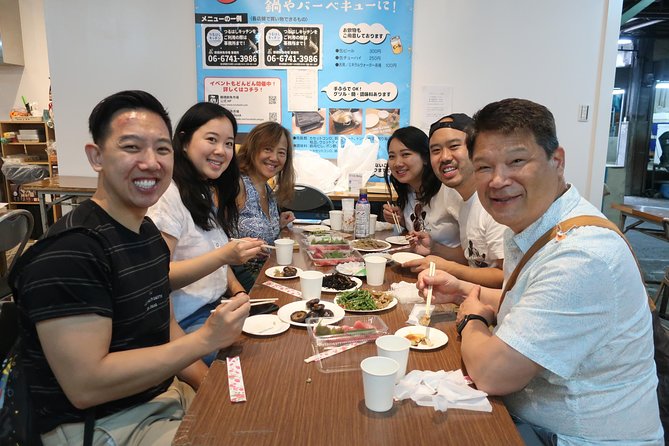
Osaka tastes best before noon. This four-hour outing connects Kizu Wholesale Market with Shinsekai and Dotonbori, giving you a useful introduction to the city’s food culture without trapping you in a large tour group. I especially like the fresh sashimi and seasonal fruit at the market, plus the chance to eat Osaka comfort food such as okonomiyaki at a local restaurant.
The maximum group size is six, which should make it easier to ask questions and keep up in busy streets. Guide Ichiro has earned praise for his patient explanations, local history, and helpful food advice. The main consideration is price: at $130.64 per person, you are paying for a guided experience and included food, but subway fares of ¥410 per person are extra, and alcohol is not included.
In This Review
- Key points at a glance
- Why this tour works for first-time Osaka visitors
- Starting at Daikokucho Station at 9:00 a.m.
- Kizu Wholesale Market: the tour’s strongest stop
- Shinsekai lunch and Osaka comfort food
- Comparing Japanese tea and seeing kitchen knives
- Ending at Ebisu Bridge near Dotonbori
- What the $130.64 price includes
- Who should book this Osaka food tour?
- Should you book the Kizu Market food tour?
- FAQ
- Where does the Osaka food tour start?
- What time does the tour begin?
- How long does the experience last?
- Where does the tour end?
- Is lunch included?
- Is public transportation included?
- Are alcoholic drinks included?
- How many people can join the tour?
- Can I cancel for a full refund?
Key points at a glance
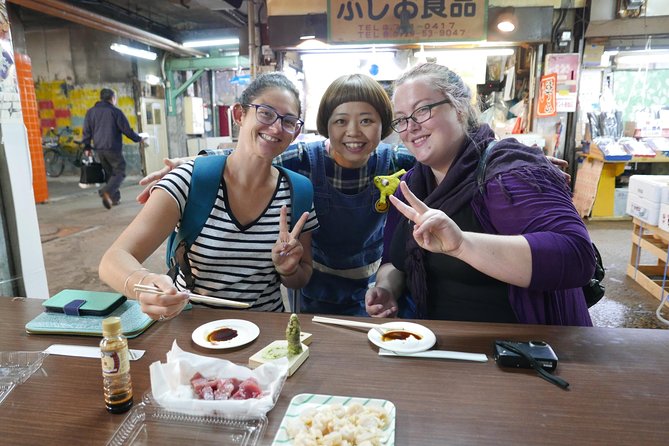
- Kizu Market before the crowds of the day: Visit a major wholesale seafood market where professional cooks shop, then sample sashimi, seafood, fruit, and snacks.
- A small group of six or fewer: The size allows more personal attention than a standard bus or large walking tour.
- Shinsekai lunch with Osaka classics: Sit down for local food that can include okonomiyaki, the city’s beloved cabbage pancake.
- Tea and kitchen knives add local texture: The route includes a tea shop for comparing Japanese teas and a kitchen knife shop.
- A useful finish at Ebisu Bridge: The tour ends near Dotonbori, so you can continue exploring Namba on your own.
- A four-hour introduction, not a full food crawl: The tour gives you a broad first taste, with lunch and samples included, but not unlimited eating.
Why this tour works for first-time Osaka visitors
Osaka is often called the kitchen of Japan, and this tour explains that nickname through places where food is bought, prepared, and eaten. You are not simply led from one famous restaurant to another. The morning begins at a working wholesale market, then shifts to the restaurant streets of Shinsekai before finishing in central Dotonbori.
That order matters. You see ingredients first, then taste finished dishes later. It gives you a clearer sense of how seafood, produce, tea, and cooking tools fit into daily food culture.
I like the fact that the tour stays on foot for much of its route. Walking lets you notice the city at street level, while the subway ride keeps the schedule practical. You should expect a mix of market lanes, neighborhood streets, and busy downtown areas rather than a single polished sightseeing district.
The tour is listed as a private activity, with only your group participating, while the group limit is six people. That is a good arrangement for couples, families, or a small circle of friends. A minimum of two people is required per booking, so solo visitors cannot book it alone under the stated rules.
More Markets and Food Halls in Osaka
- Kuromon Market Food Walking Tour in Osaka (6 stops, 6 tastes)
★ 5.0 · 550 reviews - Osaka: Kuromon Market Food Walking Tour (6 stops, 6 tastes)
★ 4.6 · 272 reviews - Kuromon Market Tour: All inclusive 6~8 Dishes & 3~4 samplings
★ 5.0 · 103 reviews
Starting at Daikokucho Station at 9:00 a.m.
The meeting point is outside Daikokucho Station at 3-chōme-11-10 Shikitsuhigashi in Naniwa Ward. The start time is 9:00 a.m., an early beginning that suits a market visit. You should arrive ready to walk and eat soon after meeting your guide.
A morning start also gives you a useful first day in Osaka. After the tour ends near Dotonbori, you still have much of the afternoon and evening available. You can return to a favorite area, visit another attraction, or stay in Namba for more food.
Bring comfortable shoes. The route combines market walking, neighborhood streets, and a subway transfer. No special fitness level is stated, and most people can participate, but this is not a seated tasting event.
Ichiro is the guide named in the available feedback, and his strongest qualities are patience and clear explanations. He has been praised for adding local history and practical facts instead of simply pointing out dishes. That matters at a market, where the food and surroundings can be unfamiliar.
Kizu Wholesale Market: the tour’s strongest stop
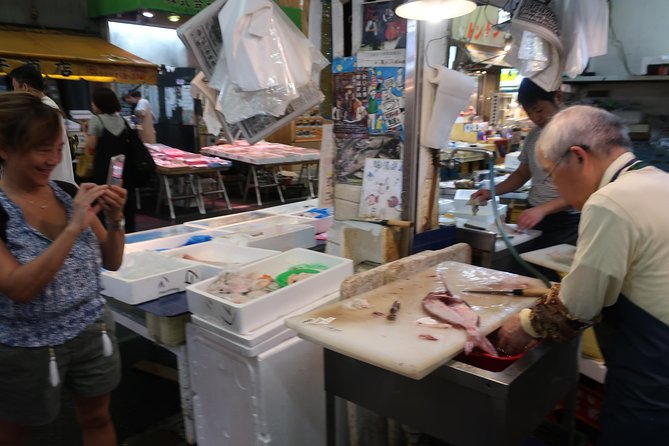
Kizu Wholesale Market is the heart of this experience. It is a large seafood market in central Osaka, and it serves professional cooks as well as the public. The visit lasts about one hour, with the guide leading you through the market and explaining what you are seeing.
The food focus is fresh sashimi, seafood, seasonal Japanese fruit, and snacks. You may also find street food and other lunch items that locals enjoy. Because the market changes with the season and daily supply, the exact selection is not fixed. That is part of the appeal, though it also means you should not book this expecting a precise menu.
A Japanese-language review described the morning visit as a chance to see professional cooks shopping and to notice traditional Naniwa vegetables. That detail gives the market more depth. You are not only looking at fish counters. You may also see produce tied to Osaka’s local cooking traditions.
The market can be a better setting for learning than a restaurant. At a table, you receive a finished plate. Here, you can connect ingredients with the dishes you will eat later. The guide can explain seafood quality, local products, and the role of the market in Osaka’s restaurant trade.
The main limit is time. One hour is enough for an introduction and tastings, but not for a slow market photography session or a long shopping trip. If you want to buy ingredients, gifts, or kitchen goods, ask the guide how much free time is sensible before making purchases.
You should also remember that alcohol is not included. Food samples, lunch, and snacks are included, but drinks such as beer or sake cost extra.
Shinsekai lunch and Osaka comfort food
After the market, the tour moves to Shinsekai by subway. Public transportation is not included, with the listed fare set at ¥410 per person. Your guide handles the route, which removes some of the stress of figuring out the transfer during a food-focused morning.
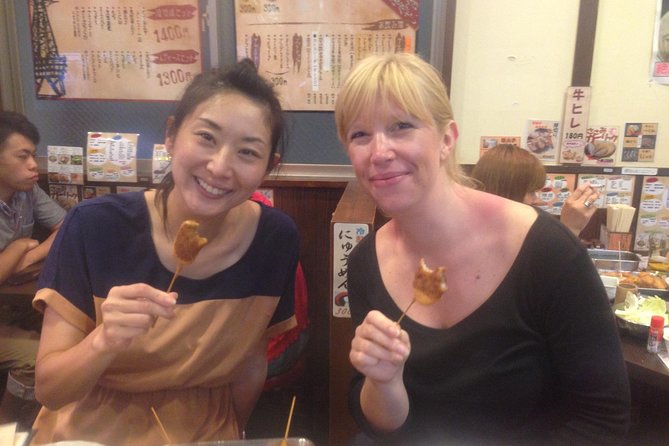
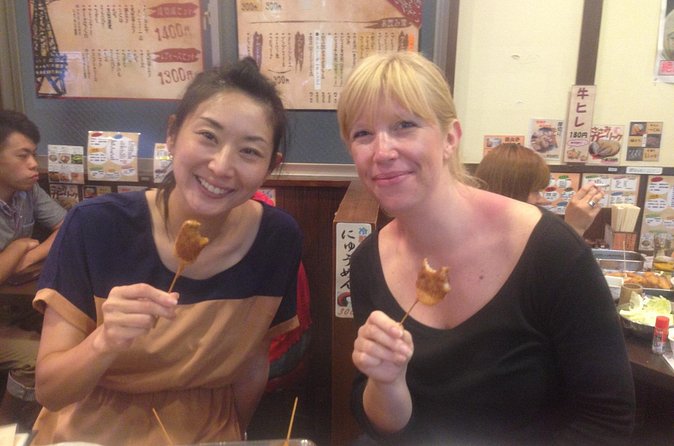
Shinsekai has a different feel from the market and Dotonbori. It is known for straightforward Osaka food and casual restaurants. The tour takes you to a restaurant for a traditional lunch, with local dishes that can include okonomiyaki.
Okonomiyaki is one of Osaka’s signature comfort foods. The basic idea is a savory cabbage pancake, usually combined with additional ingredients and sauces. It is filling, informal, and easy to understand as an example of Osaka cooking: generous, social, and made for everyday enjoyment rather than ceremony.
The included lunch is the practical core of the tour. You are not left to choose a restaurant while hungry or wonder how to order an unfamiliar dish. At the same time, you should not assume that every meal item is listed in advance. The published details name Osaka specialties and okonomiyaki, but they do not provide a fixed restaurant menu.
The tour description also says you can try local food that people in the area enjoy. That is useful for anyone who wants more than famous photo stops. Shinsekai gives you a chance to see how Osaka food works in an ordinary restaurant setting.
The tradeoff is that lunch may feel quick if you want a long, relaxed meal. The full tour lasts about four hours, and it still has to include the market, tea shop, knife shop, subway ride, and final stop. Think of lunch as a guided tasting meal, not an afternoon banquet.
More Walking Tours in Osaka
- Osaka: Hotspots & Hidden Gems Walking Tour Private or Group
★ 4.9 · 1,300 reviews - Osaka Local Foodie Walking Tour in Dotonbori and Shinsekai
★ 5.0 · 985 reviews - Osaka Bar Hopping Night Walking Tour in Namba (3 bars, 6 tastes)
★ 5.0 · 958 reviews - Osaka: Deep Backstreets Walking Tour with Dinner Option
★ 4.9 · 902 reviews
Comparing Japanese tea and seeing kitchen knives
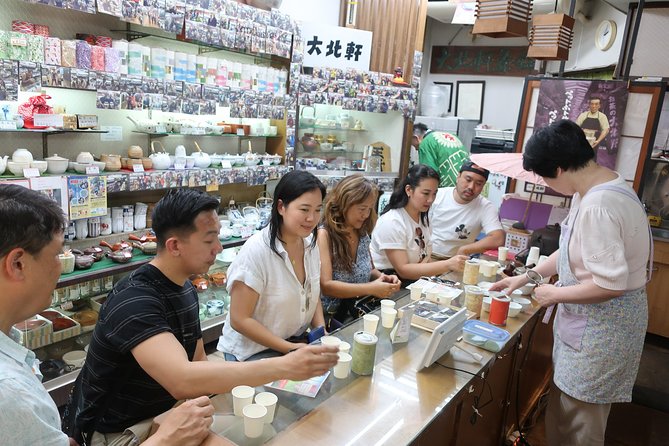
The Shinsekai portion includes a stop at a tea shop where you can compare different kinds of Japanese tea. This is a small detail, but it adds variety to a tour that might otherwise focus only on seafood and heavy food.
Tea comparison is especially useful if you are unsure what you like. The guide can help you notice differences between types instead of leaving you to select a package based only on its label. The information provided does not specify which teas you will taste, so treat this as a comparison stop rather than a guaranteed formal tea ceremony.
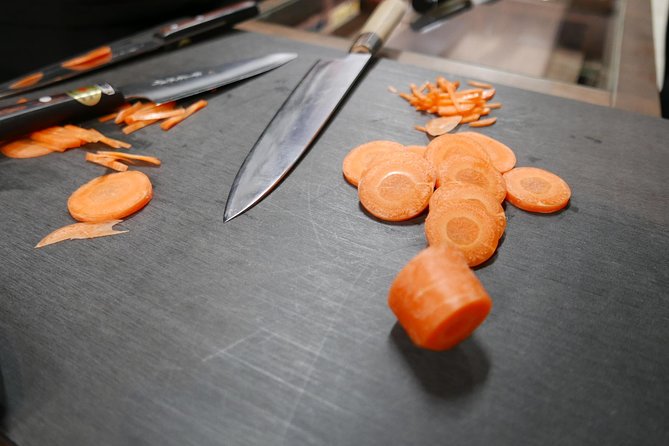
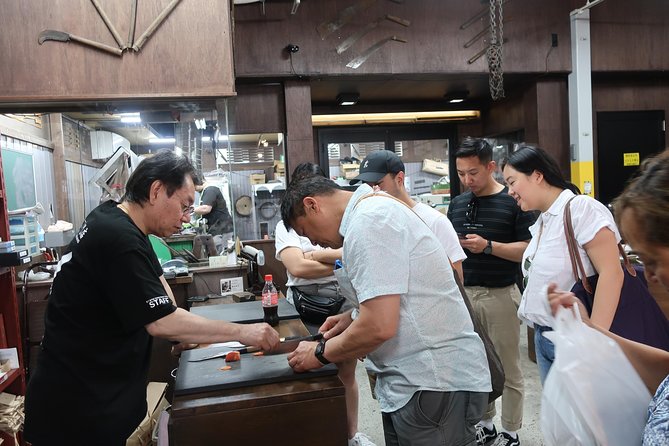
The route also visits a kitchen knife shop known for excellent knives. Osaka’s food culture is not only about eating. It also depends on tools, preparation, and the people who work with ingredients every day. A knife shop gives you another way to think about the city’s cooking traditions.
There is no stated requirement to buy anything, and purchases are not included in the tour price. If you are interested in Japanese knives, this stop may be a useful introduction. If you are not shopping, it still provides context, but it may be less important to you than the market or lunch.
Ending at Ebisu Bridge near Dotonbori
The final stop is Ebisu Bridge, near Dotonbori in Namba. The stop itself is brief, about 10 minutes, but its location is highly practical. Dotonbori is one of Osaka’s best-known shopping and restaurant areas, filled with places to continue eating and exploring after the guide says goodbye.
This is a smart ending point rather than a remote drop-off. You can use the rest of the day to explore nearby streets, return to your hotel, or begin another activity. The guide can also help you get your bearings before you continue on your own.
Do not think of the 10-minute bridge stop as a major sightseeing visit. Its value comes from location and orientation. You get a final central landmark, then easy access to the surrounding district.
The tour starts in Daikokucho and ends near Dotonbori, so it is not a round trip. Plan your day with that in mind. If you have luggage, make sure it is stored before the tour because a market and walking route are easier without large bags.
What the $130.64 price includes
The price is $130.64 per person. That is not a bargain food walk, but it includes more than a simple guided stroll. You receive lunch, food samples, and snacks, along with a guide for roughly four hours. The small group or private format is also part of the value.
I would judge the price based on how much help you want. If you are comfortable navigating Osaka, choosing a restaurant, and ordering on your own, you could spend less by visiting the market and Shinsekai independently. You would also have more control over timing.
If you prefer a clear route and explanations, the cost becomes easier to justify. The guide connects several parts of Osaka that you might not naturally combine: a wholesale market, Shinsekai, tea, kitchen knives, and Dotonbori. Food samples and lunch reduce the need to pay for a separate meal during the tour.
Remember to budget for the ¥410 public transportation fare. Alcohol is extra, and insurance is not included. Group discounts may be available, but the supplied price is listed per person, so check the final total for your party before booking.
Who should book this Osaka food tour?
I would recommend it most strongly to first-time visitors who want a quick introduction to Osaka’s food culture. It suits people who enjoy eating but also want explanations about markets, ingredients, tea, and local neighborhoods.
It is also a good fit for:
- Couples who want a private or very small-group morning
- Families, since children can participate when accompanied by an adult
- People who prefer lunch to be arranged rather than selected on the spot
- Visitors interested in Japanese kitchen tools and tea
- Anyone ending the day in Namba or Dotonbori
The tour may be less suitable if you want an all-day food crawl, a fixed list of many dishes, or a slow, independent market visit. The pace has to cover several stops, and the exact foods can vary.
Children are allowed, with a stated minimum age of one year, but an adult must accompany them. Most people can participate, and the route is near public transportation. The details do not state whether the full route is wheelchair accessible, so ask the provider if that is important for your group.
Confirmation is sent within 48 hours of booking, subject to availability. Free cancellation is available up to 24 hours before the start time. Changes or cancellations inside that window are not accepted for a refund.
Should you book the Kizu Market food tour?
Book it if you want a guided taste of real Osaka food culture in a compact morning. The fresh market visit, Ichiro’s patient guiding style, included lunch, and small group make this more useful than a generic sightseeing walk.
Skip it if $130.64 feels high for a four-hour activity or if you would rather choose every dish and stop at your own pace. For the right visitor, though, the tour offers a well-planned first look at Osaka, ending in exactly the district where you can keep eating after the formal tour is over.
FAQ
Where does the Osaka food tour start?
It starts at Daikokucho Station, at 3-chōme-11-10 Shikitsuhigashi, Naniwa Ward, Osaka, 556-0012, Japan.
What time does the tour begin?
The tour starts at 9:00 a.m.
How long does the experience last?
It lasts approximately four hours.
Where does the tour end?
It ends near Ebisu Bridge in Dotonbori, Namba, at 1 Chome-6 Dotonbori, Chuo Ward, Osaka, 542-0071, Japan.
Is lunch included?
Yes. Lunch, food samples, and snacks are included.
Is public transportation included?
No. Public transportation is not included. The listed fare is ¥410 per person.
Are alcoholic drinks included?
No. Alcoholic beverages are not included.
How many people can join the tour?
The group size is limited to a maximum of six people per group. The activity is private, so only your group participates.
Can I cancel for a full refund?
Yes, if you cancel at least 24 hours before the experience start time. Cancellations made less than 24 hours in advance are not refunded.
Just added in Osaka
- Osaka: 2-Hour Nightlife District Walking & Local Food Culture★ 5.0 · 199 reviews
- Osaka Japanese Cooking And Matcha Class near Osaka Castle★ 5.0 · 22 reviews
- Osaka Dotonbori Daytime Food Tour★ 5.0 · 24 reviews
- Osaka Dotonbori Wonder Cruise★ 4.0 · 28 reviews
- Cooking Ramen&Gyoza/KatsuCurry/Bento/Okonomiyaki+Store Tour@Osaka★ 5.0 · 138 reviews
- Osaka Private Pop Culture Tour: Historic Tenma to Dotonbori★ 4.5 · 13 reviews
- Osaka Cooking Class and Sake Tasting with Local Supermarket Visit★ 5.0 · 79 reviews
- Osaka Castle and a visit to the longest shopping street in Japan★ 5.0 · 12 reviews
Markets and Food Halls, compared.
Tokyo Tsukiji Fish Market Food and Culture Walking Tour
Read our review →
Nishiki Market Brunch Walking Tour (7 Tastings + Brunch)
Read our review →
Tokyo Sushi Making Class in Tsukiji with Professional Chef
Read our review →
Tsukiji Fish Market Guided Tour and Sushi Making with Pro Chef
Read our review →Tsukiji Fish Market Food and Culture Walking Tour
Read our review →Browse the lists this tour appears in