Reviewed · KYOTO TOURS
Shamisen Experience in Kyoto 【Private】
Make music, not just memories. This private Kyoto lesson gives you one-to-one shamisen instruction in English, then lets you play alongside Jack, a professional shamisen musician. I like the personal teaching and the chance to learn a traditional Japanese song in about 90 minutes.
I also like the Japanese tea break and the small souvenir gift, which add warmth without turning the lesson into a staged show. The main consideration is the price, $99.10 per person, which is fair for a private session but more than a group class. You should also allow time to reach the residential meeting point in Kita Ward.
In This Review
- Key points to know before booking
- Why a shamisen lesson fits a Kyoto day
- Arriving in Murasakino, Kita Ward
- Meeting Jack, the professional shamisen teacher
- The first part of the lesson: posture, seating, and tuning
- Learning a traditional Japanese melody
- The highlight: playing together with traditional scales
- Tea, conversation, and the souvenir
- What the $99.10 price really buys
- Who will enjoy this most
- Practical details that affect your choice
- Should you book this Kyoto shamisen experience?
- FAQ
- How long does the shamisen experience last?
- Where does the lesson take place?
- Where does the experience end?
- Is the lesson private?
- Do I need previous shamisen or music experience?
- Is the lesson taught in English?
- Is Japanese tea included?
- Can left-handed people participate?
- Is cancellation free?
Key points to know before booking

- Private lesson with Jack: Your group receives the teacher’s full attention instead of sharing the instrument lesson with a large class.
- English instruction: The experience is designed for English-speaking visitors and includes relaxed conversation with the owner.
- Beginner-friendly technique: You learn basic posture, seating, tuning, and playing methods, even with no musical background.
- Traditional song and jam session: The lesson builds toward playing a Japanese melody and joining Jack with traditional Japanese scales.
- Tea and souvenir included: A Japanese tea break gives you time to talk, and a small gift marks the experience.
- Left-handed players are covered: Lefty shamisen are available, an important detail to confirm at booking if you need one.
Why a shamisen lesson fits a Kyoto day
Kyoto gives you temples, gardens, markets, and endless lanes to explore. Those sights matter, but after several days of looking, a hands-on activity can wake up your attention in a different way. The shamisen lesson asks you to listen, sit properly, use your hands, and follow a rhythm.
The shamisen is a traditional Japanese three-stringed instrument. Its sound is distinctive, with a firm plucked note and a tone that can feel both spare and dramatic. You do not need to know Japanese music or play another instrument to take part.
I especially like the scale of this experience. A large demonstration may let you hear the shamisen, but a private lesson gives you time to make mistakes without an audience. Jack can adjust the instruction to your pace, answer your questions, and give extra help when your fingers or pick are not cooperating.
The lesson also offers a useful contrast to formal sightseeing. You are not simply being told about Japanese culture. You are given a traditional instrument and asked to make a sound with it. That sound may be rough at first. That is part of the fun.
A few more options to weigh up in Kyoto
- PERFECT KYOTO 1-Day Bus Tour
★ 5.0 · 13,518 reviews - [Kyoto & Nara Day Tour] Sagano Scenic Railway & Nara Park & Fushimi Inari Taisha Thousand Torii Gates & Togetsukyo Bridge & Bamboo Grove & Kimono Forest (Departing from Osaka)
★ 4.9 · 10,942 reviews - Kyoto: Fushimi Inari, Kinkakuji, Bamboo Grove 1 Day Bus Tour
★ 4.8 · 4,316 reviews
Arriving in Murasakino, Kita Ward
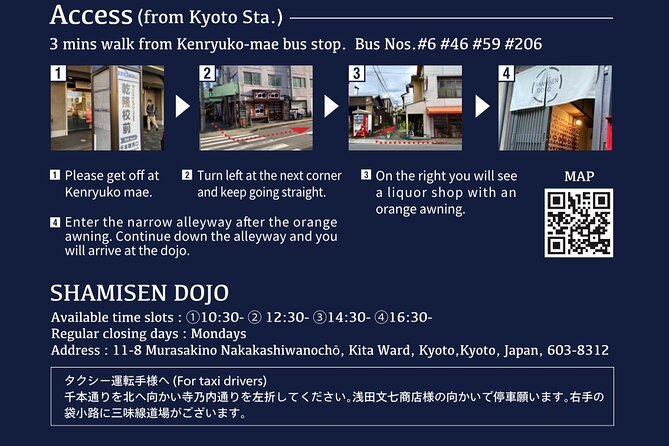
The meeting point is in Murasakino Nakakashiwanocho, in Kyoto’s Kita Ward, at postal code 603-8312. The activity begins and ends at this same point, and the location is near public transportation.
The information provided does not name a particular station or give a detailed route, so check the exact meeting instructions after booking. I would not leave this part until the last minute. Kyoto’s bus and train connections can take longer than the map suggests, especially when you are crossing the city.
The address places the lesson away from the busiest sightseeing core. That can be an advantage. You are stepping into a more local part of Kyoto rather than squeezing another activity beside the major temple crowds. It also means this is not a quick add-on between two central attractions unless your route already takes you north.
Plan to arrive with enough time to find the entrance and settle in. The activity is private, so being late can affect your own lesson rather than a large group schedule. Confirmation is provided at booking, and the mobile ticket makes it easy to keep the reservation on your phone.
Meeting Jack, the professional shamisen teacher
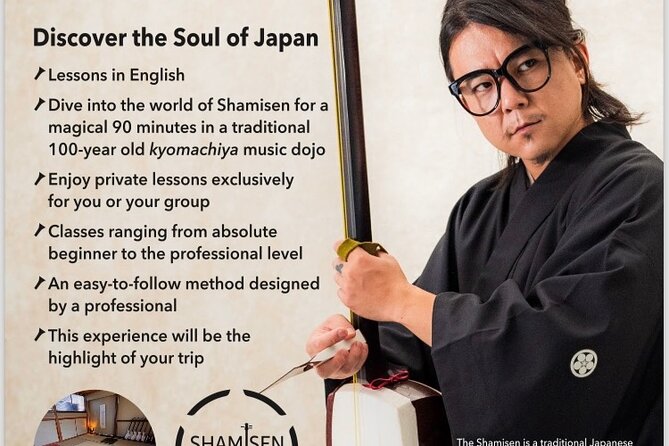
The owner, Jack, teaches the session and plays shamisen professionally. English instruction is a major reason this experience is useful for international visitors. You can ask questions directly instead of trying to understand a demonstration through gestures alone.
Jack’s teaching style is described as friendly, patient, and personal. That matters with an instrument that has unfamiliar posture and technique. You are not only learning which string to touch. You are learning how to sit, how to hold the instrument, and how to use the playing tool with control.
The lesson can also go beyond the basic material when your background allows it. One participant with some shamisen experience received additional instruction, including advanced points that would not usually fit into a first lesson. That suggests Jack does not treat every student as an identical beginner.
I would still keep expectations sensible. Ninety minutes is enough to learn the basic method and play a simple traditional piece, not enough to become a skilled shamisen player. The value is in receiving a clear starting point, hearing how the instrument should sound, and leaving with a foundation you can continue practicing.
The first part of the lesson: posture, seating, and tuning
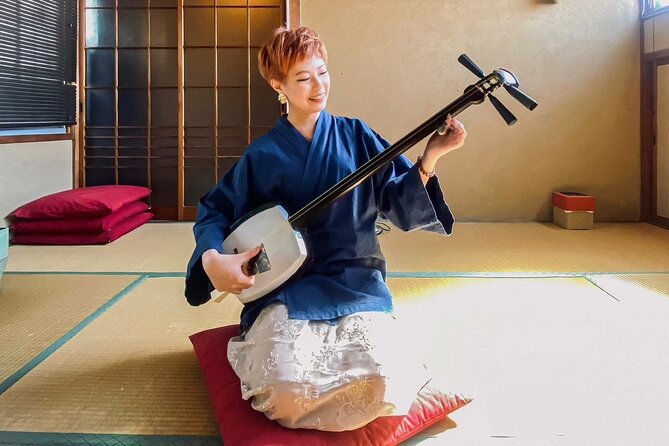
The opening work is practical. You learn the basic posture and seating needed to play properly, along with how to tune the shamisen. These details may seem small, but they are essential. If the instrument sits poorly, your hands become tense. If the strings are not tuned, even accurate playing will sound wrong.
For a first-time player, this is where private teaching pays off. Jack can watch your hand position and correct it immediately. You do not have to copy a teacher at the front of a room while wondering if you are holding the instrument correctly.
Tuning also gives you a clearer sense of the shamisen as a real instrument rather than a prop. You learn that preparation is part of playing. One participant specifically found the tuning lesson useful for continuing to learn on a personal shamisen later.
Do not worry if you have never touched a Japanese instrument. The curriculum is designed for beginners. Music experience may help you recognize rhythm or follow instructions, but it is not required.
A completely different kind of day out:
- Kyoto: Tea Ceremony in a Traditional Tea House in Kiyomizu
★ 4.9 · 3,519 reviews - Kyoto: Gion Make Your Own Chopsticks with Engraving Option
★ 5.0 · 3,465 reviews - Kyoto Nara Day Trip │ Kiyomizu-dera Temple + Fushimi Inari-taisha Shrine + Nara Park (Departing from Osaka/Kyoto)
★ 4.7 · 3,408 reviews - Kyoto Geisha Walking Tour: Gion District & Hidden Gems
★ 4.7 · 3,273 reviews
Learning a traditional Japanese melody
Once the basic handling is in place, the lesson moves toward a traditional Japanese song. This is the point where the experience becomes more than an instrument demonstration. You have a specific musical goal, and you can hear your progress as the notes begin to form a melody.
The song is taught in manageable steps. You may begin with simple patterns before joining them into a complete phrase. The precise song is not identified in the available details, so do not book expecting one particular famous tune. The important part is that you work toward a traditional melody rather than only practicing isolated sounds.
This section should suit people who enjoy a clear target. You are not left to make random noises while the teacher performs. You are guided toward something recognizable. That can be especially satisfying for families, couples, and friends who want a shared activity with a result they can remember.
The lesson also welcomes people with musical interests beyond simple sightseeing. If you already play an instrument, tell Jack about your experience. The session may have room for extra tips, as it did for a participant who knew some shamisen already.
The highlight: playing together with traditional scales
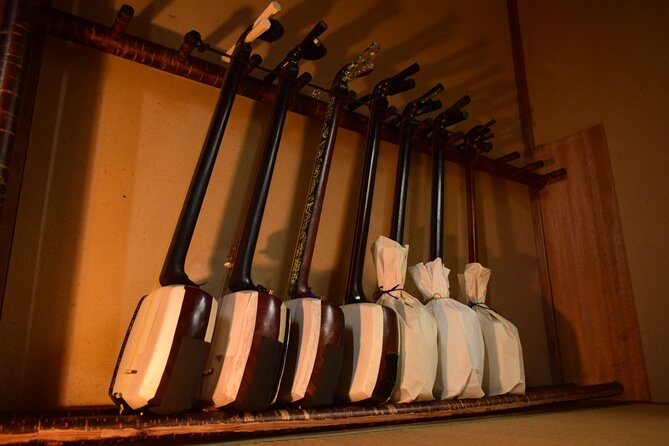
The most distinctive part of the lesson is the jam session with Jack. He accompanies you using traditional Japanese scales while encouraging you to play melodies and express yourself through the shamisen.
This is a smart finish to the class. You do not need to perform alone, and Jack’s playing gives you a musical frame to follow. At the same time, you are not just watching a professional. You take part in the sound.
For a beginner, this can feel surprisingly generous. After learning the mechanics, you get a brief chance to use them in a musical setting. Your playing will probably remain simple, but the session gives you a sense of how the shamisen functions in traditional music.
I would consider this the strongest reason to choose the private format. In a group class, a jam may be rushed or limited to a few volunteers. Here, the session is built around your group. Jack can slow down, repeat a passage, or encourage you to try something more freely.
The jam also gives the lesson emotional shape. You start by learning where to sit and how to hold the instrument. You finish by making music with a professional player. That progression makes the 90 minutes feel purposeful.
Tea, conversation, and the souvenir
The Japanese tea break is included during the lesson. It provides a pause for your hands and a chance to talk with Jack in a relaxed setting. Since he is both the owner and the teacher, the conversation can connect the instrument with his own work and experience.
This is not advertised as a separate tea ceremony, so you should not expect a formal ritual with an extended cultural presentation. Think of it as a welcoming break built into the music lesson. I like that approach. The tea keeps the session from feeling like a rushed technical class.
The conversation may be especially useful if you want to ask questions about the shamisen, Japanese melodies, or continuing to play after Kyoto. The supplied details do not promise a long lecture, so the focus remains on playing.
You also receive a souvenir gift. The exact item is not specified, so treat it as a small memento rather than a major shopping benefit. Its value is personal: it gives you something to connect with the lesson after you leave Kyoto.
What the $99.10 price really buys
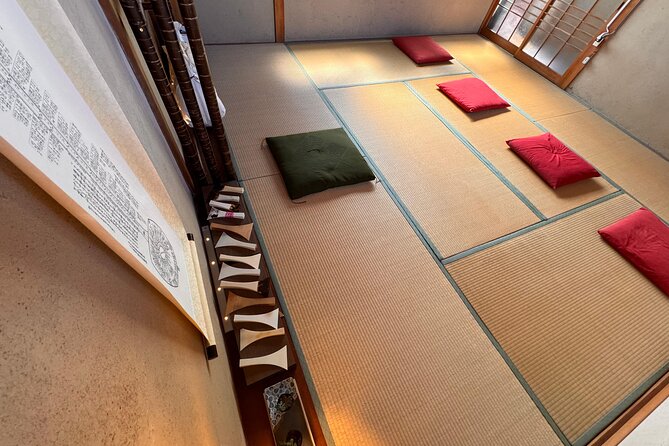
At $99.10 per person, this is not the cheapest cultural activity in Kyoto. The price makes more sense when you compare it with the format. You are paying for a private lesson, direct English instruction, the use of a shamisen, tea, a traditional song, a guided jam, and a souvenir.
A group workshop might cost less per person, but it would not offer the same amount of individual correction. If you are curious about the instrument but nervous about making mistakes, that private attention is a real benefit.
The value is strongest for people who care about participation. If you only want to hear a professional play, a concert or performance may offer more music for less money. If you want to hold the instrument, learn the basics, and play with the teacher, this experience gives you more personal contact.
The private format also works well for a small family or group of friends. You do not have to share the class with unrelated participants, and your group can learn at its own pace. The exact maximum group size is not provided, so check the booking details if your party is larger.
Because the average booking time is 35 days ahead, popular dates may fill early. That is useful planning information, especially if you have a fixed Kyoto schedule. Free cancellation is available up to 24 hours before the local start time. Changes or cancellations inside that window are not accepted for a refund.
Who will enjoy this most
I would recommend the lesson to several types of visitors:
- First-time cultural participants: You receive patient guidance and do not need prior music training.
- Music lovers: You get to learn technique, play a melody, and join a real musical exchange.
- Couples and families: The private setting keeps the activity personal and gives your group a shared story.
- Repeat visitors to Kyoto: This offers something different from another temple or museum.
- Rainy-day planners: The indoor lesson provides a useful alternative when sightseeing outdoors loses its appeal.
- Left-handed players: A lefty shamisen is available, which removes a common practical concern.
It may be less suitable if you want a long performance, a full history lecture, or advanced training in one sitting. The session is an introduction and guided experience. Its success depends on your willingness to try, listen, and accept that your first notes may sound a little wild.
Practical details that affect your choice
The experience lasts about one hour and 30 minutes. That is long enough to feel substantial but short enough to fit into a day of Kyoto sightseeing, provided you allow time for transport to Kita Ward and back.
Most people can participate, and the activity is near public transportation. No special skill level is required. If you are left-handed, note that lefty shamisen are available and mention your needs when arranging the lesson.
The experience ends back at the meeting point. Since no onward transportation is included, plan your next stop from there rather than assuming you will finish near central Kyoto.
The mobile ticket is convenient, particularly if you are carrying a busy sightseeing schedule. Keep the confirmation available on your phone and check the meeting instructions carefully.
Should you book this Kyoto shamisen experience?
Book it if you want Kyoto culture to involve your hands, not just your camera. The strongest features are the private English lesson with Jack, the beginner-friendly technique, and the chance to play a traditional song alongside a professional musician.
The $99.10 cost is easiest to justify when you value personal attention and a memorable activity over a low-cost introduction. I would choose it for a rainy afternoon, a special couple’s outing, or a trip where you want one experience that feels personal and different.
Skip it if your schedule is packed with central Kyoto sights and you do not want to spend time reaching Kita Ward. Also skip it if you only want to watch a shamisen performance. For everyone else, this is a focused, friendly way to make a small piece of Japanese music your own.
FAQ
How long does the shamisen experience last?
The experience lasts approximately one hour and 30 minutes.
Where does the lesson take place?
The meeting point is in Murasakino Nakakashiwanocho, Kita Ward, Kyoto, 603-8312, Japan.
Where does the experience end?
The activity ends back at the meeting point.
Is the lesson private?
Yes. Only your group participates in the private activity.
Do I need previous shamisen or music experience?
No. The curriculum is designed for beginners, and no previous experience is required.
Is the lesson taught in English?
Yes. The experience provides shamisen instruction in English.
Is Japanese tea included?
Yes. The lesson includes a Japanese tea break and time for relaxed conversation with Jack.
Can left-handed people participate?
Yes. Left-handed shamisen are available.
Is cancellation free?
You can cancel for a full refund up to 24 hours before the experience’s local start time. Cancellations or changes made less than 24 hours before the start are not accepted for a refund.
Just added in Kyoto
- The “Golden Route” and Ancient Japan by DIAMIR Erlebnisreisen – 14-Day Tour★ 2.0 · 2 reviews
- Japan: Castles & Cuisine by G Adventures – 6-Day Kyoto to Osaka Tour★ 4.5 · 4 reviews
- Cycle Japan by Explore! – 13-Day Kyoto to Tokyo Tour★ 4.7 · 12 reviews
- Cycle Japan by Intrepid Travel – 11-Day Kyoto to Tokyo Tour★ 4.8 · 2 reviews
- Classic Japan by Intrepid Travel – 11-Day Kyoto to Tokyo Tour★ 4.4 · 14 reviews
- Ancient & Modern Japan 14-Day Tour by Exodus Adventure Travels★ 4.4 · 40 reviews
- 5 Day Cultural Adventure of Kyoto, Nara & Osaka by Tourist Journey★ 2.5 · 2 reviews
- 12 Days Kinosaki Onsen Escape: A Journey Through Japan’s Timeless Towns by UME Travel★ 4.8 · 5 reviews
Kyoto Tours, compared.

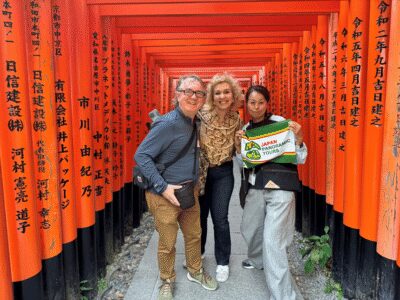
Fushimi Inari, Kinkakuji, Bamboo Grove 1 Day Bus Tour
Read our review →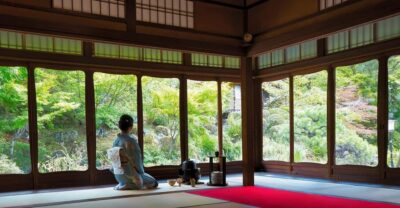
Tea Ceremony in a Traditional Tea House in Kiyomizu
Read our review →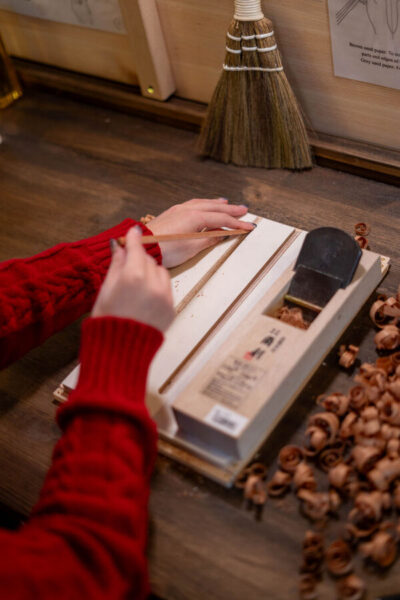
Gion Make Your Own Chopsticks with Engraving Option
Read our review →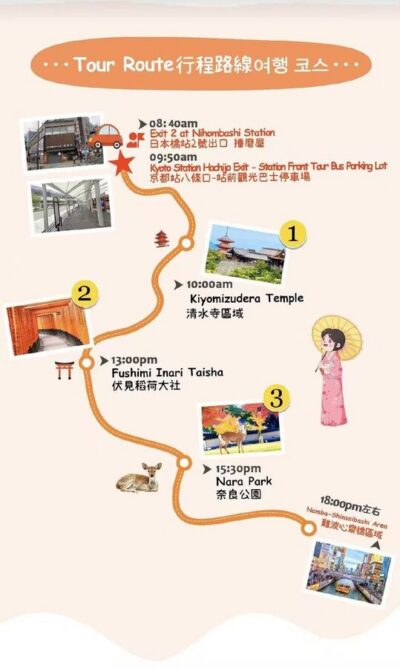
Kyoto Nara Day Trip │ Kiyomizu-dera Temple + Fushimi Inari-taisha Shrine + Nara Park (Departing from Osaka/Kyoto)
Read our review →
Kyoto Geisha Walking Tour: Gion District & Hidden Gems
Read our review →